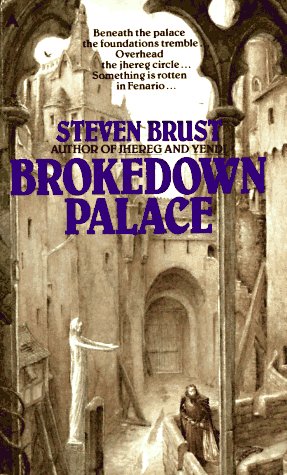
Brokedown Palace

515ke3hm56lSeriously. If this is the kind of experience any given regular person has when reading fiction, I can force myself to feel a little bit of sympathy for the non-readers of the world. It was very good, and certainly easy to follow on the primary level. Four brothers, a king and his siblings, must decide how to deal with the gradual decay of their familial home and the seat of the kingdom’s power. Sides are chosen, battles are fought, dragons are incidentally slain. So why did I feel like I spent the entire book trying to catch up and understand what was really going on?

Brokedown Palace
, set in the same world as Brust’s Vlad Taltos novels and Khaavren romances, interweaves the main story with several folk legends of that land (possibly actually Hungarian in origin, but that would be missing the point, or so I believe). I don’t really think I ever did decide what was happening under the surface. There was a lesson in the tale, and I think I’m supposed to be able to compare it to the many lessons (or were they all the same lesson?) of the interspersed fables. Only, most of the fables themselves were incomprehensible to me. As they often were to the characters of the story. Eking meaning out of that confluence of events, if any exists, is beyond my capacity.

Odd, in any case, to have enjoyed a book I understood so very little of. Perhaps I don’t actually have that sympathy after all. Below the cut, a couple of questions that act as spoilers for the book, and more importantly, as spoilers for his other novels in the same setting.
Continue reading
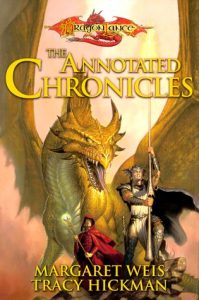
The Annotated Chronicles

When I was a wee lad, I read a ton of those AD&D Dragonlance books, pretty well indiscriminately. There came a time in my late teens when I realized that some, okay most, of the books in that setting were pure crap, and that they didn’t actually have to be suffered through in order to know the entire story. Ultimately, books written by authors who didn’t create the characters I was trying to read about, in which the characters did completely ridiculous things that they probably would never have done anyway and certainly would have mentioned doing… these kinds of books could be ignored. It was a pretty happy day, when I finally worked that out for myself.
The thing is, though, I still think that the Weis and Hickman originals (10 now, plus several short story collections and a handful separate from each other) are generally quite good. Rough around the edges early on, perhaps slightly overflowing with bile towards Wizards of the Coast near the end, but on the whole filled with likeable characters having interesting stories in a setting that I’ve always enjoyed. Naturally, then, I’d want to read about all the little notes and thoughts and stories the authors had about creating the series, once I knew it was available.

In the end, it was pleasant I liked the books well enough to enjoy a reread. There’s quite a bit of interesting material, don’t get me wrong. The problem is that the majority of the material is added by a person I’ve never heard of, probably in marketing, who exists to point out when a throwaway reference to an event or character was eventually written into a book that you-the-consumer ought to go out and buy and read now. Plus, most of Tracy Hickman’s commentary in the first book revolves around explaining exactly how D&D the game went about creating the early situations. Given that it’s the single weakest element of their work, I think that the knowledge is both fairly common by now and also not particularly worth dwelling on.

So, what I got out of it was quite a few good anecdotes from people involved in the project, some poetry analysis from the guy who added the poetical elements (well, obviously), a very few glimpses into the creative process itself (somewhat moreso into the processes, creative and otherwise, of working for a book farm like TSR in those days), and answers to a few questions I’d often wondered about. Not bad as an excuse to read for a few weeks without having to turn my brain on while still being guaranteed reading pleasure out of the process.

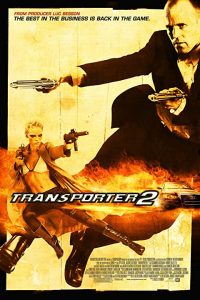
Transporter 2

There is a formula in Hollywood. One of many, of course, but this one goes as follows: Car chases + chopsocky = $$$. Car chases always include a) cars that explode, b) cars that drive up ramps on two side wheels to flip them upside down in mid-air, and c) cars that drive off the edge of a conveniently partial bridge. Chopsocky always includes a) people that punch each other, b) people that kick each other, and c) people that jump around a lot, avoiding certain death.
That’s right, Friday was double feature day at the local mallplex, and the next thing I saw was Transporter 2. Frank the ex- special forces guy plays the role of Neo if he knew how to drive, dodging as many bullets as a National Guardsman sitting out of the Vietnam War while beating up Generic Enemy 1 through 57 with as much of the scenery as Jackie Chan.

The plot, to be perfectly frank, is irrelevant. It involves the driving and the chopsocky, not to mention a soulless female assassin who spends the majority of her screen time in wet, transparent lingerie. Even the French guy was worthwhile. I’m not saying movie of the year, here, but it is the year with Serenity in it, so that explains why.

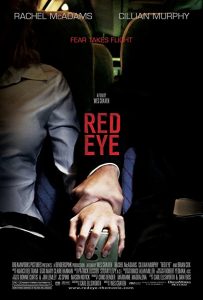
Red Eye

Wes Craven understands tension. Whether you care should be enough to determine whether you want to see Red Eye. Although his heroine fears flying and loss of control, nothing works as well for the audience as a good dose of claustrophobia, and the majority of the film delivers.
Rachel McAdams finds herself in the clutches of a professional… well, I don’t know if there’s a specific word for it, but when you need to hire somebody to do something nobody else can, but it’s a bad guy rather than the A-Team. Anyhow, he’s a professional one of those, and he has her where he wants her. Unless she arranges for a government official to be in an exposed position at her hotel, her father will die.

Any time the plot strays from the interactions between McAdams and her assailant, well, as you’ve just read, the plot is far too derivative for its own good. Luckily, the movie very rarely lets that plot get in the way of an otherwise excellent story. And as for the assailant, every bit of claustrophobia provided by the sets was matched by Cillian Murphy‘s depthless blue sociopathic eyes. Typecast he may always be, but as long as he doesn’t trip onto an unfortunately spaced barbecue fork, he’ll never hurt for work. It certainly helps that he can also act.

Special note for fans: Colby Donaldson plays a third tier role as the head Secret Service agent. So, y’know, good on him.

The Cave

The important thing is, I’m back in the groove. Well, and that there’s a lot of stuff coming out over the next couple of months, now that the summer dry season is over. I am disappointed to realize that no matter how good I think Flightplan is going to be, it cannot possibly stand up to the sheer artistry that is its preview. Still, though. Also coming soon, Venom and The Fog (not to be confused with The Mist, by Stephen King; I can tell, because I did for nearly half the preview) and The Exorcism of Emily Rose. Not to mention the couple that I missed. My point here is to say that, although slasher movies haven’t quite resurged, the horror movie is back. Hooray!
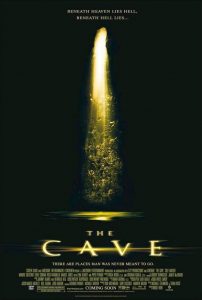
Oh, right, also I watched one last night. The Cave is the story of… well, you see, there’s this hole in the ground, under an old Templar church, with rock formations and underground dwelling creatures, and an underground river to boot. It’s sort of… well, I suppose the best way to describe would be that it’s a cave.

And, yeah, the plot is every bit as straightforward as the title. People die in approximately the order and number that you’d expect them to, after having seen the entire cast introduction sequence. (In fact, at one point I thought the wrong person was about to die, and I was aggravated at them for ruining the formula pointlessly. But, no, they came through.) The biggest flaw[1] was that rather than let the killer monsters just be random killer monsters, they attempted to explain the cause behind the random killer monsters, but then just left the cause dangling instead of doing anything particularly interesting with it.

Well, no, the biggest flaw was PG-13 rather than R. There’s something altogether off-putting about seeing a bikini rather than boobies or hearing ‘motherf-‘ rather than motherfucker in this kind of movie, and just so that the distributors can trick themselves into believing it will sell more tickets this way. Schlock cinema, even in the midst of its resurgence, is basically dead.[2] Woe.

[1] No. Being a formulaic horror movie does not qualify as a flaw. Shut up.
[2] I blame the homogenization of the movie theater landscape, combined with how the theaters are beholden to the movie studios, in a way that they were not just twenty years ago. The death of the drive-in is not a cause, but it is certainly another effect of this same cause. As usual, anytime massive success in a sector leads in the slightest amount toward monopolization, the niche suffers. Luckily, I can still go into a Fry’s and find such brilliant titles as Mulva: Zombie Ass Kicker! But without any kind of advertising or preview budget, most of these movies languish unwatched in direct-to-video limbo, simply because they are completely unheard of. So… you’re welcome? I’ll keep doing my job, anyway.

Final Fantasy

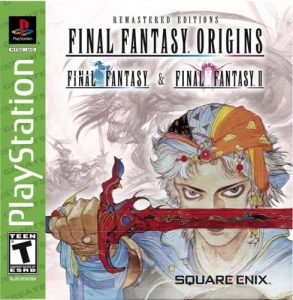
Over the past several months, I’ve played Final Fantasy (with intentions to play the other ones, eventually) as my tiny-TV-in-bed time-waster of choice. The amazing part is that I actually got around to finishing it, just last night. Well, it’s not that amazing. I am a jobless bum with no real prospects, since my marketable skills have been eroded over the past three years of getting paid a king’s ransom not to use them.
…but it’s possible that this is not about that. Um. Where was I? Right, the game. I’ve been reading 8-bit Theater for lo these many years, and once I realized they were re-releasing the game, I got it in my head to play as the characters from the comic. Then, I played it for a while. Then, I didn’t. Then, after I got unenjobbed, I returned to it, and after a quick walkthrough to remind me of the dungeon I was in the middle of, I got back to plugging away at it. It is mindless, but certainly entertaining. Even with cleaned up translations of the spells and people’s speech patterns, it still makes barely a lick of sense. But at the end of the day, the world was saved, so that’s pretty cool.

Also: unlike any other Final Fantasy game (well, that I know of; I admit that my knowledge in this regard is limited), there are no chocobos. This alone makes it the most awesome thing ever for the whole of the minute or two that you’ve spent reading just now, not to mention the minute or ten I’ve spent typing. I mean, just imagine it. A world with no chocobos! It would be fairly breathtaking, but luckily we are blessed by other video games who have never heard of such a beast, on even the quietest winds of rumor. But if we weren’t, man. People would be lining up to play this game over and over again, just to avoid that terrible fate.

Or, maybe it’s just me with the chocobo aversion.

Myst

A very long time ago, I spent a week in Southern California, right after the spring semester. Mostly hanging out on the beaches watching bikini babes rollerblading by on the boardwalk, right? Well, obviously not, because I’m me. No, a big part of that time, I played Road Rash on the Sega and Myst on the PC. However, vacation time ran short, and I did not quite have time to finish.
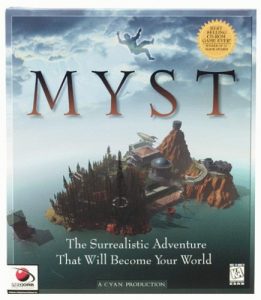
That would be the all too common end to the story, except that one of my friends hit upon the idea of buying the first three boxed together over this holiday weekend. None of us has ever touched Exile, I’ve never played Riven (except for the first ten agonizing minutes or so, after which I got bored and quit), and one of us had never played Myst. Also, none of us particularly remembered how to solve the puzzles, just pieces of the plot. So, we sat down and got to work.

And then, after about six or eight hours of gameplay spread across two days, we finished it. I learned several things from this experience. 1) Ten years down the road, a lot of games have incorporated this kind of puzzle motif, to the extent that what was new and unusual back in the day is now all to easy to spot and understand the purpose of. The paradigm has shifted, and this was certainly the game that did it. 2) Full-motion video has come a long way. 3) When I stopped playing, that early summer all those many years ago? Yeah, I was about 5 minutes from the end of the game.

What a sack of crap.

Endless Nights

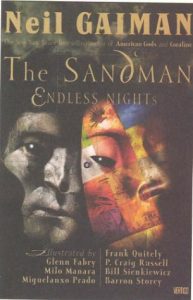
Seven stories, one for each of Neil Gaiman’s Endless siblings. It wouldn’t seem like the best description to drum up interest in the newest (although not so very new) Sandman graphic novel, Endless Nights. At least, it wouldn’t to people who aren’t familiar with the series. If you are, seeing Neil Gaiman’s name attached to this property most likely comprises one of the few value guarantees out there. (I’ll try my damnedest not to gush further, when the next one of these comes up.)
Impressions: Desire’s story made me like it a little, which I’m not sure I ever had before. (Not that this lasted for very long.) Despair, although not an actual tale in the conventional sense, was gut-wrenchingly effective. Destiny is as uninteresting as he ever was, but I don’t think it’s his fault. Ten panels of Delight was enough to break my heart. Gaiman’s smart, to use her as sparingly as he has over all these years.

Finally, there are a couple of spoilers about the main sequence stories included here. That story is a lot more about the journey than the destination, but also these would probably be easier to appreciate by knowing the characters more thoroughly, anyhow.

La Marche de l’empereur

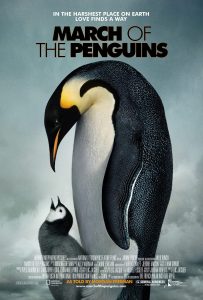
First of all, let there be no doubt that this falling behind thing is of the suck. It makes it really hard to adequately review serviceable-yet-mediocre fare when you’re a week or more after the fact. So, you’re asking yourself (or at least would be, if my titling scheme was not so utilitarian), what movie have you finally gotten around to seeing after a month out of the theaters? The Cave, surely. At the least, Red Eye, or maybe that Brothers Grimm thing, right? Well, no, instead, March of the Penguins.
There are two things to understand that will make sense out of this travesty of movie-going. 1) I do have some amount of interest in learning about things as well as stuff, and sometimes just for the sake of knowing things, not merely because of all the chicks at cocktail parties who hang on my every word and inevitably pay for the cab back to their respective places afterwards. 2) I really dig penguins. I mean, a lot. I blame Opus.

Anyhow, worthwhile movie? Yes and no. My instinctual reaction while watching was to assume that the Discovery channel is going to get a lot more advertising money over the next quarter or so. This is both its success and its failure. Excellent job of providing concise and comprehensible information about the world out there where most of us can’t afford to be. Terrible job of escaping the boundaries of a made-for-TV documentary. The only things that truly distinguish it from one of a hundred other such documentaries that have and will air on basic cable this year alone are a) a massive advertising budget and b) probability of winning an Oscar. Unless I’ve fabricated this into my days later memory banks, there were actual commercial break fades.

I forgot c), though. Probably, if this had not been theatrical, you’d have had Patrick Stewart narrating rather than Morgan Freeman. Of course, maybe this is his way of retiring and he’s hitting all of the big documentaries from here on out. Between this and War of the Worlds, he’s already off to a big start.

Season of Mists

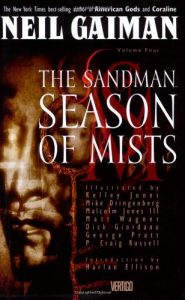
The Sandman, I said. And I meant it, because that is some damn fine literature. I read the series in 1996 or so, right after they’d all been published as graphic novels, and it was a hell of a ride. Observant visitors may notice the domain name, and wonder if it is a coincidence. (It is not. That’d be pretty funny if it were, though.)

What I didn’t ever do was own them. So, over the past few years I’ve been snagging them one at a time as the mood strikes me, and then reading them gradually at whim, not really part of a reading list schedule. The first few books are highly episodic in nature, with introductions to characters and the setting taking up a lot more space than ongoing storylines (although there’s no question that there are a couple of very solid ones). The upshot of this is that I haven’t felt compelled to review any of them yet. But over the past week, I read Season of Mists and it all fell into place. To the point where if I had income, I’d just buy the rest of them right now and take some time. But I do not, so enough about that!

I’m loathe to summarize it, in that I feel I can only damage the pristine beauty, but here goes: The Lord of Dreams attends a meeting with the other members of his Endless family at which he is goaded into righting a long-ago committed wrong, and in the process he receives a most unwelcome gift.

Having read the series before, I can also say that this is where most of the seeds are planted for remaining arc of the story, which could explain my hankering for the remaining volumes just now. The standard high quality of art rounds off the experience, which should be shared by everyone. (Incidentally: I’m caught up now. Yay!)