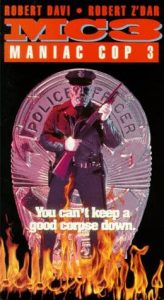
 As you will no doubt remember from Maniac Cop and Maniac Cop 2[1], there was a maniac cop who was actually sort of undead too?, and who got the best of both Richard Roundtree and Bruce Campbell, which lets you know he was a badass. And it turns out that he’d been sold out by the city and left to die in prison, and once that truth was revealed he was able to rest in peace, secure in the knowledge that a balanced view of both sides of cops (ie, way too much brutality and people should be terrified of law enforcement, or else cops should protect each other unless it’s actually a bad apple, which it somehow never is though) had been presented over the course of the two films. And if that “balanced” message has aged badly, it’s still impressive that anyone was presenting a two-sided message in the late ’80s, instead of only the one side you’d expect.
Maniac Cop 3[2] proves you can have too much of a slightly but on average good thing. Because, you see, by the early ’90s, the dial had apparently swung back to cops are always right and it’s only the evil media misportraying them that causes problems. To wit: you would think that after a lady cop foils a pharmacy robbery, getting shot in the process, she’d be a hero, right? But instead, the footage is edited to make it look like she murdered the hostage while also trying to murder the perp, and now in addition to having no brain activity in her hospital room, she’s also the postergirl for “Police = Bad”, even though the unedited footage shows her being heroic but ambushed.
Okay, so that’s probably why the maniac cop comes back to life for more vengeance, right? Haha, no, he was raised by a voodoo priest at the beginning of the movie before any of that happened, for no apparent reason! But undead maniac cops get the paper and the 5 o’clock news, same as everyone else, so it isn’t long before he makes it his business anyway. (What an unnecessary subplot, the voodoo thing. I don’t get it at all.)
Anyway, none of that is important, and knowing it’s happening mostly makes the movie way worse than if you’re just watching it to see a maniac cop kill people for no apparent reason, regular slasher style. And then later to watch Robert Davi[3] drive down a highway into oncoming traffic for about five minutes straight, watching the road for maybe one of those minutes total while mostly unloading clip after clip of his gun out the passenger window into a maniac cop of some kind, complete with real time reloads in between and occasional pauses to comfort the screaming doctor lady in the passenger seat.
It is maybe the best cop car chase I’ve ever seen, outside of a Blues Brothers revival.
[1] You won’t.
[2] I had assumed that the sub-heading, “Badge of Silence”, would be a reference to a code of silence, a la thin blue line, a la cops not turning on other cops. But there was never a plotline that came close to that as a concept, so, I have no idea what they were going for. *shrug emoji*
[3] You don’t know you know who he is, but you’ve seen him before. He has Edward James Olmos cheeks, but with dead eyes.
 So, what I knew about The Pool going in is that it was a Thai movie about a dude trapped in a really deep, empty pool with a crocogator. Which, yeah, that’s enough by itself to fill like 75 minutes I reckon?
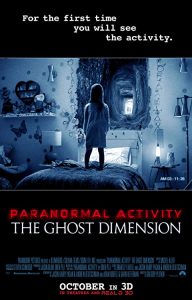 Anyway, there was one more Paranormal Activity movie that I missed, prior to the current new one that doesn’t yet count as missed. So now I’m caught up, yaaay.
 It’s been nearly a decade since I last watched a Paranormal Activity movie. …well, a new one, anyway. I rewatched the first four this week, after determining that they released entry #7 and thinking, should I catch up? Hey, why not!
 The movie starts with a high overhead shot of aquamarine water, and zooms down beneath the waves to something cloudy spurting from a crack in a rocky wall at the ocean’s bottom. We are told via music cues that this is ominous. The movie ends, if you were to play this scene backwards (dialogue excepted) with a high overhead shot of aquamarine water, tracking down to a beach and then a woman lying on her back on the beach, rocking slightly and saying over and over to herself, or possibly to the audience (since she’s speaking directly into the camera), “Don’t be scared. Don’t be scared.”
 The first few minutes of
  Here’s a movie you’ve seen at least a hundred times before: pregnant lady, around whom strange things are happening. (Most obviously, the accidental(?) death of her toddler child in the new Brooklyn apartment they just moved into.) The two possibilities presented are a) she’s paranoid or b) Satanism!
 From a plotting perspective,