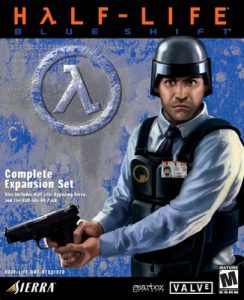
Half-Life: Blue Shift

Last night, I got around to hooking up my new computer speakers. Once you have an upgrade like that, your only choice is to dig out a new game. Conveniently, I had an old new game laying around, in the form of Half-Life: Blue Shift, the second and final expansion of the original game.

In the third perspective of the Black Mesa incident, security guard Barney Calhoun finds himself surrounded by a collapsing experimental facility, terrified scientists, impersonal military clean-up crews, and hideous alien monstrosities. In other words, if you’re looking for something new and different, pick up Half-Life 2 instead.

The game is short in a way that I haven’t experienced since Luigi’s Mansion. It doesn’t have any new monsters or weapons, or even all the monsters or weapons from either of the previous two games. It does have the same Half-Life charm, though. Puzzle-solving at its finest in a shooter, occasional scares, a well-realized world, and people to save who, unlike in previous episodes, you actually have a chance of saving. The only thing that makes it hard to recommend is that the G-Man has far too light a touch. But that’s okay. That’s what Half-Life 2 is for.

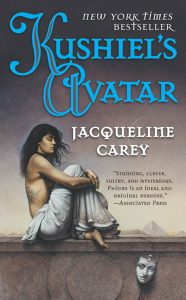
Kushiel’s Avatar

One of the unfortunate things I’ve run into while doing this is just how many series of books I’m in the middle of. It seems like every other book I review, I have to go back and review the rest of the series, too. It’s not like I can assume that just because I’ve read the earlier books, everyone has (although I only do this with the first book I review of a series, which implies I assume that any reader is intimately familiar with the contents of my endeavour here, and what does that say about me?), and so I have to review the series at the same time as the book. (Note to authors: this is not a valid excuse to recap your entire series in the process of writing each new book. Assume we’ve read the earlier ones. Please.) Still, the number of series I’m in the middle of with no review yet is shrinking, so that’s nice.

Case in point: I’ve just finished the Kushiel’s Legacy series. Set against the backdrop of a medieval-era Europe-that-might-have-been, Phèdre, unwanted whore’s get (as she’ll tell you herself, early and often), has learned well the arts of covertcy and love as well as many languages, she has faced down the military invasion of her homeland and machinations to steal its throne, she has found love coupled with understanding, and is now ready to set out on her greatest adventure: to prevent a horror from sweeping across her world, at the behest of Kushiel, God’s angel of punishment who has marked her as his own to experience pain as pleasure, and to learn the Name of God in order to save her oldest friend from a fate worse than death. (You may be thinking to yourself, wow, that’s quite a sentence there, chump. I make no apologies. Onward!)

As usual, the bare plot of Kushiel’s Avatar is romance novel simple, but what Jacqueline Carey fills it with is sheer delight. A protagonist with a compelling voice, intrigues galore, a map full of new places to visit, and a cast of interesting characters. Sure, the travelogue has been done before, and really a lot, but as long as you don’t hate it just for the sake of itself, this is one of the good ones.

Contrary to previous episodes, the sex felt a little more frequent and graphic. At times unnecessarily so, which had not previously happened. The plot, though simple, is a little bit overlarge. I felt like there were two books in there, each a bit too small to work for the publisher in these days of doorstop publishing, but the total a little large to be contained in one story. Still, it was entertaining, just not quite as tight as the previous two books.

To her credit, Carey has kept each story self-contained, which goes a long way to forgiving books of that size. Self-contained, yes, but with excellent hooks between novels. As such, the hooks at the end of this volume left me with intrigued questions. Whether there’s not ever another book and the answers are up to me, or whether another book of Phèdre’s exploits will be coming along in a few years, or whether (this is my personal bet) another book set in the same world with a new protagonist will be coming along in a few years: however it turns out, I’m satisfied with both the ending and the questions. That’s a rare treat. (Well, it used to be, but I’m reading better books these days. In any case, it’s a rare treat among the vast majority of stories that get published.)

Monsturd: revisited

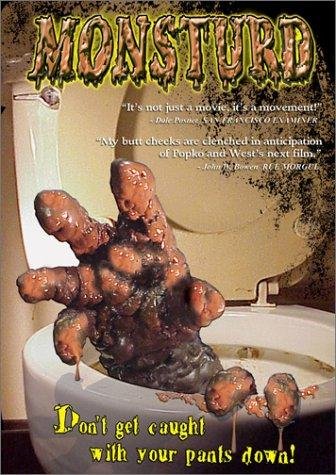
Friday marked an unprecedented occurrence, which probably went unremarked by people who aren’t me, but it bears scrutiny. I received a slightly misplaced comment from Rick Popko, the writer and director of the recently un-reviewed indie flick Monsturd. I present that comment here, in its entirety.

I guess you didn’t like Monsturd, then, eh? Sorry about that. We did the best we could for our $3,000 production budget. We’re making the sequel now called RetarDEAD. You can see a teaser trailer of the movie on our site www.4321films.com (click on the poster).

-Rick

In light of this new information, I feel obliged to provide an actual review instead of an overly snarky dismissal. My lesson has been learned, even if the odds of any other creator stumbling upon my modest endeavor are, well, awfully low.

Monsturd was formulaic, yes, but in the good way. Sure, the serial killer was going to fall into a vat of toxic chemicals and become an unspeakable monster. And the title gives away fairly well what kind of monster. And naturally there’s only one person who can stop him, the wholly adequate town sheriff. But it has things you wouldn’t expect, too. The obsessed FBI agent and the insane biochemist at odds with each other who, I’m told, will be back for the sequel. And of course the entomologist who presents one of the best film metaphors in ages, his collection of a million flies. (Of nearly equal amusement value is the part where he keeps them in a wire cage, and they still only come out when he opens the door.) And am I a big fan of the Pepto-Bismol-filled waterguns? You bet!

But that’s my real problem with the movie. It had ten pretty good opening minutes, ten excellent closing minutes, and about ten other good minutes scattered through the middle. And severals tens of minutes that alternate between unnecessary and downright disappointing. Sure, it’s my taste talking here, but I don’t really need to see the ten minute vomiting scene anymore. It’s been done often enough.

And while on the one hand, I can’t expect the movie to get from point A to point B without a reasonable discovery of what the hell is going on transition, on the other hand, I could have asked for a little more than the same treks through sewers with a piece of the puzzle revealed at the end of each otherwise identical trek, and for better dialogue in the sewers. Because, the townsfolk interactions, the police station scenes, all of those were fine. The sewers flat-out bored me, and your tension area can’t be boring. It breaks the rules, badly. I can handle the bad acting. It’s part of a $3000 budget. And speaking of that, the special effects surpassed the budget in every way. It gives one hope for one’s dream of making a lesbian zombie softcore/polemic. But if I’m bored when I’m supposed to be (even if only a little bit) scared, that I can’t take.

So, did I like Monsturd? Well, okay, not really. Would I have liked it with other people in the room? A lot moreso, at the least. But it had promise, enough so that I want to see the sequel advertised above, which is much more up my alley. Special-needs adults transformed into zombies by an insane biochemist, and the town must figure out a way to survive. Seriously, I’m there. So, in deference to my admitted tastes, and at least as much so to the fact that I sold Rick short a couple of weeks ago, I present the link to his next opus. And, if he wants to send me an advanced copy, well, I wouldn’t bitch about it.
The Phantom of the Opera

Musicals: sometimes I like them. It helps if the entire world doesn’t join in randomly and without feeling the slightest bit self-conscious about it (see South Pacific, although there are exceptions that can make this work, such as if it’s happening due to demonic interference). And it probably makes me overly trendy and without taste that I like Andrew Lloyd Webber better than the generic musicalisician, but nevertheless I do, and it’s too late to do anything about it now. Although in my defense, I hate Cats, as is good and proper.

The upshot of all this is that it was inevitable that I’d go see The Phantom of the Opera as a movie, despite the near universal panning it took. And here’s the thing. It didn’t only not suck, but was, with just a few exceptions, really good. In some aspects better than I’ve ever seen it onstage.

Problems: Too melodramatic. This went away after the first few scenes, which is good. Because that kind of thing works on stage, but makes a movie feel goofy. I’m not sure why there should be such a difference here, but there is. Also: too musical. Like I said, the singing randomly thing, it grates in a cinematic experience. I think it bugged me this time because I was prepared for all the singing, but then they did some of the scenes straight, speaking where I was expecting music. Thusly was the illusion broken, so that when they did sing, some of that failed to fit after all. And, too much naked statuary. Yes, it was in the time before Victorian England took over the social mores of the western world. And it’s not like exquisite (and I should think frightfully expensive) gold statues of women quarter-dressed in sheets bothers me, either aesthetically or pruriently, in an opera house. But the equally detailed granite naked statuary in the cemetary seemed, well, out of place. I’m just saying.

Now, the good stuff. I’m not going to worry about spoilers, a) because if you don’t know the basic story by now, it was by choice and so why should you care about being spoiled, and b) because for a movie like this, the comparison with forebears is the only really important thing to review.

In no particular order, things I liked: The gradual reveal of the Phantom’s madness, via the skew between his perceptions of himself and his world, and external perceptions of the way his world really was. Emmy Rossum‘s portrayal of Christine as a sympathetic character, which is the first I’ve ever seen. (I’ll come back to that.) The chandelier scene, which was greatly improved over past productions (and I’m not talking about the limitations of a movie vs. the stage here, so don’t start). Oh, and the opera house itself, although clearly too large to fit in the external structure they showed, was just really cool in every room.

The random over-exposition scenes were a wash, because on the one hand, blatant exposition makes for a bad film, but on the other, it was (mostly, and here I do not include the cringeworthy Little Lotte lines) interesting and depth-adding exposition.

Cutting here, as the rest contains spoilers for the movie only. Still, they’re the reasons to see the movie, so you should click through anyway.
Continue reading

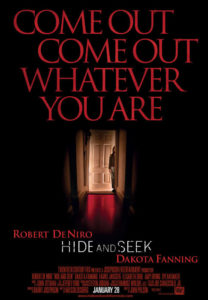
Hide and Seek

The thing is, this was a good movie. Several inevitable games of Hide and Seek, of course, but even those managed (for the most part) to be tense and creepy, rather than like the lame repetitive device they could have been.
Anyway, plot: Robert De Niro’s wife thinks their marriage is irreconcilable, and then suicides herself in the bathtub. Daughter Dakota Fanning (who is a beautiful little girl; just ask anyone in the script) goes a little bit insane. After a poorly defined period of time, De Niro takes his daughter to a gigantic house in upstate New York, so that she’s not surrounded by memories. Instead, she’s surrounded by an empty house, a creepy-looking cave in the woods, and De Niro’s hands off parenting approach, learned, apparently, through years of careful psychologist-being.

Naturally, she has no choice but to invent an imaginary friend. Except, the friend starts creating lots of scary mayhem, leading the audience to wonder: is the little girl doing all the stuff she blames on Charlie? Or is it the creepy neighbor? The meddling real-estate agent? A giant lovable-but-without-social-graces bear who lives in the cave? A hillbilly with only three teeth, who lives in the cave? Whoever it is, good camera work and acceptable child-acting keep the tension and the mysteriousness high, so I’ll say no more lest I give it away. (It’s not the bear, though.)

I think it’s because it worked so well that the flaws grate on me. Elisabeth Shue wanders in and out of the movie as the aunt of young Dakota’s would-be local townie friend, who seems to maybe want to date De Niro. And he seems maybe to want to date her too. It’s played too low key to understand, and it doesn’t help that it feel like his wife has been dead just a handful of months.

The final act drags on for an eternity beyond the (very-well played) climax, removing a lot of the goodwill I had toward the film. And then, even worse, the final two scenes both contained pointless groaners that could easily have been avoided. My recommendation: See it. Good mood piece, decent creep factor and the thing where they make you want to know what’s actually going on. But after the climax (you’ll know it when it happens), move on to something else. Whatever ending you make up in your own mind will be superior.

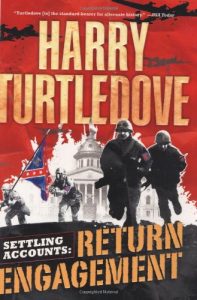
Return Engagement

I think half the fun of alternate history writing comes from the winks and nudges that the author is able to give the informed reader about the parallels and outright differences between what got written and what really happened. Not that this is hard to achieve in a Turtledove novel; he’s the genre’s Grisham, writing alternate history for the masses, which means that he’s not really writing beyond the high school history level on most occasions. There are certainly things to spot even for more informed readers, but they’re rare. (Or else, I’m insufficiently informed; that’s likely.)
As for a review of the actual book, there’s not a lot I can say. Although Return Engagement is the first of the Settling Accounts trilogy, it’s the eighth book in the same storyline. Turtledove posits that a set of military orders sent by Lee to his subordinates early in the Civil War was not lost by the messenger, and then jumps ahead first to the 1880s to examine the new fates of such historical personages as Teddy Roosevelt, George Custer, and Abraham Lincoln against the backdrop of a divided continent, while the fledgling Confederate States face their second military challenge.

Except for How Few Remain, each of the books that follows is part of a trilogy, watching the events of first the Great War, then the boom and bust 1920s and 1930s, and most recently the second World War, through the eyes and lives of fictional characters both incidental and important. It works for him, because I’m as interested in the characters’ lives and outcomes as I am in the greater outside events he is chronicling.

Unfortunately, as I said, the similar style of each of these books makes it hard to review an individual one without delving deep into spoilers, especially this far along in the series. (Hint: he’s pretty well writing the same history we have now, except the players and outcomes are wildly divergent. His theory of human nature (which I buy into) just keeps pulling them back to the same places, despite the divergences.) The quality is as high as it was in the first book of the Great War trilogy, and consistently higher in this pure venue than when he writes about fantasy settings with parallels to real world history, or about aliens who launch a worldwide attack in the early days of World War II. Turtledove is simply a better historian than fantasist, and this series lets his talent through better than anything else I’ve read by him.

One thing I can say about this book in particular: as the series goes on, I can see things coming more clearly than I could reading the early books, and as I watch these characters that I’m interested in make clearly wrong choices, the warring sympathy and revulsion leaves me very uncomfortable, I think because of how it humanizes the actors in my world’s history. For my money, that’s good writing.

Ginger Snaps Back

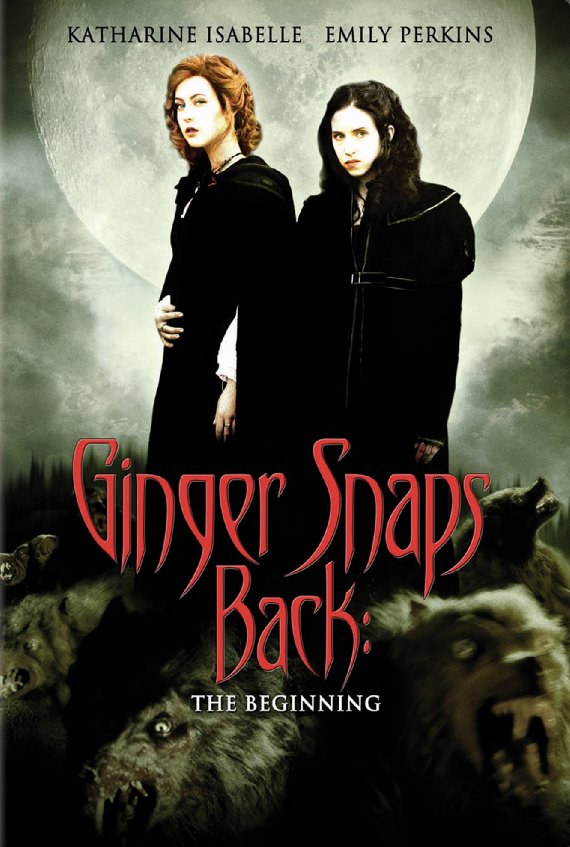
MV5BMTg1NTg3OTI4N15BMl5BanBnXkFtZTcwNDAxNDYwNQ@@._V1__SX1859_SY847_It’s a rare movie (or book, for that matter) prequel that can be watched prior to the original story without ruining the narrative flow, or at least spoiling the plot. Ginger Snaps Back: The Beginning is such a film, which makes it all the more the pity that it was so superfluous. Purporting to provide the origin tale of the werewolf-y menace that led up to the surprisingly good Ginger Snaps and its sequel, it instead tells the same story from Ginger Snaps all over again, only without the clever puberty metaphor and with a tie-in to the old wendigo legend that, frankly, doesn’t really fit.

Sisters Ginger and Brigitte are back for an old-school battle against the werewolves that are terrorizing a trading company’s fort in 1815 Canada, with a conspicuously missing explanation for how they arrived on the scene or why their dialogue sounds so modern compared with the members of the fort. With the setting and cast list out of the way, the plot follows its predictable (to anyone who has seen the original, and generally speaking, you really should) arc into the final act, which ought to have had real dramatic tension. Unfortunately, as a prequel, the outcome was basically pre-ordained.

This is why I say it would go better as the original film of the trilogy. The only problem being, it’s not nearly as good as Ginger Snaps, and deciding to give that film a miss based on it being the sequel to a fairly iffy movie would be in the same ballpark of unfortunance as skipping multiple seasons of television goodness because you were turned off by Ben Affleck’s film debut.

Elektra

The thing about being sick is that you kind of look forward to it. An excuse to not have to go to school, say. Or to work, which is even better, because the concept has been institutionalized. There are entire “sick days”, which are for the sole purpose of saying, ‘no thanks, I’m not going to work today, because I’m taking a sick day. It’s because I’m sick!’
It’s all a trick, though. The cold reality is that when you’re actually sick enough to not be at work, you won’t enjoy yourself. You’ll go to the doctor, get your prescriptions, get them filled over the course of an hour in which, sure, you have a book, but you’re sick enough that being in the same place all that time will start to make you more uncomfortable even than you started out, and it’s really hard to concentrate on reading for more than ten minutes at a stretch, what with the sinus headache, and on top of that, you get your first taste of just how bad the company drug insurance has become when they finally tell you it’s time to leave.

All of which is probably a close approximation of how Jennifer Garner felt in between Daredevil and Elektra. She had just been in a terrible movie, her character died, and… okay, that’s really all I know about her. I’ve never even seen Alias. So I guess the metaphor broke down, a little. I’m sick, sue me.

Luckily for Miss Garner, her quasi-sequel is substantially better than her last turn in Affleck’s doomed vehicle. It has a lot going for it. An old-school Campbellian plot about the motherless daughter at the heart of the ancient, hidden battle between Good and Evil, lingering, mood-setting camera work that mostly hides the TV episode-length story being stretched into a 90 minute feature, a crew of bad-ass enemies with spooky mystical powers, a boatload of ninjas, and most importantly, nary a hint of its Hollywood forebear.

All this plus decent sequel potential, and the obligatory child actor wasn’t all that bad. And did I mention the ninjas?

Naked Empire

61jwmR8eIHLAs with all people, sometimes I do things that I find embarrassing, and wouldn’t really want other people to know about. I collect Misty Mundae DVDs. I have Scooby Doo boxers. I watch Joey on NBC. Worse by far than all of these (although not my blackest secret, either), I read Terry Goodkind’s Sword of Truth series.

Yes. Still.

This I could have carried to my grave, I think, except that now I review things I read. It’s a problem, but not one that I could get around and be fair to you, my faithful reader. So, yeah. Now I have to talk about it, and feel even worse about myself. Because reading it analytically, it’s worse than when I would just read it because a new one was out, and that was already aggravating.

Sure, the first book has the ‘Let’s ban fire!’ thing, which bothers me far more now than it did when I first read it. And then the next three or so seemed like cheap Wheel of Time knockoffs. But now that the Wheel of Time is no longer particularly copyable, he’s led the reader along toward an even worse fate, the objectivist screed.

It’s not that I dismiss Ayn Rand out of hand, or even disagree with a lot of what she had to say. It’s more that Goodkind presents the arguments as though it is not possible to have a reasonable disagreement about some of the points, some of the time. And of course, since he’s writing both sides of the argument, it’s easy for him to get away with. But I could forgive him that, I think, if it wasn’t for the screed part. Because, and I sincerely believe this to be true, fully half of the 725 page story revolved around Richard Rahl – our intrepid hero who carries the Sword of Truth (and therefore is named the Seeker of Truth, which makes him the best argument from authority fallacy on two legs ever) and wields both halves of a magical gift that nobody else has been born with for three thousand years, and is the sole line of defense for the people of the world according to prophecy, and to the people of his empire literally (but only as long as they make the proper devotions to him (and yes, yes I am feeling worse about myself the further into this I go)) – going off on pages-long diatribes explaining to people why it’s wrong to oppose the war in Iraq, and why it is not only right but morally necessary to kill anyone who actively stands in the way of having it accomplished.

Sure, he talked about fictional enemies that fit into the world of his story, but he didn’t really use different words, and even if the author will claim the subtext isn’t there, this is one of those times where what the author thinks doesn’t really have much bearing on the reality.

I got sidetracked. Anyway, my point is, half the book: swords and sorcery and the incremental advancement of the main plot of the series, plus the fully realized sub-plot that is the main plot of the novel. So he has that going for him, the stand-alone accomplishment. Which Mr. Jordan is welcome to plagiarize at any time now, really. The other half of the book: lectures on objectivism and how it relates to real-world morality.

It was every bit as fun as it sounds. The worst part is, I still want to find out how the main sequence story ends. I have no self-control when it comes to following a story from start to finish. (Like I said, I watch Joey.)