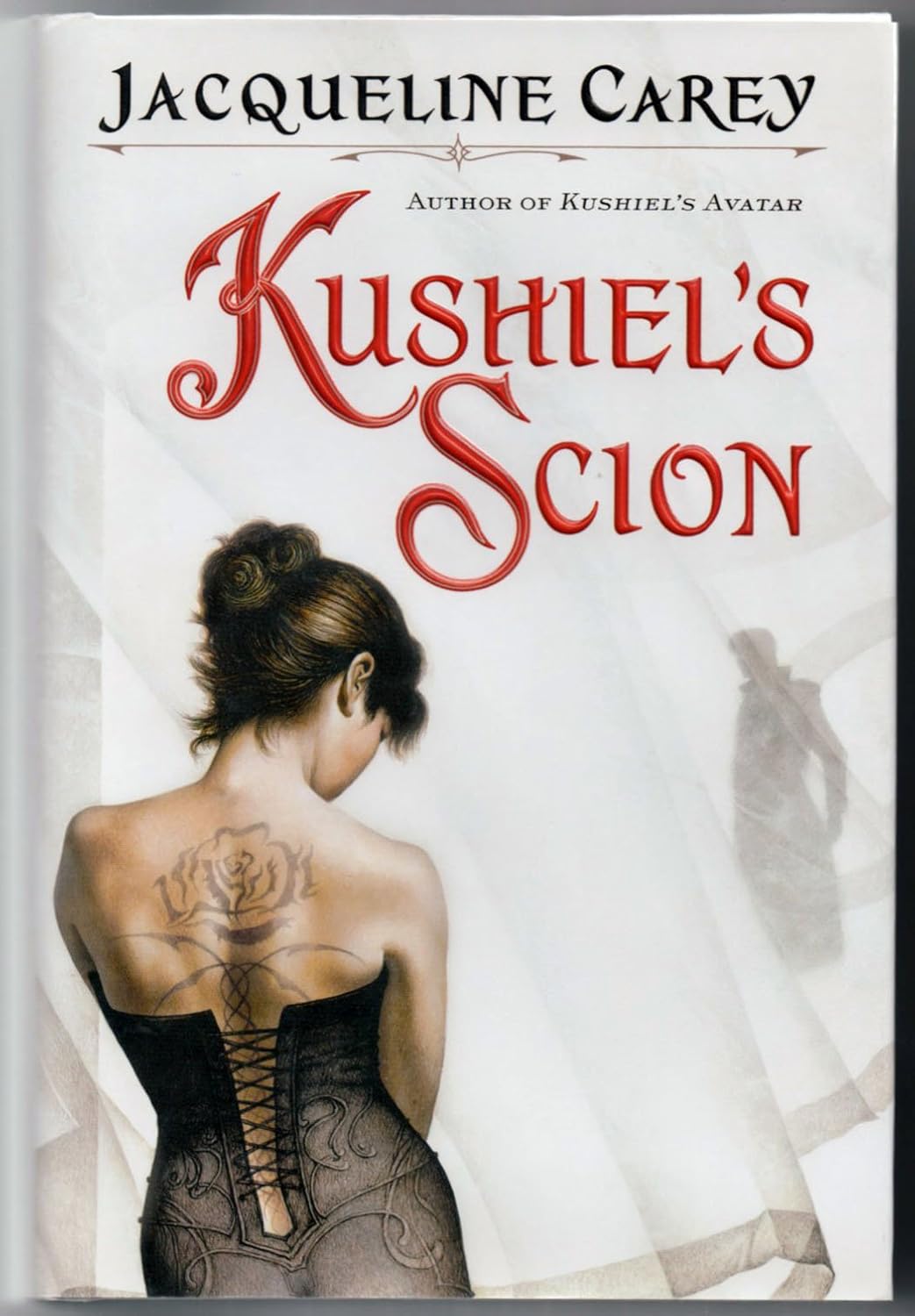
 From time to time, I browse my local Half-Price Books. Well, more accurately, there are two that are right close and another that is along a path I follow with semi-regularity, and I tend to be in at least one of them at least once a week. So, you know, a lot. I’ve always been okay with used books, and the thing where I have a lack of income has turned that into something more like necessity. But, my point is, regular freaking customer here. So when I saw a hardback copy of a new Kushiel book from Jacqueline Carey, completely without having been aware that the series was set to continue, I just snagged it and went. Only later did I learn of the unlikelihood of finding a used copy of a book that had only been out for about a week. So, hey, neat. Go, me!
And then, a pair of incredibly busy weeks made me not only read it more slowly than one might guess, but also resulted in the review being a solid week late. The details have faded a little bit, but I can only assume that Kushiel’s Scion is about the further adventures of Phèdre, discarded child, high class prostitute, and now peer of the realm as she attempts to select and customise an incredibly ugly and inexplicably popular rectangular car without bankrupting her beloved Terre d’Ange or allowing the swirling intrigues of the court to distract her from her goal. Or, possibly, it’s about something else?
So, yeah, no. In fact, it’s about her adopted son Imriel, whose legacy is nearly as convoluted as her own. Birthed as part of a plot by his infamous mother and Phèdre’s longtime adversary to steal the throne for which he is third in line, raised unwitting of his heritage or rank in a remote monastery, kidnapped into slavery and sexual abuse at a tender age (completely coincidental to his past), and now raised to adulthood in the household of the most famed citizens of the modern age, our young Imriel has had a lot to overcome. And this book is as much about overcoming it as it is about introducing the hero of a new trilogy full of the same style (and, I think, quality) of political intrigue, lush travelogue and vivid characters that made the original so enjoyable.
Best of all, it being an introductory novel in no way hinders any of the other qualities one looks for in a book. You have the tried, true, and almost never trite trope of exploring the present by revealing aspects of the past. You have a tightly contained and incompletely explored thematic question of what it really means to be good, a question that haunts Imriel daily due to the dark passions that came to him through his bloodline and his fear-disguising hatred of his exiled mother. And lest you think that ‘incompletely’ indicates a criticism of some kind, let me hasten to assure you that the opposite would be the case; the temerity to consider such a complex question as solved would be the point where I’d think far less of an author, rather. And you have an excellent hook into what promises to be an even stronger second entry. The downside, of course, is that I’m once again in the middle of an ongoing series I’d thought closed off and complete. But, you won’t find me complaining too loudly about it. I’m a sucker that way.
 One of the unfortunate things I’ve run into while doing this is just how many series of books I’m in the middle of. It seems like every other book I review, I have to go back and review the rest of the series, too. It’s not like I can assume that just because I’ve read the earlier books, everyone has (although I only do this with the first book I review of a series, which implies I assume that any reader is intimately familiar with the contents of my endeavour here, and what does that say about me?), and so I have to review the series at the same time as the book. (Note to authors: this is not a valid excuse to recap your entire series in the process of writing each new book. Assume we’ve read the earlier ones. Please.) Still, the number of series I’m in the middle of with no review yet is shrinking, so that’s nice.