Silent Hill

I am annoyed right now, because of how I’m thinking about this movie and I want to talk about facets of it, and instead I’m being made to feel guilty for examining those facets rather than committing to a single opinion, full stop, the end. However, guilt is for Catholics and people in jail, and terrorists who haven’t been charged with crimes of course; most importantly, not for me. So, Humbug, I say. Also, I say Silent Hill.

So there’s this game, right, and they made a movie. That nearly never ends well, and not least because they mostly only make movies based on good and popular games. (It is a source of surprise to me, how much more often popular equates with good in the video game arena than in the movie or literary arenas. I wonder if I’m wrong, really. But let’s assume not, as it makes it easier for me to continue with my thoughts, here.) So, there’s automatically farther to fall, as your built-in audience will necessarily be more judgmental than otherwise.

Silent Hill the game was creepy of atmosphere and mysterious of plot, only providing drips and drabs to explain what was really going on while keeping you on edge throughout. The movie provided both the best and the worst of that, more’s the pity. Because it tried very hard to be a good movie, and I can see the good movie lurking just beneath the surface. Nevertheless, it never really surfaced.

Silent Hill the movie is the story of a woman trying to penetrate the mystery of her adopted daughter’s nightmares and accompanying sleepwalking. So she takes the girl to the place those dreams speak of, a ghost town called Silent Hill. (I know, it was a shock to me, too, the coincidence of that name with the movie’s title. But I resuspended my disbelief and soldiered on.) Only, their arrival is marred by a car accident that knocks out the woman just long enough for her daughter to vanish. After that, all that’s left is to find her, and that means unraveling the mystery behind the town and its death.

The audio and the visuals were both brilliant, evocative, and a joy to behold. Perhaps a dread to behold would be more accurate, but I like what I like, and joy is the word for me. Also, I liked the music. The plot, however… possibly forgivable gaming tropes were overshadowed by an unforgivably dense plot, and the side story of the woman’s husband that had no right to be in the script at all. The good news is this: I don’t have to concern myself with the good movie that I kept nearly seeing, because I’ve got these games that totally make up for it.
The Lunatic Cafe

I had this idea to read an old science fiction novel that I’ve never really opened before. So, I found a copy and the time was ripe, and I started reading. Then, about three chapters in, I left it in the theater after Slither, and despite a lack of shows between then and when I showed up the next day to ask after it: gone! Thusly, the book closest to hand was the next Anita Blake, and I read that instead.

And then, I waited for days to say anything about it, because although I enjoyed it, I’m running out of things to say. The Lunatic Cafe had yet another reasonably good mystery (not feasibly solvable like Veronica Mars, but fun to watch unfold), still more wacky dating hijinks with local vampires and werewolves, and a heroine whose pluck has not diminished over the half-year I’ve been reading. In short, if the first one was readable, this one is too. But it’s not really any different, except for the plot and incremental growth in character depth. So, y’know.

Slither (2006)

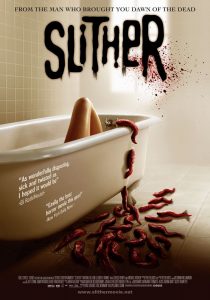
You know Creepshow? Well, obviously you do; I didn’t mean to be insulting. So, here’s my point. Imagine if the meteor that turned Stephen King into a plant instead landed in Hicksburg, The South, USA and got all The Thing on the local residents, and then it and Malcolm Reynolds got into a competition for the same girlfriend. In this circumstance, you would be watching Slither, an excellent space monster movie that is inexplicably failing to sell tickets. I mean, this movie has alien cow-tipping!
More impressively even than that, though, it has that degree of reality that I was just praising in The Hills Have Eyes, where it feels like actual people are in this actual situation, somewhere just down the road and not in my life only through sheer geographic and temporal luck. Which is quite a feat for an alien-in-a-meteor flick. So, good on them.

Also? Someone I’ve had drinks with was in the credits. That’s never not cool.

The Annotated Legends

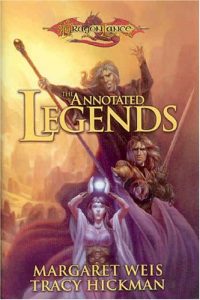
Previously, I claimed that the Dragonlance Chronicles stood head and shoulders above most of what I was reading at that time (other TSR books, Piers Anthony, etc.). I made this claim with perfect honesty and no malice aforethought. Be that as it may, it falls under that thing that we classify as ‘damning with faint praise’.

To my delight, I still find that the Dragonlance Legends are genuinely good in their own right, better than some of the books that lie ahead on my reading list over the next few months. They’re not great, or life-changing, or even wonders of prose. But they tell a story personal enough to satisfy people with no interest in the sci-fi/fantasy genre (y’know, if they were to read it, which they would not) with a scope that is epic enough to satisfy people who would refuse to read anything else. I find that usually the balance is not there. And there’s something about a good story that allows me to forgive the occasional mistakes in execution, which of course existed. I mean, yeah, I like it a lot, but it’s still from TSR.

This is all good news for me, because the annotative part of the book was a lot less well done than in the previous volume. The authors did fine, of course, as one would expect, and the poet guy too. Instead of comments all over from the design team, though, there’s one unidentified annotator covering everything else. And everything else consists of, in this case, pointing bright flashing neon signs at already sufficiently obvious thematic elements, removing any hope of subtlety. That, and pausing at any point where a moment from the past has been referenced in the text to explain exactly in what book and chapter said event first occurred. This “helpful” dissemination of information eventually came to include references to earlier points in the current book. Seriously. So, so aggravating. And I couldn’t even find a name of someone to blame, anywhere in the book.

Inside Man

As part of an excellent evening out in Fort Worth this weekend, I saw Inside Man. (Because my mom has this weird thing where if a movie has alien slugs that mutate people and/or turn them into zombies (or has a name like Slither), for some reason she pre-judges it and assumes she won’t like it. This is an ongoing mystery to me, but I must live with it.) So, bank heist, Denzel, I can dig it.

And it seems like, after enjoying it from start to finish, I’d have quite a lot of good to say. Good acting, good piece-by-piece reveal of the puzzle that was the point of the thing… okay, I’m out of good things, and that’s just it. It was like a cream puff, or light popcorn to pick a rather more trite metaphor. You enjoy it while you’re eating it, but after all, it’s mostly air and hard to describe why it was as good as that once you’re not right in the midst of it. I think it’s the plot was neither unique nor tense enough to carry it up out of the realms of summer movie, and that the collective star charisma power wasn’t either. That summer thing is the single biggest flaw, though. I’m pretty sure if it had come out four months later, I’d have been able to completely overlook the flaw of being overdone. That’s what July is for.

The Hills Have Eyes (2006)

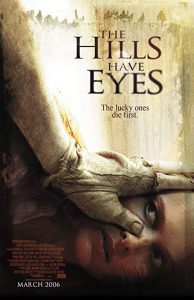
Luckily for me, this weekend was a horror double feature, so I got to see a much better movie too. Also, I watched them in the correct order. I feel like maybe there’s something wrong in my head that causes remakes not to bother me. I mean, in advance. Many of them bother me after the fact, and yet I continue to reserve judgment. Luckily, the person who remade The Hills Have Eyes understood the spirit of the original movie. That is, that sometimes and for no good reason, people accidentally cross some invisible line and step out of the everyday world and directly into hell. They don’t deserve it, and it’s usually upon them before they even realize that anything is wrong. Before they can realize that anything is wrong, because it still looks and sounds and smells just like the regular world. But then, that’s what makes it horrifying.
Of course, after doing all of that so very properly, they had to go and drain a lot of my goodwill by tacking on five minutes’ worth of Godzilla-style morality tale into the climactic third of the movie. Other than that, though, and some over the top orchestration? Really good stuff. Second-best movie of the year so far.

Stay Alive

What we have here is a movie that breaks two rules even before you’ve walked into the theater. 1) It’s a movie based on a video game, but the video game doesn’t exist. (Which is a pity, because we could build it. We have the technology.) 2) The title is instructive rather than descriptive. Well, okay, maybe that’s not actually a rule, but it seems like it should be. Horror movie titles mostly tend to tell you either when you’re going to die or what is going to kill you, or every now and then why you’re going to die. Telling you to Stay Alive is both unprecedented and really quite redundant. Although I suppose Scream was kind of the same way.

Unfortunately, all similarities to Scream that I will be able to include in this review have come and gone. Basically, someone without a talent for tying up stray plots or thinking up particularly scary (or even gruesome) death scenes watched The Ring, and decided that if watching a tape can kill you, then by God, playing a video game can too. So, some gamer geeks play the video game, and then die. (Shocking!) Inevitably, the game was far better than the movie. The problem is, unlike the standard for this formula, I can’t even comfort myself by going back and playing the game.

V for Vendetta

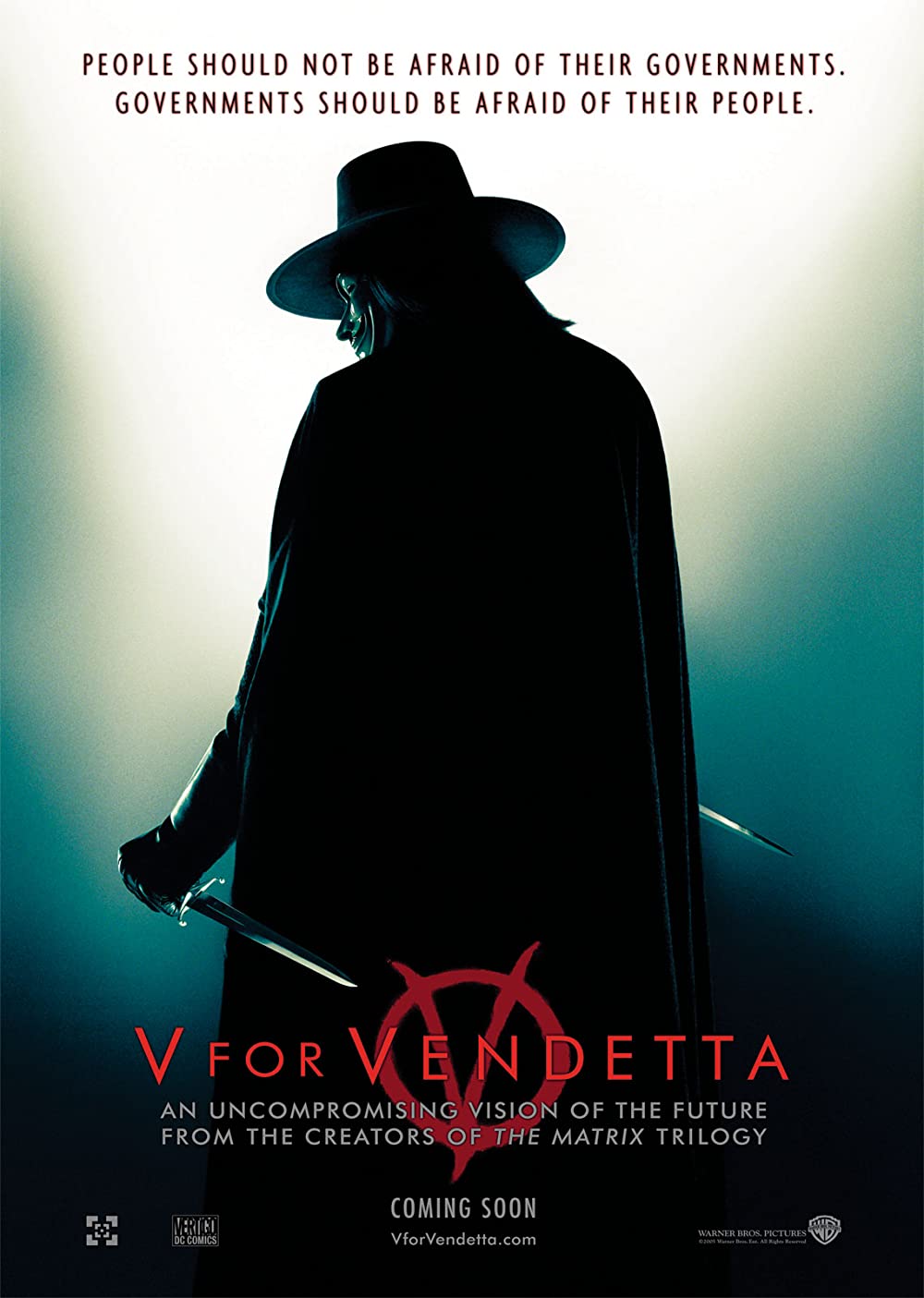
You would think that after liking a movie a whole lot, I would be compelled to get out there and spread the word, right away. And that would be very rational of me. Nevertheless, here I am more than a week after seeing V for Vendetta, and obviously I’m only just getting here. This is a movie I’d have been perfectly happy to see again in the same week, mind you, only my mom has yet to be up to it. Plus, there’s this whole test-studying thing going on, but I’m nearly done there and also I digress.

So there’s this movie, right? In a lot of ways, it’s a straight up revenge movie in the fine tradition of Sudden Impact, Death Wish, or I Spit on Your Grave. At first that bothered me, because I had the idea that it was a meaningful, important film. But then it stopped bothering me when I realized that it could be both. If your revenge is grand enough and the cause is dire enough, you can be the match that sets off hundreds of pounds of gunpowder. Metaphorically speaking, of course. And I’m impressed that in the middle of a movie that I’m willing to compare to Death Wish, there could have been something as moving and true as Valerie’s story, which segment was worth the price of admission all by itself.

It’s misleading, because it looks like a pointed political allegory condemning the way we’re living our lives here in the western world these days. And, okay, maybe it is. But what makes it misleading is that it really isn’t just about right now. It’s about any society that allows its decisions to be made by its fear, and if that seems like a timely topic just now, maybe it just means that more people need to hear the message.

Also? All of the acting was great, and I have no complaints about the scripting. Best movie so far this year, and unless its predictive value is a little stronger than I’m comfortable with, it will be the movie that stands the test of time.

Geist

I finished another game. Only, it wasn’t for the 360 nor was it for the PC. It’s definitely been a while since I’ve wrapped up an old-gen title. So, neat, go me. Geist is a pretty clever game. After getting captured in a rogue corporation’s secret lab, a federal agent finds himself ripped from his body and reprogrammed to inhabit other people as part of a political bid for power. Except, a little ghost girl mucks things up before the mental reprogramming takes hold, and Raimi is left to wander the underground structure incorporeally, inhabiting computers, faucets, rats, or people: whatever is necessary to get him closer to the secret of the lab and a way to prevent it from coming term, and whatever it takes to find and reclaim his own body.

Anytime the game is about the FPS, it is fairly serviceable but on the whole subpar. Anytime the game is about being a ghost, taking over devices to use against the enemies or to frighten them enough that they lose control and can be taken over, though? Pretty darned cool. I’ve definitely never played anything like it, and that’s not something I get to say that often anymore. Wrap it up in a bow with a decent storyline and the novel concept of a ghost girl that isn’t intended to strike dread into my heart, and I’ll have to say that I was pretty happy with it.

Adaptation.

And then, because apparently I was having a busy day, I saw Adaptation. It’s… it’s quite a movie. It’s a movie about the screenwriter’s struggle to write the screenplay adaptation of a book about flowers, which is really a loosely connected set of essays and personal thoughts. His goal is to not impose any Hollywood crap onto his adaptation, but instead remain as true to it as possible. The problem he discovers is that it’s impossible to write a movie without a plot, or themes, or events, or characters that grow and change. And… it’s almost impossible to talk about it in more depth without spoiling things. I shall say now that I really enjoyed it a lot, that I was laughing almost constantly, but that it probably isn’t the kind of movie that I’d want to watch over and over again.
Continue reading