Tag Archives: fantasy

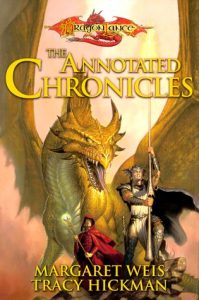
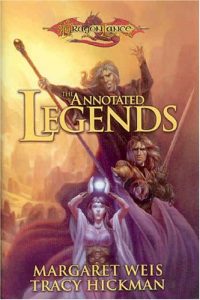
The Annotated Chronicles

When I was a wee lad, I read a ton of those AD&D Dragonlance books, pretty well indiscriminately. There came a time in my late teens when I realized that some, okay most, of the books in that setting were pure crap, and that they didn’t actually have to be suffered through in order to know the entire story. Ultimately, books written by authors who didn’t create the characters I was trying to read about, in which the characters did completely ridiculous things that they probably would never have done anyway and certainly would have mentioned doing… these kinds of books could be ignored. It was a pretty happy day, when I finally worked that out for myself.
The thing is, though, I still think that the Weis and Hickman originals (10 now, plus several short story collections and a handful separate from each other) are generally quite good. Rough around the edges early on, perhaps slightly overflowing with bile towards Wizards of the Coast near the end, but on the whole filled with likeable characters having interesting stories in a setting that I’ve always enjoyed. Naturally, then, I’d want to read about all the little notes and thoughts and stories the authors had about creating the series, once I knew it was available.

In the end, it was pleasant I liked the books well enough to enjoy a reread. There’s quite a bit of interesting material, don’t get me wrong. The problem is that the majority of the material is added by a person I’ve never heard of, probably in marketing, who exists to point out when a throwaway reference to an event or character was eventually written into a book that you-the-consumer ought to go out and buy and read now. Plus, most of Tracy Hickman’s commentary in the first book revolves around explaining exactly how D&D the game went about creating the early situations. Given that it’s the single weakest element of their work, I think that the knowledge is both fairly common by now and also not particularly worth dwelling on.

So, what I got out of it was quite a few good anecdotes from people involved in the project, some poetry analysis from the guy who added the poetical elements (well, obviously), a very few glimpses into the creative process itself (somewhat moreso into the processes, creative and otherwise, of working for a book farm like TSR in those days), and answers to a few questions I’d often wondered about. Not bad as an excuse to read for a few weeks without having to turn my brain on while still being guaranteed reading pleasure out of the process.

Final Fantasy

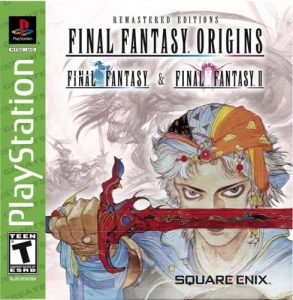
Over the past several months, I’ve played Final Fantasy (with intentions to play the other ones, eventually) as my tiny-TV-in-bed time-waster of choice. The amazing part is that I actually got around to finishing it, just last night. Well, it’s not that amazing. I am a jobless bum with no real prospects, since my marketable skills have been eroded over the past three years of getting paid a king’s ransom not to use them.
…but it’s possible that this is not about that. Um. Where was I? Right, the game. I’ve been reading 8-bit Theater for lo these many years, and once I realized they were re-releasing the game, I got it in my head to play as the characters from the comic. Then, I played it for a while. Then, I didn’t. Then, after I got unenjobbed, I returned to it, and after a quick walkthrough to remind me of the dungeon I was in the middle of, I got back to plugging away at it. It is mindless, but certainly entertaining. Even with cleaned up translations of the spells and people’s speech patterns, it still makes barely a lick of sense. But at the end of the day, the world was saved, so that’s pretty cool.

Also: unlike any other Final Fantasy game (well, that I know of; I admit that my knowledge in this regard is limited), there are no chocobos. This alone makes it the most awesome thing ever for the whole of the minute or two that you’ve spent reading just now, not to mention the minute or ten I’ve spent typing. I mean, just imagine it. A world with no chocobos! It would be fairly breathtaking, but luckily we are blessed by other video games who have never heard of such a beast, on even the quietest winds of rumor. But if we weren’t, man. People would be lining up to play this game over and over again, just to avoid that terrible fate.

Or, maybe it’s just me with the chocobo aversion.

Endless Nights

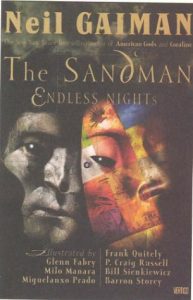
Seven stories, one for each of Neil Gaiman’s Endless siblings. It wouldn’t seem like the best description to drum up interest in the newest (although not so very new) Sandman graphic novel, Endless Nights. At least, it wouldn’t to people who aren’t familiar with the series. If you are, seeing Neil Gaiman’s name attached to this property most likely comprises one of the few value guarantees out there. (I’ll try my damnedest not to gush further, when the next one of these comes up.)
Impressions: Desire’s story made me like it a little, which I’m not sure I ever had before. (Not that this lasted for very long.) Despair, although not an actual tale in the conventional sense, was gut-wrenchingly effective. Destiny is as uninteresting as he ever was, but I don’t think it’s his fault. Ten panels of Delight was enough to break my heart. Gaiman’s smart, to use her as sparingly as he has over all these years.

Finally, there are a couple of spoilers about the main sequence stories included here. That story is a lot more about the journey than the destination, but also these would probably be easier to appreciate by knowing the characters more thoroughly, anyhow.

Season of Mists

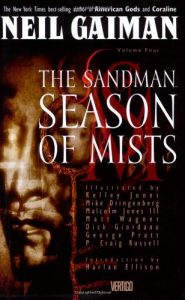
The Sandman, I said. And I meant it, because that is some damn fine literature. I read the series in 1996 or so, right after they’d all been published as graphic novels, and it was a hell of a ride. Observant visitors may notice the domain name, and wonder if it is a coincidence. (It is not. That’d be pretty funny if it were, though.)
What I didn’t ever do was own them. So, over the past few years I’ve been snagging them one at a time as the mood strikes me, and then reading them gradually at whim, not really part of a reading list schedule. The first few books are highly episodic in nature, with introductions to characters and the setting taking up a lot more space than ongoing storylines (although there’s no question that there are a couple of very solid ones). The upshot of this is that I haven’t felt compelled to review any of them yet. But over the past week, I read Season of Mists and it all fell into place. To the point where if I had income, I’d just buy the rest of them right now and take some time. But I do not, so enough about that!

I’m loathe to summarize it, in that I feel I can only damage the pristine beauty, but here goes: The Lord of Dreams attends a meeting with the other members of his Endless family at which he is goaded into righting a long-ago committed wrong, and in the process he receives a most unwelcome gift.

Having read the series before, I can also say that this is where most of the seeds are planted for remaining arc of the story, which could explain my hankering for the remaining volumes just now. The standard high quality of art rounds off the experience, which should be shared by everyone. (Incidentally: I’m caught up now. Yay!)

Return of the Jedi: Infinities

I know it seems like I should be a long way behind, but I’m not. No movies in an Age, one of my books vanished (and has since been replaced, but I’m in the middle of another book right now, which is huge and comfort material, because I wanted to turn my brain off for a bit), I’ve been playing Final Fantasy (and sure, doing well, but the end is days off yet at the minimum). However, I have read several comics lately, and I think I’m willing to review them. So, there’s that.

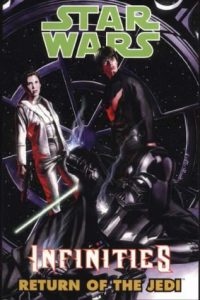
I was out looking for issues of Serenity, and I came across a 4-part Dark Horse offering, Return of the Jedi: Infinities. A minor change during one of the Jabba’s Palace scenes launches an alternate history of Episode VI. I like Star Wars, and I like alternate history, so I went for it.

Here’s the thing: it’s got flashes of unique vision, although a lot of the story seems to involve moving the chess pieces around such that the characters wind up in essentially identical situations, only slightly more bleak about it, for maximum angst. Which isn’t that bad in itself, except that the closing scene of the story is complete cheese, both on paper and in the execution. I didn’t buy it a bit, put the thing down in disgust, and may have been scarred for life if only I wasn’t aware of the awesomeness of other comics that are available these days. (Such as that Serenity I mentioned, once the third issue comes out and I finish the story. Or Sandman.)

The Joiner King

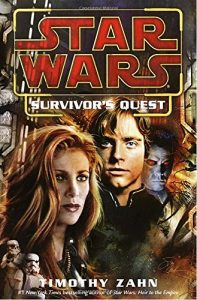
Apparently, there are new Star Wars books set later in the continuity than the New Jedi Order stuff (which has ended, so that partially explains that.) I read it between two weeks and a month ago. I wonder, therefore, if I can remember the title. …and, as it happens, I did so while explaining myself just now. It’s the Dark Nest trilogy, with this particular first book being called The Joiner King.

Even after over a decade of books detailing the rise of the new generation of characters, I’m still only minimally attached to them. It didn’t help my enjoyment of the book that a lot of what happened revolved around pheromones changing peoples’ brain chemistries such that they act in new and unexpected ways. I’m not going to come out and call it a sloppy plot device until I see how it plays out over the next couple of books, because, right, trilogy. Nevertheless, it tainted an otherwise fairly decent story. Standard adventury goodness, some rehashing of the Jedi trying to find their way in a changed galaxy and the government trying to find its way in a new galaxy, but those parts worked despite being rehashed, because the galaxy is more fundamentally changed than it was even after the fall of the Empire.

My favorite part was incidental so far, involving Luke’s discovery of some old recordings of his father and mother in Artoo’s memory banks that the droid keeps trying to prevent him from seeing, for reasons unknown. Because, like I started to say before, I’m mostly still interested in the original characters, 10 years on or not.

In sum: Interesting main plot conceit. Tantalizing side story. Character Template Modifications of Weirdness +2. Decent new characters. (An Ewok with a death mark on his head in multiple systems; cheesy, but it makes me giggle.) It’s not bad Star Wars, but I’d claim that most bad Star Wars has been stamped out these days. Not brilliant Star Wars, either. If you were already going to read it anyway, still do; if you weren’t, I’m not here to change your mind.

Harry Potter and the Half-Blood Prince

Over the past couple of years, I’ve become gradually aware of a thriving internet fandom community for these Harry Potter books, complete with wars over which person should date which and extensive fan fiction. To my very great delight, I’ve completely avoided all that smeg, and this review will be completely uninformed by that section of the internet. It’s all about me, baby! Also, I’m not sure how to discuss it in any real detail without a spoiler cut. So, if you haven’t read the book, or if you haven’t read the series but might someday, stay out from this point on. (Includes spoilers for previous books as well.)
Continue reading

Charlie and the Chocolate Factory

So, I know what you’re thinking. Hey, why not space these things out a little more evenly, instead of cramming in a bunch of updates all at once, and then you can give fair consideration to each thing instead of just finding a block of time and catching up but cheating on real content. I have a few answers. 1) How dare you? This is absolutely real content. Well, okay, but even if it isn’t, I have a good excuse. 2) I actually watched these two movies right in a row, so I had to take extra time to digest them separately instead of getting them all mixed up together. Also, for the book, I handed it to my dad as soon as I finished it, and I wanted to give him a little breathing space prior to a review that I knew he’d read even though it would have been better to wait until he was done. But I’m well over halfway through the Potter book, and two books behind is too much. So, I got off my ass and here I am.

In any case, yeah, after an hour’s break doing the whole summer mall-watching thing (the problem is that the girls in the mall are too young and you feel like a bad person and have to stop watching almost right away; if only there was a place where hot chicks walked by, but they were all at least 20. Maybe they could serve alcohol, too. Comfortable seating, maybe some TVs. Not so much actual shopping, because that’s lame. This is a million dollar idea right here), it was back into the theater for another serving of popcorn literally and metaphorically. Well, perhaps junior mints would make the better metaphor, considering the themes but especially the chocolatey subject matter of the flick in question.

After all that, you’d think I’d have more to say about the movie. Very enjoyable, almost entirely due to Johnny Depp. The writing had good moments too, but so many things that could have been really annoying (particularly the Oompa Loompa songs, to a lesser extent the morality plays that the songs served as microscopes for) were made hilarious by Willy Wonka’s childlike (sometimes spitefully so) enjoyment of them.

Comparison to the Gene Wilder version? Well, I think I liked Depp better on the whole because candy really is a kid’s game, and he nailed that. But there’s a lot to be said for Wilder’s omnisciently knowing Wonka, leading his would-be proteges through a series of tests and only pretending to wide-eyed innocence. It’s a little too musical for me, though.

Olympos

Short Answer: Olympos, Dan Simmons follow-up to Ilium, was a really enjoyable read. I was interested in every character’s story from start to finish and glad to spend a little more time on the world. The bad news (there’s always bad news, isn’t there?) doesn’t outweigh any of this, but it did make for a substantial amount of disappointment.

There were only two things wrong, really, is the saddest part. First, some of the plot elements seemed rushed. I think all of my questions about what had happened to get from today to the future earth were answered, but some aspects, usually the negative ones, seemed tacked onto the story just because they were unanswered questions; after reading the first book, I know he has the ability to write more smoothly than that. So: jarring. Worse, though, none of the characters really changed in any important way. As far as enjoying a world, more to read is more to enjoy. But as far as character and plot development, I honestly would have been just as satisfied with the way Ilium ended, without ever needing to read another word. It is a damned shame that Olympos added almost no depth, after the brilliance of the original.

House of Chains

Sometimes, it is unreasonably hard to keep up, for no particularly good reason. The upshot of all the happenings in my life (and various irrelevancies that also slowed me down, mind you; I’d never claim after being more than a week late that it was exclusively the fault of how busy I am) is that I have far less to say about Erikson’s fourth tale of the Malazan Book of the Fallen, House of Chains, than I feel like I ought to have.

Four books is a long way into a series to feel like one finally has a handle on what’s going on, it’s true. I can completely see why it would put people off. And it’s not like I can explain the first book well enough to talk people into reading it, so far. What I do know is this: despite consistent four-digit page counts and a real struggle to figure out what’s up, these are the only new books in the past several years that have made me want to drag them out and avidly reread them, despite a hip deep to-read pile. (As opposed to, say, the Martin series, which I feel like I should reread to know what’s up, but the task fills me with dread.) Mind you, I won’t be doing so for some months yet, but my point is, I resent that I don’t have time to.

In summation: it’s nice to read a book where the human emotion and the sweeping events are balanced well enough that readers looking for either one as their key ingredient will think this is the right fantasy series for them. Gardens of the Moon is available in America these days, which means (as I probably already said once before when I did book three) people should start reading these now. Lots. (Caveat: Yes, the cover is terrible. But it looks like all the other books are being published with their original covers instead of stock fantasy crap covers, so don’t let that fool you.)