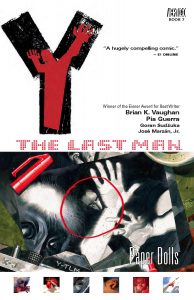
Y: The Last Man – Paper Dolls

So, I notice that my Y reviews are getting shorter over time. I figure this is in part because it grows harder to avoid spoilers as a series grows in length, and in part because Brian K. Vaughan is doing his level best to delay a conclusion to the series. (Well, in point of fact, it already has concluded or will have within just a few weeks. But I mean as of the time of the current collection, Paper Dolls.) I should hasten to point out that this doesn’t bother me. As long as the main sequence story as well as the flashbacks and digressions remain interesting, as they certainly did here in Volume 7, he’s welcome to take all the time he could possibly want.
And anyway, the plot has certainly thickened. Yorick’s quest to find his girlfriend continues to falter in interesting ways, although the quest he shares with Dr. Allison Mann and Agent 355 to bring males back to the world in time to prevent extinction may be coming to a head soon. Along the way, visits with the modern Catholic Church, 355’s past, Ampersand’s history and current whereabouts, and a drop-in by an old enemy serve to keep things popping. And there’s still plenty of time to bring all the outstanding elements to a boil. As has been the case ever since I finished the first collection, I really can’t wait to see where this is headed.

National Treasure: Book of Secrets

Sequelitis provides another glimpse into the depths of the review bucket, in which I find that my voice still sounds basically the same, at least to me. Three years and more gone, I saw National Treasure and was a little embarrassed to have enjoyed it. I mean, I still am. The plot and most of the characters were paper-thin, the acting was fine but not enough to inspire much loyalty, and Disneyfication was clearly present. Despite all that, it also had an undefinable element of fun to it that pretty much resolved all the other issues. And I should give Disney the credit for that too, despite that it hasn’t really happened as often as it used to in their heyday. Anyway, who doesn’t want to watch an Indiana-Jones-style treasure hunt through deadlily implausible traps? No one, that’s who!

Therefore, it was pretty easy to talk myself into willingness to watch National Treasure: Book of Secrets. Goofy traps and treasure: check, not allergic to Nicolas Cage: check, expectation of fun: check. And I got more or less what I expected. A plot that was perhaps two or three sheets of paper in thickness, in which Benjamin Franklin Cage 1) receives word that his great-great-grandfather may have been involved in the assassination of President Lincoln and 2) must therefore find the lost city of Cíbola to clear the family name. And the only way to accomplish that, of course, is to find the Presidential Book of Secrets, in which the current President leaves notes and drawings and possibly poetry for later Presidents to read and learn from, all the way back to George Washington. If none of that makes sense to you, well, that’s not really the point. I’ve already guaranteed goofy traps, and the goofy treasure is pretty well covered just by virtue of Cíbola being the object.

I was disappointed by my perception that, come the end of the movie, Grandpappy Cage’s innocence had not been so much established as declared by fiat. Paper-thin plotting is fine, but you can’t just toss out the paper without finishing it, you know? Other than that, I got exactly what I expected, and what I expected was maybe not good, but it was good enough.

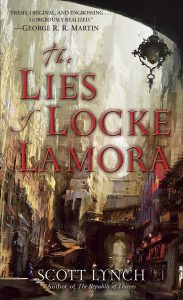
The Lies of Locke Lamora

I know it’s early yet, but this year is treating me excellently for books. I suppose the most important factor is the stack of recommendations I sift through these days, which in many ways has been a factor in the improvements my reading list has seen over the past year and more. But both of today’s book and Cryptonomicon have been more frequently and more widely recommended than the average, which I figure therefore makes a bit more difference than usual. In any event, if I read the best quality of books of my life in 2008, that’ll be awesome, and if I don’t, well, that’s probably fine too. The fact that they’re better is all to the good.
I’m holding my cards pretty close to the chest here, right? There you are, asking hopefully out into the void, “Chris, how did you feel about The Lies of Locke Lamora? If you’re just going to refuse to take a position, what good is any of this?” And I mean, yeah, you’re right, I really do need to learn to take a stand on these things. Anyway, one thing I liked about it was Locke Lamora himself. It’s been kind of a while since I’ve been so attached to a character. He’s like Danny Ocean without the inherent Clooney smugness, or maybe like Vlad Taltos without the deep and potentially unlikeable personality flaws. Another thing I liked was the last hundred or so pages of constant adrenaline. I cannot tell you the last time I was so excited at work. (Plus, the rest of the book was in no way boring, so make no mistake there.) Yet another thing I liked was the inherent lyricism of the title. I mean it, just try to say it out loud without feeling like you’re presenting poetry.

As for things I didn’t like… I’m really having a hard time. The only thing that springs out at me is a couple of times late in the book where expositional history of the city was presented just in time for it to be extremely relevant to the present plot. And even that seems like an unreasonable complaint; if he were a person telling me a story, I would expect him not to think of that kind of thing until he suddenly realized it was about to be relevant and that he hadn’t told me yet. Y’know? So there’s that, and it’s still pretty much all I have.

See, and all this talking about my feelings bullstuff has made me skip actually describing the book, in which Locke Lamora and his criminal gang wander around the grimy fantasy setting city running cons long and short on rich people and on their enemies, never suspecting the far longer and deeper con that they’ve been caught in the middle of. It’s really good stuff, and you should be sure to read it.

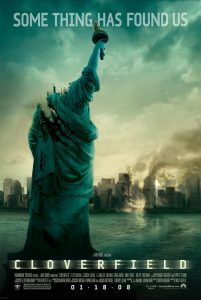
Cloverfield

Then, earlier this week I saw Cloverfield, which will mean that I’m finally caught up. So that’s awesome. As for the awesomeness of the movie… well, it turns out it wasn’t really that kind of movie, and I think that’s what made it work so well. When you see Independence Day or Godzilla, to name a couple of other times New York has been destroyed, the focus of the film is on the people who are out there saving the day, and they’re big and heroic (or occasionally dorky and heroic) and the movie is about them saving the day. Cloverfield, contrariwise, is about us. Any of the regular people who, when New York starts falling apart around them, are basically fucked. And they know they are, but the thing about being human is you still do everything in your power to survive, even when there’s no hope. And sometimes there are still amazing feats and there are still small moments of heroism, and that’s okay because another thing about being human is that every so often you surpass your limits.

I’m going to leave plot out of it, I think, because except for that something is attacking New York and there’s a dude who has a video camera[1], you don’t really need to know anything else and it might take away from the impact. And, okay, there’s the Blair Witch comparison: sure enough, if you have motion-sickness problems, this will probably not be the movie for you. People have to run a lot, which makes for shaky camerawork. But if you can get past that, the rest of the film is equal parts cool / scary things happening amid explosions and gripping human drama, or occasionally melodrama. But let’s be honest, that’s just as real a part of the human experience as the rest of it. Plus it subscribes to the first rule of drive-in cinema: anyone can die, at any moment.[2]

[1] And pretty much everyone who has seen a movie preview somewhere in the past six months knows this much already.
[2] There are just so very many reasons I liked this movie.

Buffy the Vampire Slayer Omnibus, Volume 1

The local friend with whom I’ve been reading graphic novels in tandem got a bit backed up toward the end of the year, to the point where even though I read Cryptonomicon, he was still behind. (I know, right?!) So I took the opportunity to grab something on the comic shelf that I know for a fact he has no interest in, the first Buffy comic collection. I mean, not the Season 8 thing that’s out right now; those are unfortunately unreviewed because I’ve been getting them one at a time and haven’t bothered with the collected version[s] yet. This is instead a series that was running concurrently with the show, back when I was far less comic-inclined. And even then, I doubt I’d have bothered; the purchase was definitely inspired by the Season 8 run. Anyway.

It was… not exactly what I expected, but pretty good! After a brief digression in which Spike saves the world from Cthulhu in the 1930s, the rest of the (out-of-publication, in-story-chronology order) book covers Buffy’s first days as Slayer, from a non-camp version of the movie through her next few months between burning down the gym and moving to Sunnydale. I have fonder memories of the movie that most Buffy fans, apparently, because the only piece of camp I noticed missing was that Paul Reuben’s vampire was actually a lieutenant vampire instead of a giant dork; the rest pretty much reminded me of exactly what I saw on screen, although admittedly it’s been a while.

The remaining stories explain the disappearance of Pike as well as Buffy’s experience with mental health professionals in the wake of her parents first learning about (and ultimately dismissing as fictional, of course) her new duties. Both felt very much like episodes of the series, which gives me hope that I’ll enjoy future volumes. The one odd spot was the presence of Dawn; of course Buffy would remember her presence, and I have no real complaint anyway because she was quite well done and enjoyable, but the story that had Dawn without Buffy required some mental gymnastics to accept. I know she remembers her life too, and that things related to Buffy would have impacted her. Really, it was no worse than any time travel fiction; it was just an odd choice. But, I reiterate, ultimately a good one!

The art, um, well, pretty much everything else I read is superior. But I’m pretty confident there are a large number of things I don’t read that are still worse, so there’s that?

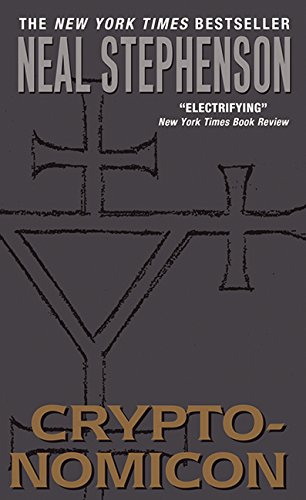
Cryptonomicon

This review is somewhere between days and weeks late; I just haven’t simultaneously felt like writing anything and had time to. I’m not entirely clear on whether that confluence of events has in fact occurred now, but I pretty much have to get over the hump, right? The sad part is, I absolutely adored Cryptonomicon. I mean, I’ve heard of Neal Stephenson and Snow Crash years since, but I never got around to reading it because I could never get into Gibson, and that made me think I wasn’t into cyberpunk. The jury is out on that question, I guess, as to my way of thinking Cryptonomicon doesn’t really qualify as cyberpunk, at least not the way I understand it.
That said, I’m not really sure how to classify it, except to say that the lone Half-Price Books I found that had shelved most of Stephenson’s books under general fiction instead of sci-fi/fantasy was clearly the correct one. It’s a book about cryptography from the early days of World War II up through modern times, where modern works out to mid ’90s, and a book about the unexpected interrelationships between a couple of families during the same span. The viewpoint characters are all either endearing or at least interesting, as are a majority of the remaining characters. The villains of the piece are not so much written ham-handedly as we are given almost no insight into their motivations at all. In a way that’s a complaint, but for the most part the book wasn’t really about bad guys, so it’s not much of one. Along with the story, which is engagingly written in exceptionally good prose, Stephenson spends a lot of time explaining about advanced mathematical concepts (well, not actually advanced, but advanced for the vast teeming majority of people who will read the book), statistics, cryptography, and the internet. While the internet is pretty much my field, most of the remaining topics are not. I therefore feel that I’m sufficiently lay of a person on those other topics to say he does a good job of explaining every point he’s trying to get across in such a way that a layperson can follow it pretty easily. Which is the kind of thing I mean when I say it’s not really cyberpunk. It’s in no way so dense that you have to know a pile of things to even wade through it, and anyway the setting is neither futuristic nor dystopian, even though there are hints of that potential for the future. Since those hints also exist in real life, I don’t think that counts as very cyberpunkish either.

And I continue to have trouble classifying it, despite odds and ends of thumbnail sketching I’ve already done. There’s World War II, of course. Lots of philosophy. A treasure hunt. Future directions that the internet can and probably should take, if it hopes to remain the repository of free information that it is now for most people around the world. More than one love story. A compelling view of undiagnosed mental disorders in people who, through luck and circumstance, end up being more or less functional in the world. A completely incomprehensible (in more than one way) island of people off the coast of Britain. Counter-counter-spying techniques. There’s just a pile of things going on, is what I’m saying. As there should be, with over 1100 paperback pages.

Mostly, though, I’m a little annoyed that nobody insisted I read this sooner, ’cause, wow.

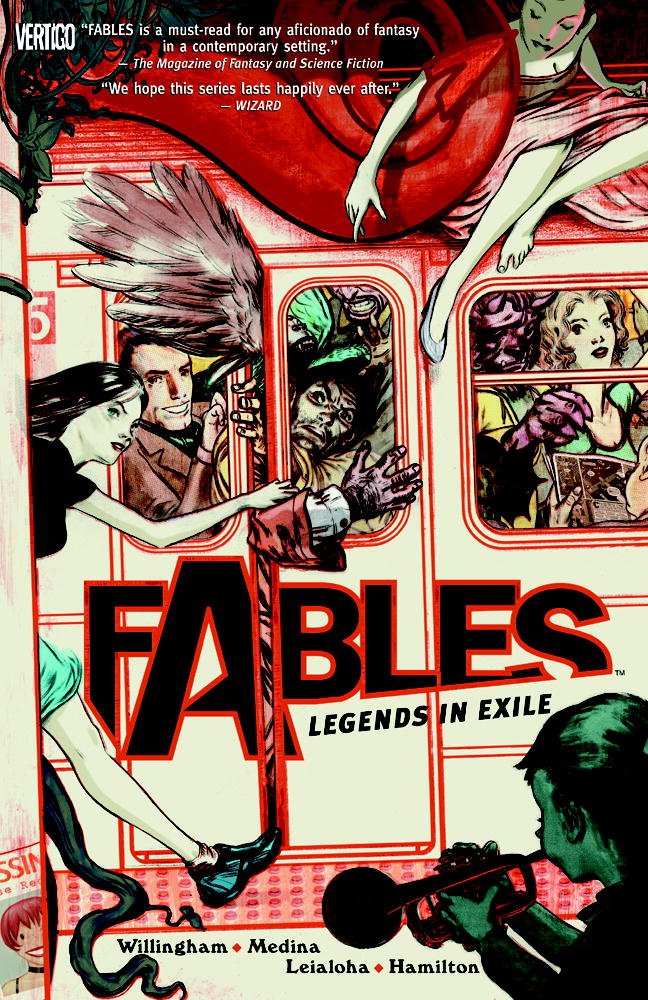
Fables: Legends in Exile

Another new graphic novel series? I can assure you, it’s all true. For, y’know, extremely relative values of new that seem in fact to reflect things published years ago. My initiation into the format only occurred within the last couple of years[1], though, so running behind kind of goes with the territory. The Fables series got on my radar via Amazon recommendations, much as with Dorothy and for that matter Ex Machina. Of my recent new series, this is certainly the one I’m the most satisfied with.

The idea of storybook characters all jumbled together in New York, while obviously cool enough to take the risk on (since I did buy it), seemed potentially fraught with peril. Apparently, they all come from different worlds (which I will choose to call dimensions) that were one after another attacked by an Adversary (who is thusfar shrouded in mystery), and by the time they realized that there was true danger afoot, they had no remaining options but to flee from their worlds to this one, which the Adversary has no apparent interest in. Being the stuff of fables, they’re immortal, so while they all came from different storybook dimensions to start with, they’ve had several hundred years on earth as Legends in Exile to properly mingle and form interrelationships. The upshot of all that background being that the interactions were rich and often funny, with distaste, attraction, working relationships, and even unlikely friendships all laid bare. The book was equal parts Storybook Melrose Place and Fable Noir.

Which raises my other extreme like for the book. The mystery was, if moderately simple, plotted quite well and made good use of the setting. Bigby Wolf[2], the sheriff of Fabletown, is confronted with murder most foul when Jack[3] reports that his girlfriend Rose Red is missing and her apartment covered in blood. Once Deputy Mayor Snow White[4], the victim’s sister, insists on including herself in the investigation and the rich and powerful Bluebeard is fingered as a potential suspect, all the trappings of a Humphrey Bogart noir are in place, and the only thing left to do is lean back and enjoy the ride. There are a lot of possibilities for the series, since the available characters cast such a wide net. I figure, if I get more volumes in the noir vein, well and good, and if not, the creators have already proven they have the chops to do good things with the premise, at least.

[1] Well, except for Sandman, which I’m prepared to call a special case.
[2] That name still gives me the giggles, even now.
[3] of “and the Beanstalk” fame
[4] whose surpassing loveliness is storied… er, whose fabled… Dammit. The point is, she’s a looker with legs that just wouldn’t quit and a smoldering fire in her eyes that told me she’d seen enough of the world to know that it wasn’t as pretty as the stories said it would be.

Dorothy, Volume I

I can no longer recall what prompted me to pick up the first volume of Dorothy, an extremely slow-publishing comic based on the Wizard of Oz that so far doesn’t have enough issues in play to warrant a Volume II. I mean, I’m sure it was related to my Amazon gold box, but as far as what made them think I should get it, I have no guess. Anyway, it has proceeded to sit on my bookshelf for lo these many months, occasionally pulled down but then supplanted by something else. Having finally taken the plunge, I am provisionally hopeful that the sequel will come forth someday. (Of course, even if it does, there will be more yet to come behind it, even slowlier.)

The most obvious thing about the book is the art format. A combination of photography and CGI makes it the most visually distinctive graphic novel I’ve read. I’m sure drawing could have done as good of a job at telling the story, but the images would almost certainly not stick in the same way, and neither would I be bothering to talk about the way it was put together except in broad strokes. So that’s a partial success. And nothing really looked bad, though I will say I’m not so sure about the contrast between the photographs and the standard comic-book lettering. A lot of the inhabitants of Oz had the long and concave faces that aliens have had ever since Communion was published, which struck me as odd. But to counter that, I feel strongly that Toto would have been greatly diminished by being drawn instead of CGIed into the photorealism.

The next most obvious thing about the book is the emo quotient. Modern Dorothy is completely alienated by Kansas’ many charms, and appears to spend most of her time doing drugs or complaining about her aunt and uncle in her diary. But once her tragic tale has been expanded over the course of several flashbacks and she’s fully committed herself to figuring out what’s going on in this bizarre and dangerous Oz place, both the plot and her character settle into a much more pleasing rhythm. For all her disaffected attitude, she’s the kind of tough in the clutch that emo kids believe they could be if only the world would give them the chance, proving right there in the statement of belief that they are not that kind of tough. And maybe being disaffectedly tough is good for her, because the Oz she’s been dropped into reminds me a lot more of the recent Sci-Fi channel movie, Tin Man, than it does of Judy Garland’s technicolor romp down the garden path. Oz is in bad shape: an evil queen in the West holds dominion over the whole land, and the only things that might displace her rule are the Wizard, who is gone to ground where nobody can find him, and prophecies of a girl who will someday come to Oz (specifically to oppose her? it’s not clear yet). Winged monkeys are out and about doing whatever they feel like, without the excuse of some diabolical mission to prompt their presence, if that gives you an idea of how bad things have become. I can dig it.

I Am Legend

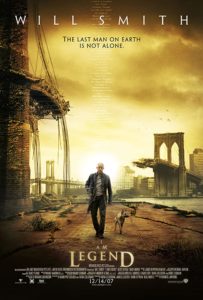
Far back in the mists of Delirium’s history (er, the site, not the girl), I read I Am Legend by Richard Matheson. He fills in one of the final gaps between the old school horror of Poe and Lovecraft and today’s modern horror renaissance birthed by Stephen King, and yet until just a few years ago I’d never heard of him. He is certainly to my liking so far, and it was with a fair amount of excitement that I heard I Am Legend was being made into a movie this Christmas. Plus, I like Will Smith a lot better than Tom Hanks, so it’s nice to see him in the role of last man standing. But I suppose that’s getting ahead of myself?

The premise of the movie is as follows: in late 2008, a viral cancer cure has just completed successful human testing and is poised to flood the market. Cut forward three years later, to where Dr. Robert Neville is a man alone in Manhattan with only his dog and department store mannequins for company. His days are spent hunting for food, watching DVDs, presumedly siphoning gasoline and maintaining his cars and generators off-screen, trying to develop a cure in his underground laboratory, and broadcasting to any person alive who can listen that he can meet them at the harbor at noon, that they are not alone. His nights are spent huddled in darkness behind metal shutters, praying that tonight isn’t the night the things that roam the darkness will find him.

The first two thirds follow Matheson’s book thematically if perhaps not event-for-event. Neville is driven to find some way out of his exile, whether via the message he broadcasts on all frequencies to convince himself that someday a non-infected person will appear, that he isn’t truly alone, or via his attempts to find some kind of cure, to bring back humanity from its rapid decline, huddled in caves by day and ravening through the streets in search of food (or explicitly in search of Neville?) by night. And Smith does a great job of conveying the drive, the despair, and yes, the subtle edge of insanity that is only barely being held off, one day at a time. The final third’s variance from the story would of course be a spoiler to explain from either direction, but suffice it to say that as interesting as Matheson’s conclusion was, the movie provided a much more reasonable ending for a screen. I mean, that sounds obvious, right? My point is, Matheson’s ending works well in a book but would fail horribly in a movie. The media are too different, in this case.

Also: someone involved in the writing of this script appears to have a vendetta against me, as with but a minor change one sequence of events would have been not just as horrible as it was but instead have actively ruined the movie for me. So, that was mean, mysterious writer guys and lady!

Mass Effect

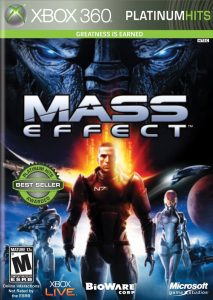
One sign of an extremely good video game is that it would be almost easier to describe it as a movie and leave out the game elements entirely. Well, okay, that may not be true. But if the reason you want to leave out the game elements is that they were so seamless and non-intrusive that you only very occasionally even felt like you were playing something instead of watching it and influencing the outcome, that would be good. It would also be a good sign if your father, no stranger to games even if he’s not the gamer type, were to ask you after watching the last 15 or 20 minutes of the game to clarify that it was in fact a game, and not a movie.

And looking at it like that, Mass Effect is an exceptional game. Short centuries from today, humanity has spread out into the solar system only to discover relics of an extinct race that had observed our solar system 50,000 years ago and left behind technology we were quickly able to make use of. Now the mass effect drives have unlocked the galaxy for rapid exploration. And of course, we are not alone in the discovery, nor are we the first. And so, at a moment when humans are accepted as an important member of the galactic community but are clamoring for a chance to be more involved in the governing and policy-making of that community, opportunity arises in the form of Saren, a Council agent gone rogue who has just unleashed a rain of death upon a human colony and garden world in the form of his AI allies, the Geth. Now, the principle character of the game, Commander Shepard, must marshal diverse resources to hunt down Saren while unraveling the mystery behind his motivations and goals. At the very least, humanity’s position in galactic affairs is at stake for years to come. And it’s always possible that the stakes could be higher still.

Mass Effect is an RPG, in the style of Baldur’s Gate or Knights of the Old Republic, not Final Fantasy. That is, created with conscious effort to be reminiscent of tabletop RPGs, if they were played by one player instead of several. In the general course of events, I can only get so much enjoyment out of those games, because the micromanagement gets in the way of the pure joy of playing. And sure enough, the inventory system is an exercise in frustration, both because of the limit on how many things can be kept and because of the horrible ordering system. This kind of thing results in the games taking ages to complete if I ever do, and any justified sense of accomplishment comes tainted by the lack of consistent gameplay over a short period of time. That is, these games take me months or years to complete because I get bored of all the between-time work I have to do, so I play something else for a while instead.

Except, contrary to expectations, I’m about to proclaim joy instead of hardship. The majority of the game was put together explicitly to minimize these kinds of micromanagements, even if the inventory part failed. Instead of pausing and selecting enemies for combat, everything is played out in real time with a third person movement and cover system reminiscent of Gears of War that simultaneously allows growing character skills to matter while providing direct control over the flow of combat. The dialog system was primarily about setting the tone of your character; not what does she say, which is for the most part scripted (though there certainly are important choices scattered throughout the game), but how does she say it: with an eye toward politics and goodwill? Strictly official to get the job done, irrespective of the opinions in his head? Or with a giant chip on her shoulder, trying to cut through the pointless bureaucracy? And there are more tones, of course. So, my point is this: RPGs in general are only so entertaining to me, but Mass Effect was spectacular. Even the simple brilliance of Portal has such a different focus as to make them non-comparable. If it wasn’t for BioShock, Mass Effect would unquestionably have been my favorite game this year. (I really need to finish BioShock. Like, a lot.)