Even though Power Down had been published for more than a year by the time I read and reviewed Smoke, Smoke, it feels as though the creative team saw my pacing and thematic concerns and leapt to address them. Which is not to say that the latest Ex Machina suddenly revealed all kinds of backstory thusfar unbeknownst even to Mayor Mitchell Hundred about how he acquired his power over all things mechanical. The story has only just reached its midpoint, after all. But with new rumors of the (still potentially alien) forces behind Hundred’s powers, not to mention transdimensional Communism, it’s pretty clear that the writers have finally and explicitly acknowledged there’s a lot more going on here than simple politics with a superheroic twist. And all this fails to even address the continued interior sabotage of Hundred’s political career, or the sinister truth behind New York’s 2003 blackout and its effect on The Great Machine. So, don’t give up just yet!
Ultimate Spider-Man: Hollywood
I’m officially a broken record. All the same, the Ultimate Spider-Man series continues to impress. You really wouldn’t think that another fight with Doctor Octopus would be all that much of a much, but where Hollywood shines is in all the gaps and cracks getting filled in with juicy, delicious plot. And also, in this case, heaping doses of meta-humor. Because, you see, there’s a certain movie about a certain urban superhero, filmed by a certain Sam Raimi and starring a certain Tobey Maguire. And it’s being filmed in Manhattan without the permission of or payments to a certain Peter Parker.[1] As if that (and let us not forget Doc Ock) wasn’t enough, longtime Parker houseguest Gwen Stacy reaches a critical turning point!
[1] I think that said movie, in reality, was one of the inspiring forces behind the Ultimate universe reboot of Marveldom in the first place. Which takes the metaness to a whole new level.
Ultimate X-Men: Cry Wolf
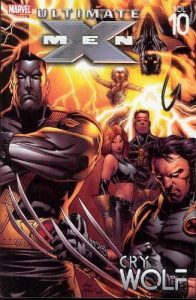
I am really ambivalent about my latest X-Men, Cry Wolf. On the one hand, it was a good story that hung together well and shifted around several of the character elements in new ways, such that I am looking forward to what comes next. Also, unlike the last time he showed up, Gambit got a proper introduction and seemed like a real person. Which is good, because he’s apparently a favorite, but I don’t really know of him from anywhere but these books.
But on the other hand, too many of the events seemed forced for the sake of hitting key plot points from the original run. It’s all good and well for there to be a triangle between Bobby Drake and Kitty Pryde and Rogue, but build it up a little bit, yeah? I’ll care more if it doesn’t seem to be performed by rote. I’m willing to reserve judgment on the Fenris Corporation, as I assume they’ll be relevant later and this wasn’t just a whirlwind but ultimately pointless mention.
(I’m not leaving out the actual plot on purpose, it’s just that it was a hanger for the character interactions and changes, and thus seems less important than the other stuff I talked about.)
Millennium Falcon
I’m not entirely sure why I bother to review Star Wars books at this point, except that it’s expected of me to review everything. It’s just, the context is pretty small, or something. Nonetheless, I’ve typed this much, so I may as well finish up! Millennium Falcon performs a few duties for the Extended Universe. Primarily, it puts together a history of one of the most famous starships in science fiction from before the days when Han Solo owned her (starting with a fairly cheesy Christine-on-the-assembly-line homage and, thankfully, improving from there). Secondarily, it provides a plot hook for a treasure hunt, and then places the Solo family on that hunt as a way to heal some of the still painful wounds brought about by the most recent Sith assault on the galaxy. Lastly, and probably most importantly to the ongoing storylines, it sets up the newest political threat to the Jedi Order, albeit behind the scenes and in throwaway moments.
The book itself was good but not great. I can’t really recommend it as a standalone, and if you weren’t planning to read it in that sense, you probably will regardless of anything I say on the topic. But the secondary characters were all pretty decent, and the stories-within-the-story format reminds me a lot of World War Z.
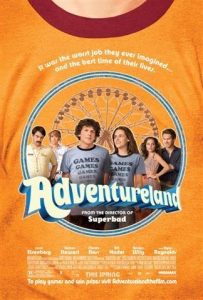
Adventureland
Have you noticed how practically everything that’s going on in Hollywood in the past three or four years isn’t more than a degree of separation from Freaks and Geeks? Which was a short-lived NBC coming of age drama, in case you entirely failed to be aware of it. But then I doubt you’d have noticed this new thing. I’ll tell you who has, though: Terry Gross, that chick from Fresh Air.
The latest such endeavour connected to a failed-but-brilliant decade-old high school show is Adventureland, a nearly perfect fusion of coming of age drama and romantic comedy in which a kid whose failure to be Michael Cera I could only rarely get past loses his chance to explore Europe and find himself in the summer of 1987 between college and grad school, when his father runs into an economic downturn. Instead, he comes home to Pittsburgh and takes a job at the local amusement park. Hijinks as well as self-finding ensue.
There are two things that make the movie better than it has any right to be. The first and more universally applicable is that the characters are so fully realized. Lots of them are annoying as all get out, but even the ones for whom the audience feels little or no sympathy are still completely believable, with nary a caricature to be found. And the main characters are as flawed, sympathetic, and nuanced as you could really ask for. (Particularly Ryan Reynolds’ lothario of a maintenance man, who could easily have been one-dimensional with little to no quality drop-off for the film.) And the second thing is that the female lead hits all of my buttons for The Right Girl.[1] I know a movie can only give a cursory character study at best, but, yeah.
If you’re wondering why I’m leaving the Not Michael Cera guy out of this review? It’s mostly because I don’t want to spoil the experience of him.
[1] Also, I am not alone in this assessment, though this is not the first time Ryan and I have agreed on such things.
Knowing
Nicolas Cage, right? Right?![1] So, he’s an astrophysicist, and his son comes into possession of a sheet of paper full of numbers. Said numbers have been locked in a time capsule for the past fifty years, but they also have predicted every major disaster worldwide over that period. And now that there are only a few numbers left on the list, Nic has a few mysteries to solve. Plus some overacting to perform, including some seriously iffy drunkenness that I actually know he’s capable of in other circumstances. And an out-of-place religious subplot to adhere to.
It’s not that Knowing was actively bad. It had a pretty decent hook, above-average effects, and a whole lot of angel-seeming dudes that all looked like Spike.[2] It’s just that the iffyness sticks out in my head far more, after the fact, than the upsides did. Also, the conclusion was a bizarre departure from the rest of the movie. It’s not really that I can say it contradicted the rest, there were just too many genres for one movie. Someone, somewhere, is far more pretentiously impressed with this movie than they have any real right to be.
[1] I really, really wish I had it in me to stop the review right there, including not having added this footnote.
[2] Said confluence of role and appearance leads to a pop-culture pun which pleases me to no end.
Louisiana Power & Light
I’m in a book club. Well, that’s not entirely accurate. As with all book clubs above a certain mayfly-like age, it has died an inglorious death, somewhere in the middle of the first book.[1] But I can say with pride that I did not contribute to that death. Yay! The book selected was one of those modern fictions in the sense that it was published since the middle of the last century and doesn’t have a particular sub-genre, but not in the sense that it was designed solely to fill me with rage. Which does make it rather a stand-out, and I’m glad someone put me onto it!
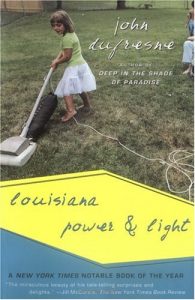
Unfortunately, the lack of genre convention makes it hard for me to describe Louisiana Power & Light without jumping right into spoiler territory. But I can at least minimize, one supposes. In 1970s small-town Louisiana, everyone is in everyone else’s business; in that sense, it reminds me a lot of some of Stephen King’s work, except with thoroughly Southern rather than Yankee sensibilities. The focal point of everyone’s attention for the previous century, though, has been the Fontana family, who all but literally crawled out of the swamp decades ago and have since brought forth a multitude of only male children who have, one by one, been brought down by tragicomic fates; in short, the very stuff of which local legends are made. But now, orphaned Billy Wayne Fontana, being raised by nuns who are grooming him for a life in the seminary, is the only one left.
And, that, ultimately, is what the whole book is about. The town has a collective narration, and that collective is primarily concerned with Billy Wayne’s outcome and offspring. It shifts rapidly between sympathetic and judgmental, ready for the Fontanas to finally stop blighting the locality with misery and failure at every moment and yet gleefully ready to recount hundreds of stories about minor setbacks and major tragedies wrought by his family’s history. And certainly the individual characters are equally concerned with his ultimate fate, though in different and often kinder ways. Untangling the motivations of the collective narrator and sifting fact from wishful thinking is a delight, though I admittedly always groove on untrustworthy narration, and the uniquely Southern digressions are one of the few things I miss in my mostly genre-fiction bookshelves. It’s just, people here really do talk and act like this, even at the very edge of the South, and it always amuses me to see someone capture it. But the very best parts of the book are the moments when Billy Wayne Fontana (and especially his younger son, who I deem not a spoiler since he’s mentioned pre-emptively in the prologue) notices and tries to act upon his own fate, instead of just floating like a ragdoll toward the inevitable thunderous waterfall just around the bend; because when that happens, the narrator is finally at a loss and we get brief glimpses of what the Fontanas really are. Legends have their place, but a dose of truth makes the legend that much sweeter, I figure.
[1] I acknowledge that many book clubs make it as far as the middle of the second book.
Hack/Slash: Friday the 31st
I’m not sure yet, and I’ve been… well, “burned” is a little strong, but I’ve been bitten by this before. Anyway, although I’m not sure yet, it looks like Friday the 31st marks the Hack/Slash series’ evolution from a novelty into something pretty damn cool. The character development that has always been its strongest suit (well, aside from the art) has been supplemented, in the form of people that slasher-slaughtering hottie Cassie Hack and her hulking companion Vlad have saved over the past couple of books, who are now banding together and offering to help out with finding new problems to solve and people to save.[1]
And at some point, I guess the series got picked up by a publisher, because after a normal one-shot (though, also as usual, continuity-influencing) issue co-starring Chucky[2], the book collects the first two storylines / four issues of the monthly Hack/Slash comic run, still apparently ongoing. The first storyline serves as a reintroduction to the characters and premise for people who might not have been aware of the haphazard schedule[3] under which all the one-offs were printed, and the second features a Cthulhian death metal band and more virgins than you can shake a stick at. And since there are at least two more books yet to go, I’m certainly looking forward to what they throw at me next. I mean, in several months when I read volume 4. Not literally next.
[1] And helping out with any unexpected costs or emergencies that might crop up. If the first such emergency and offered assistance is any indicator, I’m going to like the new Scoobies. Both directly and thematically.
[2] Yes, the evil doll.
[3] And probable spotty availability; though in both cases, I am purely speculating here.
Duplicity
I like it when movies are smarter than I expect them to be. Not the ones with paradigm-shifting plot twists in the final act, though I like those too if done well. It’s just, if I know there’s a twist, I can usually work out what it will be. No, I’m more talking about the movies that are created to be twisty and confusing right from the start, and revel in letting me know they know I know, but are confident I won’t figure it out anyway. And I can figure out a lot of those ones too, but not always.
Duplicity straddles the line. I kind of knew what was going on right away, but then I let all the nested switchbacks lull me and therefore dismissed my instinct, because the movie was cleverer than I gave it credit for. And this is exactly what I’m saying I like, so. The deal is, Clive Owen and Julia Roberts are retired spies who have moved into the private sector where they continue to spy, only now they call it corporate espionage. And they’re engaged in a steamy cat-and-mouse game between their respective companies, their respective teams, and (inevitably) themselves. The chemistry is not at all bad, but as the characters themselves acknowledge early and often, the main draw is to find out who will finally come out on top. …professionally, I mean.
It’s an entertaining movie, and I can happily recommend to anyone who likes a) to untangle puzzles or b) things that are fun.
Coraline
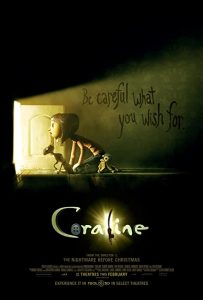
You would think that I’d have already read the long-published book Coraline, by Neil Gaiman. I mean, he’s awesome, right? But by the time I got my hands on a copy, I already knew there’d be a movie coming out, so I’ve put it off. Of course, I kept not seeing the movie, too, which really threw the whole thing out of whack, but Wednesday rendered itself convenient, and now I can at least put the book on my shelf.
Coraline is one of those cautionary fairy tales about the dangers of skipping out on the hard parents who have your best interests, in favor of the easy ones who probably have a catch. Unfortunately, the movie failed this test by making Coraline’s parents all too unlikeable, with only a hint of the tough-but-fair paradigm I think (or at least hope) they were trying to portray. Coraline Jones and those parents have just moved into the ground floor of a rental house out in the country, where they can pursue their dreams of writing gardening books, dreams which are made ridiculously implausible by their shared dislike of dirt. Of course, the larger issue is that they’re stressed out by their lack of success and resultantly treat Coraline more like an unwanted distraction than a beloved daughter. All of which would turn into a distressingly heart-rending After-School Special except that there’s a tiny, walled-over door in the rental house’s parlor which leads to a mirror world, through a glass brightly, if you will, where Coraline’s parents dote on her and are excellent cooks, and every tenant and local are present solely to entertain Coraline in a variety of kid-friendly ways, with just the correct hint of faux-danger. In short, every child’s dream come true, much less any child living under the whiff of neglect, and possibly a bit more than a whiff, that Coraline is.
Here’s the good news. Although the cautionary portion of the tale is undercut by her parents actually being kind of harsh, instead of merely not the picture-perfect givers that self-involved kids inevitably want, the fairy tale sense of mounting dread and rich climactic action are spot on. Plus, y’know, 3D, which never seems to suck. Because, of course Coraline’s button-eyed Other Mother is different from how she initially seems. (I distinctly remember mentioning, y’know, fairy tale.) Additionally, the cat is just delightfully… cattish. I can’t say what comparison there is between book and movie, though I understand from Fresh Air that one character was created entirely for the flick. But that cat has all the right notes that makes me certain Neil wrote him first. He just understands cats like nobody’s business.