A Feast for Crows revisited

Geeze, this took too long. Do you know that by the time I opened the new book I’ve been pushing towards all this time while not reading anything else at all (I even stopped the comics at the end of 1975, this is serious business is all I’m saying), it had been out for a full week? All the discussions are nearly finished! But at least I’m in it now, so that’s pretty cool. Back to the topic at hand, I should note that I remembered almost nothing of this book[1] except that I hadn’t liked it all that well. It wasn’t bad, but it was disappointing for the gap, and that had loomed larger in my mind over the intervening years awaiting another new one.

There’s a lesson in that, and the lesson is this: don’t read long doorstop series until they are completed! I know people say that a lot anyway, but my reasoning is potentially different? At the least, I’m definitely not talking about the fact that the author may suddenly die and you don’t get to find out what happened. It’s more that I have found that books I disliked in the middle of a series read a lot better when there’s no pressure on them to be “oh thank god, the new book”. This isn’t a panacaea by any means, but it’s happened often enough for me to take the hint. I mean, no, I won’t change my habits, but I’ll at least have a better idea of what just happened. The point is this: the parts that bored me were less bring than before, the parts that I liked okay were almost universally really good. But what was A Feast for Crows about, you ask? Memory, I think. Nearly every character in every arc spent some huge portion of their time considering the past and its influence on the present, to a really strong degree. Much moreso than in any other book (excepting Ned’s memories of Robert’s Rebellion and his intertwined personal stakes in the first book, which, well, I suppose there were good reasons to not save that part ’til this volume). Pity it wasn’t a feast for ravens, lest I should have been able to make a pretty cool Norse reference here.

And, that’s all I got.

[1] That review, I should warn you, is shockingly spoiler-laden if you have not read the rest of the series up to it.
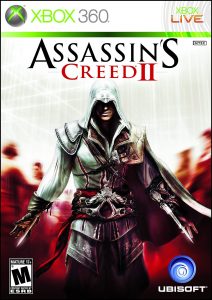
Assassin’s Creed II

Assassins-Creed-2_X360_BXSHT_ESRBI’m always so happy when I finish a game! Though in this case, it was long enough that I may need to take a break (or at least a palate cleanser) before I start anything else serious. So, remember when I hated Assassin’s Creed? But I thought I would still love Assassin’s Creed II after a brief glance at it? So, yeah, that turned out to be true. It is the same as the other game in most important respects, only subtly better every time there’s a comparison to be made. Giant sandbox of a game, this time set in 15th Century Italy, where assassins must battle Templars for control of the hearts and minds of people, and, well, also the future. But that’s okay, because the future is in every bit as much evidence as the past; in fact, you’re not really in the past so much as your near-future guy is going into a cool machine that lets him live the memories of his ancestors (I think?) and learn from them, both skills and information. So while the game is open and sandboxy and actiony and jaw-droppingly beautiful, the plot is science-fictional and always interesting. Plus also, if you for some reason don’t care for the high-level plot, the plot on the street is of this kid first learning about his family’s secrets and then, when things take a wrong turn, setting about fixing everything, over 25 years of life. Good drama!
And if none of that does it for you, you also get to climb really tall buildings, wander around dusty tombs, and sometimes pounce on people from 40 feet above to stab them in the throat. And hang out with Leonardo da Vinci all the time. And learn a lot about regional history[1]. And… y’know, if you’re not persuaded by now, I really don’t know what I could add. Damn fine game, though, and I feel bad for you.

[1] I quickly decided the easiest thing to do would be to assume everything that happens in the past portion of the game is historically accurate. I’m pretty sure it was, anyway, so.

Harry Potter and the Deathly Hallows: Part 2

To the extent that there is a problem with the final Harry Potter movie, it is this: being split in two was a mildly unfortunate design choice. Because… I mean, okay, cool, this was an incredible summer movie, with non-stop action, split occasionally by tension-breaking humor or revelation after revelation, and I have no complaints about it for itself. (And for the record, I have a hard time imagining anyone, newcomer or longtime reader, being disappointed. Sure, the story gets a little weird at the end, but the only problem with the pair of films as adaptation is that it reminds the viewer how much better the fifth and sixth films (well, mainly the fifth) would have been served by an extra hour or two.)

It’s just that, when comparing it with the tight-focused character drama of Part 1, it’s impossible not to notice that what could have been an admittedly far-too-long movie that had just about everything any movie could need is instead two movies, one that interleaves magic and mystery with some of the best ensemble teen acting I’ve seen[1], and the other that interleaves magic and mystery with, y’know, loud summer explosions. I feel bad, because this makes the second movie sound worse as a standalone than it really is and also because it oversimplifies the situation and leaves some things out. But it’s still fundamentally true. Sorry it’s probably too late when you see this to get a double feature, as that’s clearly the way to go.

[1] It doesn’t matter that they were possibly early 20s by then, dammit.[2]
[2] Because, that’s why.

A Storm of Swords revisited

Last time, I said this book maybe didn’t have much of a theme. I’m not sure if that’s true, though it still seems possible. I certainly noticed a lot of music, where there was not so much of any in the previous books, and not any in the next one too, at least to my entirely faulty memory. (On the bright side, it won’t be terribly long until I correct that impression, if needed.) That said, I can’t really attach anything to the fact of this being the most musical book in the series. Well, that’s not entirely true, as there is certainly an air of fiddling while Rome burns to the whole affair.

And that’s the truth of the matter, because there cannot possibly be another book in the series that so casually disposes of so many resources, lest Westeros be well and truly emptied before the Others (the Other? I’m starting to wonder just how accurate Melisandre might be about all this; it’s not like being a terrible person stopped anyone else from winning in this series) make their way into full-blown war against the world of life.

I can’t think of anything to add that wouldn’t be a massive spoiler, but I still cannot get over just how very much I ended up liking… well, probably you know exactly who I mean if you’ve read it, and if not, ask me and I’ll answer.

The Wild and Wonderful Whites of West Virginia

I don’t have a ton to say about The Wild and Wonderful Whites of West Virginia, and actually to some extent because of spoilers, ridiculous as that sounds. Basically, it’s this: if you want to watch a documentary that simultaneously makes you feel a lot better about yourself and a lot worse about humanity than you did before, come no further. Well, except for the guilt when you laugh, which you will many, many times. (Hopefully that part won’t make you feel better.)

Also, it has multiple cameos by Hank Williams III, who sounds a great deal like his grandfather and looks a great deal like… well, like he was born to the wild and wonderful Whites of West Virginia. Which, to be clear, is not a compliment. (Also, spoiler alert, they are not wonderful.)

Transformers: Dark of the Moon

Giant robots? Explosions? Random people yelling “Optimus!” at regular intervals? Yep, it’s a valid live-action Transformers movie. I don’t want to say a lot about it, partly because we both know there’s not a lot to say, and partly because it doesn’t seem right to accidentally give away what threadbare moments of plot exist. But I was definitely impressed by the extent as well as the quality of the extended cast, I dug the new girlfriend (though I wish she’d had more to do besides look pretty and be in danger, but, y’know, Michael Bay), and I was pleasantly surprised by the lack of racist, moronic robots as “comedy relief”.

I can’t decide if it’s worth mentioning that the plot had a massive, glaring flaw or not. (‘Cause, again, Michael Bay. Right?) And despite how (glaring plot flaw aside) it was a largely good popcorn flick, I still don’t think I’ll ever get over the first impression I had, when I was watching an incredible sci-fi movie preview about how the moon landing was a cover-up for our exploration of a crashed alien spacecraft, and I really wanted to see what would happen next. And then what happened next was Transformers 3 instead of something new, gorgeous, and possibly amazing. Dark of the Moon was funny, cool, and chock full of exploding robots, and, okay, it was gorgeous; but it was by no means amazing, much less new.

Priest (2011)

Priest was an odd duck of a movie, because it didn’t really try to be anything. There’s this weird alternate reality, see, where humans and vampires have been openly at war for centuries, and despite that the vampires are far stronger and vastly numerous, somehow the sunlight advantage has allowed humans to progress scientifically and spiritually throughout the years, culminating in some kind of religio-genetic hybrid warriors with cross tattoos on their faces who took the war back to the vampires and pretty much won it.

Only now, maybe the war isn’t really over after all, and the church leadership is in denial and considers anyone who wants to investigate the opposing viewpoint to be anathema. So there’s you a great little theme about corrupt religious power, versus reason, versus true faith, probably versus other possibilities as well, only, yeah, once the premise was settled, they went nowhere with it beyond cartoonish antagonism. And there’s a thick, rich Vietnam metaphor in the priests, who everyone can recognize as having been part of this great war that was a stalemate at best, and they no longer have any place in society now that what they were created for is over, and one of them is beset on all sides, by the law, by his past, by threats to his family, and this is the most Rambo-like character I’ve ever seen, only…. again, they did nothing with him. He almost had a sympathetic superior, but not really. He kind of had people to go rescue to prove the war hadn’t ended, but the scope was too narrow.

So, instead of all this potentially rich territory, there was a lot of CGI kung fu, cool explosions, and implausible usage of motorcycles. Oh, and a giant pile of sequel-bait, except all the possibilities for conflict more compelling than “we’d better kill this next dozen vampires” was already ignored and discarded here in what I hope will not be described by future generations as the first movie.

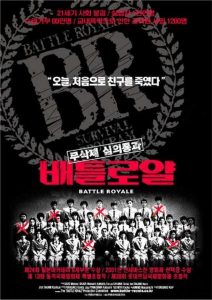
Batoru Rowaiaru

There’s only one problem with Battle Royale. The premise doesn’t make even a lick of sense. The introductory text scroll lays it out like this: Japan is in economic turmoil, with record unemployment and an extremely bad delinquency problem among the youth, apparently because they see what they have to look forward to? So, the adults fearfully pass the BR law, which… here’s where it makes no sense. Apparently, once a year, a randomly selected ninth grade class is sent to an island, given bags full of equipment and random weaponry, and asked to kill each other over the next three days. If there is more than one survivor after 72 hours, everyone left will be killed. Pretty straightforward, right?

And the events portrayed in the final 80% of the movie are chock full of hard decisions and violence and teenage melodrama, in which anyone can die at any moment, just like you’d expect of a pack of inter-murderous ninth graders. So if you can get past the premise, there’s a great deal of that, and I approve! But still, I can’t figure out how it makes any sense. That is to say, how does the “law” help anyone? At one class per year, it’s not going to make a dent in any population concerns. And randomized with such a small incidence, it’s not like the kids have any fear-based incentives to change their ways; if anything, I’d expect them to get a lot more disaffected and violent than before. (Except this particular class didn’t seem to have any idea the annual event existed, which is its own kettle of worms, believe me.)

Still, to be clear, that didn’t stop me from enjoying the other 80%, it just drove me crazy at the start of the movie and again while considering my review. So, y’know, mixed bag.

Silent Hill 2: Restless Dreams

They may eventually get bad, but so far, I cannot say enough good things about the Silent Hill series. And unlike last time, this is one I had… well, okay, I had played it before, but I never finished. Last time was spooky and inexplicably satanic, I think? Whereas Silent Hill 2 (and, I hope, the future entries as well) was deeply psychological, with no hallucinogenic drug rings to be seen. I should first mention that although the 360 claims backward compatibility, there were still some sound bugs, less bad than last time but still present, and also I found out an hour in that you can only have one save game slot, total, or the whole thing falls apart. So that bit of replaying sucked.

But the rest of the time? Awesome stuff. See, there’s this guy James, and he’s come back to Silent Hill where he and his wife Mary had the best vacation of their lives, years before, because Mary has sent him a letter asking that he meet at their “special place”. Only, Mary’s been dead for three years, the town is mostly abandoned and all the roads into it are blocked, and the people he does meet are split between disturbing homicidal creatures, seemingly disturbed humans, an oblivious child, and a doppelganger of his dead wife, a stripper named Maria. Oh, and a hulking, unstoppable brute with a giant sword and a red pyramid-shaped helmet who is bar none the scariest dude I’ve ever seen in a video game.

In the midst of these dangers, James must unravel the mystery of his wife’s summons and the dark history of the town, and in some ways, that’s just the tip of the iceberg. All this amidst the best kind of bump-in-the-night sounds, a moody score, and halfway decent graphics. Even while playing the short prequel with backstory on Maria after I finished the main sequence, there still managed to be a moment when I got an accidental adrenaline jolt from an unexpected bad guy popping up in front of me. I am impressed, it’s been awhile since a game managed that!

Pirates of the Caribbean: On Stranger Tides

I glanced at my reviews of the last couple Pirates movies, and they are a lot more positive than I remember the movies in my head. I wonder which of us is right! My point being, who can say how well you and / or future me can trust this forthcoming review of the fourth poncy Johnny Depp vehicle? Oh well, we’re both here, may as well read it anyway.

So, I have a few disconnected thoughts, and they are presented here in no particular order. On Stranger Tides demonstrates better than I remember the other movies having done that pirates, by and large, are bad people. Not so bad that I wish I hadn’t watched the movie, but I felt slimier than I really wanted to, once or twice. That said, the action set-pieces did a good job of distracting me from that sporadic feeling, much as they distracted me from what were at the time glaring plot holes, most of which I’ve forgotten since, which just goes to show you quite how successful said set-pieces were. The action wasn’t the best in the series or anything, because they’ve always been amazing. But it was absolutely at the same level of quality, minimum.

Two events stood out from the rest, though, and neither are spoilers, so I will tell you them! 1) Impressive use of the Greek literary technique, deus ex mickina. 2) Disturbingly spot-on interpretation of the Japanese dolphin capture / killing bays. (There’s a documentary in the last year or two, if you have no idea what I’m talking about. The descriptions have convinced me I would hate watching it, though.) But anyway, yeah, this was pretty good. Oh, right, some people want an inkling as to the plot, I forget that sometimes. What is is, is they’re looking for the Fountain of Youth.