Ultimate Captain America

It’s funny[1] that I was just talking about the clever storyline from the Marvel universe where they explained how Captain America could have been both frozen in the Arctic Ocean after World War II and also fighting Communists in the 1950s. Because Ultimate Captain America tells an analogous story, albeit without the need to justify the continuity issue the original guys had. Only, you know, quite a bit darker, as Ultimate Cap has always been. I shan’t say any more, because there isn’t a whole lot of story in there. But I definitely liked what there was well enough, and I’m still definitely in the mood for short-form fiction right at the moment.

[1] Although not that surprising, since it was during my review of the character’s recent movie.

Blood Noir

I’ve had a revelation. It may not be a new revelation, but I can only read books in this series so often without my brain turning to cottage cheese, so forgive me if I’ve lost track of the various ones over the years. No, see, my revelation is about the true irritant of this series. It’s that every now and again, if I can manage to scrape enough of the crap off the pages, there’s something like a decent storyline buried in there. I mean, yes, she’s been padding things with the hypersexed “relationship” plots for a long time now, and that squeezes out all but about usually 30 pages of story. But okay, that’s the book she’s writing, and if it wasn’t for the sheer gall of the packaging, I think I’d have gotten bored and moved on a long time ago. So I can accept that for what it is, it’s not the crap I’m referring to.

Let me explain. So, here’s Anita, and her good friend Jason is having a family crisis, and needs help, which is to say, a visit home with a girlfriend so everyone will stop calling him gay (which would not be as bad as all that, except he isn’t, so it’s annoying that nobody believes him). And she agrees to go, except they get caught up in (for once) human politics, and things quickly blow out of proportion, and all of that is before the vampires get involved. And sure, you could write a whole book about that, but our author cannot because she has to leave room for the porn scenes[1] and the random friend and/or stranger (but always at least one stranger, and always at least two people) that Anita will accidentally bind to herself metaphysically[2] in this particular book.

And my point is… well, it’s this. I’m not trying to say that the actual pornography and the implausibly repetitive growth of “power” and were-menagerie via sex don’t grate on my nerves. I’m not saying that the constant mentions of things tightening low in her stomach and what just does or doesn’t do it for this or that person don’t also grate after a while, but if I’m being honest with myself, all long-form authors eventually have turns of phrase that get old. I’m saying, reluctantly, that the kernel of mystery still remaining in most of these books would be enough to keep me going in the series; well, that combined with certain intangible benefits that I get from complaining about them, volume after volume. Except, well, the writing is getting objectively worse, by leaps and bounds. It’s not enough for people that she’s been friends with for a long time to have the same thought processes as she does. Well, no, that’s not true. As written, it’s easily bad enough.

“He looked like he was thinking about ponies. ‘I’m thinking about ponies!’ he suddenly declared inexplicably for no obvious reason besides the fact that all of us have exactly the same brains and the same voices, and I wanted to be sure you noticed that by showing how my thoughts and his words match up, for some reason even less explicably than the last thing that happened earlier in this sentence. And then we talked about how ponies make me angry (if Richard was the person who was talking earlier) or about how much common love we share for ponies (if anyone else was talking earlier) or about how I’m not sure sure that ponies should be involved in my sexual life, but they flat did it for him, so I would keep an open mind (if Nathaniel was talking earlier).”

But now it’s happening with perfect strangers, because writing more than one voice is really, really hard. Unless it says things in French sometimes, I guess. There was a literal, real, I’m not making this up even a little bit moment, wherein over a span of three pages, Anita makes a metaphorical leap about the situation feeling like the Twilight Zone, then a random new chick character makes a similar metaphorical leap about an unrelated situation feeling like the Twilight Zone. (Hold on, I’m nowhere near done yet.) Neither of these situations was in any way actually creepy or inexplicable or even subtly twisted, it was just the way people talk about things outside their experience. So these two different people make the connection to the Twilight Zone from two completely different experiences, and then, in the same three pages I mentioned earlier, Anita thinks to hrself about how she and this other chick are of diametrically opposed types that could never understand each other in any way.

Perhaps I’m being unfair. It could be that when the series ends, we’ll learn that she’s been captured via vampire magnetism for a dozen years or more and that all of these adventures are things her subconscious mind came up with while it had nothing better to do. That would justify almost every ridiculous thing that has happened, you know? Except Auggie the ancient master vampire that everyone has a ton of respect for and also they call him Auggie. Nothing will ever excuse that.

[1] No, seriously, at this point you could only film these books with a porn script, with the expectation that people would need to fast forward through maybe 15 minutes of plot to watch all of the sex in the maybe 70 or 80 minute movie. Seriously.
[2] And by “metaphysically bind to herself ” I mean have a non-puritanically excessive amount of sex with, which by fiat means they are tied together forever, and that is a twisty maze of passages through LKH’s psyche, all alike, if ever I saw such a maze.
Friends with Benefits

I’ve been trying to figure out what makes Friends with Benefits such a good movie, in spite of looking on paper like every other date-friendly romantic comedy on the block. It’s not that they subvert Hollywood clichés, despite an effort in that direction early in the film whose sole benefit was Jason Segel hilarity. It’s not that the lead actors (Justin Timberlake, Mila Kunis) have any especial talent or affability above and beyond the common crowd, either, although both they and the supporting cast are all quite good, and nobody is wasted or overused. It’s… you know what I think it is? It’s consciously adult, in concept, theme, and humor. Mainly the humor, as there are plenty of romance-themed dramas that cover the other issues well enough, but most romantic comedies don’t really try to do anything bigger than a middle-of-the-pack sitcom would do, I suppose because they know they don’t have to. This movie, though, tried to be a real, full-on comedy every bit as hard as it tried to be a romance. I don’t think I knew that hardly ever happens until I saw someone try. Good for them!

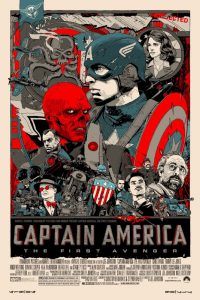
Captain America: The First Avenger

[1] You know what made this movie better than it had any right to be? It was the Captain America they wrote into it. I know that sounds painfully trite, but stay with me for a second here. I’ve read the ultra-patriotic Captain America of the 1950s[2], the reflective, uncertain, self-consciously apolitical Captain of the 1970s, and the hyper-capable, overly superior (in thought, word, and deed) Ultimate Captain of this past decade. There are things to like and dislike about each of them, but none of them made it into the movie. This guy, from his abortive attempts to enlist during World War II as an asthmatic, archetypal 98-pound weakling through his confrontation with the chillingly and somehow never cartoonishly villainous Red Skull, and at every moment in between, is just an all around average joe who happens to be the nicest guy you’d ever want to meet. That he’s brave, intelligent, and acquires super-powers is almost beside the point. The heroism, explosions, and cool stunts were certainly worthwhile too, don’t get me wrong. But mainly, it’s how damn likable Steve Rogers is that carried me through the movie. Everyone has shades of grey these days, and they should, because that’s the real world. But it’s refreshing to know that sometimes the good guy really can just be, y’know, the best guy.
It’s not fair to compare him with the Captain America who was frozen in the Arctic Circle for a variable number of decades since World War II and wakes up with his whole life left behind him in the blink of an eye. Of course that guy is going to have a harder time of it than the one who asked for a chance to fight and was given everything. But it really is going to be hard to go back to angsty and/or superior Cap after liking this one so very, very much.

[1] Just to get it out of the way, my intent was not to see the movie in 3D, but events conspired against me. It’s, y’know, fine?
[2] This is true from a certain point of view, at least.

The Walking Dead: No Way Out

Here’s the thing. For the last few books, Kirkman has been losing me. First there was a big mislead about the possibility of resolving the zombie threat, and then he started exploring themes he’s already explored before. Yes, he finds ways to invert them and make them new, I admit that, but if he’s already holding mirrors up to his thematic territory, I can’t help but notice that the plotting has dragged for a long time. And as the herd comprising his original characters has thinned and new characters join up, only to be lost to the rightfully dangerous environment themselves, I’m having an ever harder time even recognizing the characters; and that only makes it harder to care about them. But back to my main complaint, about the dragging plot: for instance, in No Way Out, the characters find themselves threatened on all sides by a) rampaging evil humans looking to take advantage b) a horde of zombies c) weather-based food shortages, I guess?, just when things were starting to feel safe and human again. Whichever one you pick, we’ve been here before. A few people die, the threat passes and/or the survivors pick up and move on, and soon we’ll be back here again.

And yet, every damn book there’s either a huge cliffhanger or else some kind of plot- or character-based epiphany that makes me think he’s finally gotten the story to turn a corner and something new is on the horizon, or in this case both, and either way, I have to at least find out what happens next to decide if the series is worth it anymore. You’d think I would learn.

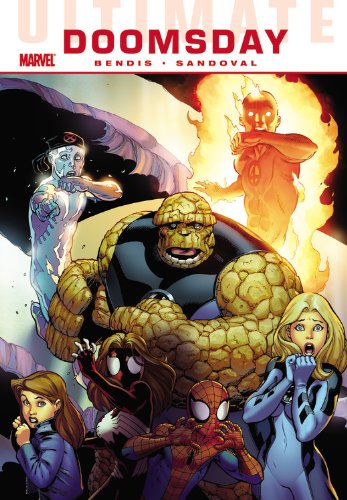
Ultimate Doomsday

51iy4c9sUqLSomething like a year ago (in graphic novel time; longer ago in single issue time, you understand, but I bet that the ratios work out about the same), the Ultimate universe came to a crashing halt or I suppose more appropriately was swept away on a tidal wave. I may have mentioned it. And then new stories began to trickle in, from Spider-Man, the Ultimates, and their black ops cousins the Avengers. Notably missing were the Fantastic Four and the X-Men, though in the latter case the fact of worldwide mutant hatred due to their ongoing terrorism made sense of that part at least. So, in the meantime, Amazon had this link to a book called Enemy that was meant to be coming out last fall, and it was the next big event in the Ultimate universe. I pre-ordered it, as you do, and then watched in dismay as it was pushed back further and further and further still.

Then, sometime in May or June while I was waist-deep in both ice and fire, suddenly I get a shipping date. Only, now the book is selling for $40 list under a new name, even though my cost never changed from $13 or so. So that was weird. Then Doomsday arrived, and it turns out to be a collection of three separate never-published graphic novels making up the entire story of which Enemy was to be the first third. I appreciate your commitment to low prices on pre-orders, amazon.com! And now, months after that, I have finally come up for air long enough to read something new. Which is nice.

So, anyway, the Fantastic Four are back, more or less, although they’re by no means the only people around. This is one of those stories like the Ultimatum or the big Galactus trilogy a number of years earlier where just about everyone gets a piece of the action. The story starts with a bang, almost moreso literally than metaphorically, when many different heroes and also, somewhat inexplicably, the occasionally nefarious Roxxon corporation are all targeted for destruction on the same day at the same time, with varying degrees of success. Then the survivors must come together to solve the mystery of who is out to get them and what to do about it.

I shan’t say more, except to allow as how I’m really suspicious of the outcome being the real end of the story. We’ll see, though! Eventually.

A Dance with Dragons

So, yeah. That was a long time coming. And boy do the internets ever reflect it. But anyway, I have come to a realization (that I may have already mentioned recently? I’m not sure) about myself and long-form storytelling, and also about other people and long-form storytelling. It is this: if you make a checklist of what details you expect to be addressed or wrapped up in a book of a series, you are doomed to disappointment. Because unless you happen to be the equivalent of that one chimp out of the infinite typewriter owners out there, your brain and the author’s are not telling the same story. This is not to say that there aren’t plenty of valid criticisms of the form and especially of specific presentations of it, but “the story is too slow” or “it has gone off the rails” are somewhere between barely valid and not valid at all. I know this is true for me, at the least, because I can find that I am disappointed a lot less in books that I thought had gone wrong the first time through when I was measuring from my expectations than I am upon a reread.

So, I have a new measurement now, as of A Dance with Dragons. (Technically, as of my reread of A Feast for Crows, the first book in this series that I had been disappointed in. But this is when I got to actually use the measurement, so you see.) In step one, I turn my brain off, watch for foreshadowing and decide what I think is cool, sure, but like I said to start with: no checklist. In step two, I only concern myself with when viewpoint characters bore me, as opposed to how cool or horrible or off-rails they are being. By that measure, I liked this book quite a bit. There’s a character that never did a lot for me, another that I have never liked and probably will never like, even though towards the end he was at least doing interesting things maybe, and a character I have historically liked that I did not care for until her final chapter this time around. Everyone else was entertaining all along, whether I was cheering for them, yelling at them, laughing, or just along for the ride. And that’s my real point, it is a ride, and it’s not my ride, so as long as I’m still enjoying the ride itself, why would I possibly complain about choice of routes or the occasional pause to slow down and look at the scenery? That gets saved for when my ass is starting to hurt and the roadsigns indicate we’re on the outskirts of Gary, Indiana.

As for the plot itself, well, you didn’t actually think I was going to talk about it, did you? Or mention the climactic event of the previous book just as though nobody could be running behind? (Not that I’m bitter about a massive spoiler I read yesterday for an unrelated series or anything.) But I will say that the title is a good stand-in for half the book, and the same kind of metaphorical dance without dragons covers the rest of it. There is still a part of me that will be unsurprised if the series ends with everyone dead and the planet encased in a permanent block of ice. And I cannot say I will find that outcome unsatisfying, in a “Decline and Fall of the…” kind of way, as long as the ride to get there maintains its general B to B+ quality. One piece of ambivalence I should report, though, is that Martin has a problem with the pacing of the ends of his books, or at least this one. ‘Cause you know how in a lot of long series[1], the last hundred pages or so turn into a downhill race where you couldn’t stop if you wanted to? Martin has a thing (sometimes close to the end, sometimes far enough a way from it that you think maybe he pulled a fast one and it’s not really true) where he likes to build a brick wall across that particular part of the road. It’s effective as hell whenever it happens, but man does it make me want to stop reading for a while. And since I really like that mad downhill rush, it’s a little off-putting. Whether the trade-off is fair is left as an exercise to the reader, I suppose.

[1] Jordan was a master at this.

The Social Network

First thing: I wonder if I am using this tag wrong. The Social Network was clearly not a documentary, but “drama” by itself implies fiction. Is there a classification for modern drama based on true events? ….that can fit into the tag of “$adjective drama”, I mean.

Anyway, though, I understand all the critical buzz this movie got last year. The script by Sorkin wasn’t as non-stop poppy as some of his previous efforts, but since the subject matter was less breezy than The American President and less smug than A Few Good Men, it definitely worked being a little heavier. And the acting, well, I can’t say for sure whether Jesse Eisenberg is kind of brilliant, but it doesn’t seem like it would be easy to make me dislike you and feel bad for you at the same time, no matter how good of a script you were handed. Anyway, though, not a lot to say about the plot of the movie, but if you were ever interested in the genesis of Facebook, this is where’d you’d go. And if you were not interested, it’s a good enough movie on its own merits that unless you are a shut-in who hates the internet and everything it stands for (like my great-uncle!), you’d probably like it anyway. It has so many good things, like genuine moral dilemmas, smart plot parallels, people who maybe actually learn from their mistakes, and like I already said, a lot of good acting. Well, I didn’t say that, but don’t let my singling-out of Eisenberg be seen to cast aspersions on anyone else. Good stuff, yo.

F.E.A.R. 2: Project Origin

I’ve played a lot of games this summer, you guys! And I’m seemingly not done yet, so, pretty cool. Anyway, this is a sequel to a game from back before the console revolution, F.E.A.R. The second entry, Project Origin covers the immediate aftermath of original game, from a new perspective and with some small degree of overlap. Basically, where the first game explored the mystery of how the creepy little girl was involved with Paxton Fettel and his army of psychically-controlled Replicant soldiers, the second game goes deeper into both the future and the past of the corporation that caused all of this to be as well as into the story of Alma herself, creepier than ever but no longer quite so little.

Of course, not much of the game by percentage follows that story, and what is revealed is on the whole unsatisfying by itself: this game has “middle of a trilogy” written all over it. And honestly I don’t think the enemy AI was as challenging as last time, though whether that says more about the game or me is impossible to determine. Luckily, it was still eminently playable and full of moody scares, which is really the number one reason I was here in the first place. At least as scary as I remember the first one being? So between that and the speed with which I breezed through it, I regret nothing and in fact still want to play the third (and final?) game in the series.

I should also admit that even though the whole game felt like a trap, the unavoidability of its execution reminded me quite a bit of a certain underwater allegory I played a few years ago, and I found the end of the game to be extremely satisfying. (The admission is due to my theory that most people won’t have cared for the ending, you see.)

Bad Teacher

It is hard to think about writing when you are reading all the time! Well, when you are reading with a purpose, and there are discussions to be had, and all that. But still, I’m two reviews behind right now, and things can only get worse from here, so it’s time to suck it up and not turn the page for the next ten minutes or so. (I mean, some of these reviews take a long time to write, don’t get me wrong, but the rewriting is never more than five minutes, and this one just doesn’t have the feel of difficulty or for that matter length, is all I’m saying.)

So anyway, I saw Bad Teacher last week. (I’ve been really good about the summer action epics, but falling a little behind on the comedies I guess? Anyway, only three movies I need to see right now, so it’s all good in any event.) First of all, it made me laugh, so that’s your answer to that question. Second of all, I’m pretty sure it didn’t have the troubling sexism in Hollywood’s comedy genre at large, making this a surprisingly good year if you’re into that kind of thing.[1] Third of all, you should avoid this movie if you have a problem with bad people, because the title is not lying. Cameron Diaz is shallow in the worst way, which is not enough I suppose to make for a bad person by itself, but when you watch the lengths to which she is willing to stoop in order to achieve her personal MacGuffin[2] while avoiding any amount of accountability toward the children she’s teaching, well… I suppose the part where we expect teachers to be better people than the common stripe is working against her, but be that as it may; she really, really is a bad teacher. Yet somehow, I ended up rooting for her. Script or charisma? Beats me! (Also, Jason Segel is awesome, as always.)

[1] Because, Bridesmaids, right? And I know, I know, how do two datapoints make for a good year? By comparing to the past, yo.
[2] Breast implants. Seriously.