Tag Archives: fantasy

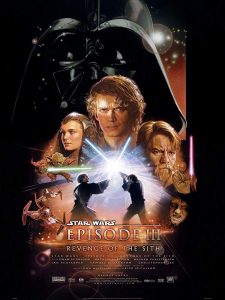
Star Wars: Episode III – Revenge of the Sith

I am jumbled, and I wonder if I oughtn’t wait until another viewing. But screw it, first impressions are important, on top of which it’s one of my few first shot times, so I’ll take it. And then cheat by first talking atmosphere. I know I go on about the Alamo Drafthouse mystique, but it was in fine enough fettle tonight to run down. Someone went to the effort of editing up the Cartoon Network Clone Wars endeavour down to its essential “here’s the bits that are related to the movie” bones, and then showed it, interspersed with all kinds of Star Wars filmed coolness and uncoolness, from Troops to Anakin Dynamite to a Muppet Show appearance to the Turkish Star Wars rip-off to the much maligned (and rightly so!) 1978 Christmas special. A very pleasant way to pass a couple of hours while waiting for the last big event movie of quite a while, and I commend them once more.
Then, there’s the movie itself. The scroll cleared the screen just in time to drop into an unrelenting action spectacle with all the right touches of humor and explosions alike. And then… well, things got a little wooden. Never bad, but never quite great. Motivations that were a hair off, decisions that very nearly made sense, enemies that were inches south of believable. Nothing enough to make me stop enjoying myself, but so much that came close to working perfectly that I had to be disappointed when it didn’t. The real irony I think is that it was the longest Star Wars movie, yet really needed another ten or twenty minutes of scenes expanded in just the right ways to achieve the brilliance it was in sight of.

That said, there’s a moment that I choose not to ruin[1] in the main portion of this review past which everything comes together again. It’s still never quite as perfect as that opening sequence, but the complaints from that moment on are nits to be picked, not faults to regret. It’s a hell of a thing, to know essentially everything that’s going to happen (not due to spoilers but to the logical consequence of having already seen the galaxy twenty years down the road from that moment) and still be kept on the edge of my seat, wondering what will happen next, if there’s a way out of it, how it came to this. For that, I’ll offer Lucas my thanks and my kudos. When he got to the important part, he made it work.

If you watched the other two movies, like or dislike, go ahead and see this one, at least the once. Even with the mis-steps, it’s worth it.
Continue reading

The Cestus Deception

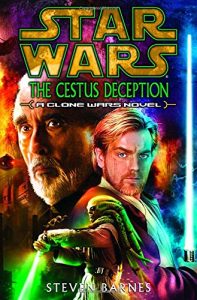
A week or so ago, I got caught up in Star Wars excitement despite myself, and snagged a Clone Wars novel at Half-Price Books, the second one I’ve read now. The whole idea is the thing where they can do some guided merchandising, build a bit of storyline between the two movies, and just generally synergize. Still, though, I’m a sucker for that kind of thing. (See also how I’m writing this from a line I’ll be sitting in for the next ten or eleven hours in order to see that one movie at the back half of the two I previously referenced.)
In any case, I finished The Cestus Deception a couple of nights ago, and have now found time to leave general impressions. They are largely the same as the impressions I had of Shatterpoint last year. You’ve got your exciting lightsaber duels, only with Obi-Wan instead of Mace Windu (also a tentacly-headed Jedi named Kit Fisto), an army of Force-sensitive bio-droids being manufactured to kill Jedi, and also lots of clone troopers. They are busily being humanized even as the Jedi are slowly being crushed by the pressures of the War. You have to admire Palpatine’s strategy; he’s put them in this impossible position where if they sit back and do nothing, everyone hates them, but if they step up and do what needs to be done in order to win the war (like force the cessation of Jedi-killing droid manufacture if it can be handled diplomatically, and I think we all know that it cannot), they get their hands dirty and nobody trusts them anymore. Much like Shatterpoint, this is more of the dirty hands storyline. I really hope the movie tonight touches on some of this theme before things start going bad, so that it’s understandable where the popular lack of support came from. If not, well, at least there are lots of people with the talent to make it clear in non-movie places, and I can just take the whole thing as one piece. Frankly, I’d rather be able to rely on the movies for everything, though.

Sethra Lavode

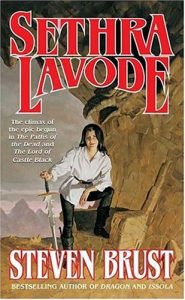
One of the problems with having a booklog is all the books that you had read just before you started chronicling all the books you read, that probably were the very books that led you to say, ‘Hey, there are books out there that people deserve to know about!’, and thus inspired you to get started on such a singularly self-involved project as a booklog. (I know what you’re thinking. ‘You read crap books all the time, nearly constantly in fact, and how dare you pretend that this is something people deserve to know about?’ Well, I do think that very thing, because I have to warn people of the bad stuff too. It’s just that serving as an object lesson wasn’t sufficient impetus, in the way that flagging down the really good books has been.)
My point, which I assure you I have one of, is this. I’ve finished the last published Dragaera book, The Enchantress of Dzur Mountain (or as the publisher insisted it be renamed, Sethra Lavode). The author has explored the recent history of this world extensively: in nine first-person books chronicling the rise to prominence, subsequent fall, and so much more of Vlad Taltos, an assassin and businessman in a world where he is a second- or possibly third-class citizen; in a single book that I haven’t yet read about Vlad’s people; and in five books written in the Alexandre Dumas historical style (and in fact directly ripped off from the Three Musketeers and later books, though gradually less directly over the course of the story) about the people in whose world Vlad moves. Sethra Lavode is the final novel of the latter group.

As with the Vlad novels, the voice of the author is the most distinguishing characteristic. In this case, the voice is that of one Sir Paarfi of Roundwood, a historian of no small renown in his own time, who has been at work on the historical cycle for a matter of some three to five centuries. (Dragaerans are a long-lived people.) As with all of the previous novels, I knew essentially how the story must end, and was so able to immerse myself completely in the telling of it. I found that Paarfi has become a much more settled and sedate author, even as his personal life has gotten ever more glamorous and, dare I say, wild. Honestly, I’m not sure I approve. The Paarfi who wrote The Phoenix Guards would never have followed the story so strictly or with so few of the divergences that made him famous in the first place. Still a very good book, just not quite up to the standards I could wish for it to hold.

As for people who have not read any of these books, or few enough of them that my review doesn’t make sense: Sorry about that, and the best thing for you to do is read them, and then see if you agree. I promise, you really do want to.

Magic Casement

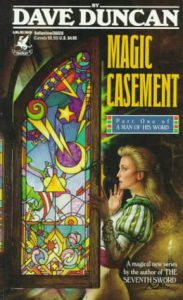
This time, light and fluffy fantasy by Dave Duncan, at the recommendation of Mike Kozlowski. Without any recommendation but that the author was good, I started with the first series I happened to find at Half Price Books, A Man of his Word. The opening volume, Magic Casement, follows the parallel adventures of Princess Inosolan as she is shipped away from her small kingdom to spend a year in Society learning to be a noble lady, and of Rap, her childhood companion and resident stableboy, as he comes to grip with magical powers he has only just discovered he has.
There’s a lot of good and very little bad here, so far: An engrossing system of magic with lots yet to be revealed. An Eddings-esque number of nationalities and nationalistic quirks (I haven’t decided if the nationalities are as internally homogenous as Eddings’ are, due to not enough information). A system of religion that may or may not be tied directly to the magic in some unrevealed way. A fun quest rife with danger. (Okay, that makes no sense. Plenty of danger, but fun to read about rather than oppressive.) Interesting companions and foes. A rollicking good cliffhanger.

My only real complaint is that the main character is unforgivably dumb at a couple of key moments. I blame the author for poor information distribution. He provides info to the reader via the character’s internal thoughts, at a time when the info is useful to solving a puzzle. And then has the character not solve it for a while thereafter. If it had been provided early on, before the character had the puzzle to solve, then either the reader would notice when the character did and nod sagely, or notice early on and have a sense of accomplishment. As it was, though, the info solved the puzzle to my satisfaction and made me want to shake the character for being so blind. (I’m making it sound worse than it was, really.)

I look forward to reading the rest of the series. It’s nice to have the occasional non-doorstop fantasy to look forward too, and nicer yet to have it not obviously be trash, as with all the Buffy or Resident Evil or Shatner books that I read.

Ilium

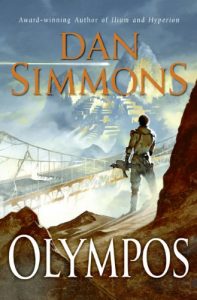
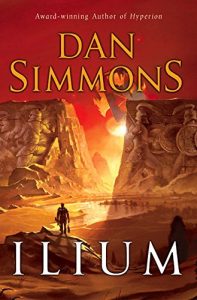
The problems with having no real standards are two-fold. 1) When you find something that’s really cool and worthwhile, people who let themselves be guided by such factors as quality or entertainingness will naturally suspect you of being up to your old tricks, and 2) you’ll find yourself being given to greater flights of hyperbole as a natural result of the first thing. Hyperbole is absolutely, positively, and I mean this 1000 percent, never effective. So, naturally, both of these are concerns of mine after having finished Dan Simmon’s Ilium.

Okay, the easy stuff. I came into it knowing it was about the Iliad, and basically not knowing any more than that. This is okay, because both the title and the first couple of paragraphs make the same point. A couple of more things that I didn’t know coming in are that it’s also about Shakespeare, and H.G. Wells, and Proust (and a little bit, I claim, about Arthur Conan Doyle), and sentient robots living in the shadow of Jupiter, and pampered people living in an idyllic golden age on Earth. It’s about knowledge, and whether knowledge has value, and whether knowledge has intrinsic value. Most of all, it is about what the very best in science fiction is always about, what it means to be human.

Ah, you ask, but is it any good? Well, obviously you’re not really asking that, because a) you don’t trust me to know anyway, b) I already basically said it’s good, and c) how can that mix of plot, character and theme not be good? I mean, really, did you even read the second paragraph at all? Seriously, though. It’s great. When I finished it, I would not have hated the author if it had been almost exactly the same[1] and been one book instead of the first of two. At the same time, if the second book were out yet, I would go buy it and be reading it now, in express violation of my policy of not reading / reviewing books consecutively. I kind of resent having to wait until early July, as Amazon implies.

Thinking it over, I can’t even say that I miss the lack of frozen zombies. Thinking it over a little bit further, there’s a case to be made that it has the potential for frozen zombies after all, and that makes me feel better about myself. At the least, I can’t say I needed them in volume one, and that’s still saying a lot.

Incidentally: Can someone who has read this book contact me external to the site? I have a question that falls outside the scope of the review, about faxing and whether there was an authorial misstep or hints for the second book. And, can everyone who hasn’t read this book go ahead and read it? The world will be a better place. I actually kind of want to read the Iliad again now. No, really.

[1] Because, being two books, there are elements of the narrative barely alluded to that are sure to come into full relief in the second book. If he’d covered everything, then a second book would be silly.

The Amber Spyglass

All things considered, I’d rather live in the parallel universe where Philip Pullman wrote a better conclusion to his fairly nifty parallel universe trilogy, His Dark Materials.

I suppose I’m obligated to say more.

So, despite my continued enjoyment of the main characters and their struggles, most of what’s left went way, way downhill at the end. The Church badness got more cartoonish than ever. The climactic battle was barely a battle and in no way climactic (although it did have a satisfying Cost associated with it). Dangers to the characters were consistently resolved in deus ex machina ways, which is incredibly ironic in this particular plot. Several interesting things happened, but seemed to be only tenuously related to the previous two books of storyline. And even now, I have no clear idea who He is, nor what His Dark Materials are, or whether I should be concerned about them, happy, or something else entirely.

Could some of this be my problem and not the author’s? Sure, I suppose it could be. But I like my odds. I’m inclined to say that two books were squashed into one to achieve trilogy status. Which I suppose is a nice change from one book being extended to three, but ultimately, the reader suffers either way. One book in one book’s worth of pages, please.

I did like the titular amber spyglass and in fact the entire storyline associated with it. Except for the part at the end, where Lyra is supposed to be tempted like Eve was. I think I can cobble together a pretty good explanation of the temptation, the choice, the outcome, and all that, but I disapprove of the fact that it didn’t play out the way it was prophesied to earlier in the book, because it left me thinking that the point of the whole series had never actually occurred. There I was, waiting for event X, and event Y happens instead, the book ends, and I have to spend the next day or so working out that, no, that really was what he meant, he just forgot to write the part where it was in any way related to the characters I had been promised would be involved.

Looking up, I feel like I ought to include spoiler protection, except that if it never happened, how can it be a spoiler? And also except for the fact that the above is a jumbled, barely literate mish-mash of words that mean essentially nothing, and will probably even confuse people who have read the book, much less people who haven’t. If it helps any, this matches my own state of mind when I passed the climactic chapter and reached end-story land. Without the story, y’know, ending.

(Also, I was not particularly satisfied with how the story did end, but that is not the fault of the author and so falls outside the boundaries of this particular review. I can easily see how it could be satisfying to people who are not me.)

Kushiel’s Avatar

One of the unfortunate things I’ve run into while doing this is just how many series of books I’m in the middle of. It seems like every other book I review, I have to go back and review the rest of the series, too. It’s not like I can assume that just because I’ve read the earlier books, everyone has (although I only do this with the first book I review of a series, which implies I assume that any reader is intimately familiar with the contents of my endeavour here, and what does that say about me?), and so I have to review the series at the same time as the book. (Note to authors: this is not a valid excuse to recap your entire series in the process of writing each new book. Assume we’ve read the earlier ones. Please.) Still, the number of series I’m in the middle of with no review yet is shrinking, so that’s nice.

Case in point: I’ve just finished the Kushiel’s Legacy series. Set against the backdrop of a medieval-era Europe-that-might-have-been, Phèdre, unwanted whore’s get (as she’ll tell you herself, early and often), has learned well the arts of covertcy and love as well as many languages, she has faced down the military invasion of her homeland and machinations to steal its throne, she has found love coupled with understanding, and is now ready to set out on her greatest adventure: to prevent a horror from sweeping across her world, at the behest of Kushiel, God’s angel of punishment who has marked her as his own to experience pain as pleasure, and to learn the Name of God in order to save her oldest friend from a fate worse than death. (You may be thinking to yourself, wow, that’s quite a sentence there, chump. I make no apologies. Onward!)

As usual, the bare plot of Kushiel’s Avatar is romance novel simple, but what Jacqueline Carey fills it with is sheer delight. A protagonist with a compelling voice, intrigues galore, a map full of new places to visit, and a cast of interesting characters. Sure, the travelogue has been done before, and really a lot, but as long as you don’t hate it just for the sake of itself, this is one of the good ones.

Contrary to previous episodes, the sex felt a little more frequent and graphic. At times unnecessarily so, which had not previously happened. The plot, though simple, is a little bit overlarge. I felt like there were two books in there, each a bit too small to work for the publisher in these days of doorstop publishing, but the total a little large to be contained in one story. Still, it was entertaining, just not quite as tight as the previous two books.

To her credit, Carey has kept each story self-contained, which goes a long way to forgiving books of that size. Self-contained, yes, but with excellent hooks between novels. As such, the hooks at the end of this volume left me with intrigued questions. Whether there’s not ever another book and the answers are up to me, or whether another book of Phèdre’s exploits will be coming along in a few years, or whether (this is my personal bet) another book set in the same world with a new protagonist will be coming along in a few years: however it turns out, I’m satisfied with both the ending and the questions. That’s a rare treat. (Well, it used to be, but I’m reading better books these days. In any case, it’s a rare treat among the vast majority of stories that get published.)

Naked Empire

61jwmR8eIHLAs with all people, sometimes I do things that I find embarrassing, and wouldn’t really want other people to know about. I collect Misty Mundae DVDs. I have Scooby Doo boxers. I watch Joey on NBC. Worse by far than all of these (although not my blackest secret, either), I read Terry Goodkind’s Sword of Truth series.

Yes. Still.

This I could have carried to my grave, I think, except that now I review things I read. It’s a problem, but not one that I could get around and be fair to you, my faithful reader. So, yeah. Now I have to talk about it, and feel even worse about myself. Because reading it analytically, it’s worse than when I would just read it because a new one was out, and that was already aggravating.

Sure, the first book has the ‘Let’s ban fire!’ thing, which bothers me far more now than it did when I first read it. And then the next three or so seemed like cheap Wheel of Time knockoffs. But now that the Wheel of Time is no longer particularly copyable, he’s led the reader along toward an even worse fate, the objectivist screed.

It’s not that I dismiss Ayn Rand out of hand, or even disagree with a lot of what she had to say. It’s more that Goodkind presents the arguments as though it is not possible to have a reasonable disagreement about some of the points, some of the time. And of course, since he’s writing both sides of the argument, it’s easy for him to get away with. But I could forgive him that, I think, if it wasn’t for the screed part. Because, and I sincerely believe this to be true, fully half of the 725 page story revolved around Richard Rahl – our intrepid hero who carries the Sword of Truth (and therefore is named the Seeker of Truth, which makes him the best argument from authority fallacy on two legs ever) and wields both halves of a magical gift that nobody else has been born with for three thousand years, and is the sole line of defense for the people of the world according to prophecy, and to the people of his empire literally (but only as long as they make the proper devotions to him (and yes, yes I am feeling worse about myself the further into this I go)) – going off on pages-long diatribes explaining to people why it’s wrong to oppose the war in Iraq, and why it is not only right but morally necessary to kill anyone who actively stands in the way of having it accomplished.

Sure, he talked about fictional enemies that fit into the world of his story, but he didn’t really use different words, and even if the author will claim the subtext isn’t there, this is one of those times where what the author thinks doesn’t really have much bearing on the reality.

I got sidetracked. Anyway, my point is, half the book: swords and sorcery and the incremental advancement of the main plot of the series, plus the fully realized sub-plot that is the main plot of the novel. So he has that going for him, the stand-alone accomplishment. Which Mr. Jordan is welcome to plagiarize at any time now, really. The other half of the book: lectures on objectivism and how it relates to real-world morality.

It was every bit as fun as it sounds. The worst part is, I still want to find out how the main sequence story ends. I have no self-control when it comes to following a story from start to finish. (Like I said, I watch Joey.)

Tigana

Wow. Good book.

It’s got the standard high fantasy tropes. Sorcery, swords, a desperate band of friends trying to save the day, multiple lands to travel to, love and betrayal. It also has things that are rare, though. For one, a southern hemisphere setting, which makes it, so far as I can remember, only the second genre book I’ve read that did so. And the most terrible vengeance visited upon a perceived wrong that I’ve ever heard of, or can really imagine. The beauty part is that this vengeance is the driving force behind the book’s action.

It also has Guy Gavriel Kay as an author. I read his Fionavar Tapestry in high school or so. I remember liking it, but also finding it annoying. I can’t really remember why right now, and I think it would benefit from an adult reread. In any case, Tigana is the second thing of his I’ve ever read. I’ve heard many times what a good prose writer he is, stylistically, lyrically, or however you might put it. His words flow beautifully from the page. And for about the first two thirds of the book, I was figuring that either it was all hype, or it was something that just wasn’t clicking for me.

But there at the end, as all the plot elements came together, so did Kay’s voice. I’m not sure how to describe it, but the hype is true. That man knows how to string words together just so, to yank you forcibly into whatever moment he has put together just then.

Another true thing that I’ve heard about this book: Well, I hesitate to put this in here, because I thought I was remembering right about this book, and I kept glancing at the back despite my best efforts, but I never took in the whole thing at once and the ending of it seemed innocuous, so I never spoiled myself or was even sure I had the right book until I got there in truth. But, I will anyway, as this is already one of the longer paragraphs just with me debating internally, and it would be lame to leave it void of content after all that. Anyhow. You’ll be a much happier reader if you avoid the final sentence of the book. Seriously. Excellent writer, pretty good author, but make no mistake. He’s also a right bastard.

My ultimate point: Read this, now. It’s on my list of recommendations, if I was sending out the email that got this site started.

Shatterpoint

I’ve had lots of real books lately, but being as this was an airport weekend, I snagged a Star Wars book I bought on a whim at Hastings a few weeks ago. I haven’t read any of these since the New Jedi Order series concluded early in the year, I don’t guess.

Anyhow, this one is set in the Clone Wars, several months after the battle of Geonosis. It’s all about Mace Windu (Samuel L. Jackson, for you casual fans, of which there surely must be very few these days) on a quest to find out why his fellow Jedi Council member and former Padawan has apparently gone rogue and is committing atrocities.

The actual plot of Shatterpoint is irrelevant. Honest. There are lightsabers, fights against overwhelming odds, bad feelings, and pretty much everything else that has the Star Wars stamp on it. The main purpose the book serves is to give you yet another window on what being a Jedi was, back in the Republic, and why the Clone Wars were ultimately their demise as a society. Which is to say, rabid fans will eat it up, and casual fans won’t care enough to get past the label.

Also, of course, it serves the ever-widening purpose of making fans rabid and casual alike resent George Lucas for being among the least capable writers in the Star Wars universe. I shouldn’t need a book to tell me in an oblique hint exactly why Palpatine’s plan was essentially unstoppable from start to finish, even while Lucas’ cinematic attempts leave me largely grasping at straws.