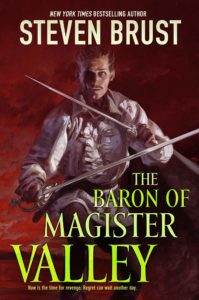
 It has taken me over three months to read The Baron of Magister Valley. This is a) not a statement on the quality of the book, and also b) it’s really not okay.
What happened was, I read the first half of the book in a leisurely rush, around child-rearing and comics-reading. That half of the book was great! There were dire plots and secret prisons and just the very best kinds of intrigue, all surrounded by Paarfi’s oh so distinctive authorial voice. I was at each moment excited to learn what would happen next! Just like I should be.
And then suddenly they wanted me to come back to work. Which means I’ve had time for watching about a gajillion movies, but reading has just fallen apart on me. And at a snail’s pace crawl, I found that I just didn’t really care much about the revenge half[1] of the book. My assumption here is that reading the book with any kind of momentum would have prevented this malaise, and I would be glowing here instead of all mehed out.
Ultimately, I think the failures of the book were either the failures of my circumstances, or (less likely but certainly possible) the failures of the source material. Or, so unlikely that I hate to think it after the stretch of great books I’ve previously read by him, it could actually be the book, and this is a failure on Brust’s part.
But whatever the case, a book whose plot I did not care about and whose characters’ motivations were mostly uninteresting to me for an entire half of the story, and the second half no less!, a book who I mostly kept reading because, whatever else was going on, Paarfi knows how to make me laugh? That is not a book I can be excited about in a review. Alas.
[1] I should say here that I’m not actually hurling out spoilers; this book, like the others that “Paarfi” has written, are based on popular works of adventure fictions from the 18th or 19th centuries.
 One of the problems with having a booklog is all the books that you had read just before you started chronicling all the books you read, that probably were the very books that led you to say, ‘Hey, there are books out there that people deserve to know about!’, and thus inspired you to get started on such a singularly self-involved project as a booklog. (I know what you’re thinking. ‘You read crap books all the time, nearly constantly in fact, and how dare you pretend that this is something people deserve to know about?’ Well, I do think that very thing, because I have to warn people of the bad stuff too. It’s just that serving as an object lesson wasn’t sufficient impetus, in the way that flagging down the really good books has been.)