Tag Archives: fantasy

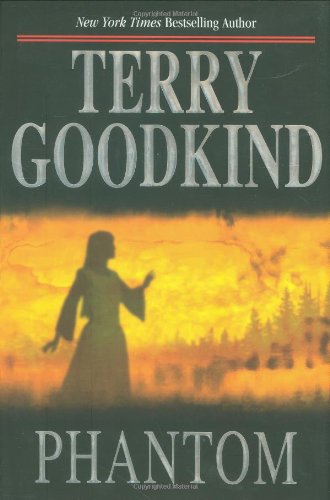
Phantom

41zwvtAmaMLNormally, this is the point in the review where I’d be digging up my previous reviews and getting an idea of what I thought of the last few books in the Sword of Truth series[1] and what the tone of the pieces were. However, as I’ve been telling anyone who will listen, I’m currently off the grid. And since I didn’t make the entire contents of delirium.org available to myself offline before I left, well, you can see that I have no choice but to wing it.

Okay, then. Plot summary first, I guess. Phantom continues Richard Rahl’s search for his wife Kahlan, erased from everyone’s memories and perception via the Chainfire spell. As if that weren’t enough to deal with, the seemingly infinite army of the Imperial Order is nearing Richard’s army, which has no realistic chance to do more than momentarily slow their inexorable advance on the last free capital on the continent. He’s already lost his sword, and now someone is in the shadows, poised to steal the last advantage he has left. And I maintain that all of this could be pretty cool, tension-driven fantasy drama, if only it weren’t interspersed with the repetitive objectivist lesson plans disguised as storyline.

The Phantom in question is still supposed to be Kahlan, as you’d expect, though Goodkind shoehorns in a few other phantom references in other parts of the plot. (A bit clumsily, to be honest; if he’d used synonyms every now and then, it would have felt a lot less hammery, at least.) But the real phantoms of the book are the various strawmen against whom he’s arguing. It’s all fine and good to think that religion dulls people, that a focus on an unproven next world beyond death can be actively harmful to providing the best possible life for oneself, one’s neighbors, and one’s progeny. There’s an interesting debate there, and it can work even if you’re an author providing both sides of that argument. But it can’t work if your authorial position is that the logical conclusion of a religious focus is a communistic dystopia in which all beauty and knowledge is despised for taking peoples’ attention away from the afterlife and in which people can be easily brainwashed into believing that the wanton rape and murder of friends and enemies alike can be an expression of solidarity in collectively marching toward that goal beyond the veil. It’s not just that painting the opposite side as ravening beasts incapable of all rationality is insulting and ultimately detrimental to any persuasion, although it is those things too. It’s that it renders the entire counter-argument suspect, if the opposition needs to be placed in such an unattractive box for the authorial mouthpieces to be able to effectively debate their cause.

[1] Yes. Still. There’s a bright side, though, in that the next book is the final one, and I will at last be free!

Preacher: Dixie Fried

51nMX6pyRVLAfter getting side-tracked a couple of times by family matters and kidnapped friends, Jesse Custer has forcibly put himself back on his quest to find God and ask some pointed questions. Trouble is, he doesn’t really know how to go about the finding, and anyway, he still doesn’t really understand the thing in his head that started all of this. So he heads off to New Orleans to dig up a few answers. Which would probably work out fine, except one of Jesse’s and a few of Cassidy’s past (and present) mistakes are coming back to haunt them all.

Oh, I didn’t say what the hell I’m talking about there, did I? Just finished the fairly inexplicably-titled fifth Preacher volume, Dixie Fried. It was refreshing to get back to the driving force of the story, after the last book’s digression. And I did enjoy the plot twists. However, it felt a little thematically empty. If Tulip had had anything come along with the express purpose of biting her on the ass, I might have been able to cobble something together about mistakes and consequences. Plus, I’m not sure if I approve of the apparent change in Cassidy’s personality. (In case it’s not clear, Cassidy and Tulip are Jesse’s quest companions, not to mention vampire best friend and girlfriend, respectively.) So, there’s a slight dip in enjoyment happening. But the story itself I’m still on board for, so far.

Harry Potter and the Deathly Hallows

I honestly couldn’t tell you the last time I read a book this long this fast, although at a hunch I’d call it the sixth book of the same series. There’s something about being caught up in the flood of a cultural phenomenon that I really enjoy. For a few days (which basically predate this review), everyone has only this one thing on their minds. Well, maybe not literally everyone, but enough of everyone to annoy the holdouts. But at the end of all that, it’s still got to be talked about out of context as its own work, not merely as the reaction to the phenomenon. It has to be if you’re me, at least, since I do this thing.

I suppose the question is, does Harry Potter and the Deathly Hallows live up to the hype of being the conclusion of a series worth billions of dollars that will eventually spawn seven movies worth additional billions of dollars and not incidentally the hype of being the fastest-selling book in history? Well. It probably doesn’t. I mean, come on, that’s an unreasonable amount of pressure, right? But does it live up to the expectations of a series that has purposefully set out to reflect the process of growing up, and maybe teach children a little bit about that, through the lens of a magical world under assault by an evil thought destroyed twenty years earlier but which had instead merely bided its time while its power slowly grew back under everyone’s noses, most people unwilling to believe it could happen again? And does it work as an England approaching World War II allegory at the same time? I’m gonna go with a resounding yes on that one.

I’m just saying, good stuff. It stopped being a children’s story books ago, but this one is probably a bit much even for some of the early teen set. It’s every bit as dark and as dire as it should be, to match with the stakes that Rowling has been implying for most of the series. And impressively, I found the conclusion satisfactory. That sounds like faint praise, but it shouldn’t be taken as such. I just wasn’t sure there would be any way that could happen, due to the unreasonable expectations I’ve mentioned previously. It’s not the great series of the age or anything, but, taken as a whole, it’s a really good fantasy series, and that’s not nothing.

Spoilers below the cut, not because I need them to finish the review: it’s pretty well done, I guess. But there are definitely things worth a mention. And when I say spoilers, I mean that I’m letting fly with plot-destruction of complete magnitude, here. Seriously. Continue reading

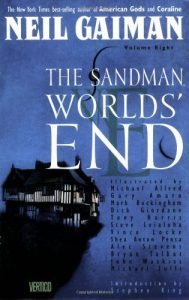
World’s End

1563891719-01-_sx450_sy635_sclzzzzzzz_It was Harry Potter weekend, and I sat at work waiting and waiting and waiting for notification that my package had arrived, so I could leave work and grab it and have some reading time back at work with which to while away the long weekend hours. The fly in my chardonnay was that UPS handed off their delivery duties to the USPS, at which point delivery info didn’t appear on the tracking page until this morning. Although I now know it arrived at 2:52, at the time I had nothing but shattered hopes. The upshot of all of which is that I started reading the eighth Sandman volume, World’s End. And then got stalled by actually having to work, and was unable to finish it before I got home and took delivery of my book.

Here’s the thing, though. It’s Sandman, right? And even though it’s one of the alternating books that explores mythos and shards of character personality instead of the main plotline, it’s nevertheless right at the climax of the series. It’s possible I could have set down an earlier volume unfinished and come back to it, and I’m sure I could have set down any other re-read and probably a lot of new reads to start my precious Harry Potter conclusion. But not this.

The story is simple, is in fact nearing a millennium in age. Travelers forced together by circumstance tell tales to each other to pass the time on the road to Canterb-, er, no. To pass the time in the inn called World’s End, where they have each taken shelter from an unseasonable storm. And if you suspect that each of these stories will reference someone that has been important to the overall Sandman cycle thusfar, well, try not to be too surprised by your perspicacity in this instance.

Knowing what I know about how the overall story ends, I was at first struck by the irony of the storm as catalyst. Because, to me, this was the calm before the real storm that has been building for, well, the entire series. But it’s been obviously building for the last four volumes. And yet, I reached the end and surprised myself with the realization that the storm within the story was generated by the outcome of the metaphorical storm of plot I’d been envisioning. The next time I read these, I’m going to be looking for the iconic moments from each of them. Just as the dinner under the stars at quest’s end was the moment to watch for in the previous volume, the procession at the climax of World’s End nearly literally took my breath away. I took about 20 minutes to recollect myself before finally cracking Harry Potter, at least. And that’s on a reread.

Harry Potter and the Order of the Phoenix

You may or may not be aware that the final Harry Potter book is going to be published at any moment now, and that spoilers are nearly as prevalent as theories, recaps, final reworkings of relationship fanfics, and all-around general buzz. Potterdämmerung, they’re calling it. The fact that you are reading this right now puts you, on average, much more firmly in the “may” column, of course. I anticipate that the faint twinges that are accompanying me putting my thoughts together on the Order of the Phoenix movie are spare precursors beside what it’ll be like to have to review the actual new book.

And that’s before even taking into account that I really liked the movie. Sure, I had lowered expectations after the many shortcomings of the previous film. And sure, this book was even longer than the last one to try to shoehorn into the same amount of space. But either the adapter was much better or the book lent itself much better to compression, because this one worked as well as any of the previous volumes, possibly exceeding the high watermark of Prisoner of Azkaban. Luna Lovegood was note perfect, and Dolores Umbridge was nearly as unpleasant as I had imagined her. And the plot, though streamlined, hit upon all of the important themes and events. Harry suffered all of his turbulent anger, angst, and teenage lust and then emerged from it into his first shaky steps toward leadership. The wizarding community at large dealt with its fear and denial and backlash at the messengers over Voldemort’s return. Voldemort started gathering his forces. And all in full technicolor glory!

Okay, it’s next to impossible to both describe what I liked about the movie and avoid spoilers, apparently. But it really did work. I know that stuff was left out (and I acknowledge that I haven’t read the book since its release), but there was nothing much that really stuck out as a tragedy to lose. Except maybe they could have spent an extra ten minutes or so in the climactic battle allowing the kids to show their stuff a little more and to show off the Department of Mysteries in more of its glory. And possibly either not included Kreacher the house elf, or else given him more to do. But I have a suspicion he was present so that he can do something more relevant in the next movie that I’ve currently forgotten about, which would make that part basically okay, in the grand scheme of things.

The Wizard

Gene Wolfe is an author whose work tends to exist right at the outer limit of what I can wrap my mind around. I swim through his novels, working to keep my head above water the whole time, and the nature of that effort leaves me with a limited perspective of the story’s surface from moment to moment. Not only that, but I’m aware of unplumbed depths of added meaning in a vague, unformed way; I guess I’m aware of it only to the extent that I can tell there’s a whole lot more happening that I’m not aware of. Possibly this all sounds unpleasant, and maybe it would be except for three things. The parts of the story I can grasp (a sizable amount of plot, bits and pieces of characterization, shadows of literary influences, and the faintest impressions of theme) have always been very entertaining; the prose is good enough to make mention of; and the parts of the story I can’t grasp exercise my reading brain. I’ll read the Book of the New Sun sometime again, and I’ll have benefited by that. Also, the Malazan series. (Which I’m sufficiently behind on now that I’ll probably need to start over. Oh, well.) Umberto Eco does this to me as well, but without quite as much enjoyability on the front end. I guess my point is that being challenged is cool.

However, it makes for difficult reviewing, because I don’t like to toss plot elements willy-nilly, and at the same time I have little else to reference right now. When I read The Knight last year, I indicated this same difficulty. Reading The Wizard was akin to leaving the public pool and taking a dip in the ocean. Which is ironic when you consider that water imagery was rife in the former volume. …and fire imagery as well. Whereas this one was much more about earth and air. So, hey, look at that! I figured something out right here in the middle of typing. Which would be cooler if I could attach some direct relevance to the revelation. But it definitely proves my point about the mind-exercise. Anyway, I’m going to see about minimizing the self-satisfaction and getting back to the review, now. I trust this will be taken kindly by all six of my readers.

Sir Able’s continuing adventures in Mythgarthr and its surrounding realities have expanded from faeries, knights, and dragons to include giants, angels, unicorns, Arthuriana, and the Norse pantheon. As difficult to integrate into my understanding of the world as these were, the (at first glance) simple plot was harder still. The first half of the book is the story not of Able, but of his companion squires and knights. The emerging lesson of the section seems to be that we are not what people call us; we are what we are, whether people call us such or not. But people will tend to call us what we are. For example, Able is a knight because he determined to be so and lived his life that way, not because anyone dubbed him or acknowledged him. Despite that from his first appearance in the book he refuses to use any powers , Able is called a wizard now by all who spend time with him because his inner reality shines through. These examples together with a spoiler from later in the book make me pretty confident that this sometimes struggle and sometimes congruence between what is and what is perceived is another important theme of the story. But again, just because I can see it doesn’t really mean that I’ve yet been able to plumb its depths and understand the buried point to it. Which, amusingly, is kind of a mirror of the theme right there.

I said it at the beginning, and I’ll say it again. Hard books are cool. Which is not an excuse for the incomprehensible mess of the previous paragraph, but it is an explanation of sorts. (Seriously. I’ve edited a lot, and well, to get it to what you see now. The original would have made you weep with frustration.) So, yeah, they’re cool, but they’re also hard. Thus, by executive decree, it’s going to be all graphic novels from now until Harry Potter.

Pirates of the Caribbean: At World’s End

A thing that annoys me is when some movie is advertising itself as the big movie you should see this summer because it’s original and otherwise you’d have no choice but to watch a sequel in this, the “summer of sequels”. Well, guess what, you indie-pretension-wielding jerk? They’re all the summer of sequels. For good or ill, that’s the way it is now, because that’s what people want to see. And what makes it even worse is that you right there on your high and mighty holier-than-thou unique pony? You’ll have a sequel in two years, tops, if there’s money to be had by making one. So shut your piehole and either be a good movie or don’t, but don’t sound like a prat while you’re doing it. You’re not morally superior to any movie out there, and don’t forget it.

Speaking of uncharted seas full of deceit and treachery where it’s impossible to know who you can trust until you’re long since committed and even when you can they’re still more interested in your money than in anything about you as a person, I saw the third Pirates movie, At World’s End. And it was good. Obviously, there were swordfights and naval battles and combinations of the two (and in settings that were clearly designed to say “Top this, if you dare!”) But the true greatness of it was the diverse plots and betrayals. Every character worth mentioning had an agenda, and every agenda was partially compatible and partially incompatible with every other one, such that any two characters together would have common cause enough to double-cross (or triple-cross) any given third. It’s not that it wasn’t confusing, it’s that it was like a roller coaster going in seventeen directions at once. It’s far more interesting to just relax and see what happens next than to figure out what’s around any particular corner ahead of time.

My only complaint is that Johnny Depp seemed like he didn’t have much to do. The movie was obviously not about Jack Sparrow anymore, and that character needs to have center stage, or else he starts to look as ridiculous as he would if you met him walking down the street in your neighborhood. Luckily, I don’t see that being an issue again if there’s one more sequel. (There might be one more sequel. There probably won’t be more additional ones than that.)

Fantasy Gone Wrong

Yay, Christmas presents! I received a short story collection whose common theme is the reversal of expectations in fantasy settings. Just to toss out an example, in one case a unicorn bonds itself to a prostitute, with substantial negative impact to her livelihood. Some of the stories work a lot better than others, though only a couple ended up being pretty bad. I’m not going to go into it story by story, and I’ve pretty much covered the book as a whole with that first sentence, so this is destined to be a short review. I will point out my favorites, though: The Hero of Killorglin, about fairies and their companion animals; The Murder of Mr. Wolf, fairy tale noir; Crumbs, about the generation succeeding Hansel and Gretel, and Goblin Lullaby, with an alternate perspective on PC adventuring. And for balance, don’t read Finder’s Keepers, as it was both rambling and (by the end) trite.

The Darkness That Comes Before

A new series?! Weak! Here’s the upside, though: it’s only a trilogy and it’s already completed, so I’m neither likely to die waiting for the final book nor to forget what was going on with the overarching story before I reach the end. (I’m looking at y’all, Jordan, Martin, and Erikson.) I wonder why this is not a concern when I think about the graphic novel series I’ve been reading lately. Hmmm. Less time investment, I bet. I know that seems like a digression, but as Polonius said, the unexamined life is not worth living. I mean, he probably Shakespeared it up, though.

Anyway, this Prince of Nothing series is pretty cool so far. It’s got priests against wizards, wizards against an evil force from beyond space and time (well, something like that; it’s not entirely clear yet), emperors against popes, civilization against barbarians, prostitutes against, well, okay still that evil force from beyond space and time (and okay it’s only one prostitute, but still), and this one philosopher guy who can read faces like other people can read books against everyone in the whole world. And maybe also against his father who can do that same awesome manipulation and hitting arrows out of the air thing as the guy I mentioned in the first place. Oh, and according to prophecy, that guy (the son, I still mean) will be against the evil force from beyond space and time. But you had probably guessed that yourself.

So this wizard spy keeps showing up in time to discover all the odds and ends of how the world is on the verge of the Second Apocalypse. We like the wizard spy. He’s there in time to watch the pope guy (who we do not particularly like) declare a Holy War against the people to the south who are heathen and own our holy city, only we never really minded before, so that’s a little suspicious. And he’s there to figure out why the wizards would agree to ally themselves with the Holy War, despite that priests dislike wizards even more than heathens, if that’s possible. We don’t know why the pope is willing to invite them, I don’t think. And he and his girlfriend the prostitute are there to uncover the first signs of the evil force from beyond space and time (who we especially do not like, as they seem to be somewhat spidery plus they crawl out of otherwise perfectly normal people). And certainly he’s there when the philosopher guy (about whom we have not yet made up our minds, though he is clearly Cool) and the barbarian general (who we like, even though we suspect he would not particularly like us) arrive to save the day and get the plot rolling. He isn’t really there for anything to do with the emperor, but that’s okay because we don’t like him anyway.

Brutal world, where the good guys are by turns plagued with self-doubt or unenlightened self-interest, there are entirely too many guys who probably aren’t good at all even though they should be, and the bad guys pale in comparison to how bad the evil force from beyond space and time is, but if not for that would be pretty unpleasant in their own rights. But there’s still plenty of hope, in that the self-doubt is likely to be overcome and in that the whole point of the philosopher guy, aside from being a badass, is that he seems primed to bring enlightenment and justice and above all LIGHT to a world that really needs it.[1] I mean, unless the evil force from beyond space and time wins instead. Which, despite just how badass the philosopher guy is, I wouldn’t rule out. (To be clear, though, he’s not the hero, that’s the wizard spy. He’s just a foil against which to measure the wizard spy’s growth. So he has to be really cool for there to be something to aspire to. That seems reasonable, I think.)

[1] Hence (among other ways that it works) the title of book 1: The Darkness That Comes Before.

Mort

41Q2E9H3D0LI have purchased more than half of the Discworld books by now, but I haven’t read any in a long while, because of a continued failure to find the actual next one. Then, last month, I finally did, which means books and books stretch before me before I need to have found the next missing link. Which is nice. I like it when little stresses disappear. I mean, it shouldn’t be a stressor at all, except that I wanted to read the books. So, then.

Also good is the book itself, Mort. For one thing, it is unquestionably funnier than its predecessors, relying a lot more heavily on situational humor rather than bits of random oddness. The random oddness is there, as it should be; it just isn’t the centerpiece. Also and perhaps due to the same root cause, the story is a bit deeper than at least the first two, if not necessarily Equal Rites. In Mort, our titular hero takes a most unusual apprenticeship and learns that even the least common of jobs can have their ups and downs.

Okay, that was trite even for cover-copy, much less a review. It’s like this. Death (the anthropomorphic personification, thin fellow, carries a scythe) opts to take on an apprentice, pass on the trade as it were. Mort learns the importance of the job that might one day be his, Death learns the importance of a vacation, and the reader learns, at excruciating repetition, the way that light and dark work on the Disc. But really, other than that (which I’m sensitive to after the last Anita Blake book), this was a fun, breezy book. The breeziest examination of causality and predestination I’ve ever read, in fact.