Tag Archives: fantasy

Pyramids

Pratchett’s seventh Discworld novel was markedly funnier than the previous volumes, and much more consistently funny at the same time. So that was awesome. Unfortunately, it wasn’t funny enough to mask how muddied the rest of the book was. Pyramids has a core theme, about the dangers of stagnancy to the human condition. It’s just that the execution wandered all over the place, making it almost impossible for me to really see that theme until nearly the end of the book, and even worse, making it almost impossible for me to really get into the plot, whose point I still probably missed.

But the increased skill at humor made up for a lot of that, and I still have to say that on the whole the series is unquestionably improving, still. I believe I’ve read the next book before, and possibly as my entry into the series some 20 years ago. So that will be potentally interesting!

Fables: Storybook Love

The third collection in the Fables series is clearly a transition point, with two distinct storylines that collectively do a great deal to change the face of Fabletown, as well as a pair of actual fables, stories that have occurred since the exile from the homelands began. In the first storyline, a mundane reporter has discovered the collective and its immortality, with fallout and consequences for all concerned. In the second, Storybook Love, enemies that Bigby Wolf (the sherriff of Fabletown, you’ll remember) and Snow White (its day-to-day administrator and deputy mayor) have recently made come back to haunt them, with, once again, fallout and consequences for all concerned. Only, a little moreso. Plus, Prince Charming gets tired of his free-wheeling lothario lifestyle and sets the wheels in motion for a political power play! Dramatic!

Hints of the inevitable on-screen confrontation with the Adversary crowd the wings, but the main stage where Bigby and Snow are advancing their relationship by what I’ll charitably refer to as incremental degrees is where the show is really at. The occasional noir bent of the series helps my case here, but I’m unable to avoid spotting the influences of Moonlighting on this series. Which is a really odd pair, don’t get me wrong.

The one-shot actual fables that I mentioned earlier, by the way, were both pretty decently put together, though probably forgettable in the long run. (Unsurprisingly, I like Gaiman’s Death better than Willingham’s.)

Mouse Guard: Fall 1152

It was my birthday, not so long ago, and I received a fairly random graphic novel about some mice, right? Just lately I’ve read it, and it was pretty okay. Mouse Guard: Fall 1152 chronicles the doings of several members of the Mouse Guard over the course of the Fall of 1152. (I’m more proud of that than you might imagine.)

But seriously, there’s a hidden society of mice, and for the purposes of transportation and trade, the Mouse Guard keeps the roads safe of enemies: weasels and cats and so forth. The map indicates that they’ve found a way to turn back large predators from their terriroty via a scent barrier; it’s clear that the world has more depth than was presented in this original book. However, all is not well in mousey-town, as someone has snuck out a map of the home city of the Guard for the purposes of villainous treachery.

The art has a very A.A. Milne or Peter Cottontail feel to it, just slightly cartoonish versions of real animals[1], but since everything is at mouse-scale, the occasional marauding snake or crab is quite exciting. The story’s pacing and spare prose adds to my impression that it was meant to be a kid-book. And believe me, it’s a pretty good one that a new reader would get a lot of enjoyment out of. I got probably 50 pages of enjoyment out of the 192 page book, myself. The story was fine, it was just widely paced, like I said. But the art made up for most of that. I just didn’t expect to finish quite that large of a book in a single day around my unreasonably crowded work schedule.

[1] To the extent that mice wear cloaks and carry swords. Which I assume is a very wide extent indeed.

Jhegaala

There are two things kicking my ass about the review of Jhegaala. (Well, three, if you count reviewing a book so deep in a series, but I’m used to that.) The first is that the next two reviews will be so simple, and then I’d be caught up, if only I could get there. The second is that I was developing a wonderfully insightful theory about Vlad’s relationship with with Loiosh, only to have it disproven a few pages from the end of the book. Grrr. I may, of course, be getting ahead of myself.

So, anyway, Vlad’s an assassin, right? And for reasons explained elsewhere, he’s on the run from the mafia-esque organization for which he previously assassinated people. As a result, he has fled Adrilankha to spend a few years among his own people, maybe hook up with relatives of his mother that he never met as a child. Except, he’s Vlad Taltos, and he naturally finds himself elbow-deep into the hornet’s nest before he hears the first buzz of approaching trouble.

I loved it, of course. You will too! Inevitable (if unintentional) spoilers follow…

Continue reading

The Order of the Stick: On the Origin of PCs

The convenient thing about having a friend who owns and is willing to lend out the second Order of the Stick prequel novel is the increased likelihood with which he will own and be willing to lend out the first one. (Signed by the author with a drawing of Belkar, no less! Which, if you knew the guy, Belkar was definitely requested art.) The upshot of which is that I snagged and read it as well. And will return the book no later than Friday, if you happen to see this, Ryan. And, y’know, because of the borrowing, I read it way out of the order I would otherwise employ. Which is cool, as it provided good perspective between the books.

On the Origin of PCs does the same thing as Start of Darkness, except for the good guys. What motivates them? How did they meet? Why are they on the trail of a douchebag lich? The stories are every bit as funny as in the other book and in the comics themselves, but there’s one stark difference between the books that also highlights a difference in the comics. When the PC prequel was written, the comic was a lot more about humor and a lot less about story depth. Which is not to say that the comics have grown less funny, only that the plot has become increasingly more important. But it happened so gradually that, without a comparison point such as between these, highlighting how much better of a story was present in the other book, it would be difficult to see how much the main sequence comic has improved.

Still, though: this one was funny and had nuggets of pretty awesome information that have yet to pay off in the comic itself, years later now. That is pretty good news, if you ask me.

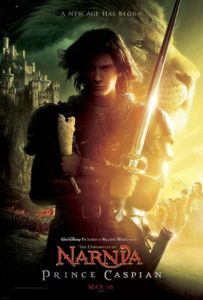
The Chronicles of Narnia: Prince Caspian

I finally saw Prince Caspian over the weekend, and it was kind of a weird experience. As a fantasy adventure movie, it kind of works. All those kids from the first movie are magically summoned back to Narnia when Prince Caspian, marked for death by his usurping uncle, stumbles across Susan’s magic get-out-of-jail-free horn where she dropped it in the woods while trying to escape his uncle’s army and blows it.[1] Or, considering he wouldn’t have known to, maybe someone gave it to him instead. Or maybe he didn’t know and was just hoping someone would show up to save him? I’m not sure.

Anyway, there they all are, and it’s been over a thousand years and their whole castle is fallen apart, because evil Spaniards (who we call Telmarines) attacked and subjugated Narnia quite a while ago, driving the magical creatures and talking animals so far into the forest that they are believed to be extinct, plus nobody has seen Aslan in pretty much that whole time. Although Caspian is heir to the Telmarine throne, the fact that his people want him dead and that plot necessity demands it combine to get all the Narnians willing to support him. His enlightened reign, he promises, will see his people and the Narnians peacefully co-existing, which one supposes is better than hiding so well everyone thinks you’ve died out.

Then he and the Narnians and the Pevensie kids (aka Kings and Queens of Narnia, aka Peter and Susan and Edmund and Lucy) all get together and have a war against Uncle Miraz and the Telmarine army, with mixed success, all culminating in a grand finale of some kind, as movies often do. So, yeah, that worked.

As the Christian metaphor that one expects from the Narnia property: well, mixed success fits well here, too. There’s a bit about not making a deal with the devil, even if it is the devil you know. And there’s a bit about not ignoring God’s little nudges in your life. Which, okay, I suspect that they maybe aren’t as obvious as seeing a lion waving you over, but that’s how metaphors work, so fair enough. But even though most of the failures in the movie were blamed on not following Aslan, as is a good and proper metaphor, the fact is there was just no real way to tell what it was that Aslan wanted of them. He just sat around waiting for things to be terrible, and then rolled in to save them all, while proclaiming that the whole point of not coming and saving them to start with, as he’d done in the previous movie, is that things aren’t ever the same twice. Except really, what he did was exactly the same, because, after all, the whole point of the metaphor is that ultimately you can’t face the evils of the world without Aslan there to carry you down the beach some of the time.

I mean, if they’d made a show of “I didn’t help you because you never asked me to”, that at least would have been a prayer metaphor, and I could get behind it working, pretty well in fact. But I mean, there was no show. And by ‘show of’, I mean not even a single line of dialogue, which is approximately how much it would have taken. Maybe another line or two of reaction, but this is not a long conversation I’m describing here. This also might have tied into the part where nobody in Narnia really believes in Aslan anymore, since nobody has much seen him in the past millennium, although at the same time, I imagine that the Narnians were looking for him to come help back when the war started and their castle was being smashed and they were doing the extinction-hiding and it had been less than a thousand years since anyone had seen him. (I mean, I don’t know how long, but this is the 10th Caspian, so it’s been a little while.) And since he obviously didn’t show up to help out then, well, that would kind of hurt the metaphor a bit, I guess.[2]

Also, the above review probably contained spoilers, and if you care about such things, you should not have read it.

[1] I just reread that sentence, and as much as I considered rewording it because it loses track of proper antecedents at least twice, I choose instead to let it stand as a monument to my awesome clarity of communication.
[2] I just remembered another complaint. It bothered me when they said that Narnia is only ever right when a Son of Adam or Daughter of Eve rules the country. Even though I understand the whole ‘man shall have dominion over the creatures of the earth’ thing, it’s just, these are centaurs and talking mice[3] and morally conflicted dwarves, and they all seem to have agency, you know, so the concept comes off a lot more as White Man’s Burden to show up from a different, far away place and take care of the poor misguided natives so they don’t screw things up too badly than as the Genesis metaphor that is apparently intended.
[3] To be clear, Reepicheep was in fact awesome. So that’s nice.
Wyrd Sisters

510tZcYWM+LI’ve just spent some time[1] looking over my past several Discworld reviews. And my memory matched the apparent reality, which is that Wyrd Sisters is definitely the first one that I’ve liked almost without reservation. It is notably the first one since Mort (my previous favorite) that lends itself to thoughtful examination and analysis. Also, it marks the first book to be populated with characters that seemed real and interesting to me right from the start.

The titular witches, who have recently formed a coven at the dreadfully modern urgings of their youngest member, are accidentally embroiled in politics when the infant heir to the throne of Lancre is deposited at their feet by loyalists fleeing from the scene of the king’s recent murder. They immediately deliver the child to a troupe of actors passing by, by way of removing the political odor as quickly as possible, only to discover that the duke who has taken the throne is bent on ruining their lives anyway. At which point, it’s time to get the heir-turned-actor back onto his rightful seat by any means imaginable.

Plus there’s a lot more and a fair bit funnier that I can’t easily shoehorn into a paragraph of plot description. I was definitely moved to laughter aloud now and then. But as I said, the depth was the best draw for me. On the surface, there are glaring parallels with Macbeth, Hamlet, and the actual life of William Shakespeare, all used to the comedic effect for which Pratchett is justifiably famous. But, and speaking as quite a fan of the Bard, the most interesting piece by far was the witches themselves.

I’ve only ever heard ‘wyrd’ in the context of witches and fortune tellers and the like, and I thought I knew that it meant something generally pertaining to that kind of job. To my surprise yesterday, wiktionary defined it as ‘fate’. Which fit very well in that the witches, despite their best efforts, are being forced to take a hand in the destiny of the entire kingdom, if only to maintain their own reasonably comfortable lives. But it fit far better as and pulled sharply together for me what a profound (if unconventional) fit they are for the Fates. Magrat the newly confirmed Wiccan, painfully naive in the ways of the world, eager to be accepted by her sisters, and entangled in a hilarious romantic subplot, is clearly the Maiden. Nanny Ogg can hardly go two sentences without reference to one of her seemingly infinite brood, and she’s as bawdy as they come. And Granny Weatherwax, despite not seeming to be old enough for the role, definitely contains the no-nonsense attitude, certainty of her own superiority in all things, and barely held-back ire that… okay, these qualities are not automatically what I would have expected from the Crone before today, but they work so very well that the urge to say I did is almost overwhelming.

All of which to say this: in addition to being as funny as he’s been yet and providing his best characters yet, this is the book where Pratchett became not just funny, but also very clever in subtly high-brow ways. I don’t think he’s quite where I expect him to be on coherent plotting, but the odds and ends that seemed off to me are partially explicable by the oddness of his world, certainly less glaring than in some previous volumes, and for the most part have already faded from my mind, replaced by everything I was happy about. So they can’t have been as bad as all that.

[1] Okay, not just; more like several hours ago. It’s not like you’d ever find out, or even know the difference. But I could never lie to you, baby, you know that.

Dzur

I’m not sure if it’s literally true, but WordPress claims that this is my 400th post here. That’s a nice round number, and for people who care about such things it is fitting that said post be dedicated to one of my favorite authors having written a new book in one of my favorite series. Sure, he wrote it a goodly while ago, and sure, I’ve never reviewed any of the other books in the series (besides a highly allegorical one set in the same world but otherwise wholly unrelated, at least that I’ve been able to detect via my apparently useless English Lit degree), but regardless of all that, Dzur is in my possession [again] and thusly, here am I.

The real problem here is that I’m trying to review the 11th book of a series without a) any previous body of work here to rely upon and b) without having read most of the other books in the series in the past 7 years, and not even any of the books in the related series in 4 or more, else there’d be a review of them here. So you see. But it’s cool, because one thing that Vlad Taltos is reliable about is presenting his stories in such a way that you don’t need to have read the previous books. It would be nice to have, both because they’re uniformly awesome and to have a little better idea of how his mind works, but it’s not required. And… although the way the books are written make my summary background more than spoilers, I still feel obligated to put a cut at this point, mostly for people who might be in the middle of the series.

Continue reading

Red Seas under Red Skies

There was a point somewhere toward the end of Red Seas under Red Skies where I proclaimed by fiat that the Gentlemen Bastards sequence is my new favorite ongoing series. It might be that I’ll get back to Erikson’s series[1] or Martin’s series[2] and my loyalties will shift all around again, but I kind of doubt it. Because while all three series have comedy, tragedy, high drama, and empathetic characters to spare, only Scott Lynch’s series is this damn fun.

The continuing adventures of Locke Lamora and Jean Tannen see them plotting an extraordinary casino heist, dabbling in politics that are really well above their comfort zone, enduring the attentions of old enemies, and taking to piracy on the high seas. And, as is quickly seeming to be the norm, almost none of it was something they saw coming.

What the book loses in sense of wonder from its predecessor and unadulterated glee over the coolness of the characters, it quickly gains back via the reader’s growing investment in the world and the changeable fortunes of the Gentlemen Bastards. The characters are (except when obviously intended otherwise, and sometimes even (a little bit) then) eminently likable, and Locke and Jean are guided by an intense and even laudable, if perhaps non-traditional, moral code. I felt equally involved in every success, no matter how minor or spectacular, and in every setback, no matter how fleeting or tragic; and there were a number of points were I perked up with certain foreknowledge of what was coming (not always correctly, mind you) and was a fair bit sad not to have someone with whom to discuss it excitedly. This is a book that just cries out to be read, from the first page to the last. And now that Lynch has done it twice, I think it’s fair to say that neither time was a fluke. I look forward with great excitement to the third book[3].

[1] which next book has been sitting on my couch for a number of months now, filling me with dread that I don’t really remember enough of the series to proceed and with equal or greater dread at the thought of re-reading the previous four or five giantastic doorstops of books. So you see.
[2] which next book is due out at the end of the summer, I hear, and that’s kind of an amusing coincidence. isn’t it?
[3] which is due out in January. I am now sad.

The Forbidden Kingdom

True confessions time: I never really got deeply into kung fu movies. I mean, I watched Bruce Lee movies when I was a kid, because they were just there for the taking on weekend afternoons on the UHF channels, and how could you not watch them? And it was awesome to see all the ass-kickery as Bruce (or whoever) made his way through an army of lesser men and then took out some bad guy or other in an ultimate confrontation. But I never really got into the storyline, just the chopsocky. And then later Jackie Chan appeared with his death-defying stunts of pure awesome but the same kind of storyline. And then Jet Li and his hidden snapper brought wuxia to my attention, with its emphasis on magical realism and Chinese folklore, and finally there were plots that I could get into, but I knew there was a ton of background to it that I somehow managed to miss on those long ago weekend afternoons, and I’ve felt kind of out of the loop ever since. It’s very tragic.

The thing about The Forbidden Kingdom is that it felt just like an introductory guide to the genre that didn’t assume you would know everything that was going on. A kung-fu-obsessed teen gets caught up in an armed robbery gone wrong, ends up with a magical staff, and is transported to historical China, where the staff must be returned to the Monkey King, lest the land be held forever under the tyranny of the Jade Warlord. Luckily, he has help in the form of traveling drunken scholar Jackie Chan, laconic monk Jet Li, and really hot chick-in-search-of-revenge Sparrow. He’ll need all their help, considering that the Jade Warlord has an army nearly as unstoppable as he is all by himself, plus a newly hired witch. (Upside of Chinese witches: they are also extremely hot, not bent and crone-y like lame Western witches. Downside: in addition to the magical powers, they also know kung fu. But, well, it’s historical China: everyone knows kung fu, is what I’m trying to say here.) And so our hero has to live out years of daydream fantasies, but with the complications that real life is a lot harder than imagination, and also a lot more deadly.

I got sidetracked by plot just now, but my point is, the hero-kid’s eyes gave me the window I needed. This was slightly ironic considering that he should have understood everything that was going on, what with his obsession with the movies.[1] But the huge blindspot between the movies and the reality (if you will) left a lot of room for explaining things to the audience. So if you’re like me and you accidentally missed this boat, or if you’ve got a kid that is in serious need of some Eastern cinema, The Forbidden Kingdom is a really great place to start. And if you’re not like me and you have been involved in these genres all along, well, my highly unscientific survey of one person says that it was pretty great through an old hand’s eyes as well.

[1] Or I guess it could be that in the movie’s reality, not unlike my apparent own, wuxia didn’t exist as a genre for him to have watched? If so, this was unclear at best and I think disproven by modern movie titles.