Tag Archives: science fiction

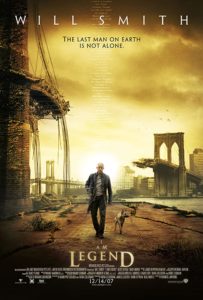
I Am Legend

Far back in the mists of Delirium’s history (er, the site, not the girl), I read I Am Legend by Richard Matheson. He fills in one of the final gaps between the old school horror of Poe and Lovecraft and today’s modern horror renaissance birthed by Stephen King, and yet until just a few years ago I’d never heard of him. He is certainly to my liking so far, and it was with a fair amount of excitement that I heard I Am Legend was being made into a movie this Christmas. Plus, I like Will Smith a lot better than Tom Hanks, so it’s nice to see him in the role of last man standing. But I suppose that’s getting ahead of myself?

The premise of the movie is as follows: in late 2008, a viral cancer cure has just completed successful human testing and is poised to flood the market. Cut forward three years later, to where Dr. Robert Neville is a man alone in Manhattan with only his dog and department store mannequins for company. His days are spent hunting for food, watching DVDs, presumedly siphoning gasoline and maintaining his cars and generators off-screen, trying to develop a cure in his underground laboratory, and broadcasting to any person alive who can listen that he can meet them at the harbor at noon, that they are not alone. His nights are spent huddled in darkness behind metal shutters, praying that tonight isn’t the night the things that roam the darkness will find him.

The first two thirds follow Matheson’s book thematically if perhaps not event-for-event. Neville is driven to find some way out of his exile, whether via the message he broadcasts on all frequencies to convince himself that someday a non-infected person will appear, that he isn’t truly alone, or via his attempts to find some kind of cure, to bring back humanity from its rapid decline, huddled in caves by day and ravening through the streets in search of food (or explicitly in search of Neville?) by night. And Smith does a great job of conveying the drive, the despair, and yes, the subtle edge of insanity that is only barely being held off, one day at a time. The final third’s variance from the story would of course be a spoiler to explain from either direction, but suffice it to say that as interesting as Matheson’s conclusion was, the movie provided a much more reasonable ending for a screen. I mean, that sounds obvious, right? My point is, Matheson’s ending works well in a book but would fail horribly in a movie. The media are too different, in this case.

Also: someone involved in the writing of this script appears to have a vendetta against me, as with but a minor change one sequence of events would have been not just as horrible as it was but instead have actively ruined the movie for me. So, that was mean, mysterious writer guys and lady!

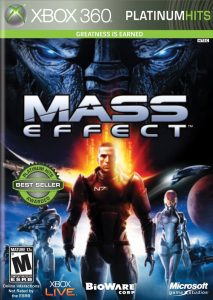
Mass Effect

One sign of an extremely good video game is that it would be almost easier to describe it as a movie and leave out the game elements entirely. Well, okay, that may not be true. But if the reason you want to leave out the game elements is that they were so seamless and non-intrusive that you only very occasionally even felt like you were playing something instead of watching it and influencing the outcome, that would be good. It would also be a good sign if your father, no stranger to games even if he’s not the gamer type, were to ask you after watching the last 15 or 20 minutes of the game to clarify that it was in fact a game, and not a movie.

And looking at it like that, Mass Effect is an exceptional game. Short centuries from today, humanity has spread out into the solar system only to discover relics of an extinct race that had observed our solar system 50,000 years ago and left behind technology we were quickly able to make use of. Now the mass effect drives have unlocked the galaxy for rapid exploration. And of course, we are not alone in the discovery, nor are we the first. And so, at a moment when humans are accepted as an important member of the galactic community but are clamoring for a chance to be more involved in the governing and policy-making of that community, opportunity arises in the form of Saren, a Council agent gone rogue who has just unleashed a rain of death upon a human colony and garden world in the form of his AI allies, the Geth. Now, the principle character of the game, Commander Shepard, must marshal diverse resources to hunt down Saren while unraveling the mystery behind his motivations and goals. At the very least, humanity’s position in galactic affairs is at stake for years to come. And it’s always possible that the stakes could be higher still.

Mass Effect is an RPG, in the style of Baldur’s Gate or Knights of the Old Republic, not Final Fantasy. That is, created with conscious effort to be reminiscent of tabletop RPGs, if they were played by one player instead of several. In the general course of events, I can only get so much enjoyment out of those games, because the micromanagement gets in the way of the pure joy of playing. And sure enough, the inventory system is an exercise in frustration, both because of the limit on how many things can be kept and because of the horrible ordering system. This kind of thing results in the games taking ages to complete if I ever do, and any justified sense of accomplishment comes tainted by the lack of consistent gameplay over a short period of time. That is, these games take me months or years to complete because I get bored of all the between-time work I have to do, so I play something else for a while instead.

Except, contrary to expectations, I’m about to proclaim joy instead of hardship. The majority of the game was put together explicitly to minimize these kinds of micromanagements, even if the inventory part failed. Instead of pausing and selecting enemies for combat, everything is played out in real time with a third person movement and cover system reminiscent of Gears of War that simultaneously allows growing character skills to matter while providing direct control over the flow of combat. The dialog system was primarily about setting the tone of your character; not what does she say, which is for the most part scripted (though there certainly are important choices scattered throughout the game), but how does she say it: with an eye toward politics and goodwill? Strictly official to get the job done, irrespective of the opinions in his head? Or with a giant chip on her shoulder, trying to cut through the pointless bureaucracy? And there are more tones, of course. So, my point is this: RPGs in general are only so entertaining to me, but Mass Effect was spectacular. Even the simple brilliance of Portal has such a different focus as to make them non-comparable. If it wasn’t for BioShock, Mass Effect would unquestionably have been my favorite game this year. (I really need to finish BioShock. Like, a lot.)
Portal

35979-portalI’m about halfway through Bioshock, and probably within an hour’s play of finishing Mass Effect. But I at least finished one of the three or five big awesome games that have come out this quarter, and I’ll take what I can get. Mind you, I’ll be playing most of the rest of the stuff in the Orange Box before too much longer, but many of those games have been previously reviewed, so I doubt I will again unless some kind of mood really strikes me. (On the other hand, at least there will be no stupid sparkles flaring all over my screen to distract me. Thanks, PC gaming!) The important part for now is that I have finished Portal.

At the risk of over-selling it, Portal is what a video-game would be if someone took pure awesome, distilled it into its Platonic form, and then burned it onto a game disc. Yeah, okay, that’s probably an oversell after all. Anyway, Portal is a game set in the Half-Life universe. You play as a volunteer at a Black Mesa rival company called Aperture Science, testing their Portal Device. The function of the so-called portal gun is to open transdimensional portals between two points in space, effectively joining them into a single point. Aside from this possible violation of the laws of physics, the portals otherwise adhere to natural laws, conserving momentum and gravity in ways that would make Escher smile like the Cheshire Cat. Utilizing the portal gun and the assistance of the Artificial Intelligence in charge of the testing chambers, you make your way through a series of tests designed to confront you with diverse challenges that can only be solved through ingenious use of these portals.

The game has three essential strengths: 1) The puzzle-solving aspect, although sometimes frustrating, is mostly a true delight. In a way that no FPS has ever done before, it lets you come up with novel solutions to otherwise insoluble problems. Every victory, however small, leaves you feeling like a giant among men. 2) As of Half-Life 2, Valve has really captured the urban decay chic, and despite that almost all of the game takes place in sterile white test chambers, there’s a real sense of the same kind of minimal but undeniable wrongness about things that marks their other recent efforts. 3) The dialogue is outstanding, even though there are only two characters with lines in the entire game. It swings between hilarious and chillingly disturbing with, at the risk of repetition, disturbing ease. (Also, the end credits contain a wonderful song to which I wish I had the mp3.) Oh, and 4), the three things I just listed combine to form a very tight and affecting plot.

I like Mass Effect quite a bit. I like Bioshock better than I’ve liked any game since Half-Life 2 came out. That said: if you find time to invest yourself in a game before the year ends, it should be Portal. You’ll thank me later. (Except you mostly won’t, because who hasn’t already played it? Nobody, that’s who! (Dear people who haven’t played it: no offense!))

Unearthed (2007)

MV5BMTczODI3NjQzNF5BMl5BanBnXkFtZTcwMTE5OTc0MQ@@._V1__SX1217_SY911_Have you ever wondered what would happen if Alien had never been filmed, and the concept sat on a shelf for 30 years, only to be released today as a Sci-Fi Channel original motion picture, set in an isolated corner of New Mexico rather than in space? And instead of being a bit-player warrant officer, Ripley is a sheriff with a dark secret, hovering on the verge of alcoholism? And instead of being trapped on a ship together, they’re trapped by a closed road and insufficient gas to get to the next town in the other direction? And instead of… well, no, that’s pretty much all of the actual differences. The characters aren’t all identical, I mean, but the four main ones are, which is plenty enough.

My point is, if you’ve ever wondered that, you should really see Unearthed. In the style of Alien, it chronicles the discovery of an alien life form that probably killed all of the Anasazi, has been rediscovered on an archaeological dig, and will now kill all of everyone else if possible. Unless Sheriff Ripley and her doomed companions can find a way to stop it, I mean. …okay, “doomed” sounds like kind of a spoiler there, I guess? I was using literary license; in reality, basically anybody might survive. (Well, not the black guy. You’ve seen a horror movie ever, right?)

Y: The Last Man – Girl on Girl

51DmVpA+bwLThings I have noticed about Y: The Last Man today, while noting that some of the things may be specific to the volume I’ve read, Girl on Girl, and not necessarily to the entire series:

1) The stars are aligning in an always entertaining but still highly improbable manner to get Yorick all the way to Australia, half way around the world and despite a variety of more logical destinations. Perchance to be reunited with his long-missing fiancée, Beth?
2) Men are not a necessary ingredient to make pirates entertaining. Yar!
3) In a world without men, lesbians really do show up a lot more often. Mmmm, lesbian pirates.
4) You know all those action movies where the bodyguard dude is keeping some material witness or annoying-voiced diva singer safe, and they start to fall in love? I guess it’s reasonable for that to happen in reverse too.
5) I suppose that’s all? It was a surprisingly short book.
6) Oh, and dream sequences are still always awesome. See also the Sopranos and that one episode of Buffy at the end of the fourth season.

Captain’s Glory

296484I got around to the end of the most recent Shatner trilogy finally. I guess I read the last one two and a half years ago? Long enough that another one has already come out, but as usual, I can wait for used with no stress. Anyway, I was pretty high on it and the last several before it. Unfortunately, Captain’s Glory is not so good. I mean, it has good dramatic Trekky scenes in which ships face off, Starfleet personnel gamble with fate at high stakes, and so forth. And the prose has no problems[1]. But the ex machina not only had too much nonsensical deus, there wasn’t even a boring epilogue in which the author clarifies what we would have been able to piece together ourselves in a better book. Now I have to downgrade it self-indulgent tripe all over again.

The plot was alright, though, prior to that bit at the end. Due to an invasion that’s been hinted at for books now, the Federation (and most other Alpha Quadrant denizens, if not further afield) is losing warp capability. What with sublight being a little slow on the galactic scale, this would be bad. So now there’s a race against both time and gradually failing technology to forestall invaders that, as of page one, only a handful of people even believe exist. See? Except for the last thirty or so pages, that would have been pretty cool. Instead (spoiler alert), James T. Kirk’s history-making semen is once again called upon to save humanity. Yay?

[1] I know that sounds like backhanded praise, but come on. The prose was never going to amaze anyone; it’s a Star Trek book.

Girls Volume 4: Extinction

Girls Volume 4 Extinction Luna BrothersI’m kind of stuck here, trying to make up my mind how I feel about the conclusion of the Girls series, other than accomplished at having completed it. I liked the interpersonal relationship changes. All the flaws and annoyances and dislikes were finally sorted out, after watching everyone remain static for the first three books. I mean, not everyone grew up or got better, but that’s to be expected. It was just nice to see the characters finally change at all, for good or ill. Trauma is supposed to do that, and this very clearly was traumatic. Being trapped away from the world, stalked by sex-starved alien clones, unable to trust anyone around you due to the gender inequity of the situation? I know it sounds awesome, but I’m convinced that some thousand-yard stares are going to result.

Also, there were a few instances of rewards and comeuppance I’d been waiting for, and those mostly worked out as I hoped too. So it sounds good so far, right? Except, there was this central mystery about how it all worked, and why the girls were there in the first place, and what the ultimate outcome would be. I am unable to even throw out my big question until after the spoiler cut, but I have to say that I came out unsatisfied, if only by a small amount on the balance scales. Except, that’s all there is to say. So, to sum up: The art was really nice, except for the people, where it remained mediocre. The character driven drama built slowly, but exploded into awesome over this book and the previous one. And the sci-fi mystery was almost where I wanted it to be, and then suddenly not. Nevertheless, it’s short, and I recommend it on the strength of how weird it is and that character drama part.

Continue reading

The Invasion

I believe that I am once again caught up on my horror movie quota. I mean, The Invasion is in actuality a sci-fi suspense thriller, but once you go longer than two words in a label, people lose interest, and so here we are in the land of miscategorized video shelves. (Except that since people no longer go to video stores, we’re in the land of miscategorized Netflix category links. Except they probably go ahead and categorize movies correctly, being who they are. But I digress.)

Space spores land on earth and jump into someone’s blood stream, re-writing his DNA in such a way that he loses many of the characteristics that we commonly consider human and is driven to reproduce the spores and introduce them into everyone else on the planet, the end result being that strong emotions will be eradicated, and along with them war and atrocities. But also passion, of course; what they’ve got is an infectious version of the Pax. It’s very much a remake of Invasion of the Body Snatchers, lacking only pods and Kevin McCarthy. (Though they did snag a female lookalike to restage his climactic scene from the original film.) Throwing a monkeywrench into the sporified plan is psychiatrist Nicole Kidman, who leads a small group in a quest to save her son, escape from the people who are no longer who they are, and maybe find a way to cure the rising tide of non-humanity. I could make jokes about how practically everyone in the cast is required to either act wooden and unemotional, or else act like they are acting wooden and unemotional for the purposes of fooling the former group. But the jokes pretty well make themselves, so I will not.

It was a perfectly serviceable thriller, making up in car crashes what it lacked in explosions. It was very nearly an excellent example of that perennial science fiction question, “What makes us human?”; it presented humans with all their flaws and their strengths, and it presented an alternative that was disturbingly non-human while at the same time debateably an improvement on the mold. But before I could start to actively consider the question, they cheated and removed it from the table. Coming so close to doing something that right has left me feeling disproportionately disappointed relative to the quality of the rest of the movie. A specific explanation resides below the spoiler cut, for the willing.

Continue reading

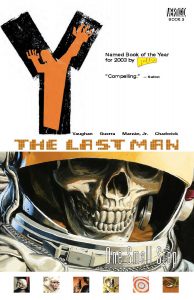
Y: The Last Man – One Small Step

The thing about nothing but graphic novels between now and next Saturday is that I’ll probably get through quite a few of them. Which means I’ll have a lot to do here. That’s not a bad thing, of course. Though sometimes I worry when I get all prolific like this that I’m just saying the same things over and over again. Probably not in this case, though, since the other stuff today was an action movie and a pretentiously dense allusion disguised as a book[1].

As for Yorick, his life goes on in the third volume of his epic tale of love and loss.[2] Being the most popular man on earth has drawbacks, though. Sure, you’re big with the ladies, but you get all that pesky negative attention too. So it is unsurprising that in One Small Step, rumor of surviving men in orbit around the earth brings a little bit of spring to his step. Nor is it surprising that his constant guardian, Agent 355, is less than pleased by the same sets of events. More men is a scientifically sound investment in the future, yes, but not at the expense of risking the one she has safely in hand to Russian spies or a platoon of Israeli soldiers. Yup, Yorick is pretty popular indeed.

Good story. Tied up a lot of loose ends. Maybe too many, because I have no idea where the story is going next. Sure, his sister is still somewhere out in the world waiting to gum up the works, and sure, they’re under the same basic set of plans from day one. Find out what happened and how Yorick and his monkey survived; find his girlfriend in Australia; save humanity from extinction. But the immediate plot is wide open now. Like I said, no more loose ends. At least for a little while. And the art has maintained quality. It’s simple, but very clear and fun to look at.

Plus, there was a nice two-issue story at the end, in very Sandmanesque style, about a troupe of traveling actors. Hardly any relevance to the main story arc, but it’s nice to get an idea of what the rest of the world is like, not just the world swirling around our hero. Because, after all, anywhere he goes? Things aren’t normal and everyday, pretty much by definition.

[1] That is not meant to denigrate, mind you.
[2] Okay, that was completely to amuse myself. And yet, it is technically a true description!

Girls: Emergence

I’m reading pretty fast lately, I guess? Must be, if I’ve already gotten to Emergence this soon after reading the first Girls graphic novel. You may recall that the little town was trapped behind an impenetrable wall with a multitude of dangers around every corner. For example: a growing number of naked clone girls who have a very specific purpose in mind for every adult they meet. The other example I would name offhand still feels like too much of a spoiler to reveal. But it’s really something to see, I can tell you that. And as the dangers grow and more people die, those who remain are failing to really grasp the fundamental nature of their situation. Until they can learn to stop turning on each other, they’re pretty much doomed. On the bright side, they’ve got two books left to figure it out. Or better yet, to start dying off more rapidly so that the story narrows its focus back down onto the handful of characters that I’m actively interested in. It was suggested to me that I would find myself annoyed at some of the bad choices they make, and that’s been absolutely true.

Really, though, I’m okay with this stuff. The beauty of the horror genre is that, on average, whoever you find yourself annoyed with for acting stupid is going to pay for it with his or her life before very long. What I’m still not okay with is the art. All of the backgrounds and animals are quite good, and yet the people leave a lot to be desired. As before, I find a lot of my time is spent trying to figure out who is which; maybe I’d have investment in more than about five characters if I could tell them apart. But the rising death toll has helped out there as well, so yay?

This would make a really good sci-fi horror movie, as long as it doesn’t go terribly wrong plotwise. And with one notable exception, it wouldn’t even require that much of an effects budget. So that would be pretty cool. I’m ready to watch it now. (Well, not right now. But if I heard it was coming out, I’d finish the series right quick so as to be ready. So don’t delay production on my account; I’ll be fine.)