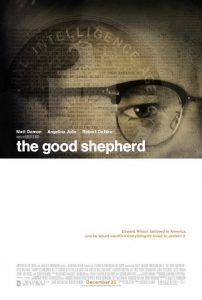
The Good Shepherd (2006)

I went to a lot of movies this weekend. Well, three, but three is kind of a lot, I think. One was Children of Men again, and I liked it every bit as much the second time. Another was The Hitcher, which I’ll discuss later. The first one, though, was The Good Shepherd, Robert De Niro’s largely failed Oscar-bait story of the founding of the CIA. I’ve been busy with things as well as stuff, but I also have been trying to let the film marinate in my brain juices so I could figure out what to say about it. It’s three and a half days later, and I’m still really not there yet.
Was the acting good? Yes. Did I like it? I did. Am I trying to fill up an entire paragraph with a Rumsfeld impersonation? I’m pretty sure he was never in the CIA, so that wouldn’t fit the theme; therefore, I will lie and say no. Was the movie too long? Maybe, but it’s a pretty dense subject. I think it comes down to whether you’re extremely interested in that subject, or to whether you care about CIA guy Edward Wilson’s experiences and the effect his devotion to the job had on his family, and the effect his family had on his devotion to the job. Because there’s a really good character study on the question of where cause ends and effect begins hidden in that script, behind layers of Bays of Pigs and deaf girls inexplicably going out for nights at the opera and in-depth studies of Skull and Bones, “the most secret society in America”. For the record, it does a much better job of portraying the character study than of exploring the early CIA, so if you’re after the latter, it probably is too long, after all.

Preacher: Proud Americans

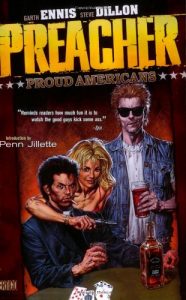
The only problem with modern graphic novels is that they fly by entirely too fast. I feel like I’m doing the art this massive disservice, even though I try my very best to linger over it. In any case, I continue to greatly enjoy the Preacher series, which as of this afternoon I am now a third of the way through. If the second volume was meant to be a reflection upon family and love, then by all means Proud Americans is an investigation of friendship and loyalty.
Preacher’s third entry begins where the second left off: Cassidy the vampire is in, er, mortal danger, and only his friends Jesse Custer and Tulip can save him. Trouble is, it’s a trap set by the mysterious Grail order, tasked with maintaining the bloodline of (familiarly initialed) Jesus Christ and interpreting the signs that will tell them when to trigger the apocalypse. Rife with fortunate meetings, fatherly reflections, fallen angels, flying bullets, Ferrari thefts, and literal fireworks, it’s not hard to see why I’m enjoying this thing so much. Sure, Jesse doesn’t get much closer to his showdown with God, and it’s possible by the end that he’s finally made an enemy he can’t afford to have. But with so many perfectly captured moments whirling through my head right now, I won’t have any problem letting myself wait a few months to see what happens next.

I’m left annoyed by what seems to me to be an unnecessary misstep, though. With so many fully realized heroes and villains wandering through the piece, it becomes lame that the few glimpses we’ve had of God leave him seeming so cartoonish by comparison. Obviously, I haven’t gotten nearly far enough into the thick of the plot to pass judgment (so to speak), but I anticipate being pretty disappointed if such a good story ends up being purposed mostly as an anti-religion wank. There’s way too much here for it to end up being petty.

Obsidian Butterfly

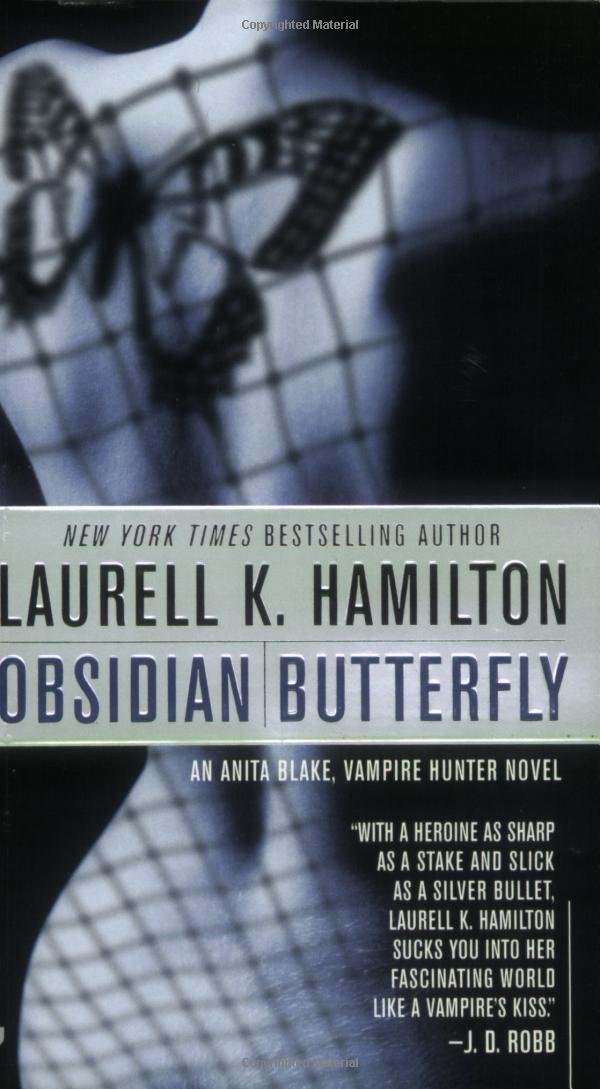
61fzp0DkFALApparently, I have read nine Anita Blake books over the past year and a half. That seems like kind of a lot, although the year and a half part brings it back down to reasonable levels. Here’s the awesome thing, though. For the first time in a little while, I really liked this one. In Obsidian Butterfly, Anita is called upon by her mysterious assassin friend, Edward, to join him in New Mexico for an old-fashioned creature hunt. They, a Native American bodyguard-for-hire, and a misogynistic German serial killer must all join forces with the local police and the Feds to track down a creature that is killing a lot of people, and skinning but leaving alive a lot of other people. Since Anita Blake’s bread-and-butter is killing the vampires, the demons, the forces of darkness… well, okay, that’s somebody else. But Anita does it too, generally speaking. If you’re unaware of her, she’s this book series chick who raises zombies to ask them questions, and sidelights as a legal vampire executioner, whenever they get too uppity and outside the law. And those skills translate into hunting down were-creatures, witches and other spellcasters, fairies, and all the other non-mythical creatures that inhabit her Earth and go rogue from time to time.

So of course I’d like that, except that lately the series has run to vamporn more than detective-y awesomeness. Which is what made this book so much better than lately. All of the ‘Who will I choose?’/’Getting my hump on is immoral, but he’s so dreamy!’/’Check out this awesome new power I have thanks to my ongoing relationships!’ stuff has been put on hold, to settle into an old-fashioned investigation and hunt. It’s possible that this reset to the early series values marks a Vampire Hunter renaissance, and I’m really going to like the next few books? It’s a nice thought.

Especially because the editing was atrocious, and having to deal with that in addition to lame storyline will make me very sad. The badness was due to repetition. If there’s one thing I really understand about this book, it’s which people have empty eyes signifying that their soul has eroded away. Because I was told about it on an average of once or twice per chapter, spread out among a very few number of characters. And this book has 60 or 70 chapters, just so we’re clear. But even worse than that are the moments when Anita monologues internally about her opinion on this person’s motives or that person’s effectiveness, and then speaks those thoughts aloud (presenting them almost exactly the same way she thought them) to some character or other that was in the room with her when she was thinking to herself, all on the same page. Speaking as someone who can maintain attention to the plot for longer than 90 seconds at a time, this was an exercise in pain. It’s possible that this speaks to just how much I enjoyed the plot, that I was only rolling my eyes at the prose rather than having it make me want to claw them out.

Night at the Museum

In case you’re wondering, there are two factors that led me into the treacherous mazes of kid movie-dom. 1) There’s only one thing I actively want to see that’s out right now (leaving aside things I’d be willing to see a second time, I mean). 2) Nearly everyone I know who isn’t me, and certainly everyone local, has kids. And since we were all free for the holiday yesterday, the obvious conclusion was to catch a flick. And Night at the Museum has seemed to be the best kid-movie option of the season. On the other side of it now, I’m willing to stand by that pre-assessment.

Still, though, it was a kid movie through and through. When you’re a dad and you’re afraid of disappointing your son one time too many… Here’s the thing. I started to say what kind of thing you do in a grown-up movie vs. in a kid movie. But let’s face facts. Unless you’re actually irredeemable, your eight-year old son isn’t going to get disappointed in you in an grown-up movie. But when you’re stuck in a kid movie and you’re afraid of blah blah blah disappointment cakes, you go get yourself a steady job as a museum night watchman, and make sure that it’s in the museum where the magical artifact of plot convenience animates all of the exhibits and skeletons and statues and so forth. Because kids dig that.

While you’re at it, may as well include a couple of pretty girls as potential love interests, a comedic fight with a monkey, and a sly reference to a certain movie from last year about the forbidden love between a man and his cowboy. Because now you have something for everybody! Okay, though, I’m being harsh now. The plot was dumb, but since it wasn’t supposed to be anything more than a vehicle for a cool premise, I can forgive that. I mean, not if the execution of the premise was terrible, but as it happens, the execution was absolutely fine. So, cool museum hijinx plus cool effects means that if you’re the type of person who has an undiscriminating kid who wants to see a movie, almost any other choice you can make right now would probably be worse.

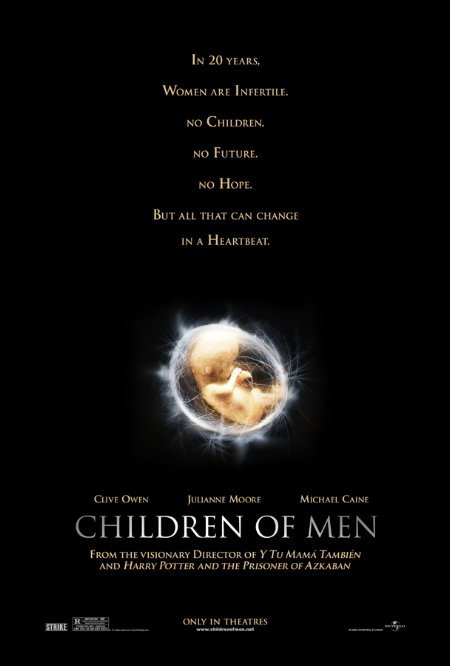
Children of Men

MV5BMTkxNDA5MTM5NV5BMl5BanBnXkFtZTcwNTYyNDE0MQ@@._V1__SX1859_SY893_I don’t have time to tell a story about the circumstances surrounding my viewing of Children of Men, because that would delay you from reaching the sentence wherein I tell you to go see it, immediately. Which, conveniently, I’ve put right here at the front, so that I can now relax and go about my review at my normal, not-as-frantic pace.

So, then. Liked it, did you? …what do you mean you haven’t seen it yet? I just said… Oh, nevermind. Fine, we’ll do it your way. In the not at all distant future, the world is rocked by the death of its youngest person. Which sounds crazy, right, because people are born on a constant basis, so how would you even know? That’s just it, though. People have stopped being born. For reasons unknown to any world government, women have become completely infertile. Even test tube materials aren’t viable. At the same time, current dystopic tropes about immigration and terrorism have been amplified by the passing years and the new situation, such that Britain is the only marginally strong country left in the world (or so they claim to their citizens), and that only by virtue of iron-fisted control over the freedoms of its people. For example, providing food to a non-citizen is a punishable crime.

Clive Owens wanders through this bleak future with only a bottle and hippified Michael Caine for companionship. And it’s likely that he would have lived out his remaining days in the same manner, except that his estranged wife reveals herself to be the leader of an immigrant-rights based terrorist group and asks him to help a young illegal to get the proper papers to allow her to reach the coast, a waiting ship, and escape from Britain. Which is not a particularly compelling story to tell, one is forced to admit, except for one exceptional factor: the girl is pregnant.

It’s hard for me to say enough good about this movie. It has a little something for everyone. Great acting all around; a compelling political statement; a perfect balance of humor; the Operative; explosions; and above all else, a fleeting glimpse of the miraculous. I’ve gotten to where I take a lot of things in film for granted, and it’s rare that a scene will leave me holding my breath and in need of emotional recovery when it has ended. So, seriously. Go see it.

The Legend of Zelda: Twilight Princess

Once upon a time, there was a lame commercial rap that currently resides in my brain in the place where I ought to be able to remember things that were actually happening to me in junior high school.

It’s the Legend of Zelda, and it’s really rad
Those creatures from Ganon are pretty bad
Octoroks, tektites, leevers too!
But with your help, our hero pulls through

And then, presumedly, there were record scratchings, rap breathing, and so forth. And the game sounded incredibly cool, despite my lack of interest in rap and my lack of knowledge as to what, exactly, a tektite was. And in the fullness of time, I found it actually was incredibly cool. And then it had a sequel, which I liked well at the time though it kind of annoys me now. And then it had another sequel which was incredibly awesome, and then even more, and all of them bottomed out at really good, with several of them maintaining brilliance. So, y’know, yay franchise. And now we have the Wii, which is like a video game system, except that instead of purposefully wiggling your fingers, you purposefully flail your whole upper body. Which translates for your average Zelda fan into actually aiming the bow, or swinging the Master Sword, or taking Princess Zelda into your arms and… okay, maybe that part doesn’t happen. Fair enough. Still, though, even without creepy video game fantasies, Twilight Princess is a good game. In fact, despite that it’s a retread of two out of the last three Zelda games with only about 20% obviously new content, it’s pretty much a great game.

Of course there are bombs, boomerang, and bow. I mean, that’s the way it goes. Except for the motion control differences, really, the gameplay is unchanged in the last five years or more. The story has a fair amount of new to it. After starting out as the young man that everyone relies on to keep the village going, Link is quickly caught up in momentous events when a band of goblins steals all of the other children out of the village and, in the same evening, a mysterious twilit fog falls, transforming him into a wolf and leaving him stranded in a world of warped and powerful beasts intent upon his destruction. (And, Princess Zelda is in danger.) Naturally, therefore, Link sets out on a quest to retrieve certain artifacts that might enable his new friend Midna, who originates from the same twilight world that is now threatening Hyrule, to save her people from that threat.

Also, there’s fishing.

Turistas

So, Halo 2, right? I’ve played it and its predecessor all the way through (good storylines, acceptable game play, frequently annoying level design), and I’ve spent a fair amount of time in the multiplayer deathmatches with my friends. Once or twice we’ve even hooked it up for 8 player team stuff, with the teams on different TVs and all. I fancy myself to have pretty solid skills, not superb or anything, but on any given day, I can win against almost any of the people I play with and wouldn’t ever lose against some of them. So, that’s cool, right? Enter New Year’s Day, in which our entire plans consisted of recover, play online Halo 2 against other folk, and eventually catch a movie. So, we laze around, download updates, get people set up, and finally it’s time to go. How good are we, you ask? After twenty games, we have a collective record of 0-20, and on only a couple of those games were things even remotely close. I’m saying we suck bad, man, too much pressure and all teeth like a shark.
Speaking of vacation plans gone awry, the movie we eventually watched was Turistas. Six tourists on a bus in Brazil are thrown together, literally, when their bus wipes out and falls down a hill. Waiting for the next bus in eighteen hours becomes too much of a chore, so they take the opportunity to wander down to a bar on a secluded beach, where they introduce themselves and their breasts to each other as well as to the natives and their breasts. Drugged booze flows like, um, wine, and they wake up the next morning without their money, luggage, even passports or shoes. Instead of wandering back to wait for the bus, they take off for the town associated with the bar to find out who robbed them. Which, of course, is when they get caught up in the organ-smuggling ring.

This movie wanted so badly to be Hostel, but with more of a moral. And, okay, you have naked people and tortured vacationers and a moral, so I suppose it succeeded? Except it left out that vital Not Sucking component that Hostel was able to hold onto. Hostel weighed in at 94 minutes, but I never felt like a moment was wasted, and the tension was on a constant increase from the first moment that anything bad happened, right up until the end of the flick. Whereas Turistas felt bloated at the same 94 minutes and probably still would have at 74, with extraneous scenes and scenes that went on far longer than I could be bothered to stay interested. Which therefore killed the tension momentum. Plus, horror? It’s not really served well by morals. (I mean, except for the moral that if you’re a teenager who engages in recreational drug use, pre-marital sex, or public nudity, a psychopath is going to come along and kill you. Who among us can’t get behind that message?)

You know who I bet liked this movie better than anyone, though? Brazil’s tourism board.

Cowboys & Aliens

I have a local comics-y friend who acquired a copy of Cowboys & Aliens and immediately thought of me. Of course, I had just started a reasonably large book, so there has been delay. But that’s alright, as I’m here now. Apparently, you can get this slim graphic novel at your local store just by buying something else, and they slip it into your bag as a promotional item, I guess? Or maybe vast quantities of overstock.

That last one fits pretty well. The art is fine, but the plot is uninspired at best: when aliens crash-land in somewhere in the Old West, cowboys, Apaches, and settlers drop their petty feud over land theft and genocide in the face of a common foe who, sheerly by coincidence and I’m sure with no thought to parallelism, hopes to steal land and commit genocide. Then they have a fight, in which people die and things explode. My favorite part (and I refer here to my least favorite part) is the opening screencrawl segment in which all of the parallels that I earlier lied were coincidental are spelled out in excruciating detail before the book proceeds to unsubtly (but much more forgivably) present them via the plot. Explicitly, at one point.

In case you’ve missed it, though, I’ll go ahead and mention it a fourth time, now. Whitey rampaged through North America during the 19th Century, not for the first time, but the most aggressively and rapidly of any post-Columbus period. It’s possible there was something morally questionable about that, as presented by the Golden Rule, aka alien invasion. There. Now you’re probably prepared to read this, in the manner the authors were hoping for you to be. To end on a positive note, though, the cowboy hero’s name is Zeke. Which you must admit is a pretty awesome name. (I mean that. Don’t make me get a court order.)

Lisey’s Story

It’s pretty much a coincidence that there are two Stephen King books in a row, as they were read concurrently rather than consecutively. Anyway, in its bid to prevent me from reading fifty books before the end of the year (well, really it’s more my job and move that have prevented that, but it gave me an opening, so, y’know, whatev), we have Lisey’s Story. It tells… well, I guess it’s kind of obvious what, right? Lisey is Lisa Landon, for two years now the widow of reasonably famous author Scott Landon, late 20th century literary darling who the world never really knew; that was Lisey’s job. It’s her story and his both, because every long marriage is the story of both people. But it’s also the story of how there’s only one of them left, and all the small and large ways in which that is hard, and all the small and large ways in which other people make it harder.

Lisey has a lot to deal with over the course of the hot summer of 2006. There’s the ongoing issue of her husband’s death, made concrete by her gradual attempts to clean out the office where he did his writing. There’s her mentally unstable sister, and the fact that the remainder of her sisters look to her as the solver of all problems, possibly because of the money but also because she’s long been the strongest of them. There’s the latest in a string of literary professors and critics who are salivating at the thought of Scott’s last papers being made public and being donated to this or that university, and there’s the man this latest professor has hired to “convince” her to speed up the process. And although his motives are far more dire than that worthy professor could have guessed, even he may not be as dangerous to Lisey as her recollections of Scott’s childhood and the secret world to which he would escape from time to time in those years and continue to visit throughout his life.

Although most all of King’s novels have some elements of horror to them, this one is not explicitly horror; it’s solidly entrenched in the dark fantasy genre. Everyone will tell you that it reveals the secret languages and shorthands that all long-lived marriages have, and explores the good parts and the bad with an equally objective spotlight. I’ve never been married, much less for a long time, so I couldn’t say whether they’re right. But it feels true.

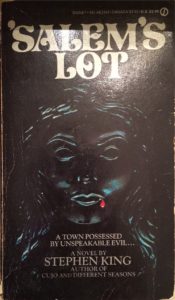
‘Salem’s Lot

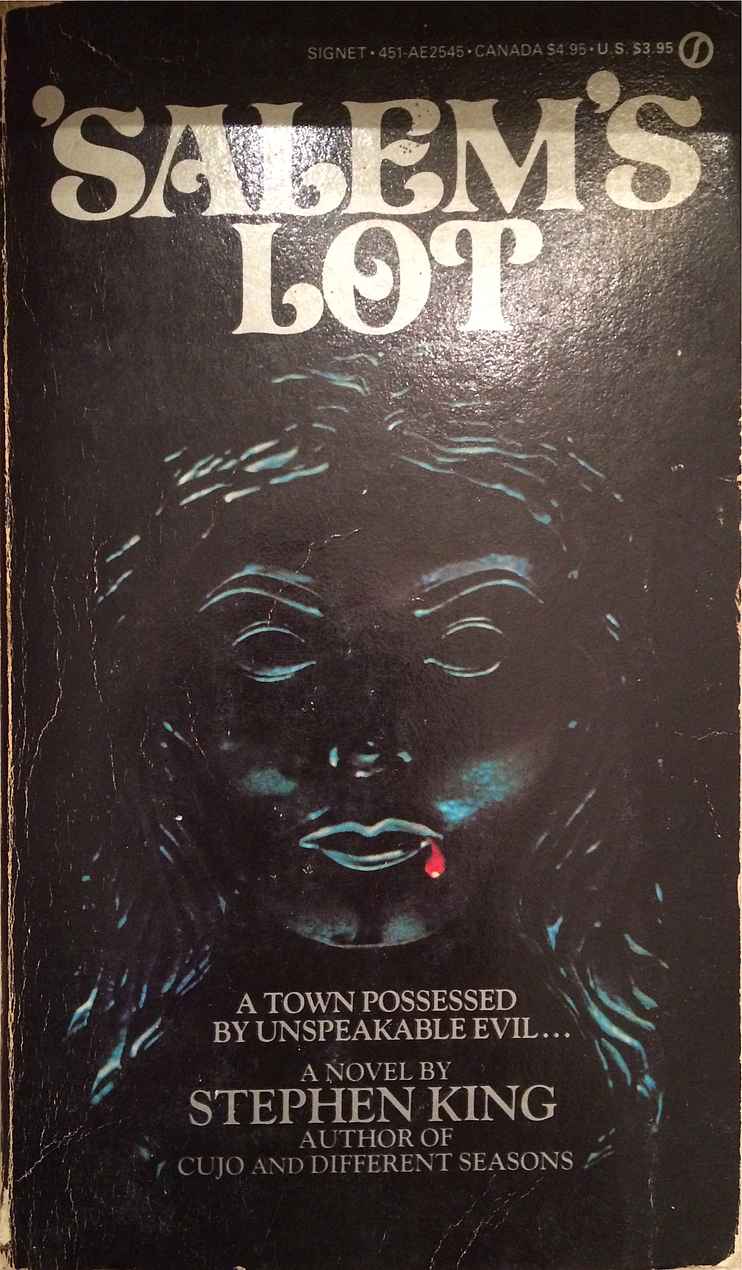
Sometimes you have to go out on a limb and say something is the best, even though you’re invoking a hotbed of controversy rivaled only by that of internet geeks arguing about who would win in a fight between Picard’s Enterprise and the Death Star. It’s an entirely different controversy, I’ll admit, but when you’re rating the best in vampire creativity, there are definitely people who will be every bit as passionate on the topic. For example, best vampire TV show? Buffy the Vampire Slayer, no question. But I know offhand of one person who reads this who will immediately disagree. Best vampire movie? I tend to put my money on Fright Night, despite the pretty terrible name. Then there are books. Blah blah blah Anne Rice cakes (and then there’s the Anita Blake vamporn I’ve been reading), but where I have a really hard time is with Dracula. Because that is a damn fine piece of literature. And yet, I must go where my taste leads me and pick my personal favorite. Thusly, ‘Salem’s Lot.

It’s possible that, insofar as the story is about the town of Jerusalem’s Lot more than it’s about vampires, I am making an unfair judgment. Because, really, it’s an excellent study of a small town in decline far more than it’s a vampire story. (Well, I say that, but almost everything I know about small town New England I learned from Stephen King, so if he’s actually not an authority on the subject, then it would probably be impossible for me to be more wrong about my current related assumptions.) So, you’ve got this pleasant little town, not too much industry but enough to not dry up, most of the people know most of the other people, and most of them are friendly toward one another. It might be on the edge of the metaphorical cliff, but it’s got good balance, so long as nothing shoves too hard.

Of course the shove has to come, though, or you don’t have a story. More traditional books on the same basic topic might toss out, at this point, a contentious election cycle or a sudden land bust. Or, particularly luridly for the type, a kidnapping or a murder. In King’s case, we have something seemingly more innocent. Nothing more than two men that have been set on a collision course as if by the guiding hand of fate. (Ha ha, that’s my little joke, see? Because it’s a novel, and has certain plot requirements.) On one side, author Ben Mears is returning to the home of his childhood to exorcise some demons, answer some questions of himself, and put together his next book. On the other side, furniture salesmen Barlow and Straker, who would seem substantially less portentous if one of them was not a vampire. And in the middle, high on a hill overlooking ‘salem’s Lot “like some dark idol”, the Marsten house, site of a childhood trauma for Mr. Mears and, some decades earlier, site of a murder/suicide perpetrated by owner Hubert Marsten; most recently, it is the residence of choice for Mr. Barlow and his associate. After all, he was invited by Hubert Marsten, in the months before that fellow’s grisly demise. Well, and there’s also the kidnapping/murder. King has never shied away from the lurid. But that’s more an effect than a cause, really.

Provided players and a stage, all that is left is the determination of which people will choose a side and which people will have a side chosen for them by the rapidly spreading vampiric disease. And then, of course, the attempt by our heroes to fight back and save ‘salem’s Lot. And that part has a lot in common with the best of vampire literature, so really the only difference is the town itself. And the town is a place worth knowing, because, at least for now, it lives. And there aren’t a lot of settings that really live, for me. Anyway, it’s been out for thirty-one years. If you haven’t read it by now, don’t you think you ought to?