Ultimate Iron Man

To my surprise, the copy of Ultimate Iron Man I found used a few months ago is unlisted at Amazon. I had intended to say that it’s practically unfindable, which probably says more about my perception of Amazon’s ubiquity than of objective reality. Nevertheless, I did find it and read it, and in a continuation of recent comic trends, it’s written by someone who’s far more famous for doing something else, in this case for writing Ender’s Game. So that’s good, right?

I mean, it’s not like it’s bad. I’m not convinced it really matches what’s going on in the rest of the Ultimate universe, which may or may not matter. Instead of a re-envisioned telling of the Iron Man story (as portrayed well but with a lot of room for expansion in the Ultimates books about which I’ve raved so extensively), we’re given a straight origin story, one that has nothing in common with the 1960s version. I shouldn’t ought to complain about that, but the others have drawn so heavily from the well that this stands out. What is worse, though, is that it’s really not all that heroic, neither literally nor in scope. It’s mostly corporate espionage coupled with biological industrial accidents, disguised as a coming-of-age story in which not much age is, er, come of.

Maybe it was kind of bad after all? It just really didn’t go anywhere, the suit felt like a tacked-on afterthought, and then it failed to have an ending. I guess I’d read the sequel if it fell into my lap, but only because I know it won’t be very long, as is the wont of these kinds of books; and because maybe the next bit would have an ending. Still and all, I kind of hope it doesn’t fall into my lap. I could use the time rereading Ender’s Game, for example.
Ultimate Spider-Man: Public Scrutiny

Spider-Man, right? Short review: still awesome.

Slightly longer review: in Public Scrutiny, Peter has to deal with identity theft, romantic troubles, and bullets. I’m having more and more trouble being able to describe why that works so well, when it looks so dumb on the page. There’s just something about this normal, everyday kid who wants to save the world now that he can, except he can never seem to catch a break. I guess that at the same time as you’re rooting for him, you can’t help but feel better about yourself?

I should say that, despite the short review above, this is the weakest volume so far. It’s still better than most of the Ultimate X-Men I’ve read, though, except for a plot hole large enough to drive an armored car through, regarding the web fluid. I guess it would be a spoiler to elaborate? But trust me, it was ridiculous.

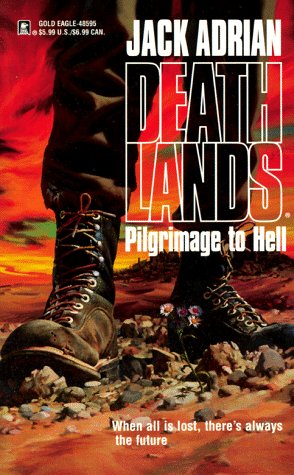
Pilgrimage to Hell

Over the past year or more, I have become more and more intrigued by a pair of series by a mythical author, James Axler, that I keep seeing on the shelves at Half-Price Books. The problem is, they run back several years, and of course the first one is never available. Right? Right? Wrong, as it happens! Not only did I find the first one, I found the first one of the older series. Unlikely, and yet I am standing here before you today to swear it is all true. The odds of finding the other first book, or this second book… but still, one takes what one can get.
Pilgrimage to Hell was written in 1986, and except for failing to predict the collapse of the Soviet Union, it handled the next dozen years fairly well. And then, of course, nuclear apocalypse provides the stage for our story, a century later. The face of North America is drastically changed via biological and chemical weaponry in the South, dramatically altered weather patterns in the Southwest, nuclear bombs along faultlines having effectively removed the West Coast, and so on. Pretty much every aspect of life is ruled by what guns you’ve been able to maintain, find, or buy. Which is why the Trader and his army are so well-regarded and so feared; he has made a career out of finding hidden caches of weapons, munitions, vehicles, and gasoline that predate the Nuke, and then taking them around and selling them to help people protect themselves from the environment, the mutants (both human and otherwise) and each other.

Of course, despite the sci-fi underpinnings and overtones, at heart it’s one of those men’s adventure type things that spends entirely too much time describing the make and model of a gun being used, the quality and quantity of brains being expelled from an exploded skull, the heft, curvature, and coloring of a pair of breasts. But surprisingly, there’s a pretty well-told tale underneath all that, with Jungian archetypes all over the place. I’m serious: this guy Ryan finds a girl who knows how to get to a utopian promised land beyond the Deathlands, has the Trader as a father figure who (spoiler alert) is not long for this world, and goes through a giant metal door in order to take his first real step along the path to this utopia, but only after defeating a guardian beast who is (and I’m still serious) named Cerberus. So, okay, it’s a hamhanded usage of Campbell’s resonance road-map, but that still leaves a lot of room for being fun and interesting in the parts of the map that aren’t as detailed.

I don’t know if I exactly recommend it, because you probably already know exactly what intersection of enough apocalypse porn and sufficient lack of gun porn is right for you[1]. But for my part, it was a pleasant surprise that leaves me forced to keep on searching for the later volumes.

[1] Please note: as far as the porn porn, except for the lead chick being described in lusting detail, the women are each and all as capable as the men at every turn, so it probably isn’t nearly as bad along the feminist axis as you were expecting, and pretty much unique among books in this category that I’ve read for being so evenly written.

The X Files: I Want to Believe

To be perfectly clear, the new X-Files movie didn’t have very much to offer a newcomer to the series. It avoided the pitfall of delving into the series’ long-winded mythology that, on TV, ultimately failed to deliver on any significant portion of its promise, instead opting for the much stronger “Monster of the Week” oeuvre that popularized the show in the first place. This episode (or movie, if you will) pits Mulder and Scully against a possibly psychic priest and gay Russian organ traffickers in the wilds of West Virginia. And in all honesty, it’s a pretty good episode, at that.

Where it fails for the new viewer, and therefore as a movie in general, is that it cannot escape nine years of collected backstory between the principle characters. And with as many old viewers as were dissatisfied by the conclusion of the series, it had to be open to some new viewers to have even a chance of success as a movie. Which is not to say that I think it was in any way a failure as an episode. As easy as it might be to make a joke[1] that the title is a quote from Chris Carter, “I Want to Believe that I can make some quick money off this and remind people that I am alive,” the truth is that, buried underneath all of the accumulated continuity, there is a deep and thoughtful exploration of two people who have lost or are on the verge of losing their belief: in God, in the presence of the truth, out there somewhere, in themselves, in each other. And it’s not like the theme of belief is limited just to our heroes.[2]

In short, the crew came back together to make a good movie that you will probably never watch, and that you’ll, for the most part, be right to avoid. It’s unfortunate, but these things happen every day, I guess. On the bright side, I think it makes for a pretty good (albeit unintentional) coda on the series. As a fan, I can live with that.

[1] I am willing to bet that someone already has, and probably weeks or months ago.
[2] Billy Connolly in particular as the fallen (in an all too modern way) priest: wow, the depth of a) theme and b) acting.

Fables: Storybook Love

The third collection in the Fables series is clearly a transition point, with two distinct storylines that collectively do a great deal to change the face of Fabletown, as well as a pair of actual fables, stories that have occurred since the exile from the homelands began. In the first storyline, a mundane reporter has discovered the collective and its immortality, with fallout and consequences for all concerned. In the second, Storybook Love, enemies that Bigby Wolf (the sherriff of Fabletown, you’ll remember) and Snow White (its day-to-day administrator and deputy mayor) have recently made come back to haunt them, with, once again, fallout and consequences for all concerned. Only, a little moreso. Plus, Prince Charming gets tired of his free-wheeling lothario lifestyle and sets the wheels in motion for a political power play! Dramatic!

Hints of the inevitable on-screen confrontation with the Adversary crowd the wings, but the main stage where Bigby and Snow are advancing their relationship by what I’ll charitably refer to as incremental degrees is where the show is really at. The occasional noir bent of the series helps my case here, but I’m unable to avoid spotting the influences of Moonlighting on this series. Which is a really odd pair, don’t get me wrong.

The one-shot actual fables that I mentioned earlier, by the way, were both pretty decently put together, though probably forgettable in the long run. (Unsurprisingly, I like Gaiman’s Death better than Willingham’s.)

Ultimate X-Men: Ultimate War

This latest UXM title continues the trend of improvement while at the same time falling terribly short of the expectations Mark Millar has set in his Ultimates titles, a fact advanced from sad to ironical by virtue of the fact that Ultimate War is plotted as a battle between the X-Men and the Ultimates. Set between the first two Ultimates volumes (you can tell because Quicksilver and the Scarlet Witch are recruited to the Ultimates’ ranks here), the X-Men are being hunted down because Professor X made a possibly understandable but ultimately flawed choice regarding the fate of Magneto, some months back. Now that Magneto is on the loose and running his mutant terrorism organization again, well, mutants in general and Xavier’s X-Men in particular are once again in heavy political disfavor. As a result of which: battle between superhero teams. It’s a common enough trope, but the intelligence of the writing mostly makes it work well.

Or perhaps I’m just easily impressed by the X-Men being decently written instead of terribly? I can only hope the trend continues, either way.

The Ultimates 2: Grand Theft America

With this fourth volume of the Ultimates series, Mark Millar has done something amazing, and all the more amazing because of how unimpressed I’ve been with his take on the X-Men and the Fantastic Four. He’s capped off an already impressive sequence of stories with what is clearly the strongest entry, and he’s managed to be politically relevant without edging far into preachiness at the same time. I can’t help but reflect on my (currently stalled) readings of late 1960s Marvel comics and feel like this modern take is very much in keeping with the early days of the brand. Which pleases me.

Grand Theft America chronicles a masterful plan to cripple the United States and her super-human defenders in one stroke, with assistance from sources that might qualify as expected or entirely shocking. (I know I had one of each.) And they’re playing for keeps, so don’t expect anyone to be safe, emotionally or physically. I really can’t say anything more without digging far too deeply into plot spoilers, but, wow. Best superhero comic I’ve ever read, I think it is fair to say.

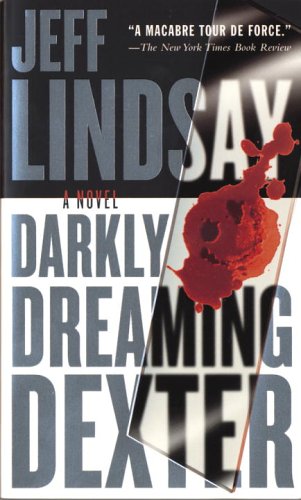
Darkly Dreaming Dexter

51Q3J1TK9TLSo there’s this guy, Dexter, right? And he’s a CSI guy in Miami, analyzing blood spatter patterns to determine facts about murders. And he has a TV show, which I have watched two seasons of now, and which first season was based on a book that I have recently read. The thing about Dexter is, his off-hours job is to be a serial killer. Many people might find that to be distasteful reading material, but Dexter, see, he’s not like other serial killers.

As the first season of the show and Darkly Dreaming Dexter explain (in very similar, but eventually divergent, ways), Dexter is different from other serial killers. He was adopted by a cop who saw the darkness inside the growing boy, understood what it was, and chose to channel it in constructive ways rather than doom him to a lusterless existence in the mental health system. Dexter has a code that he follows, in which he only murders people who are themselves killers, and he only acts when he is completely certain of their guilt. And that life has worked out pretty well for him: he’s able to fake charm while making use of extensive wit, maintaining shams of relationships with co-workers, his sister, and a girlfriend; and every few months, he strikes again. All that is about to change, however, with the appearance of a new serial killer in Miami, one to whom Dexter feels a disturbingly close bond. (When the guy who stalks around murdering people, even really bad people, is disturbed? That can’t be good.)

What makes the Dexter series stand out from the stacks of murder mystery books and shows out there isn’t that he’s a serial killer himself. Well, okay, that does make him stand out, but what makes him appealing to me is how very funny he is. And the way he views people, and views himself as a separate species from them. What could have been a weakness of the show in copying so closely from the book feels more like a strength to me: that they managed to capture the First Person Bemused viewpoint Dexter brought to my reading experience. In any event, very good book, and slim enough to easily read much more quickly than the show could be watched. But if anything, I’d recommend doing both.

Mouse Guard: Fall 1152

It was my birthday, not so long ago, and I received a fairly random graphic novel about some mice, right? Just lately I’ve read it, and it was pretty okay. Mouse Guard: Fall 1152 chronicles the doings of several members of the Mouse Guard over the course of the Fall of 1152. (I’m more proud of that than you might imagine.)

But seriously, there’s a hidden society of mice, and for the purposes of transportation and trade, the Mouse Guard keeps the roads safe of enemies: weasels and cats and so forth. The map indicates that they’ve found a way to turn back large predators from their terriroty via a scent barrier; it’s clear that the world has more depth than was presented in this original book. However, all is not well in mousey-town, as someone has snuck out a map of the home city of the Guard for the purposes of villainous treachery.

The art has a very A.A. Milne or Peter Cottontail feel to it, just slightly cartoonish versions of real animals[1], but since everything is at mouse-scale, the occasional marauding snake or crab is quite exciting. The story’s pacing and spare prose adds to my impression that it was meant to be a kid-book. And believe me, it’s a pretty good one that a new reader would get a lot of enjoyment out of. I got probably 50 pages of enjoyment out of the 192 page book, myself. The story was fine, it was just widely paced, like I said. But the art made up for most of that. I just didn’t expect to finish quite that large of a book in a single day around my unreasonably crowded work schedule.

[1] To the extent that mice wear cloaks and carry swords. Which I assume is a very wide extent indeed.

Buffy the Vampire Slayer Omnibus, Volume 3

Remember how I was highly meh on the second Buffy Omnibus of old comics? Unexpectedly, I did in fact find volume 3 used somewhere. So, hey, why not? Answer: because it’s kind of the opposite of what is good. They apparently were struggling to keep up with present day in the series despite not having nearly enough information about the direction of things. The comic is set in season 3, with which it was published concurrently. So they were (self-reportedly) struggling to figure out what was going on with Angel and Faith, as well as the show in general. It’s not that I mind the comic going episodic, despite the arcish nature of the show being one of its strengths; what I mind is how easily they could have agreed to stay a season behind and get things right instead.

I understand that this was right at the beginning of the comic’s creation, and I trust that things will improve: after all, I’ve seen a little bit of those improvements in the first couple of volumes. But for the most part, I regret the hour or two of time I lost, even after getting it in excellent condition at half price. The art and the storylines throughout most of the book are, well, amateurish. The characters frequently don’t ring quite true. The worst part, though, is that the improvements were starting to hit right at the end of the book, as though maybe the fourth one could be better from page one.