Knight and Day

I learned recently, and probably on the Daily Show, that Tom Cruise is a little bit of an adrenaline junkie, and thusly does as much of his own stuntwork as he can get away with. This is unfortunate, in that it ruins an otherwise accurate (albeit not punitive) claim that Cameron Diaz acted opposite his smile in the latest disposable summer action-comedy, Knight and Day. And man, do I ever wish I had more to say. I mean, it was good, right? Closer to cotton candy even than popcorn on the scale of movies-as-meals metaphors, but good. The actiony stuff was suitably actiony, the comedy was funnier than just that which appeared in the previews, the plot was reasonably well grounded[1], and Ms. Diaz’ lead character grows into the role of agent of her own destiny; I can’t even complain that she didn’t start that way, since she started the movie as a normal person chosen by a James Bond type as a dupe for his latest batch of spy games. So, y’know, nothing to complain about at all! But still, my overall sense of the thing is as delicate as spun sugar, and I’m sad to report that it will not someday be looked back upon as a classic of the genre.

Unless maybe that thing where a girl in an action movie developing her own agency is less common than I suppose, in which case that part should stand out over time.

[1] You can’t say it was grounded, full-stop, because, action movie. Right?
Ultimate Wolverine vs. Hulk

At long last, the weird forgotten story that languished for a few years in developmental hell even as the rest of the Ultimate universe was being tied up in a neat (by which I mean Gordian), tidy (by which I mean murderously violent) bow (by which I mean bow). After Ultimate Wolverine vs. Hulk, which I would for my sanity place after Ultimates 2 ended and before any of the Ultimatum prequel-storylines, I will be explicitly in the “after we killed the Ultimate Universe and launched a new line of comics” territory, which is physically marked by my buying them in hardback graphic novel instead of paperback. Plus also, I’m almost completely caught up and will soon run out of new ones immediately available, which is a strange feeling all itself.

As for the story, well, the title kind of covers it. There are definite twists along the way, plus also pointers to Logan’s fate in the post-Ultimatum landscape, neither of which I have any interest in spoiling. I can say that series author Damon Lindelof, famous as an integral part of Lost’s creative team, is clearly the same guy you would expect to have written both things. He plays with the narrative structure pretty much from start to finish, calling it an effect of Wolverine’s constantly tampered-with memory even though we all know it’s an excuse to tell the story out of order for dramatic effect. I have no problem with that, and I guess I can see why he felt obligated, in a world he never made didn’t create, to come up with an excuse for why it was happening, but mostly what I think instead is, come on dude, we know you did this only because you think it’s awesome, so why pretend there’s a valid in-story reason?

Anyway, though, Hulk and Wolverine? They totally versus each other, way more than that time when Iron Man was supposed to but it turned out pretty much entirely otherwise. Truth-in-advertising for the win!

Reaper’s Gale

If you’re wondering where I’ve been all this time, it’s a fair question. I mean, I’ve been wondering too, and this is speaking as someone who knows! But to answer you, no, I don’t have an incredible backlog of stuff that I need to get out in a rush, before I forget every little remaining detail of all those books. This is because, quite simply, I don’t have any backlog at all. I’ve been behind this one Malazan book the entire time. And after all this time, the better part of a month, I don’t have a lot I can really say. Reaper’s Gale is the seventh book of a ten book series, and it’s not just that I’d be worried about spoilers (although I would), it’s that it’s really no longer possible to describe the plot in meaningful terms to people who aren’t fellow readers, and I know there are not very many yet.

What I can talk about is the gamut of emotions each new book brings.[1] First of all, there’s the vividness of it all. I can cackle at one scene, cringe at the next, and feel terrible at the (almost never overblown) pathos of the random vagaries of life in a third. I can watch a genocidal war prosecuted and not really hate any of the characters involved in it even while feeling the horror, not just at the fact of it but at the separate fact that the characters know what they’re doing. It’s not just that almost every character is likeable in his or her own way, it’s that the entire series is most heavily concerned with redemption, and it’s available to everyone who really wants it. Happiness is often fleeting and never guaranteed, victory is as changeable as the sands of the desert, and justice, well, it turns out that justice is out there, but since I would link it with redemption, that just makes sense.

At the end of each of these books, I am torn between wanting to dive ahead and knowing that I have to move on to something else, and frankly wanting that pretty badly too. But sometime in the next few years after I’ve finished the series and let it settle, I’m going to have to go back and read the whole thing in a row, even though it will take me half a year or better. Not because I don’t remember what happened, but because I want to see how things look in development when I know how they will end. If you had asked me, I think I would not have predicted being this attached to a doorstop fantasy series that defines itself by who has died.

[1] Or at least what this one brings; after all, it’s been a while since I read any of the others.

Jonah Hex

Here is what happened in Jonah Hex, an improbably short movie that I saw yesterday. And I mean that sincerely, it was no more than 80 minutes if you do not count the credits. (Maybe only 70.) Anyway, there’s this guy in the Civil War, right? And he loses his whole family when another guy betrays a platoon to enemy soldiers. So the guy (played by Hollywood newcomer John Malkovich) plans elaborate revenge against his nemesis, a deformed necromancer who keeps the company of drunks and prostitutes and makes a point of blowing up basically every location he visits. Also, in a side plot that doesn’t make a lick of sense under even the mildest of scrutiny, there is terrorism afoot at the United States centennial celebration!

That said, at least Megan Fox looks pretty much the way you’d expect her to in her ubiquitous corset.

The A-Team

Do you know, it’s been since Monday that I saw The A-Team, and yet, still nothing here? It turns out that my job keeps me pretty busy all the time even when I’m not answering customer calls, much less on days like today. But I’m free of that now, and all my other obligatory writing for the week is complete, so I suppose I ought to get a move on, right? Anyway, here is where my shock kicks in. Because, and especially after I saw The Losers, I could not bring myself to believe this would be a good movie, right? I mean… let me adjust expectations here. If you’ve ever seen the TV show upon which it is based, you understand that the critical acclaim aspect of “good” does not apply. It’s a popcorn movie, with far more loud explosions than moments of soul-searching, and if the plot is action-movie convoluted, it is no more than that. So, y’know. But my point was, The Losers covered the same basic subject matter as this, and how can you believe there will be two good movies of the same type in a row?

But even before I saw that, this one is another retread of an ’80s property, and those have only gone so well[1], really.  But the thing is? It had the perfect philosophy about itself, plus a really good cast and a good budget on, y’know, explosions. But mainly the philosophy part, as that’s where it would have gone terribly wrong, if it had done. Plot summary: well, it’s an origin story to fill in the gaps around the TV show’s introductory blurb, week after week. Which is to say, there’s this military commando unit that is known for completing missions in brilliant and insane ways. But then they are sent to prison for a crime they didn’t commit, and must break out to prove this and clear their names. That plus explosions and quips? It equals your movie. Which, not to belabor a point, might have been generic nostalgia and nothing more except for that pesky philosophy, which was placed into the mouth of the main character, Colonel John “Hannibal” Smith[2]: “Overkill is under-rated.”

Try and tell me you need to know anything else about the film to decide whether to go see it. I dare you.

[1] Where “so well” is a bar that more closely resembles the word’s noun than adjective form, if you see my point.
[2] Here I crib notes from the Fresh Air review and must agree that it’s cool that Liam Neeson has re-invented himself as an action hero lately. Good for him!

Splice

Here is the main thing you need to know about Splice: it is being mismarketed in the previews as a horror movie. It is occasionally scary, it’s intensely psychological, and it has a moral component big enough for any three normal movies. But except for an unfortunate five minute interlude near the climax of the film, it is decidedly not horror. The real problem is that I’m not exactly sure what else to say; my options seem to veer between massive spoilers and convincing people that they shouldn’t watch it, neither of which would be my intention and both of which seem likely if I really tried to explain it. I’m pretty sure I can manage to dodge the spoilers, but the other part will be trickier.

So, what happens is, there’s this genetic engineering lab being funded by a pharmaceutical company, and the two lead scientists are rock stars in their field, even on the cover of Wired, for their work in splicing various genes together to create new organisms with solid pharmaceutical applications. Also, they are a couple because of how a man and a woman cannot simply be professional colleagues in a movie. (Or, it occurs to me, in comic books. But as this would be a messy digression, I’ll stop now.) Then, like you would probably expect to happen in a sci-fi morality play, they decide that it’s time to up the stakes by including human DNA into their splicing experiments. This is successful via the power of montage, and from there forward what you have is a movie. The thing is, it’s a very disturbing movie, and although I’m glad I saw it and would even say I liked it, I don’t think I want to see it again anytime soon.

Which is exactly the concern I had, because I feel like this was a very successful film in several ways: emotionally affecting, structurally sound, and technically excellent all three. Although I’m not convinced the masses will really understand[1] the distinction, I feel like they did an especially good job by portraying the moral component strictly via the  characters and their actions, never really focusing that hard on the idea that the creation of Dren (the putative star of our drama) had a positive or negative moral component at all. Which, to bring it full circle, is another way I think the previews / marketing have failed the actual movie, though again, I doubt the viewing public will realize that particular “moral” dimension was disregarded so thoroughly.

[1] Then again, the masses won’t go see this movie anyway, so I may not have a point here after all.

Robin Hood (2010)

Last night, I learned something obvious about the new digital projector systems that are gradually being rolled out to every screen in America, signalling the death of spools of film stacked man-high in old Hollywood basements and an inability for my children to understand what’s going on during the climactic scene of Inglourious Basterds; if my life had taken a small enough turn somewhere in the past 15 years or so, I would mourn this far more than already I do, but luckily I only collect books, not spools of film. So, the obvious thing I learned about digital projectors, though? It’s that they can crash. Also that, less obviously, their crash screen is colored digital snow. And then you suddenly get free passes to the theater! So in many ways, the downside was not so much of a much, but I can imagine it happening in a fuller theater, for a newer movie, and actually during the movie instead of at the end of the last trailer, and man, that would be a pretty miserable day for the theater. It’s not like film projectors don’t run into their own problems or anything, I can just tell I’m living in the modern era when my movie had to be rebooted.

I will not make a clever “speaking of reboots” segue here, because the thing about Robin Hood is that it’s always a reboot. It might be on TV sometimes, and they make movies every so often, but each iteration is distinct. It’s just, this one was more distinct than usual. That said, it was a pretty interesting take. Basically, the story is written for maximum veritas, the kind of story you might have heard peasants telling their children before memory became the legend we know today. This accounts well for some of the oddities of the story, such as why a land-owning noble would have been an archer instead of a knight. Within these historical-minded confines is a pretty decent story of political betrayal, war, and romance. Just be aware that at some point there’s going to be a pre-enactment of D-Day performed with longbows. As long as you can swallow that, the rest of the movie should be just fine.

Also, if you are unfamiliar with the basic Robin Hood story such that you needed a more plot-minded review: really? I mean, really?

Astro City: Family Album

An inevitable downside of reading books back to back[1] is that I’m forced to make comparisons that I might not make if there was a several-month gap in between, per the usual. In this particular case, I am forced to admit that Family Album does not have the strength of the first volume. …and, apparently that it is itself the third volume, not the second as I had believed? Note to self: stop borrowing graphic novels, as you are apt to read them out of order! (In everyone’s defense, there are no numbers on the covers or for that matter inside, so I can see how it happened.)

Well. That was disheartening. Anyway, the stories were a mixed bag. Even though they have been universally fun and well-drawn[2] throughout, I cannot help but notice overly intentional comparisons to familiar comic book heroes. And it’s not like these comparisons are badly created or even particularly derivative. The respectful homage is clear, it’s just that it pulls me a little bit out of the story when I catch myself saying, okay, yeah, that’s definitely the Fantastic Four, nice twist in the family dynamic here, I see what they did with the enemies there, and so on. And as that is certainly my biggest complaint for the book, you can see by its size that in general things went quite well. The big theme of the book, children in unusual family situations, covered three stories that simultaneously gave me a lot more background on some already familiar heroes. And of course there’s always something new around each corner.

It’s just… it didn’t have the bright shiny sense of wonder of the first volume, that feeling that, whoa, they’re really pulling this off. Instead, I’m already into the “What can you do for me next?” phase. Which is clearly my fault, but like I say, I would’ve been better off if I had just read it later than now.[3]

[1] This is a thing I am noticing, rather than a reason why I never do so; still my policy is clearly correct, as is now shown.
[2] Both ways
[3] And in the right order.

Astro City: Life in the Big City

Never let it be said that I do not leap to grant the wishes of my loyal readers! Or at least, that serendipity does, ’cause my semi-boss semi-randomly loaned me the first two volumes of the Astro City series within a day of when lots of people here recommended I read it soon. And I put loaner books on the top of my reading queue, as you do, which means I have already read one such, and the other is not all so far behind. Astro City has a thousand stories: Life in the Big City is a very episodic series of vignettes about six of them. And they’re really all quite good, but I think the whole exceeds the sum, because they are merely “quite good”, aside from the first one which is basically a meditative work of genius on the negative sides of being a hero.

But taken as a whole, the book has to accomplish a lot of things in a very small amount of space. It introduces an entire world with decades of history, and, okay, since there are decades of comic history and everyone always starts these parallel worlds back in the late ’30s when the superhero comic was born, I suppose it’s fair to say that people have a frame of reference there. But in addition to the world itself, it introduces decades of heroes and villains, tragedies and triumphs, all of which I have learned only enough about to know for a fact that I want to learn more; and yet I will almost certainly never accomplish more than scratching the surface. This is the kind of depth you can’t always count on getting out of multiple volumes of doorstop fantasy series, and it’s just scattered around like leaves in the fall, underfoot and part of the landscape, barely remarked upon from one vignette to the next. And I guess this is why I’m so impressed, because it has the feel of a new author writing stories in a world that has actually existed with decades of continuity all along, this being just the current batch of events; except for how that continuity does not in fact exist. And then the stories themselves take you from the petty to the profound, the average to the alien, and obviously not to every stop along the way, because that would be stretching the metaphor and the praise both a little thin. But at the same time, I can’t help believing that if the series went on long enough, “every stop along the way” would be entirely possible.

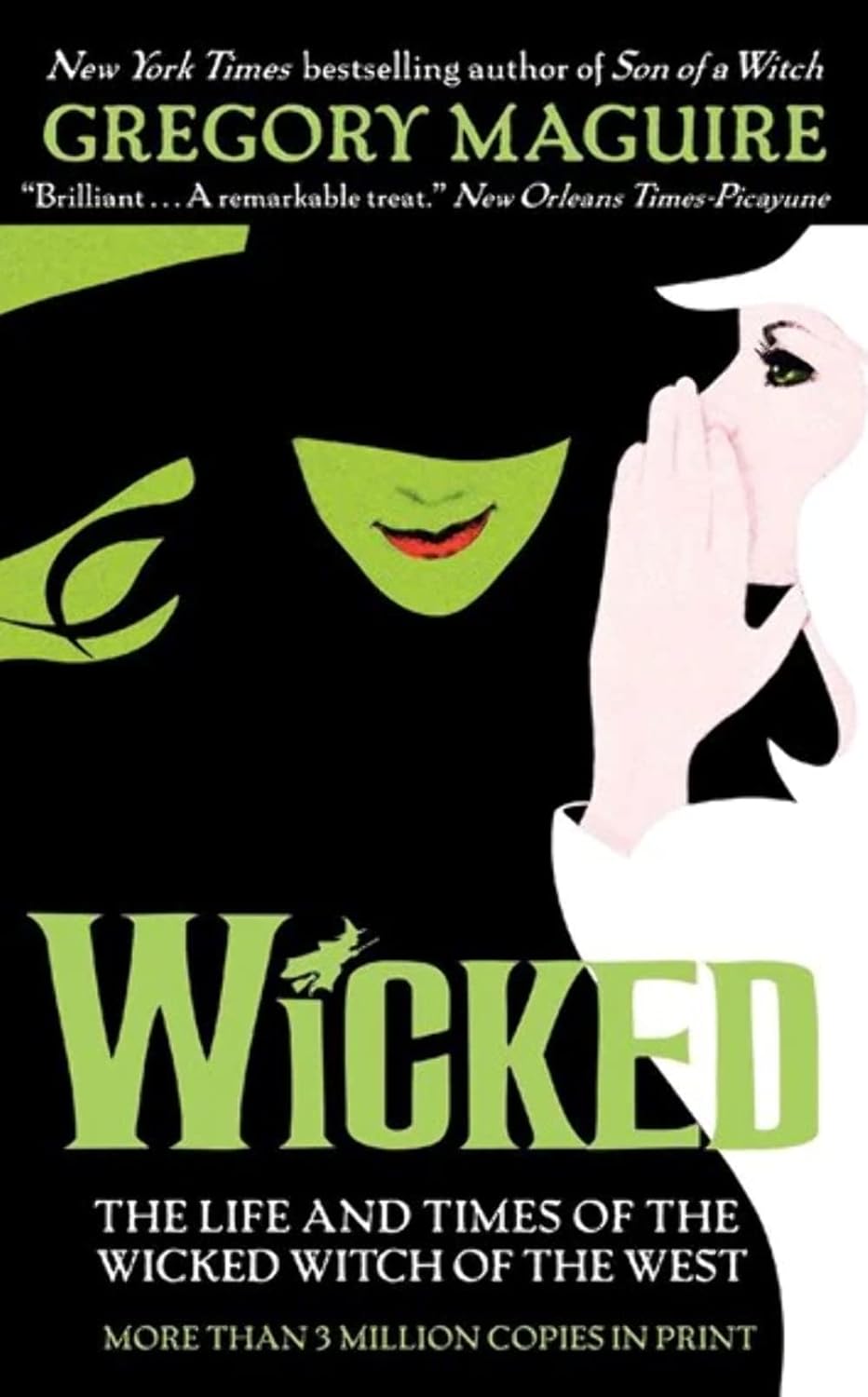
Wicked: The Life and Times of the Wicked Witch of the West

A couple-few years ago, I saw the musical performance of Wicked in Dallas. It was a little heavy-handed with its pro-PETA message, but entertaining for all of that, plus at the time we were under a tornado warning (no shit) and the power actually went out briefly mid-show. The chick who was playing Elphaba? Good lungs, as she was able to joke at the audience until the power came back up, and everyone could hear her. So you see.

Sometime not long afterwards, I picked up a copy of the book that inspired all that, also named Wicked. Then, as is often the case, some years later I have read it, and my reaction is extremely mixed. On the one hand, I’m a little surprised to have liked it, even though I couldn’t say why. I mean, I liked its derivative work well enough, right? But still, I went into it expecting not so much, but with enough interest to understand why all the fuss. Instead, I got a pretty neatly put together series of five stories that probably could have been about five different people, even though they are not. The styles differ wildly (my favorite was the second part, at school, which reminded me constantly of Jane Austen) and the portrayals of our main character differ as well, due mostly to extensive passage of time between each section. I wouldn’t want to see it in a lot of books, but I kind of approve of Maguire’s choice to disregard continuity, perhaps in an attempt to give his audience more insight into the central point he is making about passing judgment without very many facts?

Which, right, I suppose I shouldn’t ought to assume everyone knows about the book. It is, basically, the other side of the story of the Wizard of Oz, in which our wicked Witch, Elphaba, went to college with Glinda, joined political resistance against a tyrannical usurper who styled himself the Wizard of Oz, and was eventually brought low by one Dorothy who frankly had no idea what was going on around her and was everyone’s pawn at every turn. And like I say, it’s a pretty entertaining story, with a lot of interesting character voices and structural choices. So why am I ambivalent? Because, at some point in the story, after her political agitations but before the arrival of her destined nemesis, Elphaba starts to reflect upon her legacy and quickly to fixate upon it, which gives Maguire an excuse to start dealing with everything through the prism of Literature, and Theme, and Essay Questions. And if there’s one thing I cannot stand, it is the 20th Century tendency toward intentional art. People should ought to create what they want to see, not what they believe other people will consider important. And that’s the worst part: this book is something I wanted to see. It just lost its way, somewhere along that yellow brick road.