Category Archives: Words

Hack/Slash: Friday the 31st

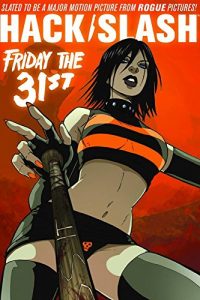
I’m not sure yet, and I’ve been… well, “burned” is a little strong, but I’ve been bitten by this before. Anyway, although I’m not sure yet, it looks like Friday the 31st marks the Hack/Slash series’ evolution from a novelty into something pretty damn cool. The character development that has always been its strongest suit (well, aside from the art) has been supplemented, in the form of people that slasher-slaughtering hottie Cassie Hack and her hulking companion Vlad have saved over the past couple of books, who are now banding together and offering to help out with finding new problems to solve and people to save.[1]

And at some point, I guess the series got picked up by a publisher, because after a normal one-shot (though, also as usual, continuity-influencing) issue co-starring Chucky[2], the book collects the first two storylines / four issues of the monthly Hack/Slash comic run, still apparently ongoing. The first storyline serves as a reintroduction to the characters and premise for people who might not have been aware of the haphazard schedule[3] under which all the one-offs were printed, and the second features a Cthulhian death metal band and more virgins than you can shake a stick at. And since there are at least two more books yet to go, I’m certainly looking forward to what they throw at me next. I mean, in several months when I read volume 4. Not literally next.

[1] And helping out with any unexpected costs or emergencies that might crop up. If the first such emergency and offered assistance is any indicator, I’m going to like the new Scoobies. Both directly and thematically.
[2] Yes, the evil doll.
[3] And probable spotty availability; though in both cases, I am purely speculating here.

Ultimate Spider-Man: Ultimate Six

So, a kind of a funny thing happened. I completely forgot to read this book. I had it in queue, and I guess it was in the back seat of my car or something, and I was so far behind on reviews anyway, and somehow I convinced myself I’d already read it. It could be that a new Walking Dead contributed to my misapprehension on this matter as well? I just realized, suddenly, that there was no review, and then while looking at the book with the intention of loaning it out to my friend Emily (who you will no doubt recall as the violently abused daughter in The Last House on the Left), it hit me that, hey, you did not at all read this. Both matters: rectified!

You would think, having finally caught up to the book I most recently finished, I would have it in me to do more than gush. There’s just something about Brian Michael Bendis writing Ultimate Spider-Man that leaves me incoherent with glee, apparently. I’d like to mind, but if that’s what it takes to get work this consistently amazing and this consistently able to top itself, then I’m not going to quibble overmuch. Ultimate Six re-envisions the first really big Spider-Man event of the original Marvel era, in which six of Spider-Man’s past foes team up to accomplish what none of them could individually: Spider-Man’s annihilation.

Of course, when I say “re-envisions”, what I mean is, “takes the kernel of an idea and demonstrates that, no matter how good Marvel really was in the ’60s, it has the ability to blow that out of the water in the modern era”. Four of Peter Parker’s previous foes, including the Green Goblin and the Sandman as a newly added fifth in a flashback sequence from a few months ago, are under S.H.I.E.L.D. imprisonment for illegal genetic modifications. The consequences of this unfortunate collection of villainy in one holding area are many and varied, ranging from the airing of Nick Fury’s significantly dirty laundry[1], to Peter’s identity being revealed to a significant portion of the Ultimate universe, to the likely psychological collapse of his once-friend Harry Osborn. And even these pale in comparison to what will happen if the Ultimates[2] cannot prevent the team of five (and their newest sixth recruit) from fulfilling their plan to strike at the very heart of the government.

[1] I like that I can trust this event will have future consequences to the continuity.
[2] For timeline purists, the Ultimate Six storyline (which was apparently independent of the Ultimate Spider-Man run, though I like that it was collected here) falls between Ultimates and Ultimates II.

Ultimate Marvel Team-Up, Volume 2

After being underwhelmed by the first Ultimate Marvel Team-Up, I was looking forward to getting through the remaining volumes quickly so that I could move on to some of the side storylines I’ve been seeing in the future that look pretty awesome, and the moreso because apparently there’s some kind of big Ultimate Universe event coming up, and I can’t be more than halfway through the accumulated catalog yet. To my surprise, though, the second volume of the series’ rather short run was thoroughly enjoyable.

The stories are all short and fluffily irrelevant to solid continuity in a way that the other runs and one-shot storylines are not. But they are far more strongly written than last time, including another visit from the X-Men[1] to explain human-mutant relations that clearly predates the UXM series’ start, and a ridiculously non-canonical visit with the Fantastic Four that was over the top hilarious. It also included the origin of Dr. Strange via a direct rip-off of the first Spider-Man/Strange crossover story back in the ’60s. The best moment, Logan/Peter notwithstanding, was the Lizard-Man origin issue. Curt Connor’s tragic scientific success is one of the best “villain” arcs I’ve seen out of Marvel in either universe, even if there’s an underlying message about the consequences of meddling with nature that I’m not so happy about.

The art varied between perfect, wonkily appropriate, and just plain wonky. Really, the only thing I was unhappy with was that three issues were outright skipped between the first and second book, resulting in my need to either scour comic stores for the missing issues directly, or to rebuy the Ultimate Marvel Team-Up run in a single volume. Both ideas are pretty solidly meh, at the moment. But I’m sure I’ll do one of them, eventually.

[1] Plus, yay, more Logan/Peter interaction. Still easily the best Ultimate crossover relationship, though the Nick Fury/Peter and /Professor X interactions are quite interesting. It’s just, Fury is so damn unlikeable most of the time.

Ultimate Fantastic Four: Silver Surfer

Being behind makes for subpar reviews. So, y’know. But I liked Silver Surfer more than I’ve liked the last few Fantastic Fours, even despite the fact that it was a fair bit more divergent from regular Marvel continuity than I’m used to the Ultimate universe being. Basically, Reed Richards is continuing to research the cosmic cube he was tricked into taking home a couple of books ago, and this time he accidentally summons a familiar-looking silver being riding a familiar-looking silver surfboard. And then the world kind of gets kidnapped. As usual, the FF are the most sci-fi series in Marvel, even when it doesn’t seem to match the rest of the continuity. Sometimes, that bothers me. This time, at least, it was a pretty damn cool story, albeit one with no apparent continuity impact. But I could be wrong about that, easily enough. If I find out otherwise, I’ll let you know!

Dearly Devoted Dexter

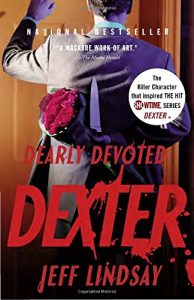
51UeGHq5w4LMan. I am way too far behind right now. It is not pretty. But, so anyway, I read Dearly Devoted Dexter, the second book in the inspired-a-Showtime-series. I’m continuing to enjoy it all out of proportion to how much I think I should, though I believe this one was helped a lot by the series’ plotline divergences after the first book/season. Plotwise, Dexter and his sister and his nemesis Sergeant Doakes team up to face a killer who physically removes just about everything from his victims, while still keeping them alive and in perfect physical health. It’s… kinda creepy! (Well, technically, all of Miami homicide and CSI and whatnot are in on the team-up, but realistically, I mentioned the important people.)

I don’t know if he was written a little differently in the first book, or if I was so busy following along from plot point to familiar plot point that I missed it, but the Dexter in this book is hilarious. Yeah, he’s pretty good at stalking and killing bad people who probably deserve it.[1] And he’s good at realizing that he doesn’t comprehend people and their emotions, though I can’t make up my mind if that’s a character deficit or a choice, despite his claims. But he also constantly lauds his brilliance and ability to blend in among the normal people around him, even though the constant evidence of his descriptions belies it. He makes good deductive leaps, of course.[2] But he also falls into traps I saw coming miles away, apparently because of his not-acknowledgedly-pompous belief in himself. And for someone who does everything exactly right to keep from being picked out as odd by people around him, there are a lot of people who seem to recognize that something is off key, a fact he also rarely accepts. It is on the whole an entirely amusing confluence of unintentionally unreliable narrator, Scoobies mayhem, and disconcerting serial killer mentality.

That last bit is what I a) anticipate enjoying the most in future books and b) feel the most guilty about. Because, apparently, his girlfriend’s children are poised to turn into Dexter: the Next Generation, and of course he is delighted to teach them what to do and not to do, just as his foster father taught him. Instead of being all squicked out by sociopathic pre-teens, I really want to see where it goes. So, um, oops?

[1] If you don’t buy this central conceit of the book, then you are really guaranteed to hate it, and should not read.
[2] It is a mystery novel, after all!

The Walking Dead: Here We Remain

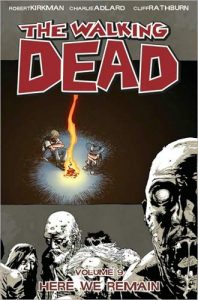
So, you know how I said I like reading about aftermath? I had not been thinking about the horrifying and unrelenting series of tragedies that marked the previous Walking Dead volume, but it was certainly a well-timed claim. All safety is gone, an astonishing number of survivors have been slaughtered, and those left are scattered to the winds. Here We Remain documents the struggle to survive what will almost certainly be the series’ low point, survive not just physically but mentally and emotionally as well. There is unexpected hope on the wind, though, and a possible new purpose beyond simple survival.

The thing about the aftermath, though, is the psychology of it all. Most and possibly all of these people have endured enough to break anyone, and only the lizard brain’s drive to survive has kept them going. The cracks are obvious in everyone after these most recent setbacks, and it will be interesting to see whether the new sliver of hope is enough to start them recovering. In any event, if this is yet another Kirkman mislead with a dire outcome waiting two or three books down the road, I won’t really be able to believe any of them can cope with it. Related to all this, I’m also speculating that the torch of series hero has been handed off from cop-turned-leader Rick Grimes to his constantly underestimated son, Carl. And I’m looking forward to seeing what else the kid can manage; thankfully, the dead world has removed any trace of plucky kid syndrome that would make the whole thing annoying.

Ultimate X-Men: The Tempest

I assume I liked the last Ultimate X-Men book, insofar as I’ve been liking them in general. Plus also, tragedy struck, and while I don’t automatically like that (depending on what happened), I definitely always like aftermath. And The Tempest is very much about aftermath, even though it’s in a quiet way, against the backdrop of a brand new villain and a mutant-assassin in his employ.

And, the book being short, that’s pretty much all that happened. I don’t want to elaborate on the aftermath, because, spoilers, and I can’t elaborate on the new villains, because I’m supposed to recognize them old school, and I did not get far enough to, I guess? But they made for a good story, and I can ask for little more than that! Except for being so deep into a series as to be pretty confusing, I could recommend the book unreservedly as an afternoon’s diversion.

So. That’s that, then!

Ultimate Marvel Team-Up, Volume 1

I may have mentioned at one point my sudden realization that a lot of things I have read during my what, year-long now Ultimate Marvel kick, had backward-looking references to some books that came out right at the beginning and I had initially failed to be aware of. But I’ve found these, and they are now in the rotation. Which brings us inexorably to Ultimate Marvel Team-Up, in which various characters from the Ultimate universe, you know, team up with each other.

Or, to be more accurate, Spider-Man meets other characters in an explicit crossover format that comes from the late ’60s or early ’70s or somewhen, because Brian Michael Bendis mostly likes Spider-Man and wanted to revive that format for the new generation. The only problem is, brief historical curiosity aside, the stories weren’t that interesting. The strength of Marvel, past as well as present, has always been its ongoing storylines with long-term consequences. Yes, there’s a lot of soap-operaish returns to life and failed relationships, but they are at least consequential from moment to moment, instead of seen once and irrelevant ever after. Necessarily, one-shot stories are going to come off pretty cold in a world where everything else matters, quite a bit.

All that said, the stories themselves were about a conflict between Peter and the first appearance of the Hulk in this timeline, during which stuff got trashed, Spider-Man proved his own relative strength and durability to the audience, and any kind of climax was left completely by the wayside; about a meeting between the also-inaugural appearance of Iron Man (complete with origin story) and our good Mr. Parker, who actually do team up to stop some… high-tech Communists, I guess? And, best of all, a meeting between Peter and Wolverine in which they try to fight off Sabretooth (he’s an evil mutant who is basically the same as Logan, only, y’know, eviller) before lots of civilians get hurt. Unsurprisingly to me, that last story was the most compelling. I assume it has something to do with what mutually-sympathetic, outsider characters Wolverine and Spider-Man are within their respective worlds. So, yay inevitable chemistry.

The art, which I only tend to notice when it is particularly egregious or unusual, or when the story is boring me, was in this instance equally boring. I wonder if I just think most of the art is fantastic and forget to say so, or if I’m really picky about handing out praise, or if I think most of the art is workmanlike and that only bothers me because I’ve focused on it in search of something to hold my attention when the story is so-so. Probably it’s the first one, but the correlation in my (possibly faulty?) memory between iffy art and iffy plot has been high over time.

Danse Macabre

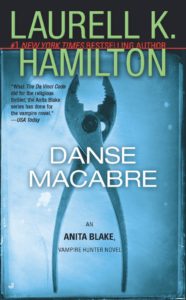
So, here’s a possibly interesting tidbit about Danse Macabre. When I first knew of its existence in hardback, I wasn’t yet halfway through the series, and it looked like a lot of change was in store ahead. Anita was going from a zombie animator and vampire killer and unofficial detective to federal marshal? Cool beans! Pregnancy scare? Sure, fair enough, she’s got a boyfriend and maybe a second one. This would have been 2006, I guess?

Also, that probably wasn’t interesting at all, but it was pretty much the only thing I could think of to type that wouldn’t be dripping with vitriol, and it seems fair to give my readers a safe haven wherein they can decide to not keep going.

Because, Jesus God, this is a fucking terrible book. It spans 48 hours leading up to a vampire ballet performance, which latter part might have been pretty cool to watch, I guess? It was ten of the maybe fifteen pages where I didn’t want to claw my eyes out of my head while reading it, anyway, so I can’t help but look upon the scene fondly, y’know? In the meantime, there are these five hundred pages spanning these 48 hours, in which nothing of any interest happens. Anita might be pregnant, and she’s going to be sure to be strong about it except for fighting with all of her friends, or maybe that should be the definition of strength instead of an exception. But she also just might carry a bunch of impossible virii and be way stronger than anyone yet suspects, instead of being pregnant. All those Master Vampires they’ve invited to town for the ballet might have been a bad scary idea that will destroy their lives, or maybe they’ll gain all kinds of new power by having giant vampire orgies instead. She’ll certainly have to manage the expectations and feelings of her myriad emotionally crippled boyfriends, sure the normal ones like Richard and Nathaniel and Jason, but let’s not forget all the awesome non-names we can throw around, like Haven or Wicked or Truth or London or Asher or for fuck’s sake Requiem! And as if that weren’t bad enough, the Master of Chicago is named Augustine, which would be like a breath of fresh air except that he’s older than perennial fan favorite Jean Claude, and yet everyone calls him Auggie. AUGGIE!!!!

It’s like… well, I know I’ve mentioned Mary Sue before, but to sum up right quick, Mary Sue is a character in Star Trek fan fiction from probably the ’70s, who was written as a stand-in for the author, and she shows up every main character you’ve heard of on the Enterprise, she’s the one person with all the special skills and talents to save the day, plus pretty much everyone wants her in the worst way. It’s not that Anita Blake is a Mary Sue kind of character. It’s not THAT SIMPLE. It’s like, in these last few books, Anita Blake is the character that the original fictional Mary Sue would have written, if she herself were an author in addition to her many space-faring talents.

The worst part? I actually finished the book. I don’t exactly know how. I mean, at the beginning, I wasn’t angry, I just wanted to quit because it was so unpleasant. But it felt at that point like I was having an unfair personal reaction to some story elements, so I persevered. Eventually the relief of that part of the plot fading out of prominence got me through the interminable middle section in a bull-rush. And by the time I realized that every time I read more than a page at a sitting, I got angry, I was a) almost finished and b) didn’t have access to the next book I wanted to read. And by the time I solved that problem, I was really almost finished, and the old idiotic completionism had kicked in. But, seriously, I think I accidentally got a little drunk on Wednesday night because I was reading, and if I couldn’t focus on the book, I wouldn’t have to read anymore. I don’t so much no longer care about these characters as I sincerely want them all to die in a fire. And I’m in the unique position of being able to make that happen. But it seems like I shouldn’t?

Anyway. Here’s what does happen: Anita gets threatened in dreams by the First Evil, or the Queen of the Damned, or someone like that. The Mother of Night, there we go. Anyway, she’s the very first vampire, and she’s been waking up gradually for a few books now. And then later, Anita talks to a guy who was made a vampire by that one chick, and who might be the Arthurian Merlin instead of just a vampire with a similar name, and who is certainly the first dude in a long time that might be more powerful than our merry band of sex-starved heroes. Which might matter, except he wants to sign on with them instead of oppose them? I guess I just ruined the book, but if I can tell you every single plot event that occurred in only two-ish sentences, it may just be that someone else ruined the book first.

God! I can’t stop being pissed off about this!

And all the fucking horrible verbal tics! “That wonderful Gallic shrug that meant everything or nothing.” “[This or that sexual pecadillo] just flat did it for me.” The repetition between thought and action, along the lines of, say, someone asks a question, then our author types, “I didn’t know the answer to that. ‘I don’t know the answer to that,’ I said.” I mean, the first few and others that I thankfully can’t recall offhand, there’s no reason for you to read them and understand how, after a dozen books of the same phrases over and over again, I am boiling with fury at the memory. But that last repetition thing? Who is possibly allowed to write like that?!

Okay. Okay. I’m stopping now. Fuck!
Tales of the Vampires

Back when Buffy and Angel were over and nobody had yet realized that they could continue the show via comics, Joss Whedon and some of his close writer friends got together to write up some ancillary material and dump it into a few graphic novels. One such outcome is Tales of the Vampires, in which an agreeable connective story (about a vampire who is, um, telling some tales about vampire-kind to some young Watchers-in-training) surrounds a reasonably high number of micro-stories that vary between so-so and surprisingly clever. As you’d expect, the Whedon-penned connective story is the best, with Jane Espenson’s entries an easy second choice. The art, as usual for old-style Buffy comics, isn’t really to my taste, but it’s never really that bad either. Mostly, though, it reminds me I should really ought to catch up on the monthly Buffy shipments I’ve been getting.