Category Archives: Words

Deep Empire

If you are paying a lot more attention than I would expect anyone to be paying, you would expect this review to cover the second Robin Hobb book. However, I ran into a pair of related problems. Maybe a trio of interrelated problems? You decide! See, thing one is that I’m still trying to read the series in conjunction with my wife. Thing two is that I went camping last weekend. The problem with that is that while I read a lot in the woods, she really does not. Thing three, which may or may not count as an actual thing, is that I didn’t want to deal with reading comics on my convertible laptop in the woods, because it’s quite a bit harder to handle / keep safe than a tablet in a case would have been. The relevance of this is that comics would have slowed me down quite a bit and made it at least mildly feasible that I could read the Farseer book without pulling irretrievably far ahead.
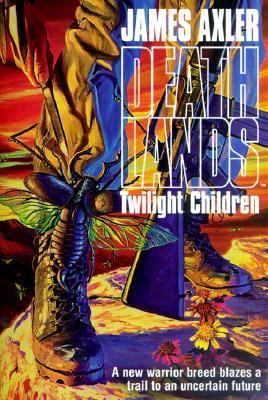
So instead, I brought five Deathlands books. The theory being that I would be out for 5 days and read about a book a day. This math was largely correct, except that I was not there for the entirety of the bookend days, and also I was building / tearing down on those days.

Enough inside baseball! You’re definitely here because you want to know how Deep Empire was. And I have good news: the title actually makes sense[1] this time. See, they come out of the teleporter into the Keys, where they encounter pirates, undersea volcanoes (because, post-apocalypse), dolphins, and rogue marine biologists.

[1] All three did, which makes me wonder if I missed something in Shockscape. I probably didn’t, but the impostor syndrome is especially strong right now, since I noticed my reviews used to be a lot funnier than they are these days. Everyone not reading this because they left me behind long ago? I forgive you.

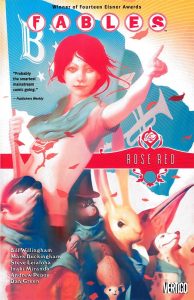
Fables: Rose Red

The big plot of Rose Red revolves around the Fables formerly of Fabletown, now retreated to their last stronghold on earth, continuing to fight against Mister Dark (who plausibly I mentioned last time). And that plot progresses, which is all fine and good, but I’m not really here to talk about that. For one thing, spoilers.

More importantly, though, the flashback story that gives the book its name is the more interesting one. See, Snow White[1]’s sister has been a pivotal character in this series since the very beginning, and it’s about time we learned why they’ve always had such a bad relationship. Thanks, flashback! And of course, thanks Bill Willingham for making sure the story made sense from both directions. It’s a rarer talent than it should be.

[1] Originally deputy mayor of Fabletown, now retired to wedded bliss with the Big Bad Wolf

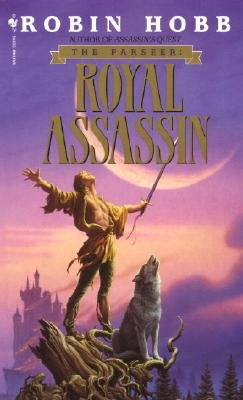
Assassin’s Apprentice

In a conclusion that will be of no surprise to anyone much, I should have read a Robin Hobb book long before now. Still, though, I’ve read Assassin’s Apprentice now; and to make up for how overdue that is, I at least had a reading companion.
To the extent that I went in with expectations, they were these: that these books are bleak and dark and full of horrible events occasionally broken up by fleeting happiness. After one such book, I have to say my expectations were largely fulfilled. It’s funny, Fitz is not a perfectly reliable narrator, but you can tell that he wants to be. His failures are not failures to see himself clearly, or unwillingness to admit to himself or his audience some dark truth or other. It’s just, his life has been so far outside the bounds of normalcy (or even the bounds of viewpoint characters in low magic fantasy realms) that he honestly cannot see just how bad he has it; and contrariwise, he cannot really tell when he is being treated badly instead of normally. It’s an impressive series of blind spots.

Nevertheless, the moments of pure happiness are there, and I had constant empathy for him, and empathy for others inhabiting his world, and interest in that world and what will happen next. It’s not just the 20+ years of bibliography that have built up. Even from this book alone, I can tell that only a very small part of what could be a very large story indeed has been told[1]. The fact that people I trust say the quality doesn’t drop off is purely icing.

[1] Or, okay, this is a trilogy. It might be more fair to say that it’s obvious there’s a lot of trilogy left to tell, with a lot of escalation between here and there. My expectations of even more than that lurking around the edges could be better described as Stockholm Syndrome from one too many doorstop series? Whatever, I like them long to the point of unending.

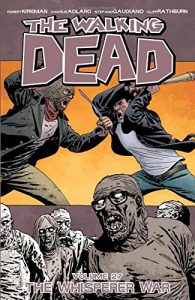
The Walking Dead: The Whisperer War

Here are the problems with The Whisperer War:

1) It is way way way too busy. Zip cuts between scene after scene, with sometimes 12 and 16 panels on a page. Which is not automatically a bad thing, except that
2) I recognize maybe half of the characters in the book, max. This is less an art problem and more a too many characters problem. Even with the TV show as an aid, I don’t know who everyone is. (I mean, to be fair, I rarely know who everyone is on the show either, but I at least come a lot closer.) Which means all those zip cuts between maybe some characters I recognize, some I know well, and some where I’m just shrugging helplessly? It’s bad.
3) I shouldn’t discount the art problem, though I’m restating the same thing in a different way. If you’re going to insist on having so many characters running around, it is important to not have an art style that serves to obscure features. (In this case, no coloring. The series has always been black and white.)

Here are the things about the Whisperer War that are pretty good:

1) A genuine sense of danger persists. That’s good because a book like this needs tension, but also because I can bring myself to believe that maybe something really terrible is on the horizon, and that the overstuffed cast will maybe soon deflate a bit, to the benefit of everyone except the ones who are (newly) dead.
2) Two characters had some solid development! That sounds like not enough, when you are thinking about a book. But when you are thinking about six issues of a long-running comic, which is perhaps the more accurate way to think about this, it’s actually pretty impressive.
3) Plenty of seeds of future foreshadowing, which is a nice change from the series ambling from one calamity to the next. It is also helpful in that I’m coming around to caring about more than one or two characters again.

That said, some of the foreshadowing is either random noise mixed into the signal and therefore not foreshadowing at all, or it dampens / kills the genuine sense of current danger. This was ever the problem with fiction, though, especially long form fiction. What can you do, really? Anyway, long story short, I have pre-ordered volume 28, and I kind of wish it was already here to read.

Shockscape

I was poised to read a Robin Hobb book, but then my schedule got pushed back, so I went for something guaranteed to be quick and easy. And then work was a bear[1], and I realized a new Walking Dead was out, so now I’m actually behind on starting the Hobb instead of ahead. Oh well, that’s what happens when I try to keep to a schedule on much of anything besides work and vacations.

Which brings us to Shockscape, a book that demonstrates Heisenberg’s uncertainty principle in action[2]. See, these books can only have either a title that is vaguely related to the plot, or a cover that is vaguely related to the plot. Never both, and virtually never more than a vague relationship. In this case, the title is as far as I can tell a meaningless agglomeration of syllables, while the cover shows a giant mutant bear, who isn’t in the book long, but he is the catalyst for the rest of the action. Which consists of the same kind of action in most Deathlands books: the good guys run into a baron[3], he sets them to some task for which failure means death and/or enslavement, depending on whether you are a person on the task or a hostage, the good guys complete the task (probably by killing someone what needed it), and then return and kill the baron too, because what kind of a dick makes people do things whether they want to or not?

It’s a good thing I don’t mind stories that are formulaic, as long as I know that whatever character or plot or world-building development missing from this book will definitely occur in the next one. Anyway, there was a pretty solid cliffhanger? (I hope they don’t resolve it in the easiest way possible, where they might as well not have had it in the first place.)

[1] Oops
[2] It doesn’t.
[3] A baron, in Deathlands parlance, is the leader of some locality. He always has sec men, and usually is in some sense a bad guy, either by virtue of terrorizing his populace or by virtue of opposing the good guys in a non-evil way that is never justifiable enough to make our heroes look like non-good guys when they inevitably chill him in the end. (Unless he’s a recurring character who gets away but will probably be killed in a sequel. That happens.)

The Unwritten: Tommy Taylor and the Ship That Sank Twice

I’ve been reading these Tommy Taylor books long enough to put them on the same level as Mike Carey’s Lucifer, if not quite the pinnacle of Neil Gaiman’s Sandman. Of course, Mike Carey writes The Unwritten series as well, so I suppose that wouldn’t be an exactly shocking comparison. I guess what I mean is that it’s nice to see him spread his wings and tell a literary story that is all his own and that nevertheless aspires to the heights The Sandman achieved.

I will, of course, have to go back and reread the series at a gulp, after it’s completed. (That’s probably true of Lucifer, for that matter. The television series is not, uh, a suitable replacement, although it is good trashy fun.) And the place I would inevitably start is with Tommy Taylor and the Ship That Sank Twice, an unexpected prequel that not only details the lengths Tom’s father Wilson went to, establishing the symbiosis between his son and the fictional character based on him (or that he is based on? I don’t think there’s a correct one-way distinction to be had), it actually provides the story of the first Tommy Taylor novel. Which, of necessity, is less of a Harry Potter rip-off than the books have seemed when only shown in snippets in the main sequence of The Unwritten series.

Then again, it also hastens to explain that the synergy between character and infant is the cause of the Tommy Taylor series replacing other child wizard academy books as the archetype of the series, so from an in-world perspective, the distinctions were probably a lot less necessary than they were from the perspective of an author and publisher looking to not get sued for plagiarism. Because, as good as the conceit of the series is at letting it get away with the in-world rip-off, I doubt Rowling would much care about a clever conceit.

I think I’ve gone off message at this point? It just fascinates me, what Carey has done here. In any case, The Unwritten is a good series, and you should read it! And this is a good prequel, and you should read it too; but like all good prequels, you should read it later, to avoid spoilers for previous books.

X-Wing: Mercy Kill

This is I think the next to last volume in the Star Wars Extended Universe series of books, by chronology. It is also, to my knowledge, the last book written by its author before he died unexpectedly a couple of years post-publication, certainly during the timespan when the EU was being gracelessly removed from Star Wars canon. There’s probably some kind of metaphor there.

Mercy Kill is about three things. Superficially, it’s about tying up loose political ends from the Fate of the Jedi series. Externally, it’s about a “wouldn’t it be cool if?” moment, the cool thing in this case being to bring back Wraith Squadron, the special ops branch of the New Republic’s navy. Being spec ops, they never used X-Wings as much as the rest of the navy did, but they were developed in the X-Wing series, and so here we are. (Also, it hasn’t been called the New Republic for a long time, but that doesn’t matter to you I’m sure, and being spec ops spy types, it doesn’t much matter to them either.)

Third and I’m sure most importantly, it’s about the horrors of war, the beauties of friendship, and the ways we cope with these things and the loss of them, and the long road of recovery. …okay, that’s a little bit overdone, but it’s not not about those things, and seeing as the series is all but ended, I’m feeling a little maudlin, okay? Oh, and fourth, like all the X-Wing books, it’s more than a little funny in the way that all good caper stories are. I guess I didn’t say, and wouldn’t have said before since I read the rest of the X-Wing / Wraith Squadron books years before there was a site to review them, but these are wisecracking, safecracking special ops people with hearts of gold, not grim dour special ops people who never leave a man behind. So the book is fun, which you would probably intuit from the Star Wars title, but might not from the mention of a special ops force as the stars.

Also, Star Wars isn’t always fun anymore, is it?

Z 2136

As you have no reason whatsoever to remember, I read the previous two books in this trilogy sometime in the last year or two I guess? And they were perfectly cromulent serial schlock. Hunger Games plus zombies, only a little light on the good half of that equation; and if I’m being honest with myself, probably they could have done a better job copycatting the game aspect of the equation. But still, if I don’t pause and think about the hundreds of better books on my to-read shelf, there was nothing wrong there.

As of Z 2136, consider that trend broken. And I mean, broken just really badly. This is the worst book that I’ve ever managed to finish. The writing didn’t change, and the already established characters were still, y’know, fine I guess. But the new viewpoint characters and the change in plot direction were just abysmally bad. Here’s my point, which I will need to entirely spoil the surprise ending of the second book plus I guess all of this one to make, but that’s okay because, seriously, do not read these books:

There were three main characters in the series, a father and two children. The father was part of the government apparatus but also had sympathies with the rebels who didn’t like living in six dystopian cities even though the walls kept the zombies out. Later, he killed his wife via mind control and was put into the zombie hunger games. Later still after learning the truth, his daughter was too. None of that really matters except that it’s an establishing shot for the shock ending of Z 2135, in which the father is executed, Ned Stark style. And then in the afterword, the authors were all, we weren’t really planning on this, but we decided we needed a big cliffhanger, so here you go!

Which leads into the third book, where one annoying guy is transformed into a raving lunatic, while another bad guy is transformed into a new father figure to replace the one they killed and then apparently realized they still needed. Result: half the book is spent on the motivations and travails of new characters about whom I already didn’t care, only now everything was so weird and forced that I actively hated them instead of just not caring much. Then, later, the book just kind of grinds to a halt instead of having an actual ending. Everything I’ve seen indicates this is a trilogy, which is a relief since Amazon would probably have already sold me book four at 99c before I knew how horribly things turned out; but I lost control of that sentence, and how I meant to end it was “but if I didn’t have these outside sources, I would be quite certain they were planning on writing more.” Because while it was not a cliffhanger demanding more story, it also was not the end of a story.

If everyone had died, that would have been more emotionally satisfying. First, because everyone never dies, and I’m pretty sure any real zombie apocalypse is much more likely to turn out that way than the way they always do turn out. But mostly because, fuck these people. They basically all deserved to die, and the ones who didn’t are at this point acceptable casualties in my vendetta.

Jack of Fables: The Fulminate Blade

So, this is the other Jack of Fables. After saving all of existence, Jack Horner has entered a kind of retirement. But his son, Jack Frost, is still wandering around the Fable worlds, trying to make a name for himself as a hero. This is a disconnected-from-everything-else book about that.

The Fulminate Blade is a literal thing, a kind of lightning sword that is the only thing that might kill a giant in the sky who stands accused of stealing gold and virgins from the kingdom below. You know that time (not pictured in any particular Fables book, but well known I think within the fables themselves) when Jack Horner climbed a beanstalk and fought a giant over an egg-laying goose with a chemical imbalance? This is like that, but a) science-fictional more or less? Amazon says it’s the far distant future of the world of Buck Rogers and Flash Gordon. That may be true? I can find no evidence of it in the text, but as guesses go: sure, it could be. Why not? …and b) with a lot more intrigue, from every direction.

Unrelated to any of this even moreso than any of this is unrelated to the rest of the Fables storylines: I’m pretty much done with Walter Mitty the miniature Blue Ox. Even one page per issue is two pages too many. Luckily, the Jack of Fables spinoff series is wrapping up soon!

Ancillary Justice

Rumor has it, Ancillary Justice won a lot of awards when it came out a few years ago. This is fair enough, because it ties a well-written take on an intriguing sfnal concept (that would be a spoiler for the early book to reveal, see footnote [1] below cut) to a good story that, to nobody’s surprise who has read the title, is deeply concerned with justice on both personal and imperial scales, and it wraps that package up in meaningful social commentary on the topic of gender and identity.

I should probably read the other two? I’m not sure how much they will further address cool sfnal concepts and meaningful social commentary, but like I said: the story was good too. Problematically, I own neither.

Continue reading