Not a review of The Walking Dead: Miles Behind Us

One thing that I do before I review a sequel to, well, much of anything, is go back and read my review (or reviews) of the previous entries in that series. Having just done so prior to my review of the second Walking Dead graphic novel, I have come to the unprecedented realization that I need to read it again before I say anything substantive. Now admittedly I went to an awesome days-long party since finishing it wherein I drank like a… well, I drank a lot. But I’m pretty sure I remember what happened in the book. I just wasn’t reading it in the correct frame of mind, and I want to look at it through different eyes before I replay my thoughts.

Currently, they are: wholly entertaining, but nothing special. And that just doesn’t fit with my review of the first book. So now I’ll get a second opinion.

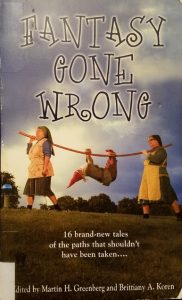
Fantasy Gone Wrong

Yay, Christmas presents! I received a short story collection whose common theme is the reversal of expectations in fantasy settings. Just to toss out an example, in one case a unicorn bonds itself to a prostitute, with substantial negative impact to her livelihood. Some of the stories work a lot better than others, though only a couple ended up being pretty bad. I’m not going to go into it story by story, and I’ve pretty much covered the book as a whole with that first sentence, so this is destined to be a short review. I will point out my favorites, though: The Hero of Killorglin, about fairies and their companion animals; The Murder of Mr. Wolf, fairy tale noir; Crumbs, about the generation succeeding Hansel and Gretel, and Goblin Lullaby, with an alternate perspective on PC adventuring. And for balance, don’t read Finder’s Keepers, as it was both rambling and (by the end) trite.

Black Hole

I keep wanting to say that I’ve found evidence that the modern graphic novel is not for me, but there’s clear evidence that it is, in the right format. Sci-fi or horror or allegorical fantasy, and I’m basically in there. Plus, of course, the superhero genre, which, y’know: tradition! But at the same time, I’ve read a few lately that seem to be just telling a regular modern fiction story (except with pictures) and I keep failing to wrap my head around them. Unlike Jimmy Corrigan, I can at least say that Black Hole wasn’t a complete slog. But at the same time, it feels like there are strands and aspects I failed to grasp despite my best efforts.

It’s the ’70s, and it’a high school. So everyone is focused on being popular or not, taking drugs, and having sex. The problem being, there’s this STD called simply “the Bug”. It has a 100% transmission rate, and if you get it your body changes somehow. It might be concealable, or it might be completely deforming, or maybe somewhere in between. And we follow the lives of a girl and a guy over the course of several months or a year as they interact with a) the diseased, b) the drugs and alcohol to prevent having to deal with any of it, and c) eventually, perhaps with the disease itself. And from time to time, d) with each other.

As a straight-up story, it’s pretty good. Bleak as all get out, but effectively told. High school interactions are completely magnified by the Bug issue, with outcasts being relegated to a tent city in the woods where nobody has to see them, rather than just one corner of the lunch room. There’s a bit of horror, both the stark version where one mistake can ruin your life (so, okay, that’s magnified high school stuff too, maybe, to an extent) and the more literary version where murder is unleashed into the diseased populace. But it’s the metaphorical layer I can’t get my head around. AIDS fits, albeit imperfectly. The fact that the story was begun in the ’80s despite a 2005 publication date on the collection makes it feel more timely, which helps. But why are some people able to go unnoticed while others are branded? Why isn’t it deadly in itself? Why does nobody outside of the high school population seem to be infected? It’s not about pregnancy, since guys are affected as easily as girls. It’s not about the act of having sex, because clean people have no problems at all, as long as they stay away from the diseased. Like I said, I just can’t nail it down. And it’s all the odder because outside of the disease part, a nearly identical story could have been told with the same plot. So it’s mostly there (I believe) solely to be a metaphor for something. And here I am, with just no idea what’s up. Lame!

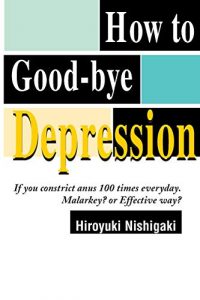
How to Good-Bye Depression: If You Constrict Anus 100 Times Everyday. Malarkey? or Effective Way?

Thing number one, which is important: I am not making this book up.

See, there’s this self-help book, in which the Japanese author recommends exercise, positive thinking, getting in touch with your body’s energy, diet changes and fasting to cure depression, cancer, family and personal problems of all stripes, to achieve success in life, to look and feel younger, and to be able to instantly apprehend all that can be known about objects and people using the power of your brain. Which, okay, is not that different from many other self-help books and/or new age treatises. The difference between those books and this one is they they were not written in Japanese and then seemingly passed through Babelfish[1] a couple of times. Nor do the first quarter of these other books consist of a mishmash of disordered Usenet postings from the turn of the millennium, before it sank beneath the waves of the internet never to be seen again.

Most importantly though, these other books do not recommend that you “constrict anus 100 times every day and then dent navel 100 times every day after constricting anus 100 times every day, following the lifestyle of long-lived British.” They do not explain that after fasting for three weeks, you will rid yourself of “a big bucketful of old, black excrement” which will weigh 4-5 kilograms. They do not exhort you to concentrate your third attention and send out your immaterial fiber at objects patiently for an hour a day for 3-5 years or possibly 10. They do not spontaneously speculate about the ways in which Al Gore and George W. Bush probably follow most of this advice and are able to * * twice or three times in succession without pulling out, as a result. (Okay, I may have taken ordering liberties with that last part; but it’s not an unfair assessment.)

Here’s my point. I don’t know if constricting anus 100 times every day is an effective way to good-bye depression or not. But reading this book? It really seems to do the trick. Sure, there’s a slow part in the middle, but mostly, more laugh density than most intentionally comedic books I read. Also, assuming you hadn’t heard of this book before, be honest with yourself. You’ve constricted your anus at least once while reading this, haven’t you? (Be honest with yourself. Not with me. I don’t want to know details, here. Come on, people! Keep me out of your anus!)

[1] Historical note from 2020: Babelfish no longer exists. I’d recommend translate.google.com as a good alternative.

Spider-Man 3

Well, it’s summer now. There is an extent to which I feel like summer comes too soon, since there are no longer any good movies left by August. Nevertheless, I can only observe the status of these things, not correct them. I am like a groundhog for movies! (Except my job’s easier; summer never doesn’t come.) My point, of course, is this: midnight showing of Spider-Man 3, from which I am still reeling. I mean, I’m not talking about the movie yet; it’s just, I got five hours of sleep the night before due to seeing a musical on stage, and then I got something like four hours last night, but (and here’s the secret to making it extra awesome!) split into two parts. So if I’m incoherent, a) pretend like this is unusual and then b) blame it on my non-functioning brain.[2]

Let’s get the easy part out of the way. It was good. I regret the lack of sleep only on an intellectual level, and I’m quite sure I’ll go see it again. I might not do so without the IMAX draw, but only because of how little time I have relative to the number of movies I want to see right now. So, yeah, good. Probably won’t be the best movie of the summer, though. People[1] will tell you it was bloated both in time and number of plots. I don’t agree with that, because each and every one of the plots was personal to Peter Parker. Maybe they didn’t need to all occur at once, but neither were they arbitrary, and it all hung together as far as I could tell. Also, the action lived up to the previous movies.

Plus, plenty of meaty themes to sink your teeth into. For example: Good or evil isn’t who you are, it’s what you do. I can find shades of that in every single major male character. The part where the females are pretty much uni-dimensional cardboard is probably a trope of the genre, but it’s unfortunate nevertheless. They stand out only because of the comparison, though. Also present, and painful to watch, is the pride goeth before a fall theme. Because you can pretty well see each part of it coming, and Peter so obviously can’t, and you just want to grab him and shake him and explain how easy it would be to dodge most of this. Except he’s still a kid, and kids are supposed to make mistakes, and I’m not even sure grown-up Spider-Man would be of any interest. Anyway, I think it’s fair to say that it’s also as deep as the previous movies.

So why won’t it be the best movie this summer? Because it has a couple of stumbles and one major failure. For one thing, there’s an extraneous character; for the amount that Gwen Stacey added to the plot, she either should have had more to do or had her purposes rolled into Betty Brant and the character saved for use in a future sequel. For another, there’s a scene with a butler late in the movie (don’t worry; he didn’t do it) that was a clumsy plot bridge and terribly acted by said butler. The former is the more egregious crime, of course, but the latter made the former stand out in stark relief. But the big failure was the lack of an iconic moment. You have the New Yorkers on the bridge in the first movie, and Spidey on the train in the second one; you can’t make the conclusion of the trilogy be great without exceeding or at least matching one of these. And it just… didn’t. As much as I liked the movie, I’m not going to end up loving it, and that’s the only good reason why not.

[1] and by people, I mean critics; apparently I am one of those, now? Or maybe it requires a paycheck. I have yet to receive a penny, much less break even on domain registration, though, so I don’t count as that. And if I was paying for the hosting, it would be even worse.
[2] Also, I can kill you with my brain.[3]
[3] For reasons of my own!
Preacher: Ancient History

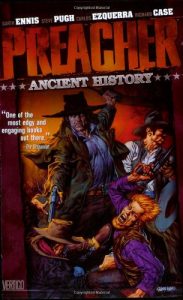
Nothing like a chasing a densely-prosed and somewhat philosophically themed fantasy brick (though it had nothing on Freedom and Necessity, I can tell you) with a light, breezy graphic novel. You know, the kind filled with bloody violence by turns deserved and inexplicable, language that would cause a nun who used to be a pirate to blush, and, well, okay, maybe not as much sexual content as usual. So I turned to the fourth volume of the Preacher series, Ancient History. (This is actually untrue; rather, of my open series, it’s the one I haven’t read in the longest. But it sounded better the other way, so I’ll probably remove this parenthetical in post-.)

Anyhow, Ancient History is appropriately named, as it digresses from the main plot to provide backstory on a few of the side characters. From a story progression perspective, I’m kind of okay with that; it allows a couple of our heroes to stay frozen a bit longer on top of the Empire State Building, in their perfect moment in the eye of the storm. From an internal novel perspective, it’s a bit of a mixed bag. The first segment is an origin story on the Saint of Killers, who has been an integral piece of the saga from early on. He is a badass’s badass, and his Old West is such a hard place that an entire town’s population is massacred just because killing the responsible parties was insufficient to the task of quenching his rage. I mean, Texas freezes over! That’s a rough landscape, man. Then the second segment is the origin story of Arseface, who in theory will return to the plot before it’s all over. Unfortunately, it really added nothing to my knowledge of the character and seemed to be a little overwrought Gen-Y-style even when I allow for the fact that it’s supposed to be an overwrought Gen-Y story. The third segment is a prequel but non-origin story of some side characters from Until the End of the World. It added less than nothing to the main story, as far as I can tell, which should have made it the least good of the three segments. However, it was a hilarious action movie parody, which makes up a lot of ground over potentially relevant but overwrought.

In the end, I doubt much value was added to the series, but I enjoyed more of the book than I didn’t. So that’s alright at least.

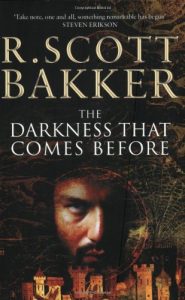
The Darkness That Comes Before

A new series?! Weak! Here’s the upside, though: it’s only a trilogy and it’s already completed, so I’m neither likely to die waiting for the final book nor to forget what was going on with the overarching story before I reach the end. (I’m looking at y’all, Jordan, Martin, and Erikson.) I wonder why this is not a concern when I think about the graphic novel series I’ve been reading lately. Hmmm. Less time investment, I bet. I know that seems like a digression, but as Polonius said, the unexamined life is not worth living. I mean, he probably Shakespeared it up, though.

Anyway, this Prince of Nothing series is pretty cool so far. It’s got priests against wizards, wizards against an evil force from beyond space and time (well, something like that; it’s not entirely clear yet), emperors against popes, civilization against barbarians, prostitutes against, well, okay still that evil force from beyond space and time (and okay it’s only one prostitute, but still), and this one philosopher guy who can read faces like other people can read books against everyone in the whole world. And maybe also against his father who can do that same awesome manipulation and hitting arrows out of the air thing as the guy I mentioned in the first place. Oh, and according to prophecy, that guy (the son, I still mean) will be against the evil force from beyond space and time. But you had probably guessed that yourself.

So this wizard spy keeps showing up in time to discover all the odds and ends of how the world is on the verge of the Second Apocalypse. We like the wizard spy. He’s there in time to watch the pope guy (who we do not particularly like) declare a Holy War against the people to the south who are heathen and own our holy city, only we never really minded before, so that’s a little suspicious. And he’s there to figure out why the wizards would agree to ally themselves with the Holy War, despite that priests dislike wizards even more than heathens, if that’s possible. We don’t know why the pope is willing to invite them, I don’t think. And he and his girlfriend the prostitute are there to uncover the first signs of the evil force from beyond space and time (who we especially do not like, as they seem to be somewhat spidery plus they crawl out of otherwise perfectly normal people). And certainly he’s there when the philosopher guy (about whom we have not yet made up our minds, though he is clearly Cool) and the barbarian general (who we like, even though we suspect he would not particularly like us) arrive to save the day and get the plot rolling. He isn’t really there for anything to do with the emperor, but that’s okay because we don’t like him anyway.

Brutal world, where the good guys are by turns plagued with self-doubt or unenlightened self-interest, there are entirely too many guys who probably aren’t good at all even though they should be, and the bad guys pale in comparison to how bad the evil force from beyond space and time is, but if not for that would be pretty unpleasant in their own rights. But there’s still plenty of hope, in that the self-doubt is likely to be overcome and in that the whole point of the philosopher guy, aside from being a badass, is that he seems primed to bring enlightenment and justice and above all LIGHT to a world that really needs it.[1] I mean, unless the evil force from beyond space and time wins instead. Which, despite just how badass the philosopher guy is, I wouldn’t rule out. (To be clear, though, he’s not the hero, that’s the wizard spy. He’s just a foil against which to measure the wizard spy’s growth. So he has to be really cool for there to be something to aspire to. That seems reasonable, I think.)

[1] Hence (among other ways that it works) the title of book 1: The Darkness That Comes Before.

Hotel Dusk: Room 215

I’m definitely liking the DS. It’s eminently portable, being pocket-sized even in jeans (if admittedly only just in that circumstance), yet it has good enough graphics to look really nice in the amount of screen real estate available. Plus, there are a lot of fun small games to play on it. It’s no wonder it’s selling so well, really. I played such a game in various bits of free time over the last few weeks. Hotel Dusk tells the story of a down and out ex-cop consumed by his quest for answers about the fateful day when he shot his turncoat partner. In his day job as a door-to-door salesman, he washes up at a shabby hotel in Los Angeles which holds all of the answers he seeks, and the answers for a few other people besides.

It’s a fun game, but having reached the end of it, I’m left with the conclusion that the best way to describe it is ‘not enough’. The side characters wandering the hotel (with the notable exceptions of bellhop with a criminal past Louie and little girl without a mother Melissa) just aren’t quite interesting or entertaining enough. Their stories don’t have quite enough depth, especially chick with a missing sister and who may or may not be a pre-Maxim model Iris and maid who is estranged from her son Rosa. The solved mystery, though itself reasonably compelling, doesn’t lead to an entirely satisfactory conclusion. The leaps of logic that you are required to make (and which sometimes can result in the game ending upon failure) waver between way too easy and choosing blindly. The puzzles to be solved are often fun, but sometimes result in frustration if you’re trying to solve them too early or if you’re trying to do the right thing but in the wrong way. (I maintain that a flathead screwdriver would be an easy tool to use to fix a partially unspooled cassette.)

That said, most of my complaints didn’t materialize until right at the end, when so much had seemed undone. The noir thing was pretty cool, and like I said, there were certainly genuinely compelling characters. And I liked the book aspect of it. There was a lot more reading than playing, but with a better story and better characters, I would be down with that. And the part where you hold the DS in book orientation and look back and forth as the characters speak and react to each other? That was just cool. Not cool enough to make up for the flaws in the game, but definitely cool enough to play through the next DS novel that comes out. It occurs to me that we are officially one step closer to the holodeck.

Vacancy

Sometimes my ability to fall behind on reviews can be ascribed to laziness, sometimes to being excessively busy. This time, though? Sheer exhaustion. Well, and being excessively busy. Since I saw Vacancy, I’ve had one day of weekend followed by three more days of being at work. And I didn’t really get enough sleep on Sunday, much less the other days. On top of which, Monday and Tuesday were as busy as any days at work I’ve had here, with the added virtue of occurring back-to-back and did I mention on not enough sleep? My fake vacation cannot occur quickly enough. (Literally. If the place weren’t so understaffed with other people on vacation right now, I’d go ahead and take off tomorrow, lost money be damned.)

Speaking of bring trapped in a Sartreian room that has a snuff film running on loop in the corner[1], estranged married couple Luke Wilson and Kate Beckinsale set out to re-demonstrate a lesson we’ve all long since learned: don’t take a shortcut unless you want something bad to happen to your car in the middle of nowhere, don’t expect the stranger in the tiny town a mile or two from the middle of nowhere to actually have your best interests in mind, and don’t stay in hotels where the proprietor is funny-looking and you are the only guests. But it’s okay; these lessons are clichéd for a reason.

Because once they get into that vacant room, they start to realize just how much trouble they’re in. I mean, watching people in your room getting murdered on video has a way of putting those petty little snipes and dislikes and even deep-seated angers with one another into perspective. (Which is the difference between this and actual Sartre; his characters would have finished the conversation first, then worried about how to escape imminent bloody death on videotape. In a way, I’m the mildest bit disappointed now and wish I hadn’t though of the comparison to start with.) From there, it’s all cat-and-mouse tension that is never relieved for any longer than what is required for the audience to remember to breathe. At least one scene is genuinely disturbing, and another is pretty terrifying in a laudably subtle way. And one scene, well, simply doesn’t fit the movie. But as that’s my only complaint, I say good on them. It’s not like it’s the best movie you’ll see this year, or even this month, but it might well be the best dramatic thriller you’ll see this year. Unless that one with Halle Berry and Bruce Willis is good? I think I heard not, though. So, yeah, this one, then.

[1] I know what you’re thinking, and you’re right. I could probably complain to someone and get the channel changed. But the alternative is this weird propaganda loop, and after a while the screams provide their own cold, inhuman comfort. …sorry, got distracted there for a second.

Grindhouse (2007)

So, a cool thing happened to me. While contemplating my upcoming trip to see Grindhouse last weekend, I figured out why this feature seems like it painted a giant target on my forehead right before the previews for it came out. (Or, put less like the way I would put something, it was totally aimed right at me.) See, there’s this place that I have mentioned from time to time called the Alamo Drafthouse. In addition to what is gradually becoming a standard practice of combining slightly overpriced food and alcohol into the movie-watching experience, they have made themselves into a movie-geek’s wet dream by gathering up all kinds of old forgotten reels from the 60s and 70s, throwing TV watching parties week after week for free admission, sing-along parties with themes as diverse as old school TV themes, Michael Jackson, boy bands, and Buffy the Vampire Slayer, and showing movies outdoors in appropriate settings. (Piranha at Aquarena Springs in San Marcos, Texas, where the climactic scene was filmed? Serenity in an old West ghost town? Chainsaw at the original Chainsaw house? Tell me that’s not just super-awesome. You will be wrong when you choose to do so.) Anyway, that’s a place in Austin, the Drafthouse. And it gathers together on a multi-weekly basis exactly the kind of person who would be thrilled by mocked-up grindhouse style movies such as Planet Terror (zombie invasion!) and Deathproof (carsploitation, with girls!) and gives them leave to laugh a lot and make fun and be rowdy and have a generally good time.

But then I remembered that Robert Rodriguez is from Austin and still lives there, and that Quentin Tarantino hangs out there constantly, and both of them will from time to time (at least once a year) host a film festival or a particular movie at the Drafthouse, with presentations, Q&A, the whole works. (Which is another awesome for film-geeks thing that the Drafthouse does, getting together actors and directors and stuff for a wide swathe of the movies they show. Such as the time I got to sit about 20 feet from Jewel Staite and just bask.) And so, of course (my theory goes) they see these people year after year, maybe drop in for shows just because without fanfare, and it must have occurred to them as they watched theater after theater be sold out that there might be a Thing here. So when people speculate that this movie was aimed right at me, well, my point is I kind of think it actually was. (And the opening shot of Deathproof being a driveby of the original theater on 4th Street cemented that opinion pretty firmly.)

Having mentioned the zombies and the carsploitation, there’s not a lot to add. You already know from reading this if you’re That Person like I am or not. But I will point out that there were multiple instance of spot-on comedic timing related to the way that movie theaters and reels actually worked at that kind of theater in those days, that each and every one of the mocked up trailers for fake grindhouse style movies is something that I would pay to see and am sad that I’ll never get a chance to, and that Quentin Tarantino kind of crossed a carsploitation flick with a Quentin Tarantino flick. There’s nothing wrong with how much the man loves to listen to other people recite his dialogue, but there were a couple of times when it felt out of place. On the bright side, it is really good dialogue on average, so out of place doesn’t automatically map onto a bad time.

Anyway, I know what I just said about the trailers being fake, but please, oh please, will someone make Werewolf Women of the SS? Please?