Elantris

So, this is an old story by now, but I picked up Elantris to read after Brandon Sanderson was named as the author of the Wheel of Time’s concluding volumes. Well, and also after being told that people like his books pretty well. And hey, good news, this is a pretty damn good book. A strong female protagonist, a holy war, a symbol-based magic system, a pretty horrific curse, and a thoughtfully drawn adversary are only some of the upsides. Plus, rumor has it that his Mistborn trilogy is even better.

The book is pretty hard to describe, though. There’s this city, Elantris, and it used to be the envy of the world. People would randomly ascend to a higher state of being, move to Elantris, do their cool magic, and everyone in the country had a pretty great life because of the free foods being distributed from the ascended magic people, and yeah. Pretty much utopian communism at its finest. Sure, there are religious differences out in the rest of the world, with a holy warrior / proselytizing empire ranged against a fairly low-key, love-based religion that most of the world’s other countries embrace. This would probably spell a recipe for disaster, except for Elantris. And then, ten years ago, its ascended, magical residents are all inexplicably struck down: their bodies waste away, their magic has failed, their city is a rotten, crumbling ruin. And worst of all, people continue to randomly ascend, just as they always had, only now they “ascend” into pain, misery, and forced exile in that once proud city.

These facts combine to form the setting for a story about three characters: Prince Raoden of Arelon (Elantris’ country), brought down by the Elantrian curse in the book’s opening sentence; Princess Sarene of Teod, who would have married Raoden a week later under better circumstances as part of a politically-motivated alliance, and Hrathen of Fjondell, the priest who has most recently converted the country to the south of Arelon by fire and is determined to not make the same mistakes with Arelon and Teod, the last countries not to have fallen under his empire’s sway. Add several interesting supporting characters, many of whom have backstories too large for this one book, stir, and watch the results, about which I can say no more. That issue, a few elements of the plot or the characters lacking enough explanation to really make sense, was my only problem with it. But these didn’t get in the way of an excellent story, and, like I said, people say his current books are better. That’s a decent achievement already, as much as I did like this one.
Up (2009)

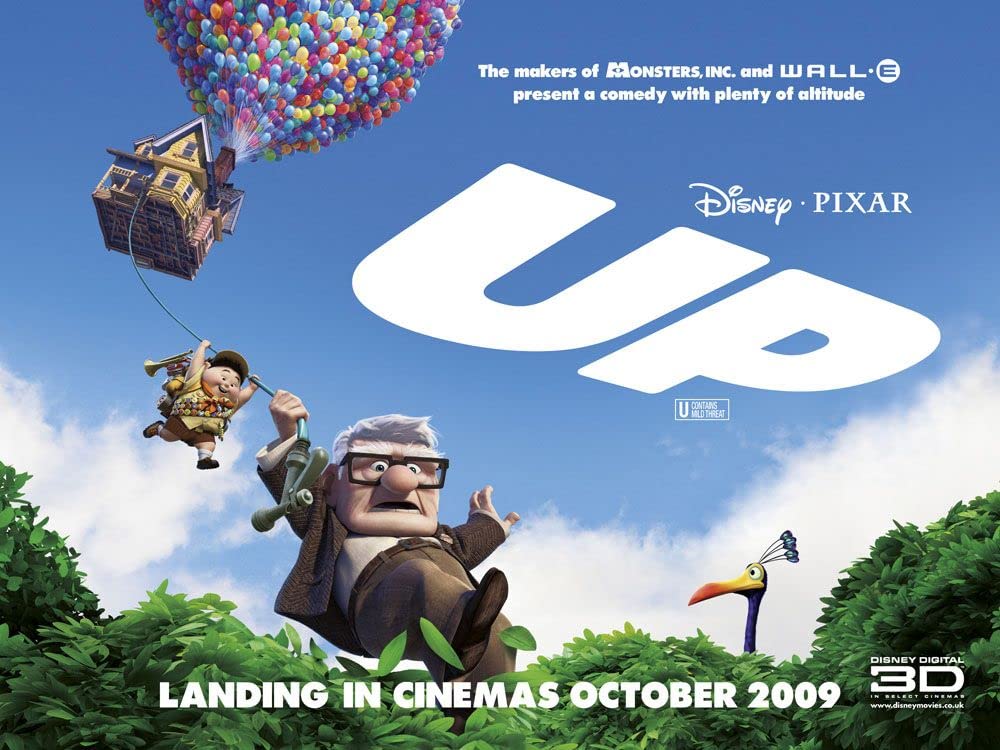
Yesterday, I learned that my occasional free AMC tickets even count for the 3D movies. That right there is pretty awesome, what with the extra charge they carry. Yay! I also learned that with a little bit of ingenuity and an unreasonable amount of helium, anyone can get a second chance. (Well, anyone who isn’t an obsessed bad guy that’s probably older than God.)

Up tells the story of a couple’s dreams of adventure at Paradise Falls in South America, and of a lonely old man’s quest to fulfill those dreams on his wife’s behalf after a protracted, ten minute long sucker punch delivered as the film’s prologue. Along for the ride are a floating house, a cub scout, a pack of talking dogs, a pretty hilarious giant bird, and the aforementioned bad guy. That’s pretty much all I want to say, because, well, it’s yours to watch now. I’m pretty sure this is the best Pixar movie, and yeah, you should really ought to go see it.

The Hangover

So, I like black comedy. The Hangover has a significant portion of that, and so I liked it pretty well. And yet, I can’t find much else to say about it. It was funny, but quite generically so, I guess? Or maybe I just like things to be a whole lot darker than people do on average.

Anyway, there are these dudes in Vegas for a bachelor party, which is intended to consist of light gambling, drinking, and general low-key debauchery. Which would be fine, except that after shots of Jäger on the roof of the hotel, they lose complete track of the night and awaken to a (very artistically!) trashed suite, a missing tooth, a stray tiger, and most importantly, a missing groom. And as they try to reconstruct their drunken night, the day keeps getting worse.

I could try to claim that there’s a lot of mileage in here on the importance of friendship, and, well, they do put in some effort on that score. But mostly, it’s yay black comedy and zany adventures. Laughs, yeah; thoughts, not so much. Oh, and an unnecessary (albeit well-drawn) caricature of a shrewish girlfriend who was the main downside of the movie. She was neither zany nor comedic, and mainly only existed to be disliked. I can go for one-dimensional characters, but the dimension needs to maybe not be repellent.

The Naked City

What I find most interesting about the Tick, at least as an artistic endeavor, is that he has evolved in much the same way as The Hitchhiker’s Guide to the Galaxy. There are all these different version of the same basic story, told and retold while, one supposes, the creator keeps trying to perfect things. The very first version of the Tick was presented in comics, and in this case in the graphic novelization of those comics, The Naked City. (Although, since it’s colorized, I’m still not technically reading the very originalest version of the story.)

But who, you ask, is the Tick? He’s a superhero parody, is the short version. He’s a moderately insane, somewhat simple-minded, bumbling, incredibly strong and nigh invulnerable guy in a skin-tight blue outfit, with inexplicable antennae, who has appointed himself as guardian of The City. That “guardianship” basically means that he leaps around rooftops, causing an alarming amount of structural damage and looking for evil to fight. Despite himself, he usually finds it.

Populated with a boatload of ninjas and somewhat amateurishly literal parodies of Superman, Elektra and Kingpin, it’s pretty easy to tell this is the beginning of the story. The good news is that the absurdist humor is already reasonably solid, and by the last issue Edlund is starting to find his own more thematic-parody voice. I should find me the rest of the comic’s run. And the animated series. And probably the live action one? I wonder if there’s other stuff I’m not aware of. Perhaps a commemorative Tick silverware set?

Drag Me to Hell

So, you know who I like? Bruce Campbell, star of such fine shows as The Adventures of Briscoe County, Jr. and Burn Notice, and of such fine movies as Bubba Ho-tep and Army of Darkness. As it happens, he is closely related via both cinema and pre-existing friendship with one of the finest horror directors of the ’80s, Sam Raimi.[1] After what feels like an extended absence, Mr. Raimi has returned to his genre of origin with what is simply the finest PG-13 horror movie I’ve ever seen.

In Drag Me to Hell, a sweetly ambitious loan officer runs afoul of a gypsy and her curse, and is then run through the gauntlet by a tormenting spirit who, in less than four days, will drag her to hell. (Unexpected plot twist there, I know.) As a technical exercise, it is quite close to perfect. From the soundtrack orchestration to the foley artistry, every moment of audio is, er, picture perfect. And speaking of that, the framing of the shots and the unusually relentless daylight[2] are every bit as well done on the visual side of things. But, however good, you didn’t come here for a piece of technical achievement. And that’s just the thing: as an actual horror flick, it is classic Raimi, straight to the hilt. The laughs are hysterical[3], in the most literal sense of the word, over the top in the kind of measure needed to make up for equal measures of jumpy scares and existential, well, horror. Because[4], the underlying message of this movie is that it doesn’t matter how underserving you are. Sometimes, you can piss off the wrong person, and your life will go extremely pear-shaped extremely quickly. That right there is an unpleasant truth that extends well beyond demonic table dancing and workplace sexism.

Really, my only complaint? No Bruce Campbell.

[1] You may be aware of some of his more recent work.
[2] I mean, relentless for a horror movie. A lot of other kinds of movies probably would not be noteworthy on this point, for even more daylight than this.
[3] There are by-God running gags. So awesome.
[4] Aside from a ten second shot of shifty-eyed Alison Lohman at the dinner party with her boyfriend’s parents, in which she signed, sealed, and delivered her ability to deliver black comedy. I am officially a fan of this woman.

Ultimate Nightmare

With my first foray into an Ultimate universe crossover series, I find myself wishing for the first time that I was reading these approximately as they come out instead of all jumbled together and out of order. One of the first thing I noticed about the Ultimate Galactus trilogy (or at least about its first volume) is that several of the characters have evolved well past who they were when these books were written. Specifically, both Wolverine and Nick Fury’s reactions to the X-Men seemed entirely uncharacteristic with my current expectations. But, on the bright side, I continue to make good progress and will eventually catch up.
The aptly named Ultimate Nightmare chronicles an unexpected worldwide multi-spectrum signal being broadcast from Tunguska, site of a century-old meteor strike that has been science fiction fodder ever since. Among the reactants to the images of an alien culture being destroyed while a mysterious voice repeats certain doom over and over are select members of the X-Men and of the Ultimates[1]. For the most part, the meat of the story purportedly being told lies in the future. This book was largely an excuse to visualize several bit character villains from Marvel’s past, in the guise of decades of Soviet experimentation. Luckily, as in the case of footnote 1, the book was more than entertaining enough to support being a mere prelude to the Galactus story I have been implicitly promised.

[1] Including a character named Sam Wilson with whom I am wholly unfamiliar; pleasingly, he was interesting to read about.

Ultimate Fantastic Four: Salem’s Seven

I’m not sure if it happens more often in some titles than others, nor whether I am noticing more often than I used to, but it’s definitely the case that some Ultimate storylines revolve around bringing back and/or reinventing heroes and villains from the original Marvel run. Sometimes this is fine, because it’s someone I want to see, and other times it’s iffy, because it’s someone I never have seen, but there’s an implication I should know all about them and resultingly a little bit too much character background is left out. Salem’s Seven was one of the best outcomes, however, wherein I’d never heard of them before, and yet the story they were brought into was entirely engrossing and entertaining.

There’s not much to tell plotwise that wouldn’t drift into spoiler territory, but this reminded me a lot of old school Fantastic Four, wherein all kinds of plot elements were thrown together just to see what would happen. You’ve got our heroes and their interpersonal issues, you’ve got a ridiculously sexy S.H.I.E.L.D. psychologist on a mission to determine the viability of the Baxter Building and its many projects, you’ve got a new batch of superheroes out of, implausibly, Salem, Oregon, you’ve got the return of Namor, and you’ve got yet another world-ending threat. This is what the Fantastic Four is (are?) all about, yo.

Management

Last week I think was a good week for catching an indie romantic comedy. Management was an enjoyable, if deeply flawed, example of the genre. There’s this guy, Steve Zahn, who is the night manager at his parents’ small-town motel. He’s the kind of actor that you know who he is, but have no way of saying what it is you’ve seen him in before.[1] One day, corporate art saleswoman Jennifer Aniston stays at the hotel, and he gets the idea to give her gifts, courtesy of “management”, in the hopes that… well, I doubt he knows exactly what it is that he hopes for, being the sad sack of a lonely man that he is. Whatever he hoped for, he got a whole lot more than that. But what would have been an unlikely one night stand is turned on its head when he flies out to see her after her departure the next day.

And that’s where the implausibility comes in. I don’t think he was a stalker, so much as a sad sack of a lonely man who also has no sense of realistic boundaries. But she didn’t have the audience’s insight into his head, and would surely have seen him as nothing but a stalker. So, we have about 75% of a movie that is predicated on the least likely reaction I can conceive of, wherein she decides to keep him in her house overnight so that they can hang out for a day or two. There are many more obstacles on the path to what may or may not be true love, as the genre dictates, but it’s hard to really buy anything after that one glaring flaw.

Still, if you can ignore that, it’s pretty decent, starting out with Office-style discomfort humor but frequently branching out into the genuinely funny kind that has no need to be preceded by “horrified”. The best acting is turned in by Steve Zahn’s mom and by his Asian sidekick; as you would expect of an indie comedy, the bit characters are the ones to shine. And I guess that’s mostly why I still watch these: yay, acting surprises!

[1] But not, I think, a character actor. It’s hard to explain why not, which possibly indicates my inaccuracy as to this point.

The Terror: A Novel

After the relative disappointment of Olympos and what I’ve been told about others of his sequels, I was a little bit nervous about grabbing a new Dan Simmons book. But after glancing at The Terror closely enough to see it had no room for a sequel and liking the cover, I snagged it and sat on it for a while. When I finally started it, well, I’m pretty happy with these results.

The Terror refers to a couple of things. Primarily, the Terror was one of two ships on John Franklin’s expedition to discover the Arctic Northwest Passage, between Canada and the North Pole; as the book opens, these two ships have been trapped in solid ice for over a year, victims of unfortunate navigation choices and a failed summer thaw. The Terror also refers to a creature that is stalking the trapped men. It is massive, seemingly unstoppable and every bit as dangerous as the weather and dwindling supplies. Like I said, I was a little bit nervous about the book, and so I may have been more critical than usual. One scene near the middle of the book seemed a touch over the top, and I was a little bit antsy about the conclusion, but I got over it. On the whole, extremely solid book.

Additionally, it spoke to me pretty strongly, because I have myself experienced some fraction of a percent of what those men did, and as the prolonged cold started to take its real toll on them, I was pulled in more and more. But then, just at the end, real creepiness struck, above and beyond both scary monsters and punishing climates. Turns out, all this stuff really happened.[1] It’s one thing to be reading a book, watching people die one by one, wondering who of the characters might have a chance and who not. It’s quite another to learn that all of the results were set in stone before Simmons’ pen was ever set to paper, and to look at a picture of the last mission report, pulled out of a frozen cairn years after it was put there, their doom written in the margins of the only paper they could find.

I am not sure, but I think that may have made it better for me than it already was. I will, for certain sure, carry it with me longer.

[1] Not, y’know, all of it.

Terminator Salvation

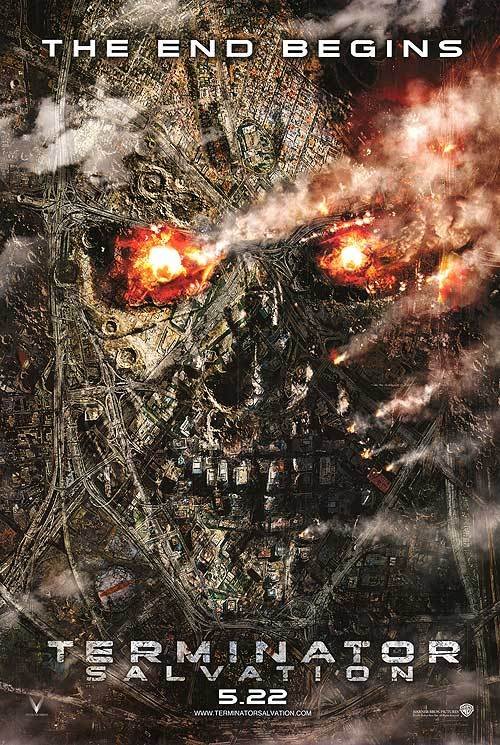
MV5BMjA5MzE0MTMyM15BMl5BanBnXkFtZTcwMDYwNjAzMg@@._V1__SX1859_SY893_So, it’s a Terminator movie, right? These are basically brilliant studies of predestination versus free will and where humanity exists, set against the backdrop of evil robots bent on making explosions happen. Very much a win-win. The latest entry in the series, Terminator Salvation, made the good decision of ignoring the third movie (without necessarily contradicting it) and the understandable decision of ignoring the recently lamented Sarah Connor Chronicles. With all of the time travel events over the course of the series, pretty much anyone could create a canonical Terminator story these days, saving only that it doesn’t contradict the first two flicks. I still haven’t completely decided how I felt about this one, but I’ll say this in its favor: it made me want to rewatch the originals.

Our setting is some years after Judgment Day. Skynet has broken humanity but not destroyed it. There are still roving bands of civilians, and there is a serious resistance against the machines, and a young man named John Connor has had some solid successes thanks to his mother’s advice and foreknowledge, enough that people see him as at least a mascot and possibly a prophesied savior. And while Connor is preparing to fulfill the destiny that will cause Skynet to try to kill him via Austrian time travel desperation, an unexpected new party, Marcus Wright, shows up with information about the whereabouts of one very necessary Kyle Reese[1] and a decided lack of information about himself, such as where he came from and why he’s a robot. And suddenly our hero is adrift in a sea of questions with no more prophetic answers.

As far as the whole question of where humanity exists, this movie was a champion. I know I just called Connor the hero, and he’s always been half of the hero of the series. But for this movie, and without intending the claim to be a spoiler, Wright was very much the hero. Or, let us say, main character, as that’s equally precise and far less prejudicial. The predestiny part was kind of handwaved but ultimately irrelevant, which makes it hard for me to accept this as a pure Terminator movie; except that the original ignored questions of humanity, so I’ll let it pass. As part of a likely series of sequels, there’s still some time to address all relevant philosophies. So, for explosions and things, yeah, it’s here and Connor is ready to deal with it. But for philosophical discussion, the camera is firmly on Wright from start to finish.[2]

[1] John Connor’s father, thanks to a crazy-ass time loop. But seriously, I’m sure you must already know that.
[2] Well, and on the talented but tragically named Moon Bloodgood.