Marvel Zombies 4

This sequel to Marvel Zombies 3 (as opposed to the series in general, because the third volume went off in an entirely new direction, you see) is interesting not for being a good zombie story (it was not bad, but it was also not good), but for being an archaeological study of the period of Marvel that I’m reading right now. The main characters are chock-full of the Marvel horror experiment: Morbius the Living Vampire![1], Jack Russell, the Werewolf by Night, Simon Garth, the [voodoo type of] zombie, Man-Thing, Daimon Hellstrom, Son of Satan, and, okay, some witch chick that I haven’t yet heard of. But my point is, these characters are wandering in and out of all kinds of crossovers with the comics I am reading (June 1976, now), and have titles of their own that all started since 1974. I am honestly surprised at how many of them have stuck around, though there are certainly changes, as I think there would have to have been. ‘Cause, really.

Alas, after all the interesting set-up that I speculated might be coming from the previous volume, Marvel Zombies 4 was a pretty straightforward fight to avert apocalypse. That certainly has its place in comics, unquestionably, but after setting up the MZ continuity to relate to horror and destruction and the existential angst of wanting to be a good guy but virally failing, watching some world fight off an incursion without any examination of the deeper causes of things and without… well, okay, in their defense, the book where we lose is already written, so putting that scenario on a new world is redundant. But I still say that using the MZ world as a springboard for “look, an apocalypse to avert!” is too, and I guess that’s why I was disappointed. Man, I wish they’d used the space to explain what the fuck is actually going on instead. Particularly if they’re going to insist on giving it religious overtones in the first place. Religious overtones = “there is a responsible party”, not “random happenstance in the universe, what are you gonna do?” So use that, Marvel Zombie authors!

On the bright side, the end of the book contained black&white issue 1 of Tales of the Zombie, which was a lot grimmer and a lot more nudity-filled than I expected a Marvel title to have ever been. Plus, it was pretty decent, even without its own more direct version of well-timed archaeology. I still won’t mind just watching these characters interact with my superhero continuity instead of actually reading about them too, but I’m at least getting a clearer picture of why people would have.

[1] I mean, they don’t themselves use the exclamation point as part of the name, but I cannot see how to say that without planning on being excited about it, and so.

White Night

I’ve reached a crisis point in my reading of the Dresden Files. See, there’s always (by which I mean starting in the third book or so) been a long-term story being told, and I know this. Plus, there’s always been continuity, and I know this too. But until White Night, I’ve been able to pick up each new book and just read it, and remember enough about the previous continuity and the long-term story to do just fine. Now, though…

Don’t get me wrong, I remembered enough to keep up with Harry Dresden’s rampage through the spirit world in response to the recent murders of magic-sensitive women, that took him through several trips down memory lane and culminated in, as usual, mostly everybody but Harry winning big[1], but there was at least one world-shaking revelation that lacked the punch I think it should have had. And I know it’s only going to get worse. So now what?

If there were a lot of books left, obviously I’d just read them. But the truth of the matter is, I’m only a few behind now, and there are (I believe) quite a few to come, as yet unwritten. So if I were to rush it now, I’d just have the same problem in October. So I guess I’ll just stick with what I’m doing? (I do kind of wish I could do online research without fear of massive spoilers, though.)

Oh, anyway, I did want to say that I continue to be intrigued by Harry’s emotional ups and downs. Struggle with sexism? Sort of. Really, he embraces it, but I have the impression that the more he talks about it, the more he is trying to figure out a better way. Anger issues? Big time. Too much paranoia (or justified fear) to work well with others? Oh, my, yes. But he’s still unquestionably a good guy, and that’s what I like best about him. The nuances. He’s an interesting, interesting person.

[1] At least he continues to win small.

Cowboys & Aliens

A number of years ago now, I was given a graphic novel that a friend had acquired at either the first Free Comics Day, or the first one I heard about[1]. And it was, well, not very good, despite an eye-catching title/concept. Fast forward four years, and I started hearing rumors about a movie based on said graphic novel, and in fact that it really hadn’t ever been a graphic novel per se, so much as an attempt to woo movie studios with their script concept. Which kind of explains the extremely free aspect of the book.

So I started downgrading my expectations hard and fast, since I knew that sooner or later I’d be bound to see it despite my foreknowledge, because who is going to listen to me trying to explain that, no seriously, I’ve read this story and you just aren’t gonna like it, I don’t care what you think, when the title I’m railing against is Cowboys & Aliens? And, as is often the case, that worked out pretty well for me.

The movie (as opposed to the comic) had three really strong things going for it. The first was Harrison Ford playing a morally dark asshole[2], and the second was the exploration of the unfortunately-renamed Jake’s amnesia and how absolution[4] is affected by people’s perspective on your history. But the third and most important thing is that Favreau focused his remaining energy on alien tech and cool explosions, instead of a trite, overused indictment of Manifest Destiny. Not because I disagree with that message, believe me, but because there are so many more interesting messages for science fiction to thematically provide us[5].

[1] Or, having re-read my review to figure out the discrepancy between book and movie reaction, none of the above. Oh, fickle memory. Why you gotta be that way?
[2] I don’t mean morally grey anti-hero a la Han Solo before Lucas started fucking around with the footage, I mean dark. The guy is a prick, and maybe it’s too much[3] of Ta-Nehisi Coates’ excellent blogging of his grapple with the Civil War talking, but I could not stop thinking about how, while a real point was made of Colonel Dolarhyde’s wartime brilliance, which side he fought for was conspicuous for not being mentioned.
[3] by which I mean the right amount
[4] Remind me to come back to this.
[5] So, right. Footnote Four. Absolution. I love that this was the (blink-and-you-missed-it, the reference was so fleeting in the opening scene) name of the town around which the film’s events were set. That’s the kind of “heavy-handed” theme I can get behind. It doesn’t make the entire coming plot an exercise in eye-rolling the way the book’s did, it just gives you the tools to watch each character struggle towards their own individual version of absolution. If the movie had been based on this book, instead of the one it actually was? It would belong in junior high literature classes. (Which is praise, to be perfectly clear. There’s no shame in being a stepping stone.)

Fables: The Good Prince

I am having trouble coming to grips with The Good Prince. Not because there’s any question of it being good; if anything, it was the most fable-like story of any long arc I’ve read in the series. I started to point out that there’s a twist where the most unlikely character of all blah blah blah, but the truth is, that is as fable-like or moreso than every other aspect of an extremely fablicious storyline. But at the same time, that’s my problem; if it looks like a happily ever after is in reach (and I’m not saying one has happened, but I can see the road from here to there), does that imply[1] that there’s going to be a sudden, dramatic (and rather unlikely) reversal of fortunes? Or is the series going to be about something else entirely than what it has been about for the last good while?

Then I remember that it wasn’t about this war with the Adversary for the first two or three books, and I liked them plenty, and I stop worrying about it. So maybe less grip-trouble than I thought?

[1] I should add here that there are a lot of books left in the series before I catch up to present time, and it’s still being published.

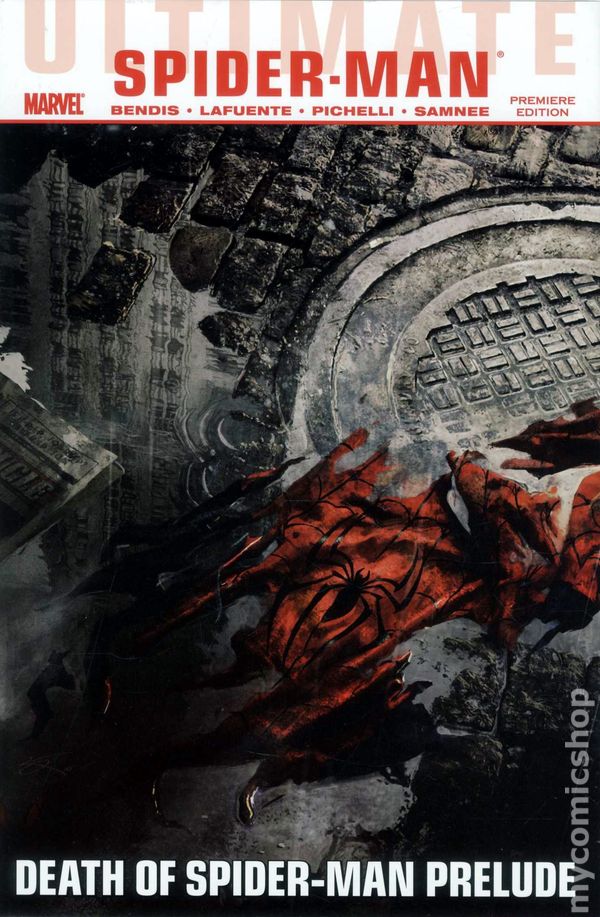
Ultimate Spider-Man: Death of Spider-Man Prelude

1160287They certainly don’t pull any punches on the spoilers when they have a big event coming up, do they? That said, I’m not going to go into any of the future spoilers (of which I know somewhere between one and two) in this review; all I’m going to do is take them at their [notoriously untrustworthy where death is concerned] word that the title is accurate, and go from there. Because, while the story in the Ultimate line’s prelude to Death of Spider-Man was good[1], it’s hard to get very worked up about it with such a huge shadow looming over the future landscape. But I shouldn’t sell it short, because it was a really great book, pulling together just about every extant plot thread and weaving them all together seamlessly. More about Mysterio, Spider-Man’s biggest foe since the Green Goblin? Check.[2] Fallout from… I mean, whatever you want to say about the way Stan Lee created the first superhero with human problems, and that being what made Peter Parker special, sometimes that boy has problems that nobody else has, because he’s a superhero. So, as I was saying, fallout from the most literal form of identity theft I’ve ever seen? Check. When the Ultimates hold a coffee klatch about whether you and/or your image can be reformed, you know things are serious. And that’s leaving the girls out of it entirely. My point is, Pete just had a really bad week, and this week wouldn’t be looking so great either, even without Mysterio’s latest gambit or the newest and arguably most dangerous holder of his secret identity.

There. Review out of the way. Now, let’s talk.

I’ve been thinking about this upcoming “death of” storyline for a couple of months now, basically since I received this book and then moreso a few weeks later when spoilers erupted in the media based on the release of a relevant comic (to be portrayed in a graphic novel somewhere down the line, I reckon), but the thoughts didn’t coalesce until after I read this one. We have this guy, Spider-Man, right? He is freakishly strong, although not much stronger than the strongest man without special powers. He has designed a web fluid that lets him swing around to get places faster[3] and that makes it easier to trap / blind / distract opponents or make a safety net for himself / bystanders. He can stick to walls. And he has a danger sense that tells him if something bad is about to happen. Not a bad little list of powers, and he makes good use of them. But all in all, if Spider-Man died, what would change? The Ultimates still take care of alien threats, large-scale terrorist activity, the really high-powered villains, that type of thing. And the Fantastic Four still takes care of random dimensional incursions, or would if they had ever gotten back together. But at least they used to, and their being missing now doesn’t really mean Spider-Man could take up that slack. More inventors with delusions of evil grandeur would get away with their initial schemes, until they got rich and powerful enough to attract the attention of the big boys, at which point it all ends up in the same place, just with a few more people hurt along the way. I’m not saying that’s nothing, but new superheroes come along all the time. It honestly isn’t a whole lot, you know?

But then we have this guy Peter Parker. Pete’s done a lot of things. He’s received random powers for no apparent reason, and even though he’s one of the smartest people on the planet, the freak genetic accident didn’t turn him into a super-villain. How many people can say that in any Marvel universe? Answer: few indeed! When New York was underwater, and most people were either trying to track down the perpetrators or else just get to safety, he was the only hero I remember who was actually running towards the devastation (well, diving towards it) and trying to pull people out. Over the past year or so of comic continuity, his aunt has changed from an angry and somewhat resentful aging widow to a strong mother figure to a lot of other heroes in the teen set, who can and will stand up to S.H.I.E.L.D.’s top agent if it will help her kids. He’s taken Nick “it’s the one that says Bad Motherfucker on the handle” Fury to task over poor ethical decisions, and even more amazingly, been successful at it. Pretty much every superhero he comes across respects him, and the exception (Captain America) is the very one whose place I see him as taking in the Ultimate universe, even if Cap almost never lives up to those aspirations in Marvel’s main continuity either. (Well, at least not as of 1976.) I see some arguments that Superman does this in a few of his movies and perhaps in limited comic runs, and Captain America in the recent movie did exactly what I’m talking about. But in long-form comics, the only character I’ve ever seen that makes everyone he comes in contact with a better person, who basically makes the world better with his every action and makes it worse with virtually none of them, is barely sixteen year-old Ultimate Peter Parker.

On the one hand, death is a very fleeting even in superhero comics. Always has been, probably always will be. But on the other hand, I’ve seen only a bare handful of people in this particular continuity come back from death, and most of them were via special cheats written into the original Marvel storylines the authors were covering. So I don’t really know what to expect, and I give you my ironclad guarantee that I have no special knowledge of what is to come, beyond the aforementioned one or two spoilers that I’m avoiding here. What I do know is this. If Spider-Man dies, as they are so strongly implying, I’ll miss a cool character, but it won’t be a big deal in the scheme of things. If Peter Parker dies, as he would nearly have to for Spider-Man to do the same, his world will be the worse for it. I’m invested in the Ultimate universe, pretty obviously to you who have read me review every last one of their releases. I’m not going to stop just because they make a choice I’m not okay with, at least not right away. But it could be that before this time next year, I’ll really want to. Why would I keep forcing myself to go back to a darker, sadder place?

[1] Isn’t it always, though? I was wondering recently whether there has ever been a 160 issue run by the same author for a shared superhero character like this.
[2] And let me tell you, I am impressed at how well they’ve rehabilitated a mostly lame smoke-and-mirrors guy from the original run.
[3] Though once he leaves or before he gets to Manhattan, what are his web-lines attached to? He’s always way too high outside the City, you know? I have no point here, it’s just always bugged me.
Pony Soldiers

I am kind of relieved to see some errors cropping into the Deathlands series. It’s not that they’re great literature; they are little more than fun sci-fi romps that would make a great 80s TV show[1], but in a way, that’s kind of my point. They have no business being as forward thinking and well-constructed as they are, considering their genre and their publication era alike. So it’s nice to see Pony Soldiers come along and suddenly provide a recurring villain as well as letting the characters act uncharacteristically foolish toward him now that he’s finally on the scene. Of course, then I think, no wait, they don’t know here in book five that the series is going to get into triple digits and still have new books coming out even as I castigate them for that lack of foresight, and most of those same 80s TV shows waited less than a year between recurring villains, which is about the length of time between the first and fifth books being published, so really this probably isn’t an error after all. Dammit. Fine, but I’m holding on to the part about them acting foolishly around him, instead of him just being so clever as to avoid his fate. At least it’s something?

In addition to all that, the story delves a little bit more into the concept of time travel that has been looming over everyone’s heads, by virtue of apparently dropping General Custer in the middle of a pitched war with the post-nuke Apache somewhere in the mostly radiation-free Southwestern deserts. Between that little mystery, viewpoints from a few more characters than we’ve had before, and ever-greyer moral quandaries, the series is definitely getting more interesting the further along it goes. And that’s not just my relief over the misstep talking.

[1]  Think A-Team, except with more continuity than they ever could have dreamed of in those days. And more female characters outside refrigerators than they ever could have dreamed of, for that matter.

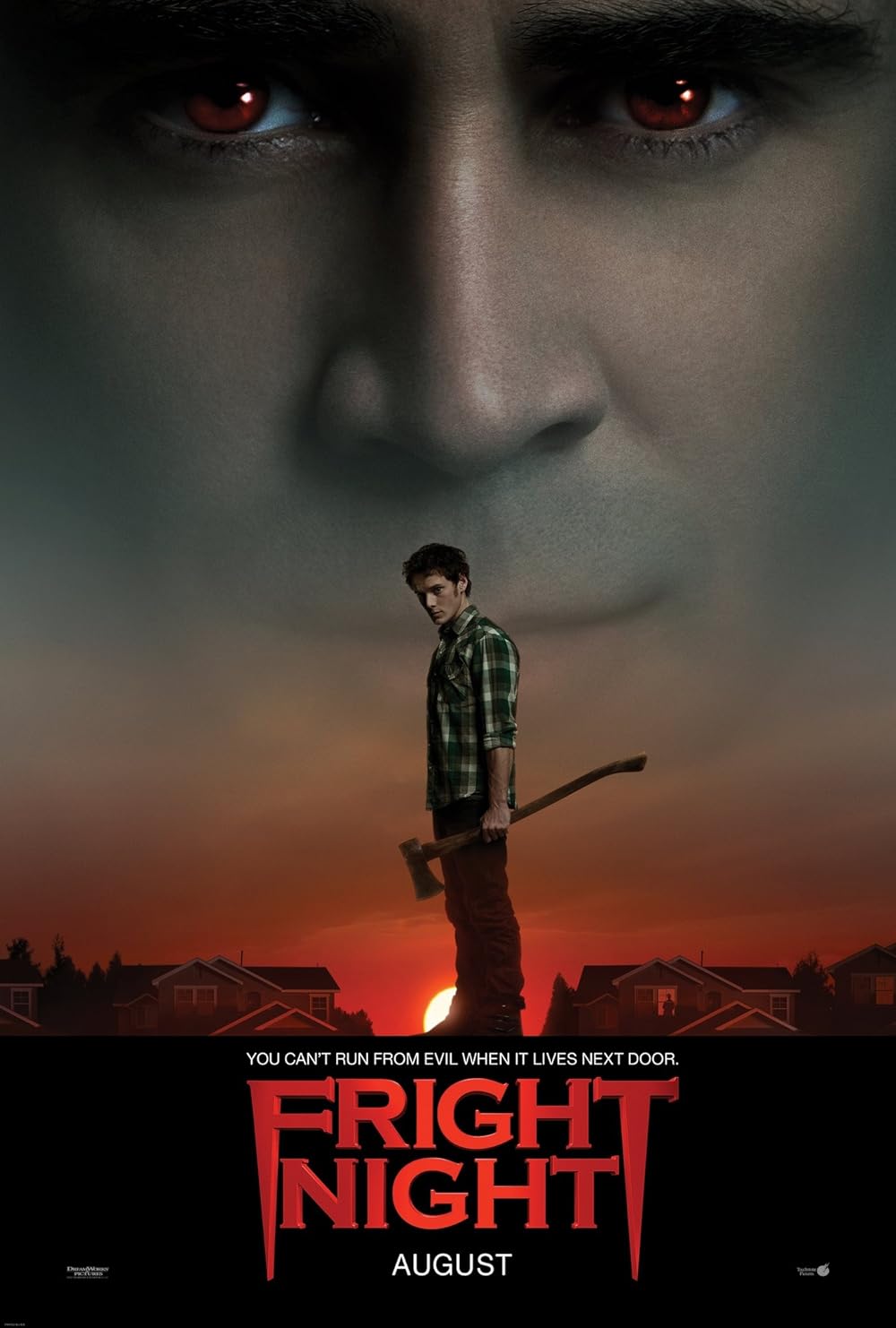
Fright Night (2011)

A number of years ago, I declared Fright Night to be the best vampire movie. I’m glad I did this, because it would be implausible to just make the claim now. “No, seriously, you guys, I totally always thought so!” Plus, of course, I stopped thinking so just recently, because Let the Right One In was downright incredible; that said, I do not mind drawing a line between film from the vampire’s point of view and film from the slayer’s point of view, and letting them therefore split the honor evenly. Completely different movies, and while the Swedes made the objectively better one, Chris Sarandon has a lot going for him on the non-art-house, specifically vampire-focussed front.

None of this would be worth hashing out, of course, except for how someone (apparently, Marti Noxon! Who knew?) decided to remake Fright Night. So, I was pretty ambivalent about that[1]. On the one hand, it’s been better than a generation since the original came out, so there are upsides to modernizing the characters and the effects. But on the other hand, man, I loved that movie, and since when does Hollywood ever do a good job of reinterpreting something that was itself originally good? Since now, I guess!

‘Cause, yeah, the modern Fright Night? Still in my top five vampire movies, I suppose primarily on the strength of the core story, which is by and large unchanged. See, there’s this kid living with his single mother, and strange things start to happen. Before very long at all, he narrows them down to his recently moved-in neighbor Jerry, who he believes is a vampire. And then, you know, hijinx ensue! Just like in the original, the show stealer is the mentor character, a late night TV host played by Roddy McDowall in the original and a Las Vegas magician played by David Tennant this time out. People call the movie part comedy, but I never really thought that was right. It’s just excellent at the tension relief that most horror movies aspire to, without ever actually removing the fear. I guess it’s that I can’t believe that any movie this good at providing a scary and realistic portrayal of  modern vampires[2] can be a comedy. But yeah, it’s pretty damn funny. Sometimes. The rest of the time, it is creepy, or scary, or awesome.

[1] In the torn way rather than the barely stirring myself to care way.
[2] I mean, actually scary vampires in modernity, as opposed to the angsty, misunderstood, paranormal romance vampires that have taken over the landscape. You know, I might like this movie just as much without nostalgia, simply by virtue of being about an honest, straightforward, hungry vampire, who isn’t in love with anyone and isn’t trying to reform himself. Seriously, guys, we get it, it’s played out! (I am all the more surprised this was Marti Noxon, now that I’m really thinking about it!)

Final Destination 5

The Final Destination series is in its own way every bit as comfortably broken in as Friday the 13th was by this point in the ’80s (which is to say, apparently, 1991); I know all the rules, better than the characters do, and even though of course there are new twists and turns, there is a fair amount of comfort in being able to settle back and enjoy the upcoming squirm-fest unencumbered by analysis about how things may or may not work. Is there more to say about Final Destination 5?

Nah, I guess not.

Powers: Anarchy

The thing that is sad about my review of Anarchy is that it will sound like I didn’t like it, when the worst I have to say about it is that I didn’t love it. The characters are still top-notch, or I should probably pass that through my filter of liking things too strongly and say instead that I continue to find them compelling. But the plot of this particular issue was really just forgettable. It was tasty forgettable, don’t get me wrong, but like when you eat light popcorn and then later you suddenly want actual food? It’s like that. I know that there were some superhero murders that tied back into the comic’s earlier days and that may well become very important later for that matter, but in the moment, it was just a glimpse of places we’d been before with people I’m happy to accompany, sure; and restoring the status quo (which had been really strongly upset by the end of the last book) was probably a good idea, but I could wish it had been more exciting to get there.

On the bright side, the book isn’t a thousand pages long and I didn’t have to wait two or more years to read it, so the standard complaints really don’t apply.

Rise of the Planet of the Apes

I caught a movie last night with an outsider / coming of age theme. The young, unusually intelligent student (played by Andy Serkis) is befriended and mentored by surrogate father figure James Franco, but despite all of their efforts, the student’s outsider status reigns supreme as he is gradually shuffled through a system that understands him no better than the inhabitants of the various locations into which he is placed by it. Can he find a way to make himself understood and grab onto happiness somewhere in the world? Can Franco make the student understand his own connection, his own love, and can that connection be enough?

Oh, also they tacked on a science fiction framework around that basic storyline, based as a prequel to a classic movie with Charlton Heston that you may have heard of[1], and also some really significant special effects and a pretty cool actiony climax. So that part was alright too.

[1] Hint: it’s not “people”.