Kushiel’s Justice

Something more than a year went by after I read Kushiel’s Scion, mostly because I read it so close to publication and that’s the approximate schedule for these books, before I found Kushiel’s Justice in the used bookstore. It had no cover, which has been a constant source of annoyance since; and in fact, if I’d known I would wait this damn long to actually read it, I would have left that copy sitting on the shelf. In further fact, while reading this one I learned that a friend was slightly further into the third one than I was into the second. Which was a little bit embarrassing, but I at least avoided big-huge spoilers, so yay! Anyway, though, I actually did read it, so you may be expecting a review?

Now that he’s home from college, Imriel is forced to face the truth that sent him fleeing to alternate-Italy in the first place: he’s in love with the heir to Terre d’Ange’s throne. Which doesn’t sound so bad, as he’s a prince of the realm himself, and in any event the only law laid down by their god, Elua, is “Love as thou wilt.” Things are always a little more complicated than that for Carey’s characters, though: Imriel’s birth parents (one of whom yet lives in hidden exile) hatched a plot before he was born to steal the throne for him outright. So naturally, there are a number of people who would not look kindly on his winning it through marriage.

So he and Princess Sidonie keep their infatuation secret and do their best to quell it, now that Imriel has been promised in a political marriage to an Alban princess (alternate-England, that is). This seems like the right thing to do, except that in being sensible, are they violating that self-same lone law to which they should be bound? The rest of the book is an examination of the repercussions of love, future foreknowledge, and bloody revenge, with more focus on Alba than has been provided in previous books, as well as new travels across northern alternate-Europe. It runs slow at the beginning, but I devoured the second half of the book around work in two short days: the moment past which stopping is impossible came barely halfway in, which is a pretty neat trick.

One spoiler after the cut. Continue reading

Get Smart

I know I used to watch the old Get Smart TV show, and that I maybe even saw a previous theatrical release with a nude bomb, which strikes me as a hilariously ’70s conceit, thinking back on it now. What I remember of the show is pretty limited, although I have access to all manner of catchphrases and signature devices in my brain. I think I’d be willing to watch it a couple of times, just to see how it holds up, but my expectation is that it’s one of those shows where the heroes win implausibly despite being consummate bumblers for the most part. Funny and definitely influential, but probably an ultimately flawed product of a less advanced television environment.

But I wanted to see the movie anyhow, because Steve Carell is awesome and Anne Hathaway is both hot and has performed well in every role I’ve seen and Dwayne Johnson deserves to be supported for any role he takes that isn’t family-oriented, so that he’ll go back to making cool movies. (See also: Diesel, Vin.) So when I learned that the Dallas contingent was going to see it on Saturday, and in my neck of the woods no less, I was in. Plus, bonus massive serving of Shiner Bock available at the theater. Worst case, good company and beer, right?

Here’s the thing, though. This was decidedly best case. I cannot tell you the last time I’ve seen a more consistently funny movie, plus it was neither one of the infinite disposable parody movies we’ve been blighted with lately nor the much better (though still not quite to my taste) gross-out comedies that seem to fill the rest of the slots. And on top of being a purist comedy, it had a fun, non-throwaway plot and characters chock full of heart. Like I said, I think of Maxwell Smart as a bumbler who manages to win despite his dubious talents rather than because of them, a la Clousseau or Inspector Gadget. Whoever wrote this saw a much more earnest character; Carell’s Smart is overly enthusiastic and incredibly green, but with genuine spy talent buried underneath that, and limitlessly optimistic. I just love homages, adaptations, or remakes where you can tell that the person in charge has genuine love for the original work, rather than just a desire to cash in. In this case, I have the impression that it was not just the people in charge, but everyone involved from top to bottom. And they done good.

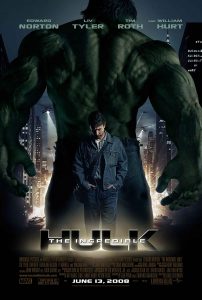
The Incredible Hulk

I can’t really explain what went wrong with The Incredible Hulk. It was much more of a super-hero movie than Ang Lee’s much derided The Hulk from a few years ago. It did a really good job of pulling in numerous sly references to the ’70s TV show, plus of course to the original Marvel comics. The effects were always spot on, as they have been of late. And I have to geek out a little bit at the way that the various movies are being tied into a cohesive Marvel Universe, just as the comics have always done.

These all sound like pretty good things. And yet, it felt like a late winter release from Marvel a la Daredevil, rather than the summer renaissance they’ve provided so often this decade, most recently with Iron Man. I know that part of the problem has got to lie with the Hulk himself; at least, what I’ve read from 1962-1967 reveals him as an insufficiently interesting character with especially uninteresting villains. And sure enough, the majority of the movie related to Bruce Banner being hunted by the army, angered, transformed, eventually captured anyway, and so on, because the army and General Ross are practically his only interesting foes, and they because of the human element. Which is good and all, but falls flat in an ostensible superhero movie. You need super villains for things to work.[1] If you don’t believe me, ask Ang Lee.

On the other hand, though, whatever pejorative comments have been thrown at Lee over the past few years, the primary flaw of his Hulk was in making a movie whose reach far exceeded its grasp. There are worse epitaphs to be cursed with, and among them is to make a movie that simply didn’t bother to reach very far at all.

[1] And, okay, this had a super-villain. Which was pretty much an alternate brute strength guy who we do not like because he isn’t green and because Liv Tyler doesn’t like him. (Well, and he’s kind of a douchebag.) Still, not much of an improvement on the army, which he is incidentally a part of in the first place. On the bright side, they laid groundwork for the only interesting Hulk villain I’ve seen in the comics to be present in a potential sequel. So that’s something.

The Strangers

I’ve mentioned this before, but the horror genre really is experiencing a renaissance. The slasher film is once more falling by the wayside, alas, but that’s a personal preference and not a big deal in the scheme of things. Plus, it always comes back to life.[1] My point, though, was that once or twice a year since earlier this decade, I’ll watch a mainstream, theatrically released horror film, and it will be scary. Which seems like it should be trivial, given the genre, but I mostly don’t get scared by demons and zombies and the like anymore, and my enjoyment for those kinds of movies is in the amusement value instead.

The Strangers falls solidly into the genuinely scary category, and all the more so because of its stark simplicity. A couple goes to a family vacation home in the woods late at night, and are terrorized by three people in masks who are always one step ahead of them in realistic ways, despite the couple not doing very many unrealistically stupid things while trying to figure out what is going on and protect themselves. The result is building, unrelenting tension that lasts until almost the final frame. Which, yeah, is what I’m looking for in my horror movie. So, yay, this one, and yay renaissance.

[1] I know, right?

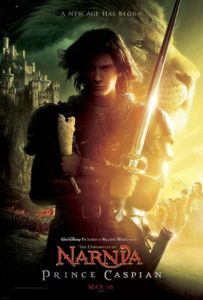
The Chronicles of Narnia: Prince Caspian

I finally saw Prince Caspian over the weekend, and it was kind of a weird experience. As a fantasy adventure movie, it kind of works. All those kids from the first movie are magically summoned back to Narnia when Prince Caspian, marked for death by his usurping uncle, stumbles across Susan’s magic get-out-of-jail-free horn where she dropped it in the woods while trying to escape his uncle’s army and blows it.[1] Or, considering he wouldn’t have known to, maybe someone gave it to him instead. Or maybe he didn’t know and was just hoping someone would show up to save him? I’m not sure.

Anyway, there they all are, and it’s been over a thousand years and their whole castle is fallen apart, because evil Spaniards (who we call Telmarines) attacked and subjugated Narnia quite a while ago, driving the magical creatures and talking animals so far into the forest that they are believed to be extinct, plus nobody has seen Aslan in pretty much that whole time. Although Caspian is heir to the Telmarine throne, the fact that his people want him dead and that plot necessity demands it combine to get all the Narnians willing to support him. His enlightened reign, he promises, will see his people and the Narnians peacefully co-existing, which one supposes is better than hiding so well everyone thinks you’ve died out.

Then he and the Narnians and the Pevensie kids (aka Kings and Queens of Narnia, aka Peter and Susan and Edmund and Lucy) all get together and have a war against Uncle Miraz and the Telmarine army, with mixed success, all culminating in a grand finale of some kind, as movies often do. So, yeah, that worked.

As the Christian metaphor that one expects from the Narnia property: well, mixed success fits well here, too. There’s a bit about not making a deal with the devil, even if it is the devil you know. And there’s a bit about not ignoring God’s little nudges in your life. Which, okay, I suspect that they maybe aren’t as obvious as seeing a lion waving you over, but that’s how metaphors work, so fair enough. But even though most of the failures in the movie were blamed on not following Aslan, as is a good and proper metaphor, the fact is there was just no real way to tell what it was that Aslan wanted of them. He just sat around waiting for things to be terrible, and then rolled in to save them all, while proclaiming that the whole point of not coming and saving them to start with, as he’d done in the previous movie, is that things aren’t ever the same twice. Except really, what he did was exactly the same, because, after all, the whole point of the metaphor is that ultimately you can’t face the evils of the world without Aslan there to carry you down the beach some of the time.

I mean, if they’d made a show of “I didn’t help you because you never asked me to”, that at least would have been a prayer metaphor, and I could get behind it working, pretty well in fact. But I mean, there was no show. And by ‘show of’, I mean not even a single line of dialogue, which is approximately how much it would have taken. Maybe another line or two of reaction, but this is not a long conversation I’m describing here. This also might have tied into the part where nobody in Narnia really believes in Aslan anymore, since nobody has much seen him in the past millennium, although at the same time, I imagine that the Narnians were looking for him to come help back when the war started and their castle was being smashed and they were doing the extinction-hiding and it had been less than a thousand years since anyone had seen him. (I mean, I don’t know how long, but this is the 10th Caspian, so it’s been a little while.) And since he obviously didn’t show up to help out then, well, that would kind of hurt the metaphor a bit, I guess.[2]

Also, the above review probably contained spoilers, and if you care about such things, you should not have read it.

[1] I just reread that sentence, and as much as I considered rewording it because it loses track of proper antecedents at least twice, I choose instead to let it stand as a monument to my awesome clarity of communication.
[2] I just remembered another complaint. It bothered me when they said that Narnia is only ever right when a Son of Adam or Daughter of Eve rules the country. Even though I understand the whole ‘man shall have dominion over the creatures of the earth’ thing, it’s just, these are centaurs and talking mice[3] and morally conflicted dwarves, and they all seem to have agency, you know, so the concept comes off a lot more as White Man’s Burden to show up from a different, far away place and take care of the poor misguided natives so they don’t screw things up too badly than as the Genesis metaphor that is apparently intended.
[3] To be clear, Reepicheep was in fact awesome. So that’s nice.
Ultimate Fantastic Four: N-Zone

As we rejoin the youthful, modern Fantastic Four, they are still trying to determine how to reverse the changes that have been wrought upon them.  Well, at least those who actually want to go back to normal, which number is shrinking as they begin to realize that the potential for the future outweighs whatever burden they may feel. Since I’m not that big a fan of the reluctant hero, this is pretty much fine by me. In any event, in this volume, they plan a trip back into the N-Zone that was the source of their new lives, for science!

The story was basically fine, with all the sci-fi trappings that attached to the original FF moreso than any other old-school Marvel comic, including a spooky extra-dimensional universe with inexplicably giant skeletons and a bad guy named (roughly) E-Vil. I don’t know if the problem lies with the objective quality or with my just having read a much superior Ultimate Spider-Man book, but this one left me mostly dry. The good news is that the character interactions among the four of them that have been the best aspect of every book so far are just as solid here and if anything continuing to grow in quality. There’s nothing worth skipping, but if it was what I had to recommend the series from, I probably wouldn’t bother to.

Ultimate Spider-Man: Learning Curve

Once again, expectations have served me greatly. With a name like Learning Curve, I expected this second Ultimate Spider-Man story to mostly revolve around Peter learning to deal with his new powers, such as climbing on walls and being strong, and that this would be basically fine, but nothing to write home about while waiting for the next good story to start up.

Instead, I got a sensible revamp of several eye-rollingly silly criminals from the early Spider-Man run (and also Kingpin, who I haven’t even gotten to yet in the originals), as well as the beginnings of Peter’s work as a freelance photographer and the beginnings of a relationship with Mary Jane. On top of this, there are some seeds scattered about for future plot development, and Aunt May seems like a real and interesting character, which I would not have guessed was possible; in my experience she has only ever been a device to serve as a limiting factor on Peter’s choices in life. All this, plus the learning curve in question is Spider-Man learning to behave intelligently instead of bulling forward into fight after unwinnable fight. Which is to say, something that’s actually interesting to read about, and not filler in the slightest.

All of that plus the beginnings of the smart-mouthed banter that was, at least to my eye, Spidey’s first real trademark maneuver have gelled this series in my mind as my clear favorite in the super-hero genre, and in the top 5 of graphic novel series generally. Looking forward to more quite eagerly, let me say.

Buffy the Vampire Slayer Omnibus, Volume 2

Apparently, the first omnibus of collected old Buffy comics didn’t leave that much of an impression on me, because I’ve felt no particular drive to read the next one since. The only reason I did now is because I’ve been trying to put off starting something new before the next Walking Dead collection comes out. But it’s been delayed by another month at least, and what the hell is up with all that? So, I caved. But the thing is, I mostly liked the first Buffy collection, both in my memory and in my review, so on the whole, inexplicable!

Volume 2 picks up still a little before the start of the series, but then rushes ahead into early season 3; I’m left with the impression that the comic didn’t start until season 3 or later, and that’s why things have moved so fast. As much as I still appreciate that the order of the comics is in show-chronology rather than publication, it is a bit jarring to see Dawn in the earliest comics, and then have her vanish from later ones when the writers were not aware that she would exist later.[1] In any event, most of these stories don’t do much to indicate when they are set, so chronology lets me only spend a few minutes trying to work it out, instead of the hair-tearing that would be happening if they were just scattered randomly.

As for the book itself: definitely a bit of a letdown from the previous. Part of it is that the art is either worse, or still as iffy but stands out again from what I’m used to, after the delay. But also, the stories mostly just didn’t do it for me. The first long one was a little too heavy on existential angst, the ones focused on writer favorites Spike and Drusilla were basically fine, the one set during Angelus in season 2 was quite good, and the remaining couple were pretty meh; one included an incomprehensible denouement, and the other had Giles’ niece as a really annoying character who contributed nothing. She wasn’t even whoa awesome enough to write her off as a Mary Sue.

I never really disliked any of it, besides the niece. But I occasionally wished it would be over so I could be reading something more interesting. This makes me skeptical about my likelihood to buy future volumes, barring if I see them used somewhere.

[1] But she’s still added a bit of flavor to those pre-series issues, and I can get behind that.

Harold & Kumar Escape from Guantanamo Bay

MV5BMTQ0NjgzMzQ1NV5BMl5BanBnXkFtZTYwMzI1Nzc4._V1__SX1217_SY911_It is unfortunate that I watched Harold & Kumar Go to White Castle before I was reviewing things, because its sequel practically demands to be compared to the original. Which I can do, but not very well without an original review to refer to; so I’m going to have to think of some things to say about the movie on its own merits as well, which is just annoying.

After returning from dinner, stoners Harold (Wall Street accountant) and Kumar (medical prodigy with a slacker attitude toward med school) hop a plane to Amsterdam in pursuit of Harold’s new romance with neighbor Maria. But before the plane gets far out over the Atlantic, their ethnicities and certain illegal drug-related activities find them hauled off to Guantanamo Bay under suspicion of terrorism, and then across the South toward Texas to find someone who can get them out of trouble with the law and incidentally maybe stop the wedding of Kumar’s college ex-. Plus, Amsterdam is still beckons from beyond the horizon.

The blend of scatalogical, sexual, political, racial, hallucinogenic, and romantic humor leaves something for just about everyone, and it was funny far more often than not. My complaint, I guess (here comes the comparison motif), is that in trying to recapture the frenetic pacing and good-natured insanity of the original film, they lost the deep current of lackadaisical fun that made it so brilliant in the first place. As a comedy, it was largely successful. As a sequel, it made a valiant but ultimately doomed effort. On the bright side, Neil Patrick Harris once again spent five minutes of film single-handedly being worth the price of admission, brilliantly portraying a beyond parodic version of Neil Patrick Harris.

Micah

I was getting ready to work up a movie review from last night, when I realized I’d finished a book a few days ago and not ever reviewed it. I mean, it was the weekend, when I rarely review anything, so the delay is understandable. The forgetting, though, quite a bit less so. I’m not sure if I’ve ever done that before, or even come close. All of this would seem to indicate bad things about the book in question, and maybe reading between the lines they do, but my expectations for Micah were set so low that I walked away pretty happy about the outcome.

Yup, as intimated recently, I read another Anita Blake book. My outline created from the several most recent books states that a book in the series will start out with a mystery, quickly shift to sexual politics among Anita’s many were- and vampiric lovers, possibly also include were- and/or vampiric politics as well, occasionally hint at the mystery, and then draw it all together in the final 50 pages, sometimes very neatly and impressively but other times wildly implausibly. But the sexual politics is definitely the unfortunate-image-inducing glue that binds the whole plot together. I’ve pretty much typed this exact paragraph in a previous review; I revisit it here because Micah is not the usual Anita Blake novel. It weighs in at a light 250 pages, and with the font and spacing choices factored in as well could not be more than a third of the length of her last several books. The big question, then: what was removed from the formula to allow for this unexpected shrinkage?

My dread was that it would be all sexual politics (or possibly just sex completely divorced from any kind of characterization or plot), with no mystery or anything else. To my surprise, it was something rather more than that. There is a plot, and of course there are sexual politics, but mostly it was a chance to provide a little bit of character growth between Anita and her most recent and eponymous boyfriend. Actual growth, relative to the reader’s previous knowledge and between each other, as opposed to the typical jockeying for sexual political position that has often masqueraded as character growth lately. And the plot, bare bones though it is, wasn’t half bad. I once more believe that Hamilton can still write good mystery fodder, if she is willing to sit down and actually do it. Rumor tells me she probably isn’t willing, though. Neverthless, I retain hope!