Inception

Inception is troubling to me, for a few reasons. There are a lot of reviews floating around the internet today talking about how amazing it is, spending a sentence or three doing so, amping up expectations beyond all reason. And they’re not saying much of anything else. For my part, I guess what is troubling me is that I can’t think of a better way to handle the situation. Because, as much as I hate the expectations game, the movie really is as good as people are saying, and I really don’t want to say anything about it either.

Still, it’s my job and I’m gonna. So. It’s like an Ocean’s Eleven heist caper, done up with sci-fi trappings and a psychological thriller hook. And with an overly dramatic soundtrack that lends an extra dose of portent to every single scene. Honestly, that part is unfortunate because the film as scripted and shot is plenty enough portentous on its own, with all kinds of moral questions to consider and dramatic fates to create or avoid. I’ve seen a few other complaints, for the most part equally nitpicky, and while I understand them, this is the only one that really bothered me.

At the end of the review, my point is this: maybe the movie has been oversold for you, and that’s a damned shame if so. But go see it anyway, because regardless of how you walk out of the theater feeling about it, you’ll regret it if you don’t get to be in on the discussion. Folks will be talking about this one for a while.
Ultimate Iron Man: Armor Wars

My recent history with Iron Man has been an odd one. The original run of comics has become truly terrible over the course of the early ’70s, the second movie was only serviceable, and the two previous solo comics in the Ultimate series were not to my taste. Despite that, I have consistently loved the character of Tony Stark in every format with which I am presented, and certainly he always works great in other, more collaborative works. Why can’t I find a consistently good solo run of Iron Man stories?[1]

Meanwhile, the Ultimate Comics brand has launched[2] in the same continuity as Marvel’s Ultimate series, only different I guess for publishing purposes? In any event, it’s right after the Ultimatum event, complete with destroyed New York City and a real dearth of living superheroes and -villains. This dearth does not include Tony Stark, who has escaped with his life and [in the collapsing economy, still] hundreds of millions of dollars. It does include the realization that his technology has slipped its bonds and there are suddenly people in advanced military suits all over the western world. And it’s Tony’s job (because it’s his responsibility? because of his pride? I guess the real question is whether those concerns are even extricable in his psyche) to get into Armor Wars with them to put at least this small corner of the brave new world aright.

The thing is… I mean, it was pretty good, right? But in all honesty, I think I liked it more because it was better than what I’ve been used to seeing than because it was an objective upgrade to the solo Iron Man oeuvre. At the very least, though, I’m glad this was Tony Stark in the full bloom of his ego instead of another chapter in his iffy origin story.

[1] I should note that I have faith in the badness of the current ’70s run being finite, and frankly also that I expect Iron Man 3 to be pretty great. Y’know, someday.
[2] Well, probably last year in real life, but the graphic novels have only launched over the past few months, which means I am approximately live on these books from here forward.

Boneshaker

Oftentimes, I do not read Hugo-nominated novels. Basically, any times. This is not by design, and I’m sure you could prove to me that I’ve read several by pointing things out on a list, but I’m at least never aware of it. I wonder if next year I will start? It would at least be an interesting change of pace. This matters to you because my good friend Skwid lent me Boneshaker, on the premise that it was a steampunk/zombie crossover novel and I would therefore like it. Which is plausibly a fair assumption to make.

So, anyway, I did.

Longer review: yes, it’s Seattle steampunk set in the late 19th Century, yes, it has differently-named zombies, yes, it has wholly gratuitous zeppelin chase scenes. Yes, it has a lightning fast pace that would be well suited to future filming. But at its heart, it’s a family drama about parents and children, husbands and wives, learning how to let go and when to hold on. It sounds insulting to say that if you removed the steampunk zombies and gratuitous zeppelins, I could find this story on the Lifetime Movie Network a dozen times a week, but it isn’t. It isn’t insulting at all, because Cherie Priest made me fail to hate the idea of reading [or watching] that story, and it turns out that (as you’d expect) it’s a pretty good story indeed when told interestingly rather than hand-wringingly. I have of course no idea whether it’s better than the other Hugo-nominated books, nor am I likely to. But yeah, maybe next year?

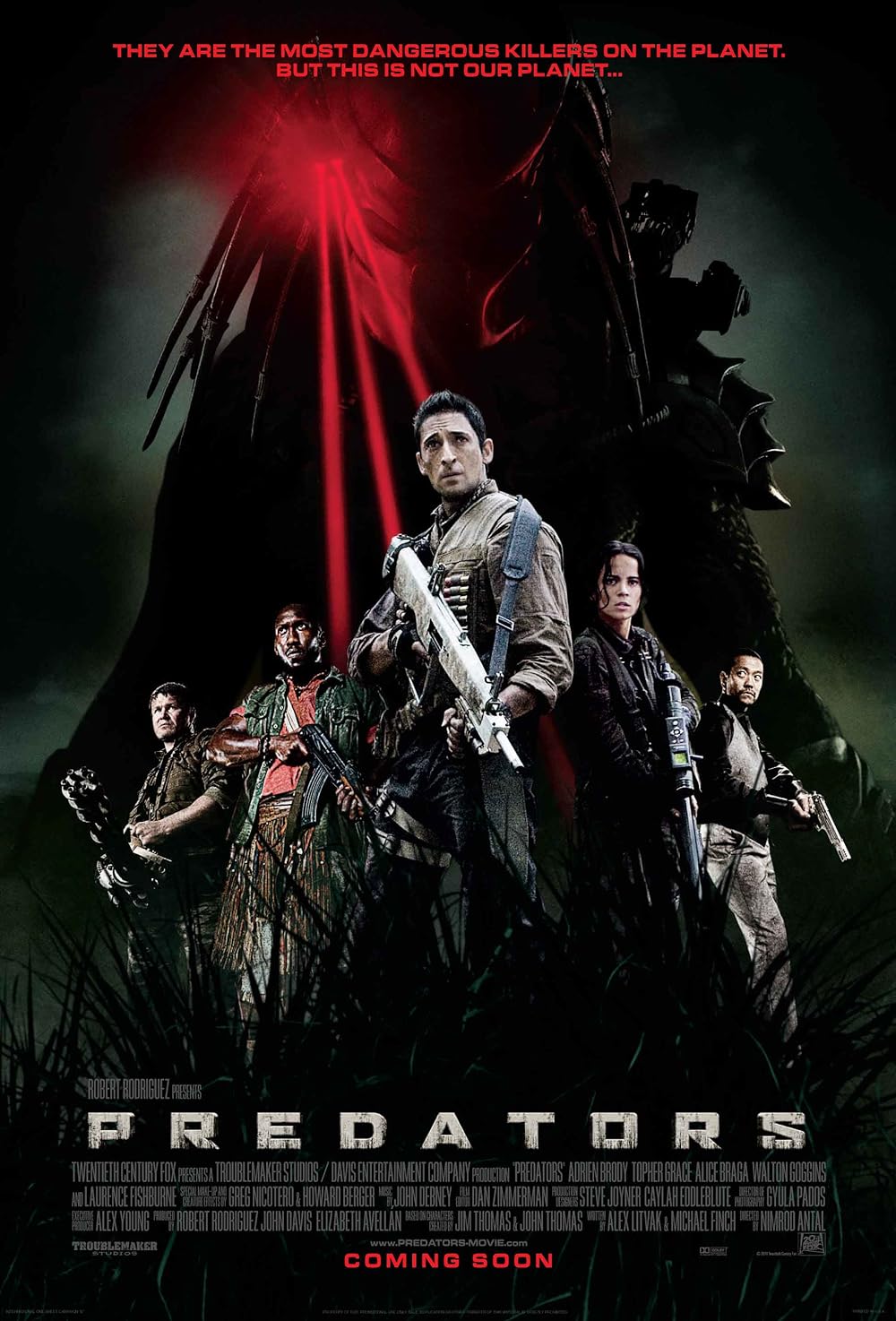
Predators

One of the things I liked the most about Predators (and make no mistake, there were very few things I didn’t like) is that it did not concern itself with reasons. Why are there skillfully violent people being dropped out of the clear blue sky? Who armed them to the teeth with things they know how to use? How did they even get here? That doesn’t matter, all that matters is, here they are. And they’ve got to find a way to survive against the deadliest hunters in the universe, all while learning to trust each other, work as a team, and somehow keep Eric from That 70s Show alive (as he is also here for some reason). Or they’ve got to die messily, one by one, with no hope of rescue or escape.

Which is another thing I like about the movie, it did not waste any more time on the premise than it did on reasons. Within five minutes, the movie is going all out and it doesn’t ever really stop. It’s possible that the original Schwarzenegger-driven Predator is the better movie, but only possible; I have seen no better movie that had a Predator in it, without a doubt. This is probably not the best sequel ever, but it is hard to imagine crafting a sequel to a movie that would fit the spirit of its originator any better than this one did.

Despicable Me

You know how people describe some kid movies as being funny for adults too? Just to give you an idea of how this played out in Despicable Me, the joke that stands out in my head involves supervillain Gru going to the Bank of Evil to take out a loan to finance his plot to steal the moon, and seeing the notice that the Bank of Evil was “formerly Lehman Bros.” So you see.[1] On the bright side, the kid part of the movie was reasonably okay. Gru, who I already mentioned is a supervillain, is in competition with the rest of the supervillain community to pull off the world’s greatest heist. Along the way, he adopts three girls for use in a cookie-selling scheme, and learns valuable lessons about the importance of placing family above work. And I mean, it really is that facile, but it was occasionally funny in ways that were not directed at adults and it was sweet as well, in the ways you’d expect a kid movie with orphans to be. I liked it well enough to regret neither the time nor money, though certainly not well enough to seek it out again. Whether my like can be correlated to the half of a 40 ounce margarita that I imbibed over the course of the flick can be left as an exercise to the reader.

[1] Dear adult readers of Shards of Delirium, please fill out this simple survey. Do you find the referenced joke a) funny or b) an eye-rollingly insulting and yet simultaneously ultra-apt demonstration of the phrase “funny for adults”? Please do not fill out the survey if you are a child reader of Shards of Delirium.[2]
[2] In the interest of equal time: dear child readers of Shards of Delirium, please fill out this simple survey. Do you love bunnies because they are a) fuzzy or b) fluffy?

Dinner for Schmucks

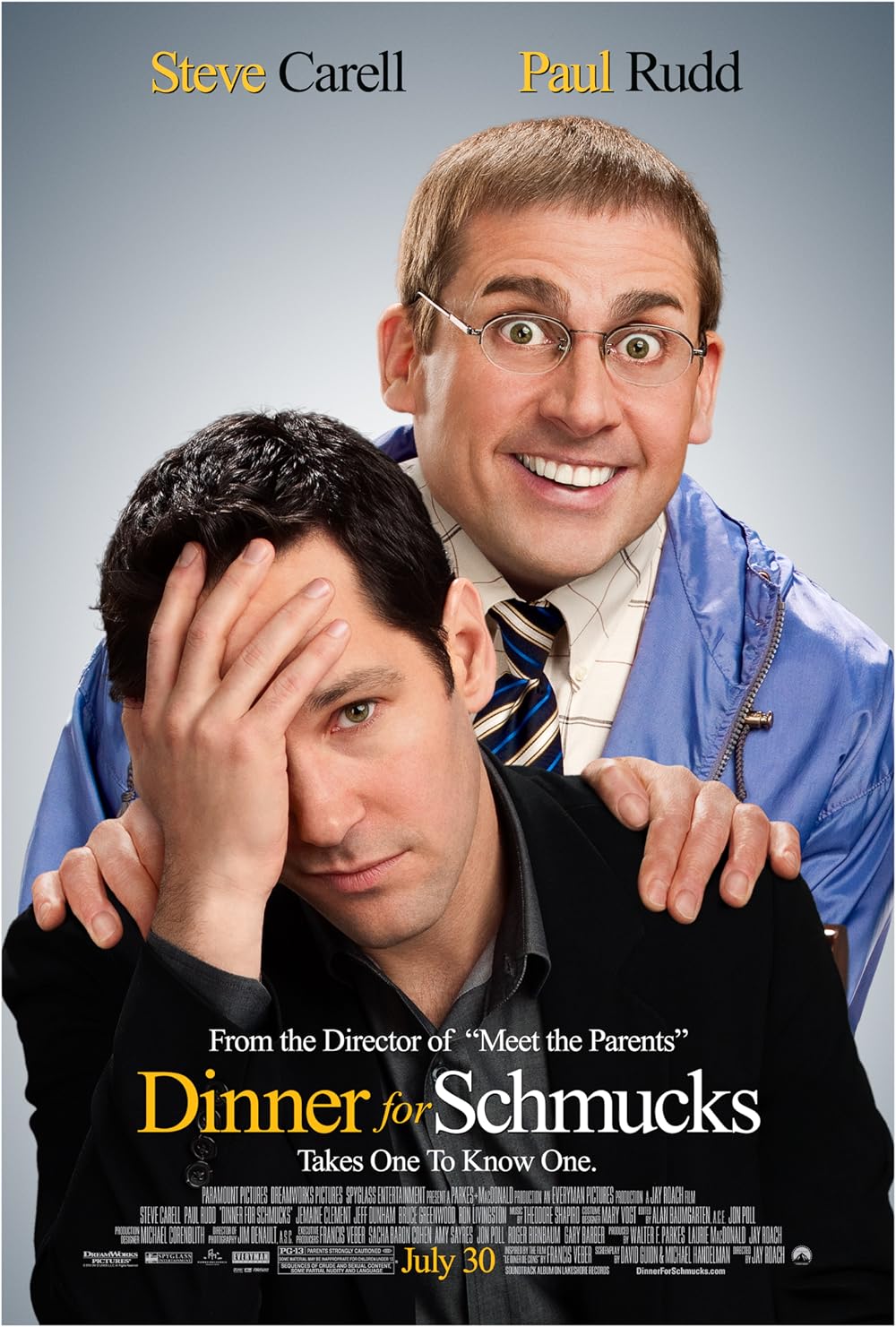
Imagine you work in “business”, by which I mean the generic everyjob that seems to only exist in Hollywood’s imagination, where people are trying to get a promotion for a corner office, and there’s a meeting in a long room with the boss at the head of the table and people throw out ideas and are called on one at a time and so forth. Got it? Now, imagine that you are about to get that corner office, only you have to impress your boss at a monthly dinner he hosts by (along with all the other invitees) bringing along a complete moron, convincing these people that they’re awesome and up for a prize, and then setting them loose. I mean, it can’t be just any moron, it has to be someone special, like a blind fencer or a ventriloquist who is married to his puppet, or a guy who creates dioramas out of mouse taxidermy. You are now in the midst of a moral quandary, because you’re basically an okay everyperson, and yet this is your only way up the ladder. Oh, and you’re also in a screwball French comedy.

I believe I have now adequately described Dinner for Schmucks, excepting only to add that it was quite a bit funnier than even the fairly decent previews indicated and that it really made a point of working that Steve Carell connection to get a lot of Daily Show people on screen. Good for them! If you like watching funny movies in theaters, you should give it a peek in a couple of weeks when it actually gets released.

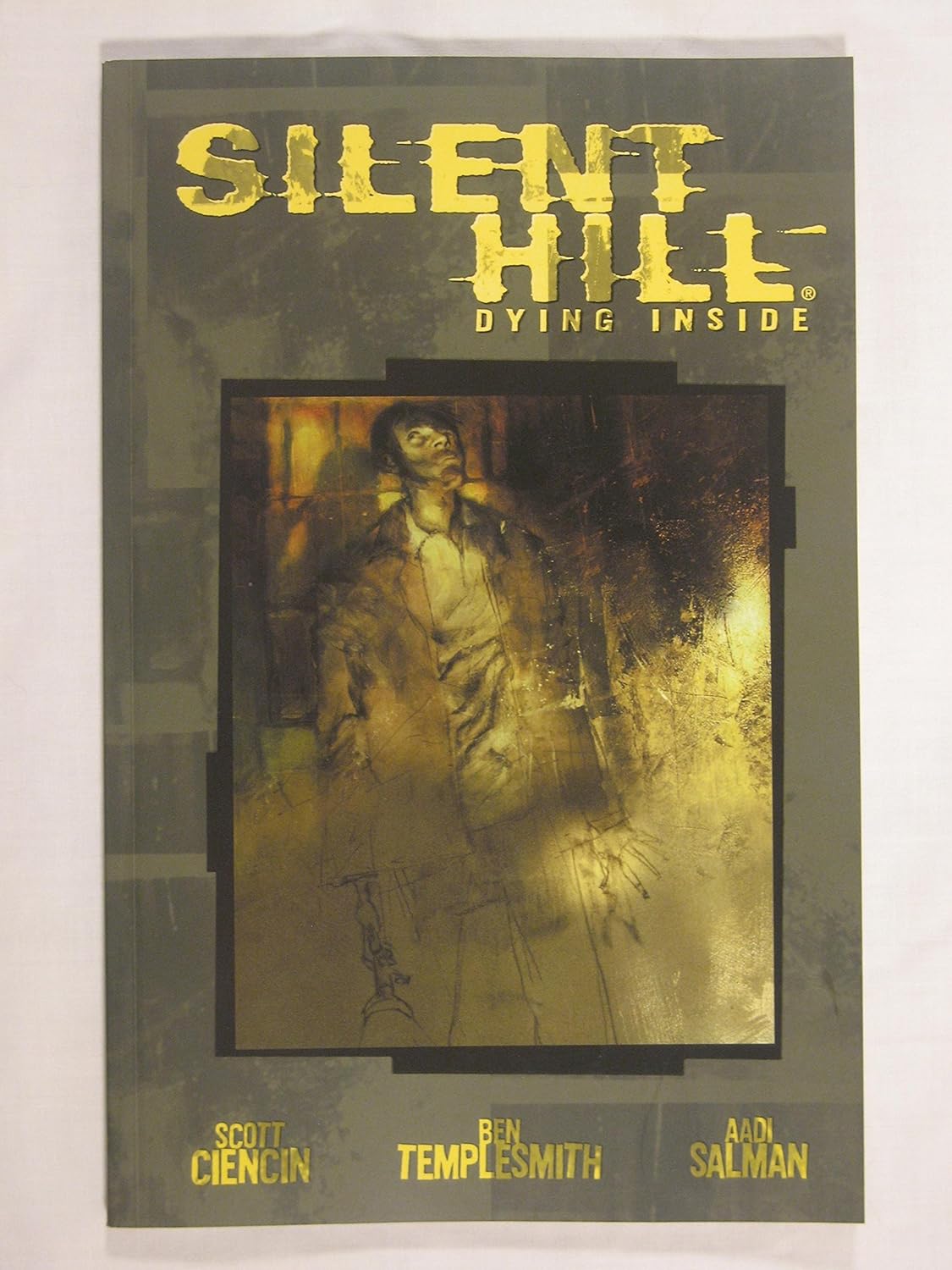
Silent Hill: Dying Inside

They say you can never go home again. Then again, they also say that home is the one place where, if you go there, they have to let you in. What is interesting to me about Silent Hill is that it is somehow the opposite of both of these things at once. Silent Hill is a place where, if you go there, it slithers inside of you and you can never really leave again. Which is why I find the games compelling enough that even though I only ever beat the first one, and with the worst possible ending, I still want to go back and play through the whole series. Which would I suppose be easier if I owned any of them.

This makes it all the more disappointing just how non-good the (apparently first in a series) graphic novelization is. Dying Inside follows a film student, a lauded psychologist, and a punk chick as they interact with the disturbingly empty (although, often it is even more disturbingly not-empty) town of Silent Hill, where a person’s bad thoughts have a way of doing more than haunting them, and really of haunting more than just them. It’s like a horrifying state of mind given flesh, and sidewalks, and hospitals and elementary schools. The story is sufficiently creepy, and has the seed of a really great concept, about a girl’s guilt over losing her little sister at the mall in pretty much the most horrible way imaginable. But the execution is almost total failure, with direction changes that come out of nowhere and plot elements that barely make any sense, even when taken as a whole after the fact. Or it’s possible that it would have been fine if I had not been so distracted by the art, which bleeds all over the page, one panel indistinguishable from the next. And that style could have been very effective as a means of demonstrating the breakdown in reality between Silent Hill and the outside world, except that it was used indiscriminately from the first page to the last. So it could be that it was the art I couldn’t follow and the plot was just fine, instead? I don’t know or really care, because I have forgotten to even write this review for the past two or three days. Not dreaded it or wondered what to say, but consistently forgotten I had even read the book.

That probably makes my point better than any of the rest. Still, it was in some way effective, because damn if I don’t wanna play me some Silent Hill! (Did I ever mention it was originally a video game? Oops.)

Lucifer: Crux

I have spotted my point of failure as a reader of the Lucifer series. All the way back in (judging by the covers[1]) the first volume of the series, there’s this performer named Jill Presto who is forcibly impregnated by a sentient deck of cards called the Basanos. And it’s an obviously important element of the plot of both the first and several of the later stories. And although in each case it’s obvious why she’s there and what’s going on, it is an inescapable fact that I cannot keep a sense of her and her doings as she relates to the arc of the story. I probably just haven’t tried, when you get right down to it? At least I know what I’ll be especially watching for when I do a someday reread. But it’s just sad to me that no matter how easily I can follow or at least unravel the rest of the plot and respectably examine the themes, there’s still this whole character that I have a blind spot for.

That said, the rest of Crux, the part that I was caught up with and able to follow along, I mean? Solid transition book in which I do, in fact, get to see more of Lilith, just as I had requested. I’m not sure yet if this was a mistake on my part. After the previous volume’s escalation toward Armageddon, every moment of Crux was set at that eponymous balance point before the plunge, getting the characters into position for the great conflict of our age. It was, y’know, successful at that, and even in plot-based transition Carey has a good eye for storytelling. Still, that next climactic book? I am hoping for big, unexpected things!

[1] Which you should never, ever do.

Knight and Day

I learned recently, and probably on the Daily Show, that Tom Cruise is a little bit of an adrenaline junkie, and thusly does as much of his own stuntwork as he can get away with. This is unfortunate, in that it ruins an otherwise accurate (albeit not punitive) claim that Cameron Diaz acted opposite his smile in the latest disposable summer action-comedy, Knight and Day. And man, do I ever wish I had more to say. I mean, it was good, right? Closer to cotton candy even than popcorn on the scale of movies-as-meals metaphors, but good. The actiony stuff was suitably actiony, the comedy was funnier than just that which appeared in the previews, the plot was reasonably well grounded[1], and Ms. Diaz’ lead character grows into the role of agent of her own destiny; I can’t even complain that she didn’t start that way, since she started the movie as a normal person chosen by a James Bond type as a dupe for his latest batch of spy games. So, y’know, nothing to complain about at all! But still, my overall sense of the thing is as delicate as spun sugar, and I’m sad to report that it will not someday be looked back upon as a classic of the genre.

Unless maybe that thing where a girl in an action movie developing her own agency is less common than I suppose, in which case that part should stand out over time.

[1] You can’t say it was grounded, full-stop, because, action movie. Right?

Ultimate Wolverine vs. Hulk

At long last, the weird forgotten story that languished for a few years in developmental hell even as the rest of the Ultimate universe was being tied up in a neat (by which I mean Gordian), tidy (by which I mean murderously violent) bow (by which I mean bow). After Ultimate Wolverine vs. Hulk, which I would for my sanity place after Ultimates 2 ended and before any of the Ultimatum prequel-storylines, I will be explicitly in the “after we killed the Ultimate Universe and launched a new line of comics” territory, which is physically marked by my buying them in hardback graphic novel instead of paperback. Plus also, I’m almost completely caught up and will soon run out of new ones immediately available, which is a strange feeling all itself.

As for the story, well, the title kind of covers it. There are definite twists along the way, plus also pointers to Logan’s fate in the post-Ultimatum landscape, neither of which I have any interest in spoiling. I can say that series author Damon Lindelof, famous as an integral part of Lost’s creative team, is clearly the same guy you would expect to have written both things. He plays with the narrative structure pretty much from start to finish, calling it an effect of Wolverine’s constantly tampered-with memory even though we all know it’s an excuse to tell the story out of order for dramatic effect. I have no problem with that, and I guess I can see why he felt obligated, in a world he never made didn’t create, to come up with an excuse for why it was happening, but mostly what I think instead is, come on dude, we know you did this only because you think it’s awesome, so why pretend there’s a valid in-story reason?

Anyway, though, Hulk and Wolverine? They totally versus each other, way more than that time when Iron Man was supposed to but it turned out pretty much entirely otherwise. Truth-in-advertising for the win!