Kameo: Elements of Power

The thing is, I got most of the way through the game and then took a vacation, and I was in danger of forgetting where I was. So I took a few moments to collect myself, and then powered through my illness in order to complete my second 360 launch title, the one by Rare, called Kameo and Her Elemental Buddies. Or something like that. It is the story of a scantily clad elf girl with a skirt that is entirely too short for flittering around using her faerie wings, as she is wont to do. Luckily for the censors, she spends most of her time transformed into her various elemental buddies, who can do things like roll up steep hills, shoot out sprays of environment-threatening oil, or climb up walls using shards of ice pulled out of their backs.

Why should Kameo do this, you ask? Her jealous older sister has enlisted the assistance of the evil (you can tell because they neither flit around hotly on faerie wings nor throw strawberries at you) trolls to win back her birthright. Did I forget to mention that in addition to all the elemental buddies, Kameo and the evil sister (okay, elf, but you can tell she’s evil because she wears a low-cut, form-fitting midnight blue evening gown) are the princeses of the Elven kingdom? Like you didn’t already assume that. Please.

Gameplay is fairly fluid despite that you have only 3 slots to transform into 10 different buddies; I never quite intuited the controls, though, wherein the main buttons are for transforming and the triggers are for enacting all of the carnage. As with any given ‘siddy game to date, it is of course completely gorgeous. Some of the puzzles are harder than others, and it becomes all too easy to ask for assistance from the wizard trapped in the book you carry around with you, so the game goes by quickly. But I really don’t mind that kind of thing anymore, with what little time I tend to have for games. The last boss fight was pretty easy, but there were really tricky ones before that to make up for it, and at least two extremely loose ends for a sequel that I would feel perfectly happy playing. Hooray for Rare, in that regard.
Minerva: Metastasis 1

Busy lately, me. As promised, I’ve been digging through the Half-Life 2 products on Steam, and I’ve found part one of what I hope will be an ongoing release called Minerva. In the initial sequence, dear old Gordon Freeman has been called to a Combine island by an unknown entity that wishes him to discover what these people are up to on an uninhabited rock containing a 70-year old and thought to be unused World War II facility. In addition to all the being shot at by soldiers and assaulted by unusually fast headcrabs, there’s the insult of that voice in your head seeming to equate you with the enemy.

I expect my problem with these downloads, in general, to be that they’re too short. Well, what else is new? On the plus side, though, the story part was highly intriguing, with a lot of literal and figurative delving left to go into Gordon’s mysterious…. benefactor? and into the Combine plans for the facility. Ultimately, though, I kind of expect the project to fall apart before I learn what the whole story really is. Still, maybe not!

The Unseen Queen

Hey, cool, another book-in-a-day event. Okay, it was an airport day to some reasonable extent, but still, it’s a rare thing, and I always have to groove on it when it occurs. So, yeah, another second book in a trilogy, too, this time Star Wars’ Dark Nest (which I was yesterday given to understand bridges the gap between the New Jedi Order series and a forthcoming new multi-book sequence).

The Unseen Queen picks up a year after the last book. The Jedi are in as precarious a position relative to the government as they ever were under the Old Republic (except for not being hunted down and murdered, I suppose), due to a combination of bad press over their defense of the hive-mind insects from that book and a certain moral looseness within their own ranks. And then, of course, the Dark Nest starts to make a new move that could threaten the galaxy forever. (I feel like that ought to have been exclaimed rather than stated, but: no.)

It felt like quite a bit better of a book than the last one. Luke’s discoveries about his lineage that kept me interested last time were doled out more sparingly here, but the storyline was substantially better and the Joiner aggravation reduced, so on the whole I’m happy with proceeding toward the end. (I guess the book is out already?) This is good, because it would kind of suck to dislike the bridge to an entire sequence. Contrariwise, I hope it isn’t actually about all the insect hive folks, because they’ll have about outlived their interestingness by then. I’m pretty sure it will be about something a lot better, though, if I’ve properly gauged where the recent releases are going these days, though. Something rather more Chiss, say.

Drive to the East

I have this weird relationship with Harry Turtledove; about half of his books I see, and I roll my eyes and move on, whereas the other half I’m intensely interested in, and buy them as soon as they appear at the used bookstore. Part of it is the whole learning about history thing, as even though it’s fake history, the basis is still very solid and usable. Part of it is the style, certainly. I just like watching all these different people react to different circumstances and identical news and so forth. Part of it is an almost certainly unreasonable romanticism in my head with the South. Plucky, heroic, and just evil enough to be ultimately doomed anyway.

As for this second book of the Settling Accounts trilogy, it is by now completely unreviewable sans spoilers; the story has moved too far along. But for the most part, the specific events aren’t the point. It would be like telling a 3rd grader about the atomic bomb at Hiroshima when all he really knew was that WWII vaguely existed. Thusly, I proceed.

In short, the Confederate States have, um, risen again after being defeated soundly for the first time in their history in World War I, thanks to the charismatic leadership of President Jake Featherston, whose two-plank platform of punishing the damnyankees and solving the “colored problem” once and for all have allowed him to prosecute an excellent war plan through the end 1941 and part of 1942. However, his tenuous hold on sanity is starting to slip, now that the United States have failed to surrender according to plan. Meanwhile, the death camps have begun to turn out some real efficiency, and a secret U.S. project promises to bear explosive fruit.

So, whatever. It’s WWII, and because these are Americans rather than Europeans, some of the motivations are more clear, at least to me. The most disturbing part is how I really kind of want the bad guys to win, despite disagreeing with virtually all of their actions. It helps that the U.S. people are not particularly clean-handed in this war either (as many of them want to eradicate Mormons as C.S. residents want to eliminate the blacks), and that unlike anything I’ve ever heard about Germany and the Jews, both groups of Americans have a reason. (I do not claim that it is, or that there could be, an acceptable reason. I just mean it’s nice to comprehend how they got there. Also, I’m done being apologetic about it, ’cause that’s boring.) As usual, I’ll read the next one once I eventually see it on a shelf, probably about this time next year.

Munich

Two ‘based on true events’ murder stories, I said. And two it was, as the limited engagement for Munich included one of my two local theaters. (And a couple more around here, but nothing with actual expended effort, so, hooray!) And when I say it’s a movie all about murdering, well, that’s completely true. Still nothing like the other one, though, what with the nuanced script and acting, Spielbergian direction (I’d feel bad for him if it wasn’t, I expect), and general lack of being a horror movie in favor of solid drama.

Shortly after the events of the 1972 Olympics at Munich, where a Palestinian assault on the village resulted in the deaths of all of the Israeli athlete-hostages, Mossad and the Israeli Prime Minister are purported to have authorized a black ops mission to eliminate eleven members of Black September, the terrorist organization responsible for the strike. After you know that much, all the rest is fallout. So many good questions here: Is it acceptable to rain terror down upon terrorists? Is that even a valid strategy in the first place, given that your goal is the cessation of your enemy’s hostilities rather than revenge? Is it possible to do evil in order to protect good, and keep your soul intact? (See also Serenity, for this one.) Can you ever come back from the edge? Is it even possible to see the edge, except from the other side of it?

But, as good as the story and the acting (and incidentally the history lesson) were, my favorite part was the balance. It takes a real talent to showcase an event that is so clearly delineated as far as who was wrong and who was not, and have sympathy for the people who were wrong without being insulting in the same move. The question I walked away with, and it’s not a question that’s ever gotten burrowed down into my head before, is about what the fate of the Palestinian people will be. Regardless of whether they’re right or wrong, and regardless of who is ultimately to blame for their status, when I think about them now, I see people who are pretty similar to the Jews in 70 A.D. (and not a few other times in their own history), and I wonder what they will be 2000 years from now. Out of a movie made by a Jewish director, that is more than anything else about an atrocity perpetrated on Jewish people. And without being insulting to the memory of that event. Like I said, folks: that’s talent.

Half-Life 2: Lost Coast

I noticed (apparently a while after the fact) that the Half-Life 2 expansion, Lost Coast, was finally available through Steam. So then I downloaded it and played it. Some brief web-searching indicates that if I’d spent another $1000 or so on my PC in the past year, it would look like the prettiest thing I’ve ever seen on my desktop’s monitor. I have not, which only leaves the gameplay.

Now, here’s the thing. I was expecting it to be a full expansion going in, like the two that followed the original Half-Life. So, when it took approximately as long to play through the single level as it did to download and tweak the settings to my taste in the first place, well… not what I’d call a satisfactory experience. That said, it was definitely Half-Lifey goodness, and as a result I’ve snagged the first of what will probably be a few third-party level packs to play at, whereas before I’d never have thought to look. So, a win? Sure, why not.

Wolf Creek

Busy movie week. I basically ran the gamut of movies that can be described as ‘based on true events’, and yet the core element of them was identical. That is to say, murder. It is possible that this says something about my deeper taste in film. It is also possible that this has already been said, again and again.
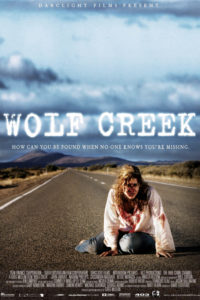
Out of Australia, the chilling true tale of three vacationers in the western part of the country who stumble upon their doom near the meteor crater at Wolf Creek. Shades of Chainsaw, sure, but how can you avoid that when you’re talking about plausible serial killer activity framed as a horror movie? The job here is to take the tension, and ratchet it higher and higher. For two thirds of the movie, there was success, and I can’t ask for more than that.

On the downside, it was constrained by the actual events in a way that a less literal film like Chainsaw doesn’t have to be, and to its detriment. We have a point A and a point B, and no way to know exactly what happened in between, so the writers had to make up something that was both exciting and true to point B at the same time. This is only possible if you artificially inflate the stupidity quotient of the principles. So, whatever else good I can say about it, I cannot say it’s smart. Still, it’s a horror movie, so were you really expecting me to?

The Colorado Kid

After a month-long book, it was time for a quickie. Lucky me, Stephen King has just dropped off a pulpy crime drama that may not even be a crime. Although I’m going to have to leave that question open, I’ll say that The Colorado Kid delivers in a lot of other ways. It’s a story about telling a story: in the latter sense, it ranges across the country and twenty-five years, while in the former it never leaves a tiny, island newspaper office, except to go out on the deck and watch the ocean rolling in.

Weighing in at a slim-for-the-size 163 pages, it revisits a lot of the tropes that made King famous. Small-town Maine and its closely held secrets; that delicious accent that is so perfect for spinning a yarn; mysterious, incomprehensible events. It’s the first book since he finished the Dark Tower series and stopped writing books (well, obviously that’s not so, and I’m glad he’s still doing it; there’s another one in January, whee!), and I think perhaps he’s trying to revisit his earliest days, maybe get back on a new horse in the same saddle. I know I’m playing it close to the vest, but the nature of the story demands that I do. I can say that, as usual, it works.

Call of Duty 2

In amidst all the extra-long book reading and multiple movies-watching I’ve been up to lately, I managed to squeeze in time to finish the first of my three launch titles for the XBox 360. (Yay, I found one!) Call of Duty 2 tells yet another version of that same half-decade story of tragedies and triumph that is World War II. And really, this is the beauty of the WWII video games; there are an infinite number of stories to tell, so everyone can cash in as early and often as they’d like, so long as the story and the game are good.

In this case: success. I mean, it’s easy to care about beating Nazis, but they do a good job of making you care about the soldiers around you as well, which I haven’t seen very often yet. You might call it a mistake to get the AI unintelligent enough to run in front of another soldier lining up a shot, but I call that realistic. These were kids, after all, and probably they took more than their own fair share of actual friendly fire. But I appear to digress. Anyway, you’ve got a standard sequence of Russians, British, and Americans fighting it out against the German war machine, mostly in Europe, and let us never forget a fateful D-Day landing thrown in for deadly measure.

Really, deadliness was the one problem with the game. It was far, far too easy to survive on the normal setting. That’s okay, as it has replayability in spades, and I actually expect to for a change, at least once. The worst part was the multiplayer. … … Okay, now that you’ve settled down, let me explain. I haven’t gotten onto Live and found a big battle to jump into with a couple of friends. But I had a friend around to do one on one in the console, and… man, it stank. It’s possible that the options let it tweak down to usable levels, but all we had was a series of one-kill, reset to beginning of level, and on a level that was a little large for two people and without any ammo to collect to change up the flow. Very boring. So, I’ll reserve judgment there, and really hope that the online play and some tweaks make it as fun as I’d expect it to be, instead of as miserable as it was.

And did I mention how very, very pretty it is?

Midnight Tides

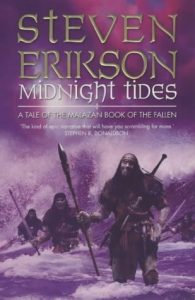
You would not think that by the fifth book of a ten book series, it would be prudent to be introducing what is essentially a completely new cast of characters in a completely new situation. And sometimes you’d be right. To my surprise, though, not always. Midnight Tides marks another high water mark in Stephen Erikson’s epic tragedy of the Malazan Book of the Fallen.

It has a lot of oddities relative to the rest of the series. It’s almost completely prequel, in that it tells the story of a character first met in the fourth book and how he came to the dire straits the reader found him in. (Or it pretends to do that, though ultimately it stops short, leaving us with only the flavor of that betrayal. Which is okay.) It essentially leaves out the Malazan Empire entirely. And there’s considerably less warfare than I personally am used to from the series.

Nevertheless, it has a lot of what I’ve come to look for, too. For one thing, the Crippled God is here in force, revealing enough of his nature that it’s finally fair to pick a side. But mostly I’m not talking about plot elements, because these aren’t books you come to for the plot, good though it is. It would be like admiring Monet’s work with stippling and never bothering to step back to see the actual image on the canvas. We have tragedies galore; mirrored families on both sides of the conflict, one betrayed by the empire they are sworn to uphold, one doomed by attempts to tear down the evils they see in an empire that has long since outlived whatever good it may once have brought to the world. And within the families themselves are betrayals and true brotherly spirit alike, sometimes from the same brother to the same brother, in the same action. It’s a complex tapestry against which to weave the fall of an old, old empire to the ascendancy of a bloody new one that has forgotten its own ancient past, wrought in bloodier betrayals still.

This is also the funniest of the books so far, perhaps in an attempt by the author to cut the horror and tragedy to bearable scales? It worked, in any case. It’s been a while since I’ve laughed so often at a book that wasn’t written to make me laugh. Best of all, there are a few people left to play meaningful roles in the future of the tale; I’m pleased, because these are all people I really want to see more of.

One off note, which I suppose is inevitable these days. Was I the only one who saw the Letherii Empire as a blatant caricature of a popular external view of modern America? It’s not that the overt politicizing of a really good story would bother me (although it does, a bit), so much as that on more than one occasion it forcibly pulled me out of that story. That, I really don’t care for.