Unrest (2006)

The third movie of the evening was easily the best. (Which perhaps says good things about the remaining six movies. …I just realized that I will have watched a dozen movies in ten days before this thing is over. Even after taking into account that I let a couple of months slip by before last weekend, that is downright unnatural.) Unrest is a medical school movie. Since med students in movies only have to take one class, it’s easy to guess that the site of the mysterious horrificness will be the gross anatomy lab. And sure enough, once the scalpels start flyin’, people start dyin’. (I made that up myself.) And only a petite blonde girl holds the key to putting the vengeful spirit to rest, which would be fine if she didn’t also have to balance an incredulous professor, a newly blossoming love interest, the groaningly unlikely placement of her living quarters in an abandoned hospital wing, and being a petite blonde girl in a horror movie.

Six bodies. At least four cadavers, some of which were actually cadavers. Six cadaver breasts. No actual breasts, which I blame on the camera-person being attracted to men. Bone saw fu. Formaldehyde fu. Pen to the neck. Feet roll. Arms roll. Drive-in academy award nominations to the dead vengeful spirit chick, for doing most of her acting without a ribcage and for not twitching a muscle even when it is explained over her naked cadaver that she’s had children because her nipples have darkened from breast feeding, and to the petite blonde heroine chick and her boyfriend for spending their second date diving for corpses in a formaldehyde dunk-tank. Three stars.

Rinne

Moving right along, then. The second film of the evening was Reincarnation, another in what is certain to be a long line of J-Hor hits that get remade into American versions in which petite blonde girls face almost certain doom and then re-appear in an American sequel which has no J-Hor analog, despite that Japanese sequels exist. (I couldn’t tell you which sequels end up better, although The Ring Two was an excellent movie.) Since J-Hor movies are actually more spooky than horror, I’ll forego the drive-in totals.

Reincarnation is about… well, I think you know, right? It’s a pretty well-known word, and all. Anyhow, a director has set his sights on making an emotions- rather than plot- based movie retelling the story of the 1970 mass murder of eleven people at the Oko Kanko hotel (or something like that) by a disturbed professor who subsequently committed suicide. Seems very artistic and well outside my usual tastes, but that’s the movie he’s making, not the one that I watched, so it’s okay. And considering that it reminded me a fair bit of The Shining, it’s only fair that the director character should make me think of Kubrick. And during casting, he immediately focusses on a soft-spoken young actress to be his lead, despite any tangible skills. (She didn’t even seem to audition at all, so much as just show up in the room.) Unfortunately for her, from the moment that filming begins, she has an inexplicable connection to the subject matter, which kicks into overdrive as soon as they start filming on location. In no time at all, it’s easy to imagine that she might be (admit it, you saw this coming) the reincarnation of one of the victims. But will she survive her return to the site of her tragic end?

Well, as to that… I have a theory.

Dark Ride

It is Saturday. Which means the first night of the Horrorfest thingy is over. Which means that I watched three movies last night, sure, but it also means I only got four or so hours of sleep last night. The part where I have three more movies to watch tonight? It’ll probably be tough. But that’s okay, because I got a t-shirt out of the deal, plus lots and lots of movies. Makes me feel more like myself again. The only downside so far is that there have only been three new previews in total, and nothing to get me excited the way Slither[1] did this time last year. Well, and the aforementioned lack of sleep. Nevertheless, I forge ahead, because falling behind at this point would be suicide. Literally!

The first movie of the night was Dark Ride, a by the numbers psycho teen killer thriller. Some years ago, one of the ubiquitous carnivals along the Jersey shore was closed down when it was discovered that a teenager had been living in the unlikelily literally-named Dark Ride, snatching people out of the cars as they came by (it’s like a haunted house, but with a track running through it so you don’t have to deal with all that irritating exercise) and killing them in gruesome ways. Years later, a set of circumstances converge to create mayhem: the ride is finally scheduled to reopen, the psycho killer has escaped from his mental hospital, and Meadow Soprano and her friends drive through the town on their way to spring break. And of course, like all good college students, they cannot resist the opportunity to break into the abandoned ride and spend the night taking drugs and engaging in premarital sex. After all, it’s far cheaper than a motel room would have been.

I’m going with the Joe Bob style of review summation, because it’s just that kind of weekend. Seven bodies. Two breasts. Head rolls. One of the most psychologically damaging sex scenes I’ve ever witnessed. Drive-in academy award nomination to the psycho killer, for menacingly dragging a scythe along the wall throwing off sparks despite never using it as a weapon, and to the crazy hitchhiker girl for saying, “So, I hit him in a very sensitive place, if you know what I mean. DING-DONG! Of course, I lost my ride.” I came away from this movie with two important lessons: 1) Never slap a vegetarian on the head with meat. 2) No statement that begins with ‘Guess what I found in the bathroom!’ will ever end well.

[1] Now available on DVD!

Farcry: Predator

I’ve been moving. So I have a house full of stuff, little time to do much with the stuff, and a lot of the remaining free time being used to get through house acquisition paperwork. On the bright side, soon the acquisition part will be over. I close in a week and a half, and nearly all the utilities are in my name. So it’s going well. On the not as bright side, I’ve barely touched any of my game systems, and right when things are starting to get interesting. Which means I’m a fair bit behind, but so be it. In any case, I did finally snag some time last weekend, and managed to finish off a game that I had (all unbeknownst to me) been only an hour or so from finishing when I last set it aside, a few months ago. Which makes it nice that the controls were simple to pick up. For example, I dread picking up Oblivion again just because of having to relearn how everything works.

Anyway, this was the second part of a two-part game that I played through the first part of some months ago. Farcry: Predator picks up some months after the first game left off. Jack Carver has been kicking around the South Pacific with his newly rebuilt charter business and learning to live with his new biological advantages, mostly thanks to the assistance of a steady supply of alcohol. Unfortunately, history repeats itself, and before he knows it another beautiful woman has gotten him caught in an internecine war, this time between a band of local pirates and some natives who seem to be the basis for Krieger’s research into human enhancement. And sure enough, the CIA is still keeping an eye on things just around the corner.

To me, that plot doesn’t sound so bad. Nevertheless, it turned into a thoroughly lackluster story. On the bright side, Farcry continues to have good gameplay and lush landscapes, so I didn’t have any complaints while I was playing. Still, there also wasn’t really anything new added to the mix in that arena as well. Thusly, I got to the end and was left thinking, “So, that’s it?” This is somewhat unfair, in that I’ve gotten two reviews and a solid number of hours of gameplay out of the disc. Still, though. There are plenty of games that don’t leave me feeling like that, so there you go.

The Texas Chainsaw Massacre: The Beginning

“Ah,” you say, “but you told us it was a double feature, and now a day later there’s still only one movie mentioned.” (See how I pretend I have daily readers? It’s downright adorable is what it is.) Well, you’re right about that. As it happens, I saw a second movie, which had not quite as much irritating pun potential, but still more than is preferable. The Texas Chainsaw Massacre: The Beginning is, on the face of it, a seriously pointless movie. It’s a prequel to the remake of a movie that itself had two sequels. Mind you, the remake was very good as remakes go, though it simply couldn’t live up to that original film, which was filled with non-stop tension that only old-school grainy filmstock can provide, as well as (I’m pretty sure) the single most annoying wheelchaired character in the history of film. It’s possible the latter part isn’t a selling point for everyone, but I like it when my movies are superlative in some way. Of course, Chainsaw is superlative in more than one way, so that’s good too.

Anyhow, that was the face of it. The reality of it is… well, there’s a 15 or 20 minute short subject film in which most of the beginning is explored, true to their words. Then it turns into ‘Let’s kill some pretty hippies and/or bikers!’ for the next hour; while that’s what one should expect from a movie in the Texas Chainsaw Massacre franchise, it does seem like a pretty thin premise on which to hang a prequel. And they’re not even naked hippies. What is the Vietnam era coming to, these days? Anyhow, after the hour, there’s a little bit more with the prequel bait, and I’m have to say that they finally managed to get an iconic moment in there. Although I’ll admit to watching anything with the word ‘chainsaw’ in the title, I’m still willing to say with authority that as sequels and prequels go, this one at least falls above the 50 percent mark, and if you’re only including horror movies, it easily gets a passing grade after the curve. After all, it was merely not very pointful; it was still competently plotted and filmed.

Saw III

More awesome by far than merely seeing a movie after a long drought is going to the drive-in and seeing a horror film double feature. (For one thing, it’ll make good practice for next weekend.) So, of course, that is what I did. The Galaxy Drive-in in Garrett, TX is far enough outside DFW to cut down on the light pollution, and the food is just barely on the correct side of tolerable. Result: an opportunity to step back in time and realize that the old method of watching movies was… okay, terrible, because seriously, who wants to have their windows open during the time of year when it’s dark enough to watch movies at a reasonable time, and then listen to a mono movie-track? But it’s okay, because you can leave the windows up and tune in on the car radio instead. The potentially inferior sound quality versus the cineplex is more than made up for by the ability to control the volume and other sound settings, and best of all, the ability to hold conversations about the movie at any volume you feel up to, with nary a shush to be heard, or for that matter some other rude sonofabitch who won’t shut up during the film.
Although the majority of movies are drive-in acceptable, of course the best options are horror films. So, like I said, I went and… saw a couple. I can already tell where this is going, having had experience with it before. So I’m saying right now, just don’t start. The first movie I, um, viewed, was Saw III, a franchise that is quickly turning into a Halloween staple. Picking up right around the point where Saw II ended (which is sensible when your antagonist has a brain tumor and tends to be hovering right at death’s door throughout the series), the movie follows the actions of serial killer Jigsaw, who to all appearances has started to cheat his victims. In the past, he has always provided them with an escape from the deaths he has arranged for them, if only they have the will to take it. But the last few Jigsaw deaths have been murder, pure and simple.

That’s the backdrop, though. The main plotline is pretty familiar from the original movie: a doctor and this other guy are provided with different sets of information and tasks and are then set on a collision course. And might it be that they’ll turn out to be connected on a deeper level? That’s a broad stroke; the details are quite different. But it’s still a noticeable trend. As usual, Jigsaw has set up a game, with rules, and woe be to the person (perhaps even Jigsaw himself?) who chooses not to follow them. Although this was not as good as either of the other two entries, it still had the flashes of psychological brilliance that are the hallmark of the series. Well, and the naked people and the buckets of blood, of course. And the cringe-inducing death machines.

Borat: Cultural Learnings of America for Make Benefit Glorious Nation of Kazakhstan

That thing where I haven’t seen a movie in forever? I aim to remedy that. In fact, I’ve already made a bit of a start. Of course, my start was kind of unexpected, in that I went to see a movie based on a character from Da Ali G Show, which I thoroughly disliked the one time I watched it. But it was a group friend outing, and I haven’t been to anything in so long that I went for it. Plus, the previews have amused me from time to time. Plus plus, I read a review of it by someone I trust, which let me know that despite the majority of the people on film not being aware it’s fake, there is still a coherent plot during which characters grow and change. Well, okay, that might be taking things a bit far, but the plot is coherent.

Our hero, Kazakhstani newsman Borat Sagdiyev, has been sent by his country to America to film a documentary that will use us as an example to teach them how to become a great country that can overcome its problems (economic, social, and Jew). Along the way he meets a lot of people, demonstrates that they are perhaps even more racist and sexist than he is, and falls in love. Except, of course, that the joke is on all the people he encounters, because he’s only pretending, and they really, really aren’t. It’s a weird movie, in that I spent equal time laughing and cringing, sometimes at myself for laughing. I’m going to steal the metaphor that sold me on the movie, though, as it explains it better than anything new I could come up with. Sacha Baron Cohen is playing a game, with his subjects and with the audience. It is possible to win the game, but only by either rejecting most everything that he claims to stand for, or else by understanding the joke and spending most of your time laughing (but still cringing, a little, for the sake of humanity) at the people who are losing the game. And my word, how easy it was for him to find people willing to step up and lose big. And without even the excuse of not knowing they were on film at the time.

In any case, I can easily see why it’s not for everyone, as nearly all of the humor has the potential to make you uncomfortable. But Borat the character is endearing despite how awful he is, and unlike most of the folks whose path he crosses, he even seems to come out of his journey a slightly better person. As, one hopes, will most of the people leaving the theater.

Agyar

The most awesome thing about travelling, aside from the destinations tending to be filled with people that make me happy (because, apparently I am a traveller for visits vastly more than I am a traveller to see new things; I don’t think of that as a bad thing, because while I may eventually fail to see the world (but I may not! it remains to be seen (ha! I just got that)), I’m also pretty much guaranteed that every trip will be a good trip; but I digress), is that it leaves me with far more time to read than I have in my normal life. Mostly while sitting around in airports and on airplanes at way too early in the morning, it must be admitted, so I also use some of that time to sleep. Nevertheless, between long works hours, good things on TV, and moving (mostly moving, and I am so very, very ready to be done, I can tell you), I’m left with only wee amounts of time to read, usually at lunch or right before falling asleep. So that airport time is pretty awesome indeed.

As a result, I’ve already finished another, albeit short, book. It’s by Stephen Brust, so you’d think it would be Dzur, but I keep forgetting to look for it in the used bookstore, and I frankly have too many books in my pile to justify buying it new right now. (That’s probably not true, and I bet that as soon as I remember to go to Amazon and snag Lisey’s Story, I’ll get Dzur too. Or I could go back and reread the rest of that series first, but that seems unlikely right now too. So. It is a quandary. And man, can I not stay focussed today. My employer must be thrilled.) Anyway, what it actually is is Agyar.

It’s interesting. The eponymous John Agyar is writing the story out on a typewriter just for the sake of writing it. He has no particular audience when he starts, although he occasionally acquires one; mostly the ghost with whom he shares his house, an ex-slave named Jim. (I spent a fair amount of time wondering, incidentally, whether I’m meant to believe we’re referring to Huckleberry Finn’s Jim, here. Ultimately, I could not decide either way.) He is chronicling his short-term stay in suburban Collegiate-Anywhere, Ohio just for the sake of doing so. It’s not that he’s an unreliable narrator so much as that he doesn’t present information that he takes for granted, only information that is novel or exciting to himself. I don’t think I’m going too far, therefore, to say that there’s a fair amount of information that is left for the reader to unravel from context.

So, that’s how the story is presented. As for what it’s about? It’s a combination of murder mystery, love story, and study of unhealthy power relationships. Nearly every character is in some way despicable, and nearly every character has the hope of and chance for redemption. So I guess what I’m saying is that it’s populated by, y’know, actual people. Which is not as common as it could be in the fantasy/sci-fi section of any given bookstore. Plus, the story was interesting and the prose quite good, which is not as common as it could be in the general fiction section of any given bookstore. My point here is ‘yay’.

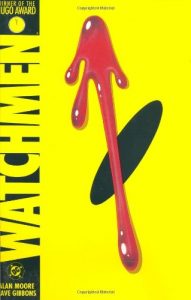
Watchmen

And so I continue through my list of genre greats. I avoided reviews of stuff while I was reading these, because I’ve mostly been able to not spoil myself on any given comic up to now, and it would be pretty awesome to not do so now that I’m actually reading lots of them. But I’m pretty sure that any random review of Alan Moore’s Watchmen will tell you that it’s a seminal masterpiece, or a watershed moment for the genre, or some other such reviewer-speak for ‘I liked it; now, you must also like it’. So, I’m going to cut to the chase: I liked it. I am enlightened enough to know that my tastes are not universal, for some inexplicable reason, so I will not proceed to tell you must also like it. But you probably will.
Now is where a weekend of debauchery is causing me to struggle to remember what kinds of things I can say about it. In short, it’s an alternate history where the comic book heroes of the late 1930s caused real people to start donning masks and outfits and engaging in enlightened vigilantism. Which was all well and good until the second generation of costumed heroes in the 1960s changed the world in drastic ways; by 1977, nearly all of them had been outlawed. Now, in 1985, the world hovers on the brink of catastrophe and, as ever, only the heroes can save the day. The problem being, most have retired; one still operates due to his uncompromising moral code, despite being more wanted by the law than most of the criminals he continues to take down. And of the two who are still government-sanctioned, one has just been murdered. The most important question being, was it random, or was it part of a far-reaching plot to neutralize any and all of the heroes who might yet be willing to step in and stop the clock before proverbial midnight?

Okay, I’m forced to admit that wasn’t short. And yet I’ve barely scratched the surface. That’s because the book is about almost everything: the relationships among heroes, of course, and between heroes and the public they serve or menace (depending upon who you ask); from where power most justly derives, and to where (“Who watches the watchmen?”); whether governments or lone vigilantes, either one, can justly use the power they have rightly or wrongly acquired; and whether it is permissible to sacrifice the few to save the many, at both the macro and micro level. Less thematically, it’s about how close to the brink of nuclear war we really were in the 1980s, and about noble last charges, and about allegorical pirates. In the words of a certain pirate in the current popular consciousness that, when taken allegorically themselves, very nearly fit: “You’re off the map. Here there be dragons.” And as much as I really approve of maps, the most interesting things happen when off them.

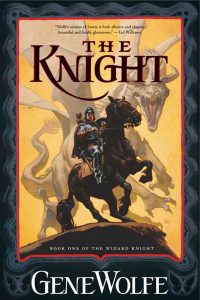
The Knight

Hard to believe, but true: I actually haven’t done anything in the past month or so. Well, okay, completely untrue. I’ve done lots of stuff in the past month or so. But they’ve all involved being at work a lot or hanging around the house catching up on my TV watching (alas, not reviewed here; but you should be watching Veronica Mars) while my house guy makes various improvements or moving stuff from my storage unit to my house and unpacking and sorting and cleaning and the like. What I haven’t done is play more than about 10 hours of video game total, or watch any movies, or finish more than one book.

Luckily, I did finish that one book, earlier in the week, and that means I get to be here and talk about it. A long time ago, we used… no, that’s wrong. A long time ago, I was in a book club in San Jose. It met for (I want to say) two books. But one of them was the first part of a Gene Wolfe series, the Book of the New Sun. And although I can remember few or none of the plot elements at this particular moment, I distinctly remember liking the main character, the setting, and the prose. A lot. So I’ve had this low-grade interest in Wolfe ever since. And now, I have finally exercised that by reading the first of his most recent pair of books, The Knight.

In what is apparently a common theme of Wolfe’s writing, the eponymous knight is a first-person narrator of dubious reliability. Despite his size, strength, and apparent wisdom, he is in reality a young boy (no older than teenaged) who wandered off unsupervised one day, Alice-style, and found himself in a fantastical (and apparently multi-dimensional) medieval world; and who, a short time later, found himself grown to adult size via enchantment. So, like any boy probably would, Able determines to become a knight and seek adventure and the favor of a lady.

And now, an undetermined period of time later, he appears to have found a way to communicate with his older brother back in America. The story is entirely his very long letter to that brother. Unfortunately, Able still has the mind of a child. He presents information haphazardly and out of order, often whenever it occurs to him without respect for the narrative flow. What he finds important is not always what the reader would, and he puts his trust and faith misguidedly at times. The result is a mish-mash of fact and speculation and almost certainly outright fiction, too. (I mean, internally fiction.)

I say all this like it bothers me. It really did not, though. Sure, it’s a little bit harder to read and work out exactly what’s going on, but I’ve always gotten something out of puzzling out events and peoples’ motivations and so on. It’s like history; it can’t always be clean and orderly and straightforward, because history (and books) are populated by humans who are flawed, wicked, stupid, and often many of these at once. Unlike history, it’s also rife with metaphor, allusion, and dreamlike fairy tale prose. I can dig it.