Ultimate Fantastic Four: The Fantastic

As I believe I have mentioned from time to time, I’ve been reading a lot of Marvel Comics from the 1960s. The Ultimate series of Marvel Comics (a reimagining of the best-known characters from that period as though they had never been created and only appeared in the last 5 years or so instead) is not, alas, on DVD. However, I can find large swathes of the serieses in graphic novel form at my local used bookstore, and hey, why not? I’ve read enough of the original titles to know that I like the characters and the world, and enough to catch at least a substantial number of the references. Plus, I could conceivably catch up on this some day and read it sort of live, which is something that will never happen with the regular Marvel universe and its 45 years of bloat. That’s pretty cool, I guess.

So, anyway, The Fantastic provides the origin story and first major enemy faced by the Fantastic Four, who you’ve possibly heard of before, here if nowhere else. In this version of the story, the team is formed largely of precocious students who have been gathered together at a magnet school with government funding to invent the future, and the accident that provides their powers is the result of a teleportation experiment rather than flying through cosmic rays in space. In fact, my one complaint about the story is that the ‘What caused this?’ subplot was left unresolved in an unsatisfying way. I’m assuming they’ll make up for it by continuing to search for answers in future volumes. But the problems and personalities are spot on, the Moleman is far better realized than he ever was in the original comics (at least as far forward as I’ve read), the in-jokes were occasionally hysterical, and the art…

Well, I know it’s probably heresy, but I’m a lot more fond of the current art than the original stuff, and for a couple of reasons. The really heretical part is that I’m just not that big a fan of Jack Kirby. His backgrounds are great, yes, but his people have always left me cold. The other part is that the big, full-page art is very nice. It admittedly slows the story way down, explaining why what took FF #1 in 1962 about 20 pages to tell took the modern people 100 or more; but I don’t mind that the story slows down a bit, as continuity between issues is far tighter even than it was then. (And one of my most consistent praises of old era Marvel is how continuity-minded they were, and how high above my expectations the writing has been as a result.)

My point in all of this, I guess, is that I certainly liked what they’ve done with the reboot, and anticipate liking the other Ultimate titles as well. But since in a roundabout way I’ve been reviewing the old comics and the reboot concept more than this particular story, it’s probably fair to say that any future Ultimate reviews will be shorter than this. I mean, if that’s the kind of thing that worries you. (Which it probably would me; it’s a short graphic novel in the scheme of things, and not chock full of symbolism and enigma like most of the non-superhero comics I tend to read more often.)
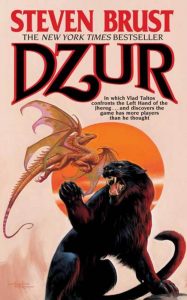
Dzur

I’m not sure if it’s literally true, but WordPress claims that this is my 400th post here. That’s a nice round number, and for people who care about such things it is fitting that said post be dedicated to one of my favorite authors having written a new book in one of my favorite series. Sure, he wrote it a goodly while ago, and sure, I’ve never reviewed any of the other books in the series (besides a highly allegorical one set in the same world but otherwise wholly unrelated, at least that I’ve been able to detect via my apparently useless English Lit degree), but regardless of all that, Dzur is in my possession [again] and thusly, here am I.
The real problem here is that I’m trying to review the 11th book of a series without a) any previous body of work here to rely upon and b) without having read most of the other books in the series in the past 7 years, and not even any of the books in the related series in 4 or more, else there’d be a review of them here. So you see. But it’s cool, because one thing that Vlad Taltos is reliable about is presenting his stories in such a way that you don’t need to have read the previous books. It would be nice to have, both because they’re uniformly awesome and to have a little better idea of how his mind works, but it’s not required. And… although the way the books are written make my summary background more than spoilers, I still feel obligated to put a cut at this point, mostly for people who might be in the middle of the series.

Continue reading

Hack/Slash: First Cut

Last fall during a period when I was buying two or three graphic novels per week, Amazon was quite insistent about recommending me all sorts of additional such novels outside the serieses I’d been focusing on, many of which looked either terribly uninteresting or not quite interesting enough to roll with sans recommendation by actual people. And then there were the three volumes of Hack/Slash, in which a scantily clad chick is taking on an assembled mass of movie murderers. That, I could get behind sight-unseen.

And now, a goodly long time later, I’ve read the one I bought, First Cut. And, well, there’s no denying that it suffered from my unreasonable expectations. The backstory felt both rushed and a little bit shoddy, and the initial storyline took a while for me to warm up to. But as the second and third issues unfolded (there are only three in this first volume, plus a short illustrated Christmas poem and a wealth of sketches and other source material), I was won over.

The biggest part of that conversion, aside from the gratuitous sexuality and violence, was due to the growth of partners Cassie Hack and Vlad. In a world where a teenaged girl and a hulking, slightly deformed guy in a gas mask can wander the country in search of serial killers (that is, folks who murder a lot of people) and slashers (who are basically the same, only they’re a lot more unkillable, and often dead in the first place; the kind you’d expect to see in a horror movie), it’s hard to credit that real character development could occur over the course of three brief stories. And yet, they managed it pretty handily. Credit where it’s due, this could possibly turn into a pretty good series. Downside: I’m not sure where to find the second volume, so it may be a while before I return to this.

Red Seas under Red Skies

There was a point somewhere toward the end of Red Seas under Red Skies where I proclaimed by fiat that the Gentlemen Bastards sequence is my new favorite ongoing series. It might be that I’ll get back to Erikson’s series[1] or Martin’s series[2] and my loyalties will shift all around again, but I kind of doubt it. Because while all three series have comedy, tragedy, high drama, and empathetic characters to spare, only Scott Lynch’s series is this damn fun.

The continuing adventures of Locke Lamora and Jean Tannen see them plotting an extraordinary casino heist, dabbling in politics that are really well above their comfort zone, enduring the attentions of old enemies, and taking to piracy on the high seas. And, as is quickly seeming to be the norm, almost none of it was something they saw coming.

What the book loses in sense of wonder from its predecessor and unadulterated glee over the coolness of the characters, it quickly gains back via the reader’s growing investment in the world and the changeable fortunes of the Gentlemen Bastards. The characters are (except when obviously intended otherwise, and sometimes even (a little bit) then) eminently likable, and Locke and Jean are guided by an intense and even laudable, if perhaps non-traditional, moral code. I felt equally involved in every success, no matter how minor or spectacular, and in every setback, no matter how fleeting or tragic; and there were a number of points were I perked up with certain foreknowledge of what was coming (not always correctly, mind you) and was a fair bit sad not to have someone with whom to discuss it excitedly. This is a book that just cries out to be read, from the first page to the last. And now that Lynch has done it twice, I think it’s fair to say that neither time was a fluke. I look forward with great excitement to the third book[3].

[1] which next book has been sitting on my couch for a number of months now, filling me with dread that I don’t really remember enough of the series to proceed and with equal or greater dread at the thought of re-reading the previous four or five giantastic doorstops of books. So you see.
[2] which next book is due out at the end of the summer, I hear, and that’s kind of an amusing coincidence. isn’t it?
[3] which is due out in January. I am now sad.

Iron Man (2008)

mv5bmtcznti2oduwof5bml5banbnxkftztcwmtu0ntizmw-_v1_sy1000_cr006741000_al_Going to a sneak preview is a thing that… well, okay, I’ve done it pretty damn recently, but I haven’t been to an advance preview for a blockbuster that everyone in the world is going to see, at least not in a while. However, I have an awesome friend named Kara who has that skill where she knows every single person on the planet, and can therefore get into clubs or crowded restaurants sans reservation, that kind of thing. As a result, she received an astonishing number of passes to Iron Man last night. Enough to fill more than an entire middle row with people that she knows (many of them people I know as well, and not incidentally including me). And this is just not an unusual event around her. So, yay Kara!
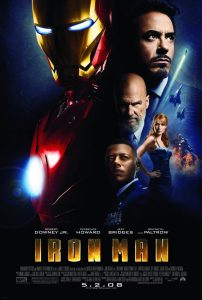
And then, on top of being surrounded by awesome, there was the whole ‘crowd of people who all love this idea too’ that I’ve mentioned liking from time to time. The energy of a theater full of real fans, in a big event movie like this, is something I really dig. (Even though, sometimes, I felt a little like our row was appreciating everything on a more visceral level than the rest of the crowd. I don’t know if this is factual or just proximity to what I could hear best, and if it is true, I don’t how much to blame on the huge press section just below us in the middle.) The downside of crowds is that, even in shorts and a t-shirt, I was dying of heat by the final act. Too many people and lack of air-conditioning spells consequences, my friends. But they did sell me a milkshake, so that was pleasant.

The careful readers among you may be noticing that I haven’t said very much about the actual movie yet. There’s a good reason for this, which is that I don’t wish to set anyone’s expectations at an unfortunate level. Realize that my Iron Man experience essentially consists of the first couple of years of him in the comics, plus the first many years of his time with the Avengers, and whatever odds and ends I’ve heard about his doings in the Civil War thing that just happened, but my feeling is that the latter has no real bearing on anything for these purposes. But, with the amount of Iron Man experience I have, I’m prepared to say that this is the best Marvel movie that wasn’t Spider-Man.

Contributing factors to this claim include the awesomeness of Robert Downey Jr.’s portrayal of Tony Stark, more special effects than you can shake a pointed stick at, the tastefully understated but always clear and heartfelt interactions[1] between Tony and his friends (which casts a wider net than you may initially think), the ease with which origin story and Iron Man versus a bad guy were shoehorned into the same two hours, and I’ll have to reiterate how great Robert Downey Jr. was. Even though I’m only familiar with the 1960s versions of the characters, it’s instantly apparent that at least Tony Stark and Pepper Potts were meant to grow into these two characters when adjusted for modernity. There’s no way to ask for more than pitch perfect characterization in a comic book adaptation; if you have that, the rest is guaranteed to work, says me. And this? Did.

[1] Later, you’re going to realize that this is hilarious.

Zombie Strippers

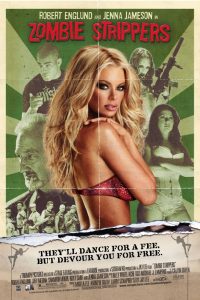
mv5bmti5mtm4nta5mv5bml5banbnxkftztcwnzc0mtu2mq-_v1_sy1000_cr006681000_al_It’s probable, I think, that having provided the name of the film, there’s really nothing left to say. I mean, when a movie is named Zombie Strippers, is there really any other factor that’s going to go into your decision-making process? On the off-chance that there is, though, here I am!
But seriously, it’s pretty great. Okay, the acting is a little wooden towards the beginning, and okay, there’s a brief interlude after the initial outbreak during which both comedy and zombification are lacking, in favor of plain-jane stripping. But other than these things, there’s a lot more to like than you’d probably think. I mean, you’ve got stripper rivalries, a goody two-shoes girl forced to strip by circumstance, a philosophical zombie, a jawless zombie, a goth zombie, a zombie head, literal zombie-stripping, and even a lesbian zombie, plus Robert Englund as the awesomely sleazy strip club owner and some Transylvanian chick as the proprietress.

Mix all that with over-the-top political humor, deep (well, shallow, but still present) philosophical underpinnings, and more naked mayhem than you can shake a pointed stick at, and clearly this is one for the ages. I weep that all of these kinds of movies are direct-to-video these days; even with a mere handful of people in the theater, it was a clearly moving group experience for us all. You should’ve been there too!

The Forbidden Kingdom

True confessions time: I never really got deeply into kung fu movies. I mean, I watched Bruce Lee movies when I was a kid, because they were just there for the taking on weekend afternoons on the UHF channels, and how could you not watch them? And it was awesome to see all the ass-kickery as Bruce (or whoever) made his way through an army of lesser men and then took out some bad guy or other in an ultimate confrontation. But I never really got into the storyline, just the chopsocky. And then later Jackie Chan appeared with his death-defying stunts of pure awesome but the same kind of storyline. And then Jet Li and his hidden snapper brought wuxia to my attention, with its emphasis on magical realism and Chinese folklore, and finally there were plots that I could get into, but I knew there was a ton of background to it that I somehow managed to miss on those long ago weekend afternoons, and I’ve felt kind of out of the loop ever since. It’s very tragic.
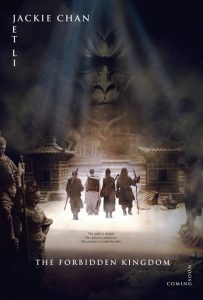
The thing about The Forbidden Kingdom is that it felt just like an introductory guide to the genre that didn’t assume you would know everything that was going on. A kung-fu-obsessed teen gets caught up in an armed robbery gone wrong, ends up with a magical staff, and is transported to historical China, where the staff must be returned to the Monkey King, lest the land be held forever under the tyranny of the Jade Warlord. Luckily, he has help in the form of traveling drunken scholar Jackie Chan, laconic monk Jet Li, and really hot chick-in-search-of-revenge Sparrow. He’ll need all their help, considering that the Jade Warlord has an army nearly as unstoppable as he is all by himself, plus a newly hired witch. (Upside of Chinese witches: they are also extremely hot, not bent and crone-y like lame Western witches. Downside: in addition to the magical powers, they also know kung fu. But, well, it’s historical China: everyone knows kung fu, is what I’m trying to say here.) And so our hero has to live out years of daydream fantasies, but with the complications that real life is a lot harder than imagination, and also a lot more deadly.

I got sidetracked by plot just now, but my point is, the hero-kid’s eyes gave me the window I needed. This was slightly ironic considering that he should have understood everything that was going on, what with his obsession with the movies.[1] But the huge blindspot between the movies and the reality (if you will) left a lot of room for explaining things to the audience. So if you’re like me and you accidentally missed this boat, or if you’ve got a kid that is in serious need of some Eastern cinema, The Forbidden Kingdom is a really great place to start. And if you’re not like me and you have been involved in these genres all along, well, my highly unscientific survey of one person says that it was pretty great through an old hand’s eyes as well.

[1] Or I guess it could be that in the movie’s reality, not unlike my apparent own, wuxia didn’t exist as a genre for him to have watched? If so, this was unclear at best and I think disproven by modern movie titles.

Fables: Animal Farm

I really am reading slowly lately. How else to explain a four month turnaround to cycle through my graphic novel serieses? At long last, I’ve made it to the second Fables volume, Animal Farm. As alluded to in the initial book of the series, not all of the exiled fables can mix with the mundanes in New York City. Talking pigs, just to toss out a random example, would be remarked upon in ways that a high-powered businesswoman, no matter how coal-dark her hair or snow-pale her skin, would not. And so, the giants and the dragons and the Three Bears and Louie from the Jungle Book and Chicken Little and pretty much anyone else you can think of along these lines are kept in a spacious preserve upstate.

As the arc opens, Snow White is off north to perform her biannual inspection of the farm, addressing the residents’ concerns and the government’s alike. She also hopes to reconnect with an estranged family member. What she does not expect is what she finds: a populace tired of being caged away, on the verge of full revolt, and planning an armed insurrection against the Adversary who has driven them from their original homes. An insurrection that, notably, hopes to keep its secrets until the plans have ripened. And thanks to his lack of popularity among the quadruped populace, there will be no Bigby Wolf to protect her this time.

Although the storyline flowed directly from the events of the first book, the tone was quite different. Rather than breezy noir, Animal Farm was packed with political rhetoric and literary references and a fair bit more darkness; thinking about it now, in fact, it was dark on a scale that you’d expect to see in the original fairy tales, before Disney and Charles Perrault took to clean them up. As much as I enjoyed the noir tone of Legends in Exile, Animal Farm pulled all kinds of strings with my more firmly entrenched literary scholar side. Good stuff, and I’m once again looking forward to volume three.

88 Minutes

So I saw 88 Minutes, starring Al Pacino and Leelee Sobieski and a fair number of recognizable TV actors. (Oh, and the serial killer guy is also mostly in movies, but I can’t remember his name. You’d know him if you saw him.) Anyway, Al Pacino is a forensic psychologist for the FBI who testified to get the serial killer locked up, but it’s questionable whether his testimony was completely accurate or fair, and maybe that guy actually isn’t a serial killer at all, y’know?

Therefore, come the scheduled day of execution, things go wonky. There’s a copycat killer in town for the first time in 8 years, unless it’s the real killer? And evidence points to Al, who meanwhile has been warned that he has 88 minutes to live by someone using trademark phrases the convicted guy used during the trial. And anyway, maybe Al really is the serial killer, in which case it’s the convicted guy and not the real serial killer threatening him? Plus, there has to be an accomplice, which might be his TA, or one of his students, or the creepy motorcycle guy who’s stalking around everywhere.

That right there is where the movie excelled. It ratcheted up levels of paranoia, both in Pacino and in the audience who couldn’t be sure about his real role in events, on a non-stop basis. And there were layer after oniony layer of new questions continuously being exposed. The problems I had weren’t really enough to bring me down from that high, but they were real problems.

For one thing, the script was often wooden. I would normally blame this on the actors, but I’ve seen these actors excel elsewhere, and I know that when you’ve got a Pacino on set with you, your game is naturally raised up anyway. So I listened to the lines themselves divorced from intonation, and hotty Alicia Witt bemoaning her choice to fall for her professor while he sits beside her in stony silence, almost as if she’s supposed to be having an internal monologue, that was a terrible scene. But I can’t believe it’s because she or Pacino are terrible, which leaves few options. I suppose the directing may have been bad instead; or perhaps they colluded, partner-style, one from prison? Oh, oops. Forget I said that. Anyway, that was an occasional issue, plus the ending kind of stalled out for me. But since I can’t point to any specific complaint, it may just tie back into the original issue, that the villainous monologue had the same kinds of problems as at other script-points.

But I’m seriously about the paranoid tension. They hit that one out of the ballpark.

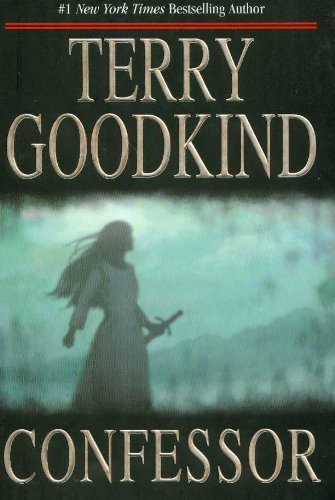
Confessor

41zwvtAmaML 51VSfzZ9TcLThat’s that, then. The Sword of Truth series is officially over, marking, what, the second open-ended series in my adult life to be completed by its author? (The only other one I can think of is King’s Dark Tower series, though it technically predates my adult life.) The final book, Confessor, very nearly drew me in. Despite the inevitable lecturing on the nature of good and evil as they relate to objectivism, there were some really solid moments. I’m thinking especially of the climactic rugby[1] game in the middle of the book and the events that followed after. I know that sounds like a ridiculous (if not outright parodic) thing to say, but I’m sincere on this point. There were 5 or 10 chapters of non-stop action that was probably as affecting as anything I’ve seen Goodkind write; my pulse was up, I was excited to see the outcome of the events (not just the game), I basically couldn’t put the book down. So, hooray for that.

My complaints, alas, outweigh that moment. I mean, I’ve accepted that objectivist screeds are an inevitable side-effect of the series, but there’s more to it than that in this book. It’s that the first screed was performed between two of the good guys, and since the good guys are all on the side of objectivism, it was required that one of them act angrily out-of-character so that the other could calm him down with the clear truth of things. It’s that a later one was performed by a (let’s say) 10 year-old girl, explaining to a (let’s say) 14 year-old girl that it was the teen’s own evil choices that had led her to this fate and she had nobody to blame but herself, moments before her flesh was devoured from her bones. It’s that the climactic screed was performed to an audience of, literally, every person in the entire world. (That’s right. Literally.) Plus, on a non-screed topic, it’s pretty clear that in the last 200 pages Goodkind still had about another book’s worth of story to tell, but was either out of screeds or tired of the series or wanted to stand by his promise that it was the final book, and so he had to rush things to a degree that was certainly all out of pace with the entire rest of the series, but that also[2] genuinely felt like important explanatory events were being left out. Plus plus, I’m nearly positive that elements of the series’ conclusion were lifted from Atlas Shrugged. But this last is not something I’m willing to elevate to the level of complaint, partly because I have thusfar failed to finish that book and partly because I’m pretty sure it would properly be called an homage, anyway.

If you’ve made it this far[3], you may as well finish the series out, right? Plus, that middle part of the book was, I reiterate, genuinely good.

[1] I mean, it’s not exactly rugby. But close enough for the purposes of this review.
[2] Because, and let’s be honest, it’s hard to see that as a negative at first blush. Objectivist screeds kind of break up narrative momentum, is what I’m trying to say here.
[3] And let’s face it: you haven’t.