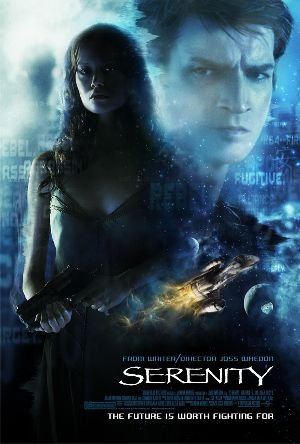
 Some time ago, there was a new Star Wars movie coming out. I’d been burned by the series a bit, if not as badly as some, so I was looking forward to it still, but guardedly. Meanwhile, the Joss Whedon movie, Serenity, was pushed back from before Star Wars until months after it, here at the end of September. So I hatched a plan, made a promise with myself if you will. Star Wars was over, whereas Serenity might spawn new films or even a return to television for its show of origin, Firefly. So, however many times I felt compelled to see the Sith get their revenge, I would see Serenity twice as often. The problem is I no longer have a job with its pesky reliable income, and that the Star Wars movie was really quite good. Good enough that I kind of saw it four times, and only didn’t see it more because I was in the midst of moving, and ran out of time to see it before it vanished.
So, now I need to spend some reasonably large amount of money to see Serenity seven more times. (Or possibly eight; previews don’t make money and so don’t count toward totals, and emptying my pockets to them was kind of the point of this exercise.) So, that’s the bad news. The good news is this: except for having to sell my body on the cold, cold streets for ticket cash, I will not find this task in any way burdensome.
I had a couple of problems with the movie, although at this particular moment I’ll be damned if I can remember what they were. Instead, my head is flooded with individual scenes, some funny, some gripping, one that left my mouth open for at least a full minute, not a few technically amazing pieces of work that would have, well, if not left Lucas jealous of the skill, at least left him acknowledging that it’s not only him can make these things happen on a screen, these days. So, I’m a geek for Joss Whedon and especially for this show, and no denying it. Perhaps that makes me easier to please, perhaps it makes me harder to. I know this, though. I’m going to wander around in a happy daze for the next few weeks.
Will it work for new people? I think yes, if they can be talked through the door. The introduction scenes were rapid, because Joss doesn’t assume his viewers are stupid. I’m pretty sure the average Hollywood consumer is in fact not nearly as stupid as most movies take them to be, so having rapid-fire intros shouldn’t be a problem. A couple of the characters were introduced less well, but I think still well enough. He created the sense of history without deigning to explain it, but it was there solidly enough that you should be willing to allow it to be true and wait for the payoff. The plot should be plenty easy to follow, though, and the characters and dialogue should make up for any unfamiliarity by the end of the second sequence.
As far as the plot: River Tam, a government experiment in mind-reading and enhanced military capability, and her brother Simon are on the run from the government that created her. They have fallen in with the crew of Serenity, a group of people who don’t much cotton to the way the Alliance of Planets keeps its nose in the affairs of people who would just as soon be independent, and who make their living on whatever side of the law is most convenient. The problem is, River has a secret buried in her brain, and very important people want it back. At any cost.
Lastly, the part where I snagged it early. It was a bit of an event last night. I got to see it in an Old West ghost town (well, okay, a movie set, but done up well enough), at sunset, with a Chinese box lunch and a fortune cookie that included an actual fortune if you can believe it, not just a compliment. Also, Kaylee and River were there. I would have a hard time imagining a better way to get to take it all in. Here’s my point, though. Go see it. This weekend if possible. If I’m wrong, tell me about it and I’ll make amends. But I’m pretty sure that won’t happen. (Even if I did have a couple of complaints.)
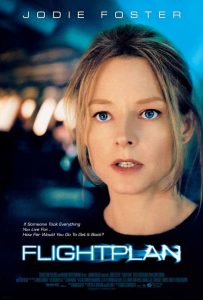 Some time ago, I mentioned one of the best previews I’d seen in a long time, for a movie where Jodie Foster gets on a plane with her daughter, goes to sleep, and awakens to discover that not only is the girl missing, but nobody remembers seeing her and there’s no proof she even had a ticket for the plane. In the months that passed between my first awareness of Flightplan and seeing it this weekend, I came to realize that it had a fatal flaw. The setup was all laid out in the preview, leaving only the central question of the movie unrevealed. Is the girl alive and kidnapped, or has she been dead all along, and Jodie Foster is just coping poorly?
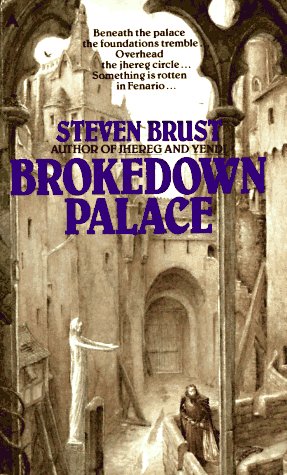 Seriously. If this is the kind of experience any given regular person has when reading fiction, I can force myself to feel a little bit of sympathy for the non-readers of the world. It was very good, and certainly easy to follow on the primary level. Four brothers, a king and his siblings, must decide how to deal with the gradual decay of their familial home and the seat of the kingdom’s power. Sides are chosen, battles are fought, dragons are incidentally slain. So why did I feel like I spent the entire book trying to catch up and understand what was really going on?
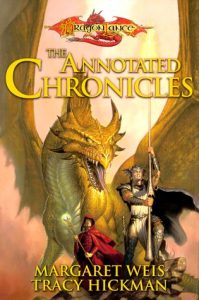 When I was a wee lad, I read a ton of those AD&D Dragonlance books, pretty well indiscriminately. There came a time in my late teens when I realized that some, okay most, of the books in that setting were pure crap, and that they didn’t actually have to be suffered through in order to know the entire story. Ultimately, books written by authors who didn’t create the characters I was trying to read about, in which the characters did completely ridiculous things that they probably would never have done anyway and certainly would have mentioned doing… these kinds of books could be ignored. It was a pretty happy day, when I finally worked that out for myself.
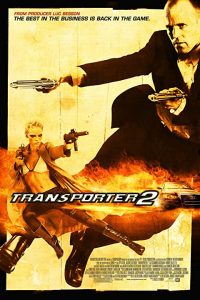 There is a formula in Hollywood. One of many, of course, but this one goes as follows: Car chases + chopsocky = $$$. Car chases always include a) cars that explode, b) cars that drive up ramps on two side wheels to flip them upside down in mid-air, and c) cars that drive off the edge of a conveniently partial bridge. Chopsocky always includes a) people that punch each other, b) people that kick each other, and c) people that jump around a lot, avoiding certain death.