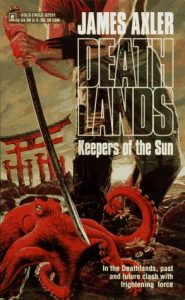
 This week in the Deathlands, our heroes… are not in the Deathlands, actually. See, for the past three to five books, there have been hints of circa 17th C samurai that have been using the same teleportation gateways that our band of semi-heroes have been using to travel around the post-apocalyptic remains of what was once the United States. (So, y’know, near future sci-fi.) All of which to say, this time they come out in Japan!
Well, in the post-apocalyptic remains of what was once Japan. Because, you know, global thermonuclear war has only the one winning move, and nobody in this series took it.
Anyway: Keepers of the Sun is mostly interesting as a historical time capsule of the late ’80s[1], when we had an economically tense relationship with Japan. I have frequently lauded the sexual egalitarianism of these books, and I would have guessed that the racial parts would be the same. This is… kind of true here? Not as much as I wanted, but in some ways it felt like the blustery, rough-edged folk of the future were learning not to be racist against the Japanese[2] as a stand-in for the (let’s be honest) mostly working class truck driver type who became the biggest audience for this series.
I know for sure that I kept expecting [hereafter follow spoilers for a book you will never read] the other shoe to drop with the nominally noble-minded, Bushido-coded warlord[3], but no, he really was what he seemed. Even their points of contention over a possible mass invasion of the Deathlands could I think have been solved by the realization that even with the many uninhabitable or outright destroyed regions of North America, population reduction has resulted in plenty of room for everyone. But the mostly episodic nature of the series largely prevents that size of change to geopolitics, I suppose. So they found another way to resolve it.
[1] I’m trying very hard to disregard the 1996 publication date here.
[2] Except manga. Everyone stayed racist against manga.
[3] Okay, what I cannot especially defend is the premise that the meager remains of Japan’s main island would revert to circa 17th C warlords, samurai, ronin, and peasants. But since the US has mostly reverted to feudalism, it’s not as troublesome as it sounds at first glance.[4]
[4] I’m a little proud of that phrasing.
 If you’re like me[1], when you saw the preview’s for Blumhouse’s
  I have really a lot of thoughts about
  So, uh, massive spoilers for not so much this book but for the entire series through Peace Talks, which is not yet published as of this review. Don’t read farther unless you don’t mind.
 When I started thinking last night about my review of
  I scrolled to the tail end of my watch list on Shudder last night, because it’s been a minute or three since I watched anything there that wasn’t hosted by Joe Bob Briggs. The movie at the end was conveniently short (since I was halfway thinking about going to sleep early instead) and in English (since I wanted to get my outstanding review handled before the plot got very busy[1]), so perfect placement, and thusly did I watch
  Jesus, I read
  Considering how close I am to the end of the published Powers series, you would think I would not have gone three and a half years since
  There are two things working against me here. 1) I am not used to reviewing reference books, and 2) I’ve been reading
  I am shocked to see that we finished listening to the last Dresden Files book less than six month ago. It really seems much longer ago. Which means that yay, still accomplishing something here. Anyway: as usual, the first and most important part of