 I can’t even remember exactly why I picked the book up in the first place. Most likely, there was an internet discussion about which urban fantasies were worthwhile and why, and after the Harry Dresden and Anita Blake books[1], the Rachel Morgan series was the only one that struck my interest. Anyhow, between the amount of time I spend at various Half Price Books around the metroplex and the amount of depth on my to-read shelf[2], I can’t exactly be surprised that I’d bought five books into the series without ever having read the second sentence of Dead Witch Walking quite yet.
Mind you, I have now. It was not bad. There’s this girl Rachel, and she’s a witch. And she has a job capturing the bad elements of the magical world that humanity is stuck with, however unhappy it makes them. But when she decides to get out from under her boss’s oppressive thumb and go into business for herself, things quickly go from bloody to deadly. Soon, she’s caught between her old boss’s hired assassins, a potential and unwanted relationship with her vampire business partner, and a Cincinnati councilman / criminal overlord of unknown lineage and power. And that’s just for starters.
Okay, truth be told, I’m not sure I would have finished the book if I hadn’t already bought the next four. Our heroine took a while to get past whiny to likable. (Honestly, she may not have managed it yet, and it’s more that I got used to her voice finally, complainy-pants and all. She for damn sure isn’t as good to her friends as I would prefer.) The plot took a little while to quite get revved up from a simple problem to be solved into actually interesting events. Most troublesome was the setting, though; the average urban fantasy, in my still-limited experience, works as closely as possible to our normal world, with only limited variation to explain all the fairies and werewolves and ubiquitous vampires roaming the landscape. This one took a different tack, diverging in, I think, the 1960s; and what a divergence! Half the population or better dead in America, far worse elsewhere, and with all the magical people suddenly taking center stage by virtue of not having been susceptible to the deadliness. All of which is fine and good, except that the author kept dropping modern pop-culture references into the mix. It’s not that J.R. being shot or Luke learning about the Force are all that impossible even in a changed history. But when she tossed in another three of four such references that I’ve forgotten, it began to strain the bounds of reason. I don’t want to be yanked out of my suspension of disbelief over such trivial matters, is all; if you want to call the pop-culture, just don’t change your world around that much; that pretty much handles the problem right there.
But in the end, it turned out to be a decent book, and I have enough questions I care about that I will want to see what happens next. My hope is that someone mentioned the wonkiness to her, and I won’t run into these problems by the time book two comes around.
[1] about which I already know plenty
[2] Now officially overflowed, if not quite extending onto a second full shelf yet.
 This weekend, it has been all about the subtitles. After rolling out of work a little early on Wednesday, I fought traffic and a driving blizzard to get to the Angelika in time for
 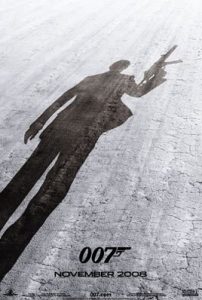 So, new James Bond movie, which is almost by definition cool and only really needs to be compared to other Bond movies. I liked it enough to have seen it twice, and yet I’ve been stuck on the review for a while now. I think it wasn’t until I realized that and thought about why that I was able to come up with something, but it does all kind of make sense now.
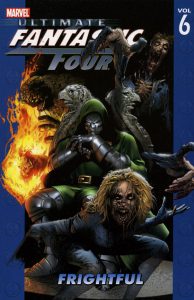 I’m not really sure what was done differently, but the latest volume of the Ultimate Fantastic Four managed to be as busy as the last few have been while simultaneously not feeling like each individual story was rushed. If anything, it felt like a return to the madcap days of the ’60s where each storyline lasted for two or three issues and hints of the future or ties to the past bled into each individual magazine; in short, like there was an ongoing, somewhat-planned story arc. It turns out, I really dig that.
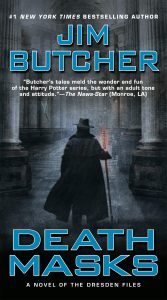 The awesome thing about reading a Dresden Files book is that I’m guaranteed it will be good, between the quality of the earlier entries in the series and the universal acclaim it has received among my friends who have read them. Plus, reading them spread out like this means I’ll still have new ones ahead of me for at least months, if not years. The downside is that it’s really hard to convince myself to read something else instead once I’m done with one. Like now!