A Storm of Swords revisited

Last time, I said this book maybe didn’t have much of a theme. I’m not sure if that’s true, though it still seems possible. I certainly noticed a lot of music, where there was not so much of any in the previous books, and not any in the next one too, at least to my entirely faulty memory. (On the bright side, it won’t be terribly long until I correct that impression, if needed.) That said, I can’t really attach anything to the fact of this being the most musical book in the series. Well, that’s not entirely true, as there is certainly an air of fiddling while Rome burns to the whole affair.

And that’s the truth of the matter, because there cannot possibly be another book in the series that so casually disposes of so many resources, lest Westeros be well and truly emptied before the Others (the Other? I’m starting to wonder just how accurate Melisandre might be about all this; it’s not like being a terrible person stopped anyone else from winning in this series) make their way into full-blown war against the world of life.

I can’t think of anything to add that wouldn’t be a massive spoiler, but I still cannot get over just how very much I ended up liking… well, probably you know exactly who I mean if you’ve read it, and if not, ask me and I’ll answer.
The Wild and Wonderful Whites of West Virginia

I don’t have a ton to say about The Wild and Wonderful Whites of West Virginia, and actually to some extent because of spoilers, ridiculous as that sounds. Basically, it’s this: if you want to watch a documentary that simultaneously makes you feel a lot better about yourself and a lot worse about humanity than you did before, come no further. Well, except for the guilt when you laugh, which you will many, many times. (Hopefully that part won’t make you feel better.)

Also, it has multiple cameos by Hank Williams III, who sounds a great deal like his grandfather and looks a great deal like… well, like he was born to the wild and wonderful Whites of West Virginia. Which, to be clear, is not a compliment. (Also, spoiler alert, they are not wonderful.)

Transformers: Dark of the Moon

Giant robots? Explosions? Random people yelling “Optimus!” at regular intervals? Yep, it’s a valid live-action Transformers movie. I don’t want to say a lot about it, partly because we both know there’s not a lot to say, and partly because it doesn’t seem right to accidentally give away what threadbare moments of plot exist. But I was definitely impressed by the extent as well as the quality of the extended cast, I dug the new girlfriend (though I wish she’d had more to do besides look pretty and be in danger, but, y’know, Michael Bay), and I was pleasantly surprised by the lack of racist, moronic robots as “comedy relief”.

I can’t decide if it’s worth mentioning that the plot had a massive, glaring flaw or not. (‘Cause, again, Michael Bay. Right?) And despite how (glaring plot flaw aside) it was a largely good popcorn flick, I still don’t think I’ll ever get over the first impression I had, when I was watching an incredible sci-fi movie preview about how the moon landing was a cover-up for our exploration of a crashed alien spacecraft, and I really wanted to see what would happen next. And then what happened next was Transformers 3 instead of something new, gorgeous, and possibly amazing. Dark of the Moon was funny, cool, and chock full of exploding robots, and, okay, it was gorgeous; but it was by no means amazing, much less new.

Priest (2011)

Priest was an odd duck of a movie, because it didn’t really try to be anything. There’s this weird alternate reality, see, where humans and vampires have been openly at war for centuries, and despite that the vampires are far stronger and vastly numerous, somehow the sunlight advantage has allowed humans to progress scientifically and spiritually throughout the years, culminating in some kind of religio-genetic hybrid warriors with cross tattoos on their faces who took the war back to the vampires and pretty much won it.

Only now, maybe the war isn’t really over after all, and the church leadership is in denial and considers anyone who wants to investigate the opposing viewpoint to be anathema. So there’s you a great little theme about corrupt religious power, versus reason, versus true faith, probably versus other possibilities as well, only, yeah, once the premise was settled, they went nowhere with it beyond cartoonish antagonism. And there’s a thick, rich Vietnam metaphor in the priests, who everyone can recognize as having been part of this great war that was a stalemate at best, and they no longer have any place in society now that what they were created for is over, and one of them is beset on all sides, by the law, by his past, by threats to his family, and this is the most Rambo-like character I’ve ever seen, only…. again, they did nothing with him. He almost had a sympathetic superior, but not really. He kind of had people to go rescue to prove the war hadn’t ended, but the scope was too narrow.

So, instead of all this potentially rich territory, there was a lot of CGI kung fu, cool explosions, and implausible usage of motorcycles. Oh, and a giant pile of sequel-bait, except all the possibilities for conflict more compelling than “we’d better kill this next dozen vampires” was already ignored and discarded here in what I hope will not be described by future generations as the first movie.

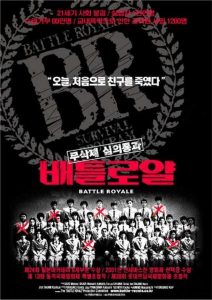
Batoru Rowaiaru

There’s only one problem with Battle Royale. The premise doesn’t make even a lick of sense. The introductory text scroll lays it out like this: Japan is in economic turmoil, with record unemployment and an extremely bad delinquency problem among the youth, apparently because they see what they have to look forward to? So, the adults fearfully pass the BR law, which… here’s where it makes no sense. Apparently, once a year, a randomly selected ninth grade class is sent to an island, given bags full of equipment and random weaponry, and asked to kill each other over the next three days. If there is more than one survivor after 72 hours, everyone left will be killed. Pretty straightforward, right?

And the events portrayed in the final 80% of the movie are chock full of hard decisions and violence and teenage melodrama, in which anyone can die at any moment, just like you’d expect of a pack of inter-murderous ninth graders. So if you can get past the premise, there’s a great deal of that, and I approve! But still, I can’t figure out how it makes any sense. That is to say, how does the “law” help anyone? At one class per year, it’s not going to make a dent in any population concerns. And randomized with such a small incidence, it’s not like the kids have any fear-based incentives to change their ways; if anything, I’d expect them to get a lot more disaffected and violent than before. (Except this particular class didn’t seem to have any idea the annual event existed, which is its own kettle of worms, believe me.)

Still, to be clear, that didn’t stop me from enjoying the other 80%, it just drove me crazy at the start of the movie and again while considering my review. So, y’know, mixed bag.

Silent Hill 2: Restless Dreams

They may eventually get bad, but so far, I cannot say enough good things about the Silent Hill series. And unlike last time, this is one I had… well, okay, I had played it before, but I never finished. Last time was spooky and inexplicably satanic, I think? Whereas Silent Hill 2 (and, I hope, the future entries as well) was deeply psychological, with no hallucinogenic drug rings to be seen. I should first mention that although the 360 claims backward compatibility, there were still some sound bugs, less bad than last time but still present, and also I found out an hour in that you can only have one save game slot, total, or the whole thing falls apart. So that bit of replaying sucked.

But the rest of the time? Awesome stuff. See, there’s this guy James, and he’s come back to Silent Hill where he and his wife Mary had the best vacation of their lives, years before, because Mary has sent him a letter asking that he meet at their “special place”. Only, Mary’s been dead for three years, the town is mostly abandoned and all the roads into it are blocked, and the people he does meet are split between disturbing homicidal creatures, seemingly disturbed humans, an oblivious child, and a doppelganger of his dead wife, a stripper named Maria. Oh, and a hulking, unstoppable brute with a giant sword and a red pyramid-shaped helmet who is bar none the scariest dude I’ve ever seen in a video game.

In the midst of these dangers, James must unravel the mystery of his wife’s summons and the dark history of the town, and in some ways, that’s just the tip of the iceberg. All this amidst the best kind of bump-in-the-night sounds, a moody score, and halfway decent graphics. Even while playing the short prequel with backstory on Maria after I finished the main sequence, there still managed to be a moment when I got an accidental adrenaline jolt from an unexpected bad guy popping up in front of me. I am impressed, it’s been awhile since a game managed that!

Pirates of the Caribbean: On Stranger Tides

I glanced at my reviews of the last couple Pirates movies, and they are a lot more positive than I remember the movies in my head. I wonder which of us is right! My point being, who can say how well you and / or future me can trust this forthcoming review of the fourth poncy Johnny Depp vehicle? Oh well, we’re both here, may as well read it anyway.

So, I have a few disconnected thoughts, and they are presented here in no particular order. On Stranger Tides demonstrates better than I remember the other movies having done that pirates, by and large, are bad people. Not so bad that I wish I hadn’t watched the movie, but I felt slimier than I really wanted to, once or twice. That said, the action set-pieces did a good job of distracting me from that sporadic feeling, much as they distracted me from what were at the time glaring plot holes, most of which I’ve forgotten since, which just goes to show you quite how successful said set-pieces were. The action wasn’t the best in the series or anything, because they’ve always been amazing. But it was absolutely at the same level of quality, minimum.

Two events stood out from the rest, though, and neither are spoilers, so I will tell you them! 1) Impressive use of the Greek literary technique, deus ex mickina. 2) Disturbingly spot-on interpretation of the Japanese dolphin capture / killing bays. (There’s a documentary in the last year or two, if you have no idea what I’m talking about. The descriptions have convinced me I would hate watching it, though.) But anyway, yeah, this was pretty good. Oh, right, some people want an inkling as to the plot, I forget that sometimes. What is is, is they’re looking for the Fountain of Youth.

A Clash of Kings revisited

The truth of the matter is, good reasons or not, I really didn’t review the book very well last time. So I guess this isn’t so much a revisitation as an actual, um, visitation. (But with less ghosts/aliens than that.) So, here’s the thing about A Clash of Kings: the series no longer has shock value. Okay, that is almost certainly not true, but it no longer has shock value based on the paradigm-shattering events of the type seen in the first book of the series. Not to say that shock value is necessarily a benefit in the first place, I just find it impossible to think of the opening salvo to the series without the issue of expectations rearing its head. But in the second book, expectations have finally been set, and it’s time to see what will happen.

And what does happen? War. I suppose the title implies as much? But for my money, it’s some of the truest, grittiest war out there. I don’t mean the battle scenes, although I loved them, particularly the climactic battle of [spoiler elided]. I mean war and its effects on a pre-industrial society. Sure, we are seeing everything that happens through the viewpoints of lord, ladies, knights, or the children of the above, but that doesn’t mean they cannot see and be affected by (physically as well as emotionally) the devastation to the peasantry going on around them. If I had to pick a theme for the book, it would be simply that. War is hell.

I should add that I’m shocked by how very little happened. With very few exceptions, every character arc was advanced incrementally in terms of both geography and growth. None of it was the least bit unimportant, don’t mistake me, I just thought I’d see more. All of this tells me that the third book will be an even bigger deal than I had remembered, so that’s cool. (But seriously, this is a good book; I know it sounds like I’m describing the chess-positioning of some middle/late Wheel of Time books, and that’s not it at all.)

Incidentally, protected spoilers in the comments.

Bridesmaids (2011)

I’m going to show my premise here, as it seems kind of important to the rest of the review. I’ve seen a goodly number of Judd Apatow productions at this point (though, bizarrely, still not the earliest big hits that put him in the spotlight after Freaks and Geeks was so soundly ignored), and while I’ve never felt any solid connection to his male ensemble buddy cast members, I understand that there are apparently wide swathes of the male populace who identify intimately with their particular brand of shenanigans. The upshot is that, having seen Bridesmaids, I am willing to take on faith that this is how some significant segment of the female populace behaves among themselves at times when I can’t see it happening.

And see, that is anthropologically interesting if it’s even partially true, because I have no [moral] way of observing how women might tend to behave when men are not around. And Hollywood is notoriously bad at giving this kind of thing any airtime.[1] So, until told that nobody knows any people like this, I’m going to assume it’s probably somewhat valid, and therefore the movie is interesting instead of merely funny.

Which, make no mistake, it really is. See, Annie’s life is a mess. She hasn’t figured out relationships, the economy has destroyed her small business dreams, and for whatever reason, she really doesn’t seem to have many friends. And right when she hasn’t yet acknowledged much of this, much less come to terms with it, her best friend has gotten engaged and named her maid of honor. Only, the rest of the bridesmaids are Lillian’s friends, and therefore strangers to Annie. Plus, the rich and pretty one seems to be replacing Annie as Lillian’s best friend, which is exactly the kind of shit up with which she will not put. Escalating tensions plus a series of unfortunate events bring Annie’s life to a crisis point, after which… I guess this being a comedy, saying “nothing may ever be the same!” is a little over-dramatic? But even though I never stopped laughing, the emotional tension was very real, a feat which impresses me separately from the mostly high comedic quality. Also, it has that not-as-weird guy from The IT Crowd in it. I approve of him! (And his show, for that matter.)

Anyway, don’t go see it for the anthropology, even though I’d be intrigued to see other people’s reactions. Do go see it because it’s funny.

[1] There’s even a term for that, which I know I’ve mentioned here before.

Super 8

So, the thing about Super 8 is that you’re not really allowed to talk about it. There are these kids making a movie in 1979, as you do when you are kids and have a video camera and a friend who wants to make movies and video games haven’t been invented yet. And while they are at the train station filming a scene, they accidentally witness a pretty huge train wreck. All of this is in the teaser trailer from like 18 months ago, right? Anyway, after the wreck, things get mysterious, and that’s all I’m going to say.

What I suppose I am allowed to talk about, though, is the reactions it has been getting. I’ve seen people say that it implies there used to be magic in the world, but you have to go back in time to get it because now things are way too mundane for a big adventure. I have a little bit of sympathy for this, I do. Because I’ve thought to myself that if I had been older in the ’70s, I might have been one of those people making a Chainsaw or an Evil Dead, so I’m already a little predisposed to see the ordinary, everyday magic of widened possibilities in that era moreso than in this one, where you have to be slick and polished to even get any word of mouth going. (That’s not true, of course, but most of what I’ve seen for which that wasn’t true was just terrible. And clearly it wasn’t always thus.) But when I watch this movie, I don’t see anyone saying the magic has gone out of the world. I see someone saying, this is what the world was like when I was a kid. Of course, I also notice the freedom of movement and association those kids have versus what I expect kids today to have, and I wonder. They’re in a small town, and maybe things haven’t changed all that much? But if things have changed, we’re the adults now, deciding what kids of that age are doing, and if the magic of 30 years ago is absent these days, there’s really only us to blame for it. But for now, I think it’s mostly a difference of place than time, and that the young writers and directors of today will still be finding magic in their own childhoods as we near the middle of the century.

On a more technical level, I’ve also heard people make comparisons to Goonies or Gremlins. While those are both fine movies, I didn’t tweak to either comparison myself, except at the most superficial level. No, what it immediately made me think of, and I never found myself disagreeing later, was a sweeping Stephen King small-town epic, along the lines of It or Under the Dome. Only, presented on the screen far better than any of those have ever been. You may be aware that’s pretty high praise.