Tag Archives: fantasy

Bright

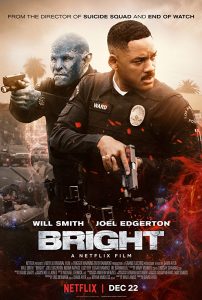
When I was in LA in mid-December, I saw posters everywhere for a Netflix movie called Bright, starring Will Smith. It was to be released in like a week, but I had never heard of it before that weekend. No idea why, really. I mean, I suppose the fact that 90% of LA billboards are advertising for the screen instead of like 20% here in Dallas could account for part of the reason?

Anyway, it looked interesting. See, it’s the modern world as we know it, except orcs are the stand-in for the downtrodden classes, elves are the stand-in for the wealthy and powerful classes who don’t want to be bothered with having to acknowledge that there even is an underclass who got a raw deal, and humans are the stand-in for, y’know, whoever fits in between the two extremes I just detailed. Oh, also, there was a Dark Lord a long time ago, and people hate orcs because they were on his side then. Institutionalized racism at its finest, folks!

And, frankly, that’s the problem with the movie in a nutshell. Someone decided that, oh, cool, we can highlight the massive race and class problems in America by using fantasy race stand-ins! …and then they didn’t really do anything else with the idea except point at it over and over again. For example: at one point, cop Will Smith and his orc partner (who is the first ever orc policeman, and if you guessed that both every orc and every cop hates him, then you already see my point here) are interviewing some hispanic folks in a house, and they’re speaking Spanish, which Will Smith knows and the orc does not. But it’s okay, because Will Smith doesn’t speak orcish when they’re in the orc gang hideout, and, oh, wait, why do elves speak elvish and orcs speak orcish, but humans have all the same languages we’re already used to since it’s regular earth? It’s possible this shouldn’t bother me as much as it does, but it’s just so damned shoddy!

Anyway, yeah. Buddy cop movie with high tension between the nominal buddies, and there’s a lot of magic floating around via all-powerful wands that most people can’t touch without just exploding to death, and of the people who can, mostly they’re only elves, but also the world is so shitty that people would go ahead and grab a wand anyway if they were just laying around because hey, if you don’t explode, cosmic power is yours for the wishing. And I’m pretty okay with that as a setting, but man, the clumsily (and, worse) lazily-handled race stuff ruins the whole thing for me.

But I hear it did well and there’s a sequel, so maybe they can focus on Dark Lords and magic next time, or at least have someone set them straight on how to not build ridiculous caricatures that we’ve all seen before. (I should say: the opening credits of the movie highlight the tensions and problems of both their world and ours extremely well, so much better than the plot or dialogue ever came close to.)
Aftermath: Life Debt

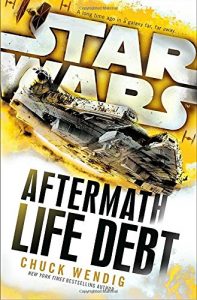
Life Debt is the second in a trilogy of books that falls between Return of the Jedi and The Force Awakens in the new Star Wars continuity. I have more of a feeling than I originally had that I will learn very little about how we got from there to here, after having read this book. That’s disappointing, but not enough to take away from my enjoyment of the book for itself.

The cool team of rebels (or whatever you call them instead when the Empire is kind of defeated although not entirely but for sure there’s a replacement or at least alternative government in place) from Aftermath is back, to do Princess Leia a favor. See, the new Republic government is focused on fighting the Empire over systems with tactical or political value as they gradually try to put out the flames, instead of on who is suffering; and one Han Solo owes a Wookiee of his acquaintance a free Wookiee home world.

Only now they’re out of contact, and Leia asked those people I mentioned from the last book to go find him. And thus, a plot! Also, there’s some seemingly (but I’m afraid ultimately not) relevant byplay among the Imperial remnants, trying to figure out who will come out on top and how they will crush the new Republic, you know, like you’d expect them to want to do. Wake me up when one if them is named Snoke and I’ll care more about where that part of the plot is going.

But the laser battles and ship battles and infiltration plans and whatnot? Definitely still Star Wars, and that’s fine by me.

Blood Follows

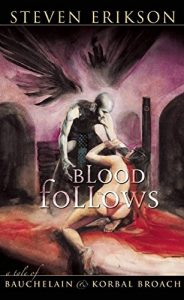
There is one problem with publication order, and that problem is when small run publications are later gathered into collections. Well, to be fair, it’s not a problem with reading; you just read the part of the book that contains the story you were reading in publication order, and then put it down until later. But it is a problem for me specifically, since I include links to the book I read from, and yet the book I read Blood Follows in is not strictly the original book itself, since it’s a collection. Like, it’s fine now, but what about when I have the same cover and the same link for the next story I read from this collection? (It turns out I used the cover of the original small batch publication, so that may help a little.)
(It’s possible[1] I’m thinking about this too much.)

So, in Memories of Ice, one of the subplots I did not mention was that of the necromancers Bauchelain and Korbal Broach. This is because despite touching on the main drive of the story at several points, they really have nothing to do with anything that’s going on. Despite that, they are fascinating characters. Well, the one who murders people and uses their parts to build constructs in pursuit of some nebulous goal that may not rightly exist[2] is not especially fascinating. But the one who accompanies and protects the crazy one because it gives him a chance to further his own necromantic research, and who presents as a polished and urbane yet evil supergenius in the vein of Dr. Doom, he is fascinating. And their manservant, Emancipor Reese, is usually played for comic relief, but in a way that makes you care about him. He’s stuck in a situation, and making the best of it. (Well, trying and mostly failing to, whence comes the comedy.)

Anyway, though, Blood Follows. This is a short book that gives an answer for why these characters were in the main sequence book: because Erikson is as fascinated by them as I am. We join our characters several years earlier and half a world away. Emancipor Reese has just lost another in a long string of employers to unfortunate death (this time at the hands of a murderer stalking the streets of his city for the past fortnight), and he needs to find a new job fast, lest his wife and probably non-biological children think even less of him than they already do. Also, there’s a reasonably cool police detective type trying to solve the murders.

By and large, this is a story that you will care about if you care about the characters you already knew, and otherwise, you will not. In part this is because Erikson is a far worse mystery novelist than he is a fantasy and war novelist. In part, it’s because even to the extent that the mystery worked, too many characters emerge as major players in the final act, and it is seen through the eyes of someone who has just as little idea of what’s going on as the reader does. This can work in the first book of an epic series, if your reader trusts you and in the meantime the story is written masterfully. It works a lot less well when the story is barely a hundred pages long and the things the reader didn’t really understand revolved around characters he (by which I mean I) doesn’t really expect to encounter ever again.

This isn’t to say I didn’t like it. It is to say that if I wasn’t already invested in the world and the main characters, I probably would not have, though.

[1] probable
[2] That is, I don’t really think he has an endgame in mind (nor that, even if he does, I’ll ever learn it). It’s more like he’s playing with legos to see what he can make.

Jack of Fables: The End

The final volume of Jack of Fables is hard to review for two reasons. If I’m being honest with myself, the series had outstayed its welcome since probably the big crossover, or at the very latest whichever book after that involved the dragon. So for my perspective: I’m glad it’s over. But that’s an opinion, not a review.
Reason one why The End is hard to review: because it’s not only the last entry in a series, but also the ninth. So, spoilers galore. This is a common problem that I have, and the lesson I suppose is to read more standalone stories?

Reason two why it’s hard to review: because anything I actually would be willing to say is already covered by the title itself. This book right here? Delivers on its promise. So, what else even would there be to say? Was it satisfying? Since I was already done with these characters, one of them probably before he ever existed[1], it’s hard to answer that in true fairness. But yes, I’m satisfied.

….except for the perpetual Walter Mitty miniaturized blue ox. I never got that at all. But I’m glad I will never have to worry about it again, at least!

[1] Jack Frost

Vallista

New Vlad book! Which you’ll know if you’re a long time reader here is kind of a big deal. You’ll also know that the series is coming towards an end[1], which explains why I can say very little. Basically, Vlad Taltos is an assassin, he’s made powerful enemies and powerful friends, and this particular book is more about the latter than the former. Worth knowing: Vallista has straight answers to a number of longstanding questions about the nature of reality (which is one of the ways you can tell the end is near).
Also worth knowing (perhaps the only other relevant thing to know): Brust’s tenure as the only author I’ve read with no disappointing books continues unabated. In addition to the reliable storyline and voice of this series, I was especially amused by the chapter titles. But mostly, I continue to love everything about this character.

[1] Somewhere between three to five books left, if I understand what’s going on correctly.

Star Wars: The Last Jedi

I’ve seen The Last Jedi twice now. There’s been a lot of hoopla, you know?[1] People complaining about things that are debatable matters of taste[2], people complaining about the politics of the movie that are not really debatable[3]: to the extent that they are not simply injecting their own politics instead by complaining, their politics are wrong and the movie’s are right, so that’s how I feel about that.

But all of that is stuff I can’t go into, because I presume that people care about spoilers, not only now even though it’s nearly two weeks past release, but even for posterity. I will say that I liked it quite a lot, have virtually no complaints[4], and have a lot of praise. Was it the best Star Wars movie? Man, how can I even judge something like that after watching it twice, when the first three are so fundamentally entwined into my childhood. But seriously, it might be[5]. It was absolutely the most emotional, emotion-driven of the films, and I do not say that due to foreknowledge of Carrie Fisher’s recent death. Although that knowledge certainly adds an extra gut punch beyond what the movie had already accomplished.

I guess I’m saying these things: 1) if you’ve ever gone to see a star war, and you somehow haven’t gone to see this one yet, you really ought to. 2) It rewards multiple viewings.

[1] Spoiler footnotes below the cut

Continue reading

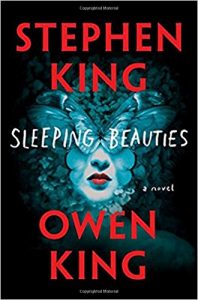
Sleeping Beauties

I have been reading the new Stephen King book for like two months, which is just strange. I mean, there were various reasons behind the delay. I’ve been really busy at work all the time, for one, and a shoulder injury made me loathe to carry it around, for another. (I mean, the injury was not entirely debilitating, and neither is this the biggest book ever printed, but the two factors did not play well together.) These are all true facts, but at the same time, I don’t think any of them was the real problem.
Sleeping Beauties tells the story of a world without women, more or less. They’re all here, but once they fall asleep, they get shrouded in a mysterious cocoon and don’t wake up. (Well, they do, for brief periods, if you are too insistent; but that’s a bad idea.) Half the story deals with the world’s, which is mostly to say men’s[1], reactions to this sudden new reality, mostly via the small Appalachian town that acts as the setting. The other half deals with the supernatural underpinnings of the event, and what this all means to the women who are cocooned away.

That first half, wrapped up in a hypothetical reality, no matter how potentially troubling, is where the book shines. There are heroes and villains, small petty vindictive bullies, understandable antagonists, helpless children, and everyone in between. Stephen King has always been a deft master of interweaving motivations, and nothing much has changed in this regard. The second half, in which spoilers abound, is… well, it’s two things.

I don’t know much about Owen King[2], but I do not assume that he is what of this book I didn’t like. At least, not specifically. Because, the first thing is, King’s biggest flaw in my estimation is that his explanations sometimes get too big for him[3], and end up unsatisfying. That’s less true here than in some cases[4], but still highly visible. Intertwined with this is the second thing which is: two men are not really qualified to write about how women would deal with the spoilers I’m not going into. This is not my feminism talking, although it could be; it’s more that the outcomes on the page simply didn’t feel true to life.

Anyway, I still liked it. But it is definitely flawed.

[1] There are definitely a lot of women striving to stay awake, and they matter to the plot. But not, thematically, to this half of the story. If you find that to be some measure of problematic, know that you are not alone.
[2] The default author’s son, and co-writer of this book, in case you didn’t use the mouseover text.
[3] This is not the proper phrase for what I mean, but I cannot figure out something better.
[4] For example, Under the Dome, which would have been better if no explanation had been offered. The only worse answer I can think of is the one the TV show came up with.

Assassin’s Quest

So, I have read a Robin Hobb trilogy. I definitely in a way had expectations that were met, but mostly I still think I didn’t. If that makes as much sense as I think it does, well, I blame the malort but will also elaborate by way of apology.
Assassin’s Quest starts off the way you’d expect, as a good old-fashioned revenge story against a man what done someone wrong. Fitz has been poisoned, betrayed, beaten, and ultimately murdered, and he ain’t gonna take it anymore! (I’m being flippant on purpose, partly to downplay and/or avoid spoilers, but also because it occurred to me while thinking about this that you could tell the same story if you are Quentin Tarantino, albeit with a spectacularly different outcome.) And that difference of outcome is I suppose the point, since about a third of the way through, Fitz’s quest changes suddenly and unpredictably from assassination to magical travelogue, and eventually, well, it would be all kinds of spoilers to explain, but if you are wondering whether the meat of the trilogy is resolved in one way or another, the answer is yes.

I liked the book, and in fact the trilogy as a whole (although the book less so). Pacing issues are the main reason, and again most of the rest would be a spoiler. But at the same time: if I care enough about characters in a story to be unhappy about where they end up, that is more of a positive thing than a negative. Which is the elaboration I promised above.

I’ll read more.

Royal Assassin

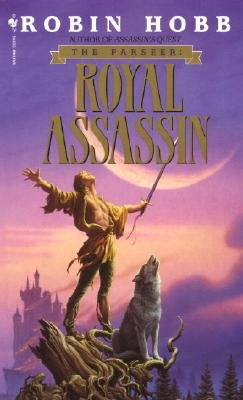
I’ve been sitting on this review for better than a week, because I just have no idea what to say. Okay, that’s not entirely true. I could easily sum up Royal Assassin in a single sentence. But that sentence would just be incredibly spoilery, and I’m not sure how else to talk about it without doing that. So here I’ve sat, not writing anything, but instead turning it over and over in my head, since Mary is still like half a book behind me so I can’t start the next one yet anyway. And I honestly might wait longer, gorging on comics all the while, except that my newest device is having touchscreen problems and I’m maybe about to have to ship it off for repairs, so, uh… yeah.
The thing about Assassin’s Apprentice is that it’s dark and grim from start to finish. The Fitz starts off as an unwanted bastard, learns of his secret royal parentage (but in the “still totally a bastard” way, not the “gonna end up the king of everything” way that usually happens in fantasy), trains to become an assassin (I mean, like you’d expect. It’s right there in the title!), and makes friends and enemies along the way. In the end, he faces a challenge and comes out beat up badly, but successful.

(There’s more to the review behind this cut, because my god the spoilers just explode everywhere.)

Continue reading

Fables: Rose Red

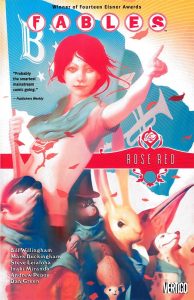
The big plot of Rose Red revolves around the Fables formerly of Fabletown, now retreated to their last stronghold on earth, continuing to fight against Mister Dark (who plausibly I mentioned last time). And that plot progresses, which is all fine and good, but I’m not really here to talk about that. For one thing, spoilers.

More importantly, though, the flashback story that gives the book its name is the more interesting one. See, Snow White[1]’s sister has been a pivotal character in this series since the very beginning, and it’s about time we learned why they’ve always had such a bad relationship. Thanks, flashback! And of course, thanks Bill Willingham for making sure the story made sense from both directions. It’s a rarer talent than it should be.

[1] Originally deputy mayor of Fabletown, now retired to wedded bliss with the Big Bad Wolf