Tag Archives: science fiction

Moon Fate

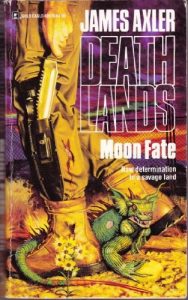
51B5enw1nlLApparently, the Deathlands series is completed, at 75 books, as of sometime last year. That’s kind of cool, because it implies that I might ever finish[1]. Not a habit I’m used to, what with Marvel comics that have been published continuously since 1961 with no end in sight.

I’m not sure that has any special relevance, but I learned it while doing research into the author of Moon Fate. (James Axler is a farm name, you see, assigned to any number of actual writers in the series, but not a real person in his own right.) The sad reason for this research was that there was a tonal shift so drastic, I briefly hoped there had been a change of the usual author to explain it. Here’s an implausible number of words about that.

Weirdly, even now, I can’t tell if I’m being unrealistic. In thumbnail, Ryan Cawdor is returning from the events of Chill Factor to rejoin his friends, but due to a series of the kind of tragic event that is so typical in a post-apocalyptic hellhole, they end up split once more, with he and his girlfriend captured by vengeful mutant “stickies”, so called because they are part of a common lineage in the Deathlands whereby their arms are covered with incredibly strong octopus-like suckers, strong enough to strip flesh right off any “norms” they might come in contact with.

And here is where problem one crops up. Normally stickies are, in addition to being strong and violent death machines, quite lowly ranked on the intelligence scale. Which is fine, killer mutants are a staple of any nuclear holocaust. But they were lead by an especially intelligent throwback to humanity, who of course was a figure from Ryan’s past. I don’t mind that they had a bad time together and the stickie wanted revenge. I mind that, after going to all the trouble of making him a leader who was intelligent and strong-willed enough to organize his troops instead of the usual ravening hordes, the story still treated them as mindless enemies. A story where the mutants could also be human would have been much cooler.

In any case, not enough to put me off the story, but then there was a rape scene in which a female stickie took Ryan into her quarters for to satisfy her carnally. And… I mean, there was only the one mostly human throwback, so I’m not saying I have a problem with the run of the mill mutant being a grotesquerie. And if the rape scene had been reversed, with lead female character Krysty Wroth being the victim, that wouldn’t have been any better, for all kinds of reasons. Still, the scene where Ryan was being forced to perform oral sex was just relentlessly anti-female, in a way I have thusfar thought this series was better than. And like I said, I read over the caveats and feel like I’m being way too sensitive about this; because yes the scene could have been left out entirely, but once you accept its presence, I can’t really see anything unrealistic about it. All the same, it felt skeevy, and I hope it doesn’t happen again.

Third, not that I much care about this, and especially in comparison to the other two, but I have no earthly idea what the title had to do with anything at all.

Anyway, leaving aside those complaints, the book was at least a nice change of pace from the standard “teleport somewhere, right a wrong, move on” template the series quickly fell into. I mean, yes, that is technically exactly what happened, but the trappings were all different, what with resuming from a split party, visiting friends, and staying in town for months rather than days or hours.

[1] Given that this book is #16, I’m already 20% of the way through!
Serenity: Leaves on the Wind

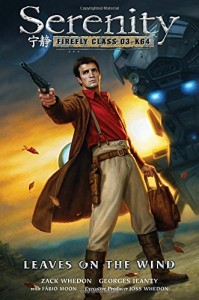
513Coa7zVcLUntil a credit card error combined with an email filing error caused me to miss several issues in a row (and I was already months behind on actually reading them even then), I collected Buffy and Angel comics set after those shows had ended. In addition to those, a handful of Firefly comics were released, but these were not of the full-sized sequel variety the others had been. A three issue follow-up story with only one spoiler of any consequence, and a second batch about which I, perhaps tragically, remember nothing (but it was past stories instead of future), and then by the time the third set happened, I had already had the card failure of which I speak, I guess?
Leaves on the Wind is not only the fourth collection; it is also, finally, a full-fledged continuation of the story with (I believe) more to come. In addition to the fruits of that spoiler I mentioned, mostly this one is about the fallout of the big revelations broadcast by Malcolm Reynolds about the Reavers and how they relate to the Alliance; you know, the ground covered in the movie. There are people who don’t believe a word of it, people ready to start a whole new revolution, people looking for all kinds of bloody revenge. You know, the usual.

Definitely worth reading, but read Those Left Behind first.

10 Cloverfield Lane

MV5BMjEzMjczOTIxMV5BMl5BanBnXkFtZTgwOTUwMjI3NzE@._V1__SX1859_SY893_Friday was movie day, as occasionally comes around. And unexpectedly, 10 Cloverfield Lane was the new movie of the weekend. I’d been interested in this since I heard about it, and the lone preview I’ve seen helped that interest along, so.

Short answer: I liked it. But, here’s the problem with naming your movie after Cloverfield[1]: if the new movie is a direct sequel or shared universe sequel or prequel of the original, then the tension of the unknown is greatly reduced by this knowledge. Yet, by contrast, if the new movie is not directly related in some way to the original, then you’ve squandered this reduction in tension for no apparent reason. Or, even worse, tried to trick people into thinking they should be worried about the tension of the unknown when they shouldn’t be. No matter which thing is going on, my real point is this: if your audience is sitting there thinking about relationships to other movies and whether they make sense or even exist instead of fully paying attention to the movie you made, probably the title should be different.[2]

In a valiant attempt to avoid spoilers, I’m not saying which of those possibilities occurred, but I’m definitely saying I was thinking about this more than I would have liked. Especially because, late act revelations that the movies are linked or not, this one easily had the legs to stand on its own. The first 5-10 minutes in a nutshell: The second most successful alumnus of the old NBC soap opera Passions wakes up to find herself chained up in a fallout bunker by creepy John Goodman, but the good news is that “chained up in a fallout bunker by creepy John Goodman” is currently the safest place she could possibly be, because the world is ending. Just ask creepy John Goodman!

Who wouldn’t want to watch that movie, I ask you? I’ll tell you a movie you probably haven’t seen that this was a spiritual successor to: After.Life. Man, I should watch that again. For at least two three reasons.

[1] Really, after any previous movie whose tension relied in part on the unknown; this point is broadly applicable.
[2] Or else if you did it on purpose to get people into seats and that’s the only reason, you are a bad person who should feel bad.

The Hunger Games: Mockingjay Part 2

MV5BMzg4OTcxNzAyNV5BMl5BanBnXkFtZTgwOTc4MTEyNjE@._V1__SX1859_SY847_You know the drill by now. Some people trapped in a dystopic nightmare got tired of sending their kids off to the annual deathmatch, and once Jennifer Lawrence came along and showed them that the Capitol could be defied through the power of teamwork, they all came together to act on this new knowledge / long-standing grievance.

Other than mentioning the second act’s surplus of death traps[1], anything at all I could discuss about the plot would be a spoiler, so I’ll just say that the second half of Mockingjay’s adaptation continued to deliver on the promise of the rest of the series: to remain as faithful as possible to the original story while jettisoning everything that held it to the level of teen melodrama rather than realizing its potential greatness. I don’t know that I’ve ever said, “Naah, just go watch the movie.”

[1] Because if you can’t have teens killing each other, you can at least still have the environment trying to kill a lot of folks to make up for it; this is still a Hunger Games movie, after all!

Fantastic Four (2015)

MV5BMTQ4MzY2ODI5Ml5BMl5BanBnXkFtZTgwNDYyNDAwNTE@._V1__SX1859_SY893_It’s kind of astonishing, how different of a viewer I am today than I was ten years ago when Fantastic Four came out. I mean, am I more sophisticated as a viewer of movies? Probably not at all. But as a viewer of comic book movies… well, that is definitely another thing. I’ve read like 3500 comics from the ’60s and ’70s, and another 800ish in the Ultimate Marvel series in the modern era. I have definitely formed a lot of opinions and learned a lot of knowledge over those ten years, is what I’m saying.

Now a Fantastic Four reboot has come along, and I actually feel qualified to talk about it this time. (That review in the link above? It is rough and unpolished like nobody’s business.) Unfortunately… man. Sure, they’re no Marvel Studios, but 20th Century Fox is good at making X-Men movies. They were even pretty okay at making Fantastic Four movies, last time. But this? It was pretty enough and it wasn’t actively awful, but it is not what I would call a good movie.

They did a lot of things right. The Storm family dynamic was great, and the friendship between Ben Grimm and Reed Richards, if it was not entirely earned without another significant chunk of footage, was nevertheless well-acted and felt entirely real. Victor Von Doom was delightfully self-interested. Really, every character was great. But the plot was just so awful. Origin story: mostly good, except for the part that was insulting and either a) also made no sense or b) was more insulting than I think. Supervillain arc: utterly wasted and with no understanding for the character. Middle act between these two ends of the movie: okay, that part was pretty good. But not nearly good enough to make up for the failures.

I should say, there were scenes from the previews that did not actually occur in the film. So maybe the director’s complaints about studio edits ruining his vision have merit? All I know is, I did not care for whomever’s vision actually made it to the screen.

Ant-Man

MV5BMTc3NzgxNTM0N15BMl5BanBnXkFtZTgwNTMwMDI5MzE@._V1__SX1859_SY847_Saturday was a day of two movies. Hooray! The second one was, finally, Ant-Man. To get it out of the way: it was a) definitely relevant to the overall story progression of the Marvel Cinematic Universe and b) good enough in its own right. Also, to get the other thing out of the way, it’s about a guy who can shrink to the size of about a flea or a bit smaller, and also he can talk to ants, and he uses these powers to be highly stealthy, mobile, and also to be unexpectedly strong[1], and then he has to deal with a supervillain tailor-made for said powers. Like you do.

There. Now to the meat of it. See, in comics, there are two people who have been Ant-Man. (Well, that I know of.) The first of them, Hank Pym, is one of Marvel’s first characters. The second, Scott Lang, I have not actually gotten to yet. The movie is about, well, technically both of them, but the point here is that it’s mostly about the one I don’t know. Which means, virtually no preconceptions! Paul Rudd was damaged and charming, and the character was entirely likeable. The plot was heisty and heroic and if it was often predictable, it made up for it by never being boring.

My complaints about Hank Pym are spoilers, but the fact that I have complaints can be put down to the fact that he’s a known jerk of a character. (Unlike Reed Richards of the Fantastic Four, who is objectively as much of a jerk on paper, but people always seem to like him anyway. This has nothing to do with anything, I’m just complaining about it.)

Anyway, pretty good movie. Worth seeing, especially if you’ve been watching the other ones. Spoiler thing about Hank Pym in the comments.

[1] Something something physics: space between atoms is reduced, increasing density and therefore retaining the same strength in a much smaller package; you know, comic book science.

+1

MV5BMTQwOTA5Mzc3Ml5BMl5BanBnXkFtZTgwOTkxODAxMDE@._V1__SX1859_SY893_Before telling you that you definitely want to avoid +1[1], I should at least try to explain what happens in it. So, the first layer of the onion is that it’s one of those high school / early college break-up movies where the boy and the girl have some kind of valid or contrived misunderstanding, and then the one who isn’t pissed tries to make up with the one who is at a big, raunchy teen movie house party, while various secondary stories play out and roadblocks keep appearing to prevent the inevitable reconciliation.

The complicating factor is some kind of space-spawned electrical disturbance that resets time weirdly. So, like, the first one jumps everything backward about 20 minutes, and you have the people who already lived through those 20 minutes and the people from 20 minutes ago, now both existing at the same time. (Not occupying the same space, because the vast majority of partygoers end up in different locations right before the jump, which is convenient I guess?) Then the same thing happens again, but the backward jump is only like 10 minutes the next time, and so forth. Inexplicably, there are never more than two sets of people, but whatever, go with it. Poorly thought out consequences is not why you want to avoid this movie.

Honestly, the background stories all kind of worked. The nerdy girl’s search for peace, the rowdy best friend’s search for a hot chick to bang, the big group’s reaction to the weird happenings going on around them mostly unnoticed, each of these stories plays out in novel or at least believable ways, which is more than you can say for most teen house party movies. But the main story about the boy trying to reconcile with his wronged ex-girlfriend? It starts off in the exact formulaic way you would expect, with him using found knowledge from the time rewind to get his reconciliation speech just right. And then it gets seriously a whole lot worse, without any kind of ultimate consequence or useful lesson.

Long story short: I want to kick this movie in the nuts. And then I want a time loop to jump back 20 minutes, so I can kick it in nuts again at about 19:30, and then the other me kicks it again immediately afterwards.

[1] Because you should avoid it, I’m not going to be shy about the spoilers. If for some reason you think I’m wrong and you want to see it anyway, probably don’t read this review? Also, make sure you’re good on blood pressure meds.

Chill Factor

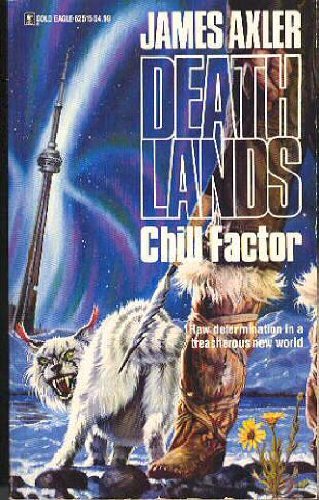
51Z1R4iI8nLIt is pleasing that I have basically infinity comics to read, because sometimes I fail to plan trips correctly and run out of book too fast. In part this is certainly due to being kind of sick and not wanting to do anything besides read, unexpectedly, but also in part this is because the Deathlands books are comic-like in their own way. Obviously, they read extremely fast, but also they are similar in that they have recurring villains and in that they lay the groundwork for future books in the current book, so the overall story tends to feel seamless instead of purely episodic.

Chill Factor sees one-eyed killing machine Ryan Cawdor off somewhere in the extreme north to rescue his son from a sulfur mine run by Russian slavers, while dodging the tender affections of a series of badly thought out but extremely lethal, er, killing machines. Like, you know, hunter-killer security droids. T-800s by way of R2-D2. Because of handwavy reasons, he’s performing this task by himself instead of with his usual crew, and while I don’t mind that, it’s certainly time for one of the other characters to get a spotlight book.

Anyway, if you like this kind of thing, the series continues to deliver. I especially appreciated, in this case, how convincing the environment was, with most everyone’s lives measured in days or weeks rather than months. Between, you know, the constant sub-zero temperatures, the radiation, and being a slave in a sulfur mine. That said, the books don’t exist digitally, so probably it’ll only ever be just me reading them.

Terminator Genisys

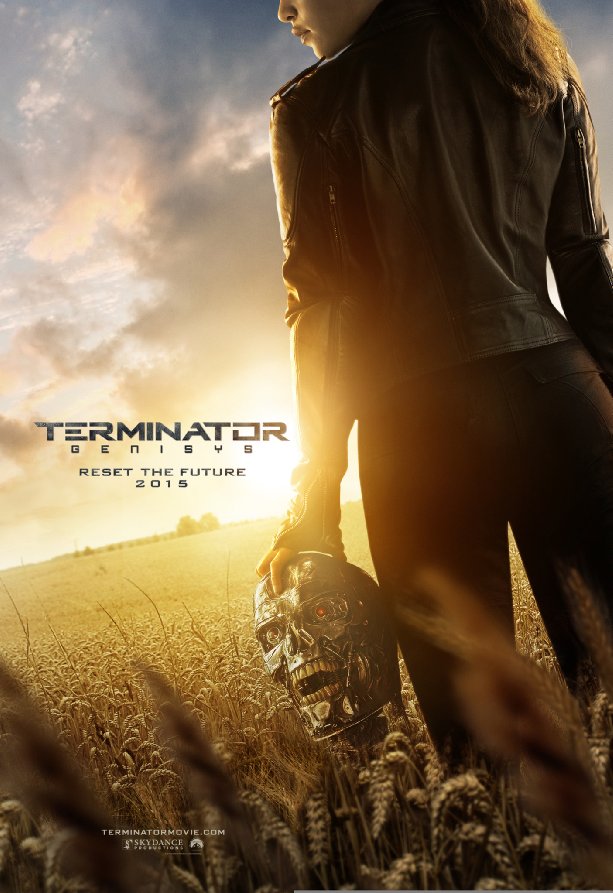
MV5BNjQyMzYxMjI2NV5BMl5BanBnXkFtZTgwODIwNjA2MzE@._V1__SX1859_SY893_Downside of watching a movie at the start of the weekend: I fall behind. Like, every time. That said, I have a possibly relevant anecdote concerning my personal viewing of the film. See, I made plans to see it with a couple of friends on Thursday afternoon. Due to some failures of brain, one of them ended up at a separate theater at the exact same showtime. We figured it out by the time the movie was over, and he said, who cares? We wouldn’t have talked during the flick anyway, so I basically feel like I did see it with you guys! And you know, that’s completely fair enough.

Except… This is a Terminator movie. After the first two films, three movies and a (tragically underrated) TV series have each been provided as sequels, and unlike the first two movies, no two of them seem to inhabit the same… man, I’m not even sure what word to use. Same timeline misses the point entirely, as none of these movies have ever been entirely in the same timeline. I’d say same universe, but since multiverse is a term of art within time travel theory, that has basically the same problem. My point is, they all feel mutually exclusive in a way that the first two films plus any one of the purported sequels do not.

So, which is the one true sequel? I would still pick the TV version, because it had time to really dig in to plot, character, and philosophy in a way that movies necessarily do not, and also because Summer Glau. (There are more reasons I could name, but these are enough.) But I don’t review TV shows, so it seems only fair to pick a best movie sequel also, and Terminator Genisys is the one. I know you’re shocked.

So, my reasons are as follows. 1) It did time travel plausibly correctly[1], which I’m pretty sure the earliest and worst of the sequels[2] did not even really manage. 2) It understood how and when to throw a curveball. 3) It still cared about predestination, which I think the second sequel[3] did not enough. 4) It for sure cared about where humanity fits into things, which the second sequel certainly did not. Nor really the first one, which was by and large soulless if I’m being honest with myself. James Cameron, famous for creating the first two films which as you can see have been at no point up for debate in this discussion, names this the first sequel he can get behind. I say, well, but did you watch the show? Then, without waiting for an answer that might make me sad, I nod and add, fair enough.

Anyway, though, my anecdote has been left hanging. Which is important, because I believe I indicated it had some partial relevance to this whole topic. Which is to say, at this point, there are so many plausible sequels to T2 that probably there are still more that I don’t know about, leaking into the timeline at various points between 1984 and 2029 (or later!), and really, there’s no way to tell which of them my friend in the wrong theater actually saw. For that matter, he may have ended up in the wrong theater because of one such attempted sequel or other. Time travel, man. It’s a bitch.

[1] Or maybe it did not? There’s definitely one huge question mark floating in front of my brain right now, but I would need to watch all three movies and diagram everything out to be certain. Scotch and other people would be involved.
[2] Terminator 3, I guess? Who can remember.
[3] Terminator Salvation

Jurassic World

MV5BMjMyNjI3ODQyNV5BMl5BanBnXkFtZTgwNDM5NTk5MjE@._V1__SX1859_SY893_Things Jurassic World had going for it, right out the gate:

Dinosaur technology is better than ever
Chris Pratt is, also, better than ever
The John Williams anthem

Things Jurassic World had working against it:

“Let’s add some kids to run around in danger a lot. That makes it family friendly! I’m sure they’ll be great at acting.”
A music person who clearly had no clue how to appropriately use the John Williams bits
The lead female character’s primary role was to gradually devolve from manager of the world’s most lucrative entertainment enterprise to girlfriend, while gradually showing more skin as indicators of key moments along the progression

Seriously, though, if I was not so annoyed by that last thing, the rest of it made a pretty good movie overall. The music part was rough, but at least they got better at it over the course of the film, and the kids were dumb, but really not any dumber than the kids in Jurassic Park. If you like dinosaurs and chase scenes, that’s enough to go by, and as a bonus most of the characters and situations were pretty well developed. But man, Claire is just a terrible character that damages the rest of the movie so much.

I mean, it was still the best Jurassic sequel by a long shot. Of course it was, did you see those?!