Tag Archives: graphic novel

Ultimate X-Men: The Most Dangerous Game

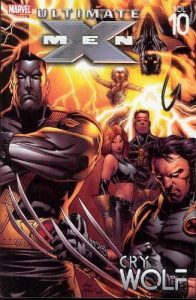
I’m having a hard time quantifying my most recent Ultimate X-Men book. On the one hand, The Most Dangerous Game is every bit of retreaded ground that its title implies. What, you say? Mutants are being hunted for sport, and that’s all dangerous to the hunters? Inconceivable! But it has things going for it, too, including a nice murder mystery and a chance to get some face time with the many new mutants that have joined Xavier’s school lately. I pretty much feel like I have a handle on all of them again, and that’s pretty cool. On the whole, it was a perfectly serviceable middle-quality storyline that would seem terrible in some of the other Ultimate series and pretty much the best thing written in the rest.[1]

Things I look forward to in the next book: the fates of several X-Men missing from this story, and also maybe for Magneto or the Sentinels or some other cool ongoing enemy to come back. ‘Cause, those dudes are sweet.

[1] That most of the remaining “series” I have in mind tended to actually only be standalone books instead is perhaps beside the point?

Lucifer: Inferno

Here’s an irony for you. Despite being the book I finished most recently (and wrapping up today’s spate of reviews, in fact), it’s the one I remember least. Not, I’m pretty sure, as a reflection on Inferno‘s quality, either. I know I was liking it as I read. Anyway, though, I can say a few things about it. The first of which is that it feels like the second half of its predecessor, The Divine Comedy. And, okay, eponymously speaking, that seems apparent. But I still find it noteworthy because of the regularity with which graphic novel editors make a point of having standalone collections, as far as an ongoing series can accomplish that. And given the thematic divisions that tend to accompany plot breaks in Gaiman’s work and its spinoff here, it’s more noteworthy still. Which I guess is a lot of time spent to say, “Huh, it’s two halves of the same basic storyline, and that doesn’t happen often,” but like I said, it is unusual for the format.

Thirdly[1], I have a fair amount of respect for the character evolution that Carey has been giving Lucifer. He’s always been an interesting and occasionally, briefly, likeable anti-hero. It would be hard to publish very many months’ worth of comics without that much to recommend the main character. But at some point that has crept up on me unawares, there was a tipping point to a process I hadn’t really perceived before the fact: he’s been gradually infusing Lucifer with a certain nobility of spirit[2] to match his uncompromising (albeit typically self-serving) sense of honor, to the point where now, any time things seem to be going pear-shaped, I’m not merely interested to see the story of how he twists things to his advantage and wins after all. No, at this point in the tale, I unexpectedly find myself genuinely disappointed at the idea that he might not win through. Sympathy for the devil, indeed.

Also? Mazikeen[3] has surprised me once again, and I think before very long at all she will be my favorite character in the series, and maybe even retroactively a very strong finisher in Sandman itself.

[1] I know what you are thinking. I respectfully disagree.
[2] See also the impressive To Reign in Hell, by the always impressive Steven Brust.
[3] Who I see I have never previously mentioned is Lucifer’s one-time right-hand woman, and more recently (as the newly-appointed leader of her people) one of his many grasping adversaries. Though of course it’s more nuanced than that.
Ultimate Marvel Team-Up, Volume 3

This third volume marks the last of the Ultimate Marvel Team-Ups, and I cannot say I’m sorry to see them go. For every reasonably good story, such as Spidey’s encounters with the woefully underused Ultimate Black Widow or the Chinese storybook account of his meeting with an ultimate (as opposed to Ultimate) fighting guy (Shang-Li, or something, who I guess was relevant in mainstream Marvel continuity at some point, that point probably falling in the 1970s?), there’s a kind of terrible story about him running into Blade (Blade, for fuck’s sake!) and Elektra and the old-people version of the Fantastic Four[1] and a particularly bitchy Daredevil, all for no apparent reason. Yet even here, there are moments of good writing, such as when he has a conversation with Johnny Storm about power and responsibility as related to stable living, or when he gives a class speech about his research into a hero. The last bit, in fact, rose above every attempt by writer and artist alike to be cloying and overwrought, and I have to give mad props to the soul of the story for managing that in the face of such strong opposition from its creators.

Which I guess is my point in a nutshell. It really has been a very rarely bad series, but I’m so used to unadulterated brilliance from the majority of the Marvel Ultimate universe that something merely okay but with moments that shine still feels like too much work. So, I’m glad it’s over because I’d continue to go looking for those moments, and now I won’t have to anymore, secure in the knowledge that I’ll have them dropped in my lap by ongoing future titles instead, where the rhythm has already been perfected. (These three books were among the earliest written in the Ultimate continuity, in case you were not previously aware.)

Oh, and I’m also glad it’s over because the art kept changing, sometimes in the middle of the same story, and as annoying as that sounds, I also almost never liked any of that art. Would stable and bad have been better or worse than fluctuating and bad? This is a question I hope never to consider again.

[1] Who have since been replaced-or-retconned in Ultimate continuity, as you will no doubt be aware from my review earlier this morning, and from the nine previous ones.

Ultimate Fantastic Four: Ghosts

It’s been almost a week and an unfortunately high number of other books since I read Ghosts, but I can certainly say that I liked it. The Cosmic Cube storyline that started all the way back in God War finally comes to a head, and in such a way as to make me like that book a little better than I did at the time[1]. Basically, big bad guy Thanatos shows up to swipe the Cosmic Cube he tricked Reed Richards into making for him, which has consumed Reed’s attention for so long that all of his relationships are falling by the wayside. And as if a godlike dude with complete control over death being given a device chock-full of cosmic powers[2] isn’t enough to worry about, two threats from the communist past are also hanging around to make life tricky for our overwhelmed heroes. So, if you’ve been missing the Crimson Dynamo from your admittedly non-existent Ultimate Iron Man series[4] or the Red Ghost (who you may recall controls hyper-intelligent animals and is also sort of a ghost) from this series, Carey has got you covered! Meanwhile, brief spoilers below the break. Continue reading

X-Men Origins: Wolverine

Summer arrived at last. Technically, it arrived in the form of a horrendous downpour that was among the worst I’ve experienced from the driver’s seat. But the important thing is, I and my companions got to the theater in time, so none of that matters. What does matter is having seen the Wolverine movie, and having it work pretty well. Explosions: check. Pathos: check. A few new mutants, both familiar (to me, that is) and un-: check. Matches current movie series continuity: check. Matches current Marvel continuity: well, okay, that part not so much, although it could be that it matches some Ultimate continuity I have not yet exposed. However, I do not care that it didn’t, because all the other parts were done pretty well.

In the end, it was a nice little summer comic book movie, better than some that have been released over the past decade; and I have no driving need for more. Though if they want to give me a simultaneously hysterical and horrific riff on the Superman origin story while they’re at it, I am willing to laugh and cringe appropriately, and with a song in my heart. Well, y’know, sort of. Maybe less so during the cringe?

Ex Machina: Power Down

Even though Power Down had been published for more than a year by the time I read and reviewed Smoke, Smoke, it feels as though the creative team saw my pacing and thematic concerns and leapt to address them. Which is not to say that the latest Ex Machina suddenly revealed all kinds of backstory thusfar unbeknownst even to Mayor Mitchell Hundred about how he acquired his power over all things mechanical. The story has only just reached its midpoint, after all. But with new rumors of the (still potentially alien) forces behind Hundred’s powers, not to mention transdimensional Communism, it’s pretty clear that the writers have finally and explicitly acknowledged there’s a lot more going on here than simple politics with a superheroic twist. And all this fails to even address the continued interior sabotage of Hundred’s political career, or the sinister truth behind New York’s 2003 blackout and its effect on The Great Machine. So, don’t give up just yet!

Ultimate Spider-Man: Hollywood

I’m officially a broken record. All the same, the Ultimate Spider-Man series continues to impress. You really wouldn’t think that another fight with Doctor Octopus would be all that much of a much, but where Hollywood shines is in all the gaps and cracks getting filled in with juicy, delicious plot. And also, in this case, heaping doses of meta-humor. Because, you see, there’s a certain movie about a certain urban superhero, filmed by a certain Sam Raimi and starring a certain Tobey Maguire. And it’s being filmed in Manhattan without the permission of or payments to a certain Peter Parker.[1] As if that (and let us not forget Doc Ock) wasn’t enough, longtime Parker houseguest Gwen Stacy reaches a critical turning point!

[1] I think that said movie, in reality, was one of the inspiring forces behind the Ultimate universe reboot of Marveldom in the first place. Which takes the metaness to a whole new level.

Ultimate X-Men: Cry Wolf

I am really ambivalent about my latest X-Men, Cry Wolf. On the one hand, it was a good story that hung together well and shifted around several of the character elements in new ways, such that I am looking forward to what comes next. Also, unlike the last time he showed up, Gambit got a proper introduction and seemed like a real person. Which is good, because he’s apparently a favorite, but I don’t really know of him from anywhere but these books.
But on the other hand, too many of the events seemed forced for the sake of hitting key plot points from the original run. It’s all good and well for there to be a triangle between Bobby Drake and Kitty Pryde and Rogue, but build it up a little bit, yeah? I’ll care more if it doesn’t seem to be performed by rote. I’m willing to reserve judgment on the Fenris Corporation, as I assume they’ll be relevant later and this wasn’t just a whirlwind but ultimately pointless mention.

(I’m not leaving out the actual plot on purpose, it’s just that it was a hanger for the character interactions and changes, and thus seems less important than the other stuff I talked about.)

Hack/Slash: Friday the 31st

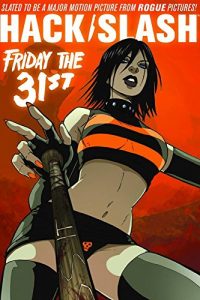
I’m not sure yet, and I’ve been… well, “burned” is a little strong, but I’ve been bitten by this before. Anyway, although I’m not sure yet, it looks like Friday the 31st marks the Hack/Slash series’ evolution from a novelty into something pretty damn cool. The character development that has always been its strongest suit (well, aside from the art) has been supplemented, in the form of people that slasher-slaughtering hottie Cassie Hack and her hulking companion Vlad have saved over the past couple of books, who are now banding together and offering to help out with finding new problems to solve and people to save.[1]

And at some point, I guess the series got picked up by a publisher, because after a normal one-shot (though, also as usual, continuity-influencing) issue co-starring Chucky[2], the book collects the first two storylines / four issues of the monthly Hack/Slash comic run, still apparently ongoing. The first storyline serves as a reintroduction to the characters and premise for people who might not have been aware of the haphazard schedule[3] under which all the one-offs were printed, and the second features a Cthulhian death metal band and more virgins than you can shake a stick at. And since there are at least two more books yet to go, I’m certainly looking forward to what they throw at me next. I mean, in several months when I read volume 4. Not literally next.

[1] And helping out with any unexpected costs or emergencies that might crop up. If the first such emergency and offered assistance is any indicator, I’m going to like the new Scoobies. Both directly and thematically.
[2] Yes, the evil doll.
[3] And probable spotty availability; though in both cases, I am purely speculating here.

Ultimate Spider-Man: Ultimate Six

So, a kind of a funny thing happened. I completely forgot to read this book. I had it in queue, and I guess it was in the back seat of my car or something, and I was so far behind on reviews anyway, and somehow I convinced myself I’d already read it. It could be that a new Walking Dead contributed to my misapprehension on this matter as well? I just realized, suddenly, that there was no review, and then while looking at the book with the intention of loaning it out to my friend Emily (who you will no doubt recall as the violently abused daughter in The Last House on the Left), it hit me that, hey, you did not at all read this. Both matters: rectified!

You would think, having finally caught up to the book I most recently finished, I would have it in me to do more than gush. There’s just something about Brian Michael Bendis writing Ultimate Spider-Man that leaves me incoherent with glee, apparently. I’d like to mind, but if that’s what it takes to get work this consistently amazing and this consistently able to top itself, then I’m not going to quibble overmuch. Ultimate Six re-envisions the first really big Spider-Man event of the original Marvel era, in which six of Spider-Man’s past foes team up to accomplish what none of them could individually: Spider-Man’s annihilation.

Of course, when I say “re-envisions”, what I mean is, “takes the kernel of an idea and demonstrates that, no matter how good Marvel really was in the ’60s, it has the ability to blow that out of the water in the modern era”. Four of Peter Parker’s previous foes, including the Green Goblin and the Sandman as a newly added fifth in a flashback sequence from a few months ago, are under S.H.I.E.L.D. imprisonment for illegal genetic modifications. The consequences of this unfortunate collection of villainy in one holding area are many and varied, ranging from the airing of Nick Fury’s significantly dirty laundry[1], to Peter’s identity being revealed to a significant portion of the Ultimate universe, to the likely psychological collapse of his once-friend Harry Osborn. And even these pale in comparison to what will happen if the Ultimates[2] cannot prevent the team of five (and their newest sixth recruit) from fulfilling their plan to strike at the very heart of the government.

[1] I like that I can trust this event will have future consequences to the continuity.
[2] For timeline purists, the Ultimate Six storyline (which was apparently independent of the Ultimate Spider-Man run, though I like that it was collected here) falls between Ultimates and Ultimates II.