I have a tendency to regularly troll a number of area Half-Price Books, looking for ever more cheap, used copies of the huge stack of Ultimate Marvel comics that I read. I end up seeing a number of other titles as a result, and grab the odd one now and again. Today’s such find, Lost & Found, was an extremely short Buffy-themed comic set more or less as an episode in Angel’s final season. In a sequel to the Gem of Amarra sequence, Spike and Angel go looking for yet another vampire that seems to be able to survive the sunlight. It’s not a bad little story, short though it be. It tries and (I think) fails to provide much in the way of character development for Spike or Angel, but if it had been the main arc of an actual episode in the show, I would have liked watching it. To be perfectly clear, it very much needed a secondary arc to have felt fully formed, though.
Tag Archives: graphic novel
Ultimate X-Men: Magnetic North
Historically, I’ve been down on the Ultimate X-Men titles as compared to the other ongoing series. I know there was a point, several books ago, when I changed that opinion. Magnetic North marks another such shift, as this is simply one of the best Marvel Ultimate titles I’ve read, period. Almost every minor and major event in the past several books is pulled together into one web of intrigue, surrounding the escape of Magneto. It is both too complex and too good a story to get into in more detail than that, and in all honesty, I think the title and the cover[1] revealed as much as I already have anyway. It has a cinematic plot, with almost as many story and character twists as there are pages to turn. I just cannot stop being excited over these books!, and more the further into them I get.
[1] at least, the cover of my copy, which does not match the one Amazon shows.
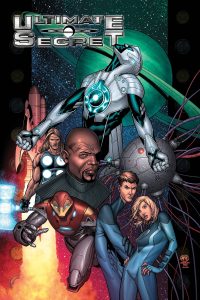
Ultimate Secret
Ultimate Secret continues the Ultimate Galactus trilogy in much the same fashion as the opening volume. That is, it tells a reasonably good story whose main flaw is feeling entirely too short. I mean, most of the Ultimate books have felt like discrete storylines in the lives of our heroes. The Galactus books, on the other hand, have felt very much like part of an (extremely incomplete) ongoing story. It is not particularly a flaw, except that it makes it hard to feel much excitement for the review; it’s as though I’m reviewing thirds of a book, instead of three books.
Another way it matches the first volume is that it uses the Galactus story to talk about other characters entirely that had not yet been drafted into the Ultimate universe.[1] In this case, the fight is against the alien Kree who are sabotaging mankind’s space program, in the hopes that when Gah Lak Tus arrives, the planet will have no survivors. The story was decent, it just wasn’t what I was looking for. Again. I’m really relieved this is only a trilogy, as I’m not sure I could take much more pushing back the payoff.
Except for the lack of character continuity, what this has most reminded me of is the old G.I. Joe event weeks when they’d present a five-part series in which Cobra and G.I. Joe were crossing the world in search of parts for a doomsday machine, and inevitably Cobra would manage to get all the parts, fire up the machine, and then lose anyway. The continuity meant that each episode had a series payoff feel, unlike these books, but there’s still definitely a race across the world in search of clues feel. (Does anyone but me remember those episodes fondly? I mean, clearly there’s a movie studio that hopes so.)
[1] Captain Marvel? Really?
Ultimate Spider-Man: Superstars
I have to admit this, right up front. Superstars tricked me. Despite the disclaimer around the initial two-issue arc that the writer knew full well it was over the top and not to be taken seriously, when I saw Peter Parker and Wolverine in the middle of a Freaky Friday knockoff, I rolled my eyes hard and internally kvetched about how this kind of thing is exactly why the Ultimate Marvel Team-Up series was mostly flawed, despite its quality moments.
But, okay, there were the disclaimers. But after that, the additional two arcs featuring first the Human Torch and then Doctor Strange meant more bad times, yeah? In fact, no! Instead, the first story introduces the canonical Ultimate Fantastic Four into crossover territory and gives Peter a chance to recover from the emotional wounds inflicted in Carnage. And the second story, well… I don’t like to say more because of spoilers, but it is a Spider-Man book, so you can probably guess.
The shorter version of all this is, you can still trust Brian Michael Bendis to write some of the best comic on the market. Even his fluff-piece breaks are still entertaining and verging on excellent in their own rights.
Ultimate X-Men: Hard Lessons
The one thing that sticks out to me about my most recent X-Men book, Hard Lessons, is that there really weren’t any. There were several bridge stories placed to catch us up on characters that haven’t been around lately and to remind us about bad guys that will probably pop up again soon, but lessons? Nothing apparent to me! This doesn’t bother me all that much, but it is a little weird.
Instead of lessons, there are these stories. What’s up with Professor Charles Xavier? He’s maybe out of money courtesy of old enemies, and he’s also held hostage at a bank. And he’s a devious son of a bitch, which is one of those things I like about the Ultimate line. Yay, layers and shades of grey![1] What’s up with Storm and Wolverine? The one is looking for (and, okay, has just found) the other, and their pasts are about to team up to bite them both in the ass. What’s up with Rogue and Gambit? They’re about to face the return of Juggernaut, who, um, I kind of forgot had been in a previous book? Anyhow, all three stories produce incremental plot shifts that indicate to me big things are on the horizon, even if I can’t get the shape of anything but their inevitability. Which in some books might be an annoying delaying tactic; but in the hands of Brian K. Vaughan the stories are every bit as good as the future glimpses are.
[1] Well, deeper layers and more shades of grey than at least Marvel in the 1960s. I could be underselling later and modern Marvel due to ignorance, and I clearly was underselling the early Marvel catalog, which itself had a lot of depth. Especially for the time.
The Naked City
What I find most interesting about the Tick, at least as an artistic endeavor, is that he has evolved in much the same way as The Hitchhiker’s Guide to the Galaxy. There are all these different version of the same basic story, told and retold while, one supposes, the creator keeps trying to perfect things. The very first version of the Tick was presented in comics, and in this case in the graphic novelization of those comics, The Naked City. (Although, since it’s colorized, I’m still not technically reading the very originalest version of the story.)
But who, you ask, is the Tick? He’s a superhero parody, is the short version. He’s a moderately insane, somewhat simple-minded, bumbling, incredibly strong and nigh invulnerable guy in a skin-tight blue outfit, with inexplicable antennae, who has appointed himself as guardian of The City. That “guardianship” basically means that he leaps around rooftops, causing an alarming amount of structural damage and looking for evil to fight. Despite himself, he usually finds it.
Populated with a boatload of ninjas and somewhat amateurishly literal parodies of Superman, Elektra and Kingpin, it’s pretty easy to tell this is the beginning of the story. The good news is that the absurdist humor is already reasonably solid, and by the last issue Edlund is starting to find his own more thematic-parody voice. I should find me the rest of the comic’s run. And the animated series. And probably the live action one? I wonder if there’s other stuff I’m not aware of. Perhaps a commemorative Tick silverware set?
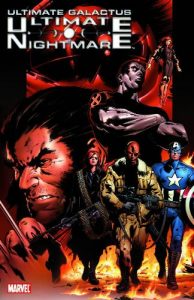
Ultimate Nightmare
With my first foray into an Ultimate universe crossover series, I find myself wishing for the first time that I was reading these approximately as they come out instead of all jumbled together and out of order. One of the first thing I noticed about the Ultimate Galactus trilogy (or at least about its first volume) is that several of the characters have evolved well past who they were when these books were written. Specifically, both Wolverine and Nick Fury’s reactions to the X-Men seemed entirely uncharacteristic with my current expectations. But, on the bright side, I continue to make good progress and will eventually catch up.
The aptly named Ultimate Nightmare chronicles an unexpected worldwide multi-spectrum signal being broadcast from Tunguska, site of a century-old meteor strike that has been science fiction fodder ever since. Among the reactants to the images of an alien culture being destroyed while a mysterious voice repeats certain doom over and over are select members of the X-Men and of the Ultimates[1]. For the most part, the meat of the story purportedly being told lies in the future. This book was largely an excuse to visualize several bit character villains from Marvel’s past, in the guise of decades of Soviet experimentation. Luckily, as in the case of footnote 1, the book was more than entertaining enough to support being a mere prelude to the Galactus story I have been implicitly promised.
[1] Including a character named Sam Wilson with whom I am wholly unfamiliar; pleasingly, he was interesting to read about.
Ultimate Fantastic Four: Salem’s Seven
I’m not sure if it happens more often in some titles than others, nor whether I am noticing more often than I used to, but it’s definitely the case that some Ultimate storylines revolve around bringing back and/or reinventing heroes and villains from the original Marvel run. Sometimes this is fine, because it’s someone I want to see, and other times it’s iffy, because it’s someone I never have seen, but there’s an implication I should know all about them and resultingly a little bit too much character background is left out. Salem’s Seven was one of the best outcomes, however, wherein I’d never heard of them before, and yet the story they were brought into was entirely engrossing and entertaining.
There’s not much to tell plotwise that wouldn’t drift into spoiler territory, but this reminded me a lot of old school Fantastic Four, wherein all kinds of plot elements were thrown together just to see what would happen. You’ve got our heroes and their interpersonal issues, you’ve got a ridiculously sexy S.H.I.E.L.D. psychologist on a mission to determine the viability of the Baxter Building and its many projects, you’ve got a new batch of superheroes out of, implausibly, Salem, Oregon, you’ve got the return of Namor, and you’ve got yet another world-ending threat. This is what the Fantastic Four is (are?) all about, yo.
Fables: The Mean Seasons
In the wake of the Battle of Fabletown, the winds of change are blowing. The exiled Fables finally have prisoners who might reveal information as to the disposition of their long-abandoned homelands, not least of which would be the identity of their Adversary. Despite the seeming upswing in fortune, though, it’s really more of an ill wind as blows nobody any good. Political discord, births, deaths, clandestine spywork, and ultimately the scattering and separation of our long-time heroes, all blows on this wind. No wonder the book was named The Mean Seasons!
Although the book seemed to be rushing along on those winds, blowing a year past in almost the blink of an eye, there were several points of interest along the way. Demonstrations of just how capable of a leader that Bigby Wolf and Snow White each have really been are scattered throughout; particularly, Bigby’s prowess as a manager and spymaster are laid bare. Meanwhile, Snow stumbles onto an unfortunate murder mystery, and there’s a completely gratuitous WWII story thrown in. By and large, it’s a good book that suffers only by letting the ongoing plot simmer instead of boil. I’m still looking very much forward to whatever comes next.
Utimate Spider-Man: Carnage
Carnage is yet another book I am not sure how to adequately address. Not, this time, because I have mixed feelings about it. Rather, because there are huge turning point spoilers. I can’t say I know how long the consequences will ripple forward[1],but this felt like the single largest event since Peter first came to terms with his powers, or at the very least since the Ultimate Six storyline (but really that one was/will be more of a delayed reaction consequence thing, without the sense of immediacy shown here). Anyway, the story starts off with genetic engineering master-minded by Peter’s very first reformed enemy, Dr. Curt Connors aka Lizard Man[2], and ends up with the Spidey suit having been put away… for good?
Okay, probably not, but I think I like the idea of that part sticking around for a while. Brief spoiler discussion fodder below the footnotes.
[1] There’s an Amazon review (which you should avoid reading by all costs, as they are less good about spoilers than I) that implies the consequences are few if any. I’m not sure I can bring myself to believe it, though, since the series has stood out so high above the pack to date. I’ll let you know, though!
[2] Lizardman wins![3]
[3] I mean, spoiler alert, Lizard Man isn’t even in this book. I’m talking about something else. Continue reading