Tag Archives: superheroes

Black Panther: The Bride

Things I do not do, a partial list:

1) Kick puppies, whether they deserve it or not.
2) Drive on the left side of the road.
3) Keep track of modern Marvel comics. (Well, or particularly the old ones, for that matter.)
4) Mine for diamonds in Siberia.

None of which would be relevant except that a co-worker happened to hand me a collection of Black Panther comics from last year in which the eponymous character goes off in search of a wife to be the queen of his kingdom in Africa. Despite hints of a super-powered bachelorette auction on the cover, apparently the Black Panther has had someone in mind the whole time: Storm, that one chick in the X-Men who controls the weather. (Apparently, she’s also their leader now? Not a big surprise that she might be without me knowing, since the most recent X-Men comic I’ve read was from 1968, well before the whole universe was reset a few years back. Hmmm. Maybe I do keep track of modern Marvel comics? Except, really, I don’t. I know people who feel obligated to keep me up, though. I’m not really sure why or anything, but I don’t mind.)

Anyway, it’s a pretty soap opera story. First they have the thing where they decide if they even like each other (apparently they have history that predates their herodom), then they have the shopping and parties and make-outs, then there’s a wedding. It all seems like an excuse to draw pictures of pretty people doing wedding things while random villains posture ridiculously and the Civil War storyline bubbles over from time to time. (Apparently, there’s a civil war between the superheroes, where some of them think they should all be registered with the US government for public safety and some of think they have a right to privacy. I guess Captain America got killed over it? Seems very involved.)

Things I have learned: comics are better when not taken in the middle, as it is easier to have an investment in the characters; super-villain-y declarations of their dramatic name and why they are not to be taken lightly because they’re so evil and effective worked a whole lot better in the 60s where it seems campy than today, where it just seems like they’re literally brain-damaged; that civil war storyline might be interesting, except that modern (and let’s be honest, historical) superhero comics are so convoluted and intertwined and downright incestuous that nobody could ever start at any arbitrarily defined ‘now’ moment and have a hope of catching up; and female superheros with average-sized breasts do not occur in nature. Well, okay, I already knew that last thing.
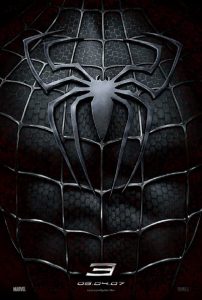
Spider-Man 3

Well, it’s summer now. There is an extent to which I feel like summer comes too soon, since there are no longer any good movies left by August. Nevertheless, I can only observe the status of these things, not correct them. I am like a groundhog for movies! (Except my job’s easier; summer never doesn’t come.) My point, of course, is this: midnight showing of Spider-Man 3, from which I am still reeling. I mean, I’m not talking about the movie yet; it’s just, I got five hours of sleep the night before due to seeing a musical on stage, and then I got something like four hours last night, but (and here’s the secret to making it extra awesome!) split into two parts. So if I’m incoherent, a) pretend like this is unusual and then b) blame it on my non-functioning brain.[2]
Let’s get the easy part out of the way. It was good. I regret the lack of sleep only on an intellectual level, and I’m quite sure I’ll go see it again. I might not do so without the IMAX draw, but only because of how little time I have relative to the number of movies I want to see right now. So, yeah, good. Probably won’t be the best movie of the summer, though. People[1] will tell you it was bloated both in time and number of plots. I don’t agree with that, because each and every one of the plots was personal to Peter Parker. Maybe they didn’t need to all occur at once, but neither were they arbitrary, and it all hung together as far as I could tell. Also, the action lived up to the previous movies.

Plus, plenty of meaty themes to sink your teeth into. For example: Good or evil isn’t who you are, it’s what you do. I can find shades of that in every single major male character. The part where the females are pretty much uni-dimensional cardboard is probably a trope of the genre, but it’s unfortunate nevertheless. They stand out only because of the comparison, though. Also present, and painful to watch, is the pride goeth before a fall theme. Because you can pretty well see each part of it coming, and Peter so obviously can’t, and you just want to grab him and shake him and explain how easy it would be to dodge most of this. Except he’s still a kid, and kids are supposed to make mistakes, and I’m not even sure grown-up Spider-Man would be of any interest. Anyway, I think it’s fair to say that it’s also as deep as the previous movies.

So why won’t it be the best movie this summer? Because it has a couple of stumbles and one major failure. For one thing, there’s an extraneous character; for the amount that Gwen Stacey added to the plot, she either should have had more to do or had her purposes rolled into Betty Brant and the character saved for use in a future sequel. For another, there’s a scene with a butler late in the movie (don’t worry; he didn’t do it) that was a clumsy plot bridge and terribly acted by said butler. The former is the more egregious crime, of course, but the latter made the former stand out in stark relief. But the big failure was the lack of an iconic moment. You have the New Yorkers on the bridge in the first movie, and Spidey on the train in the second one; you can’t make the conclusion of the trilogy be great without exceeding or at least matching one of these. And it just… didn’t. As much as I liked the movie, I’m not going to end up loving it, and that’s the only good reason why not.

[1] and by people, I mean critics; apparently I am one of those, now? Or maybe it requires a paycheck. I have yet to receive a penny, much less break even on domain registration, though, so I don’t count as that. And if I was paying for the hosting, it would be even worse.
[2] Also, I can kill you with my brain.[3]
[3] For reasons of my own!

Ghost Rider

And now I will demonstrate the usefulness of lowered expectations. Going into Ghost Rider, I expected a big pile of badness surrounding some enjoyable special effects. The special effects were, as predicted, pretty enjoyable. Of course, the fact that they can be in a February movie says more about the current state of the art than it does about the care taken on this particular project. But my sense of wonder has not yet faded on this axis, so I’ll let that part slip by unnoted. Then there’s the plot and the acting.

Acting first, as it’s easier. The scenery-chewing characters chewed scenery appropriately. (The Devil, the animatronic actual Ghost Rider, the bad guy, etc.) Sam Elliot made the best of his restrictive archetypal role. Eva Mendes made the best of her role as Bringer of the Cleavage. And Nicolas Cage played per usual. Any time he tried to be funny or dramatic, I was forced to cringe. Any time he tried to be soulful, he was fine. Best of all, though, any time he didn’t really try to be anything, he was pretty good. Especially with deadpan humor, possibly because he wasn’t told it would be funny? I really don’t get how he can be so hit or miss, but he definitely had some amount of hit on this one, which helped a lot.

And then there’s the plot. Well, really, the two plots. They’re inextricably tied together, but still pretty distinct despite that. On one hand, you have the origin story. Why did Johnny Blaze decide that jumping motorcycles over things wasn’t enough to get out of life, that he had to melt off his flesh and go all flamey and collect evil souls? How did he get that awesome chain whip? How has it affected his romantic life? Will the cops disapprove? And so forth. This part was pretty good, more engaging than any of the other February Marvel releases I can remember. And on the other hand, you have the story of the Ghost Rider vs. some demons. This was choppy and boring, and the payoff at the climax was too little, too late.

I wish I was in junior high or something right now, because ‘Ghost Rider: A Study in Contrasts’ would make an excellently pompous title.

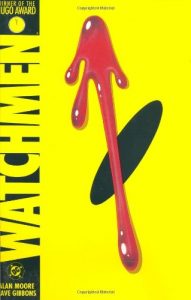
Watchmen

And so I continue through my list of genre greats. I avoided reviews of stuff while I was reading these, because I’ve mostly been able to not spoil myself on any given comic up to now, and it would be pretty awesome to not do so now that I’m actually reading lots of them. But I’m pretty sure that any random review of Alan Moore’s Watchmen will tell you that it’s a seminal masterpiece, or a watershed moment for the genre, or some other such reviewer-speak for ‘I liked it; now, you must also like it’. So, I’m going to cut to the chase: I liked it. I am enlightened enough to know that my tastes are not universal, for some inexplicable reason, so I will not proceed to tell you must also like it. But you probably will.
Now is where a weekend of debauchery is causing me to struggle to remember what kinds of things I can say about it. In short, it’s an alternate history where the comic book heroes of the late 1930s caused real people to start donning masks and outfits and engaging in enlightened vigilantism. Which was all well and good until the second generation of costumed heroes in the 1960s changed the world in drastic ways; by 1977, nearly all of them had been outlawed. Now, in 1985, the world hovers on the brink of catastrophe and, as ever, only the heroes can save the day. The problem being, most have retired; one still operates due to his uncompromising moral code, despite being more wanted by the law than most of the criminals he continues to take down. And of the two who are still government-sanctioned, one has just been murdered. The most important question being, was it random, or was it part of a far-reaching plot to neutralize any and all of the heroes who might yet be willing to step in and stop the clock before proverbial midnight?

Okay, I’m forced to admit that wasn’t short. And yet I’ve barely scratched the surface. That’s because the book is about almost everything: the relationships among heroes, of course, and between heroes and the public they serve or menace (depending upon who you ask); from where power most justly derives, and to where (“Who watches the watchmen?”); whether governments or lone vigilantes, either one, can justly use the power they have rightly or wrongly acquired; and whether it is permissible to sacrifice the few to save the many, at both the macro and micro level. Less thematically, it’s about how close to the brink of nuclear war we really were in the 1980s, and about noble last charges, and about allegorical pirates. In the words of a certain pirate in the current popular consciousness that, when taken allegorically themselves, very nearly fit: “You’re off the map. Here there be dragons.” And as much as I really approve of maps, the most interesting things happen when off them.

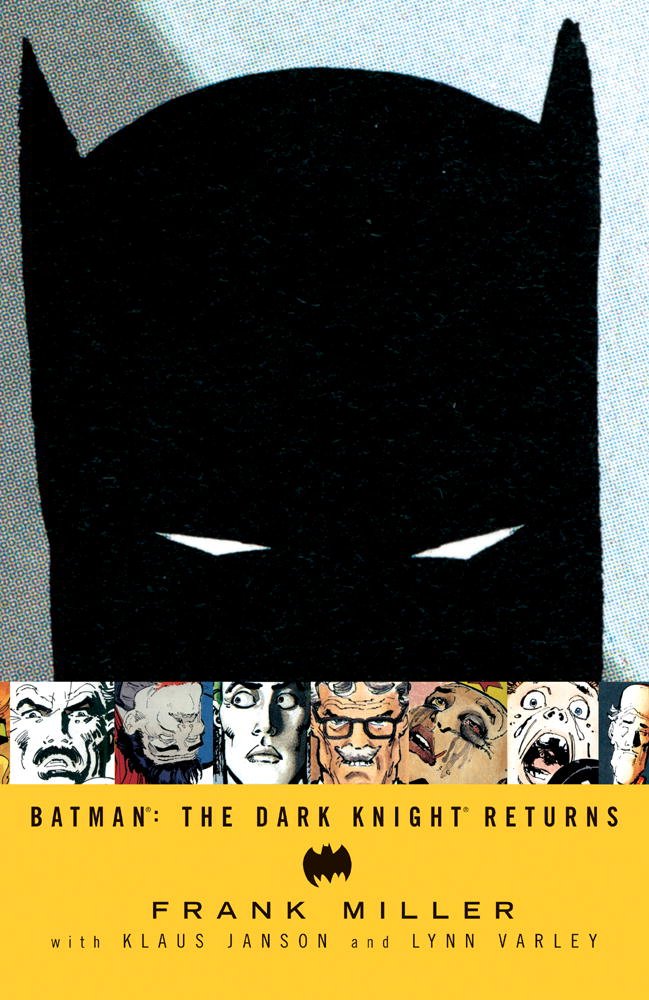
Batman: The Dark Knight Returns

61H8BOtqAbLThrough chronological coincidence, my next comic entry is an excellent choice to follow the previous one. Having seen where the Batman got his start, The Dark Knight Returns gives me a chance to see where he ended up. And where he ended up isn’t pretty.

One Robin, Boy Wonder has left him and a second has died in his arms. He has been retired for ten years, due to a nebulous agreement that retired or co-opted the other superheroes at the same time (save for Superman, who is now employed by the US Government). Gotham is overrun with crime, filled with gangs of teenagers who own the streets and can make and carry out threats at will. Commissioner Gordon is facing mandatory retirement, and among most of the talking heads on TV, the rehabilitation into society of such criminal masterminds as Two-Face and the Joker are cause for celebration at the success of the system rather than horror and fear at its failure.

Whether because of the declining morality of the youth population, because of guilt over his involvement in Harvey Dent’s (that is, Two-Face’s) inability to cope with his freedom and subsequent return to villainhood, or simply because he doesn’t feel like an entire man without the Bat, the re-costumed Bruce Wayne hits this socio-political climate like a thunderbolt, taking on the gangs, old enemies and old friends alike, condemned by cartoonish liberals for what he is doing to criminals and by cartoonish conservatives for what he is doing to law and order, and joined at an opportune moment by a new Robin. It’s a very raw take on an old man’s unstoppable crusade against everyone who brings society down instead of building it up.

Being raw, though, it does have its flaws. The stories are held together by the world around them, but seem pretty episodic in nature on their own. The art, while excellently frenetic, occasionally lends itself to being difficult to follow. It’s hard to really like any of the characters on a consistent basis (with the exceptions of Gordon and Robin). But flawed or not, it has the power of its rawness, and I’m not a bit surprised that the Batman mythos since this work has owed far more to it than to anything that came before, outside of those initial episodes that first set the character down on cheap pulp. (And which, frankly, were a lot like Frank Miller’s vision in this book. It’s much easier to imagine a straight line between the two graphic novels I’ve read that doesn’t go through Adam West than one that does.)

Also: as you’d probably expect, the Joker (newly revived from catatonia at the news that he once more has a nemesis worth committing senseless murder for) steals every scene he’s in, whether it be praising the media for being his own personal fan club, highlighting all of his criminal activity on the evening news so he doesn’t need to keep track of it himself or whether offhandedly promising to kill everyone within sight of his face and being laughed at for, well, joking (he was not, of course). It’s easy to make an argument that the Batman needs a Joker, an enemy that the forces of law cannot hope to cope with, that justifies his vigilantism. This story makes the far more compelling argument that the Joker needs a Batman; because, if there’s no chance of failure, is there really a point in proceeding on the basis of sociopathy alone?

[Late-breaking full disclosure: I actually read this in the Absolute format, but it contained two books, of which I still in 2015 have not read the second one. So it’s hard to produce a link and image for only half of a book, much less one that is by now long out of print.]

Batman: The Dark Knight – Archives, Volume 1

After the extensive silliness of the archival Superman collection, I was a little trepidacious at the idea of the cracking open the initial Batman collection from the same people. (Well, okay, the people are DC, so that’s kind of a dumb way to put it, I guess.) But for lack of a better system I’m reading them chronologically, and that one was next. Therefore, in I plunged.

I’m pleased to report that this was a much stronger entry off the bat. (Er. Sorry.) I found that I kind of missed the full magazine approach that the other one used; no text stories amid the comics and no X-ray glasses or Batman fan-club order forms for me. I think as much as the nostalgia factor, I missed them because it left me less certain that I was actually reading all of the first few Batman adventures. (It didn’t help that one episode referenced a previous encounter between our hero and the villain in question. I have no idea if it was an in media res device or an actual backward reference to a missing story.) And in one unfortunate occurrence, Batman stole a story directly from the Superman of the same period: a football player is kidnapped, so Bruce Wayne uses his make-up and disguise talents (which are, admittedly, a lot more palatable than contemplating Clark Kent’s, whose best disguise consists of a pair of unlensed frames) to render himself identical to the missing player and win the big game. That’s, uh, heroic.

But like I said, on the whole it was a much stronger book. For one thing, it had iconic villains from the earliest stories. While Superman is off fighting interchangeable industrialists bent on raping the middle class and poor countries around the world, Batman is fighting the Joker or Catwoman. Definite advantage here. I have to think the smaller scope in general is part of what makes him a better superhero for the ages. He can be hurt, he can face real setbacks, he has enemies that can make realistic plans to take him out of commission.

And, he has a sidekick that… well, okay, Robin bugs me a little bit, in that he seems to be as effective at sixteen as the full-grown man he’s working with, despite the latter’s drive to avenge his parents and past. (As I understand it, Robin has an equally grim past, but it was never delved into in this volume.) Plus, he’s always grinning widely. Artistic decision, sure, but it also bugged me a little. I guess it’s part of the propaganda portion. He doesn’t really have a character of his own besides ‘generically happy’. He is clearly there for no better reason than to stand in for the teenage boy reader, which isn’t so bad by itself, but then he’s constantly used in that role to teach moral lessons. And I know that’s probably more good than bad, but I’m here for the plots and the characterizations, and I’m simply not going to like it when things get in the way of that. So, less Robin, more Batman, please.

Anyhow, that was as minor of a concern as the football adventure, really. The point is, Batman is dark but likeable, easy to identify with, has excellent opposition, and is just downright fun. Plus, he seems more averse to leaving a trail of corpses behind him, which it took the (seemingly more moral) Superman a little while to accomplish. The misogyny, though, that’s still there. Sure, he keeps saving Catwoman from other villains and now and again from the law simply because he thinks he can get in there, someday. (And watching Robin be confused over that hidden motive was worth his character being present at all.) But that’s the kind of misogyny that I’d think a girl could get behind, if it means she gets away with thousands of dollars worth of jewels every so often.

It’s the other kind that made the book for me, based on the shocked giggles it provided. (I know it’s a double standard, but since it happened 65 years ago and is so, well, cartoonish on top of that, it just doesn’t feel real; as I know it couldn’t happen now, I permit myself some obviously morally defective enjoyment out of it.) I will now describe a single panel of the book, from Batman’s first encounter with the Cat. Awful, I know. But also kind of awesome? You be the judge.

He has just removed the old lady wig, revealing Scooby Doo-style that she’s the villain. Now, he is forcibly wiping the old lady makeup from her face. She cries out, ‘Let go of me!’ His response: ‘Quiet or Papa spank!’

X-Men: The Last Stand

So a few years ago, they made an X-Men movie. Despite having played an X-Men video game for the NES in the 80s, I really knew nothing about them except that Nightcrawler was fun to play in that game and Wolverine was supposed to be pretty cool. Comics and me have never really gotten along to the extent that I would expect them to, considering how much I enjoy the movies and games and other trappings of the comic book industry, not to mention how much I enjoy, y’know, books and television. So, there I am, with no expectations. And the movie met or exceeded them. It was fine for what it was, but nothing crazy exciting or groundbreaking. Then they made another one, and man, it was really good. Meaningful character interactions, tough choices with tough consequences, that storytelling meme where the guy that you used to dislike turns out to be really stand-up and helpful when compared against the new opponent that hates all of the characters equally, so the established people have to put aside their petty squabbles and face the new thing together. That’s an idea that has rarely failed to wow me.

And now, the trilogy has been completed. X3 is kind of a weird movie to me. I mean, not the plot. The plot was fine, with its paired external struggles of mutants against government and mutants against mutants and internal struggles between certain sets of key characters, its allegorical hearkening back to the original film, and its pyrotechnics and combat by virtue of leaping through a lot of air at your opponents. So, that was all fine. (Okay, I’m lying about the leaping through the air thing. It didn’t take very many such leaps to start looking really dumb. But, whatever.)

No, X3 is weird to me in that it has so many successes and so many failures. On the one hand, you’ve got the subtle brilliance in the contrasting character development between Magneto and Wolverine, even including an ironic mention of it in conversation between them. But on the other, you’ve got reference to the comicbook love triangle between Rogue, Iceman and Kitty Pryde that goes absolutely nowhere despite ample screen time to make some kind of point. Mix that in with a choppy editing job early on, and I’m forced to conclude that although the spectacle of it was almost total greatness and although the story from all three movies was wrapped up cleanly by the conclusion of this one, it nevertheless falls well below the bar set by X2. Still, though, far better than the original. After all, unlike that (and unlike a lot of first entry comicbook movies, really), it had a plot with deeper complexity than good guys versus bad guys.

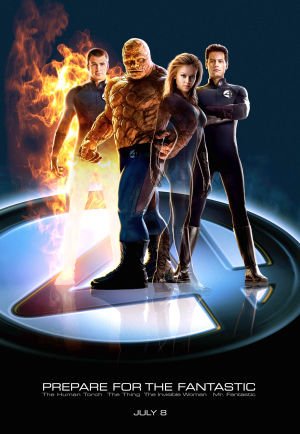
Fantastic Four (2005)

MV5BMTM1NTIwNjM4M15BMl5BanBnXkFtZTcwNDc2NjgyMQ@@._V1__SX1859_SY847_The bias here is that I had no real interest in the Fantastic Four as a kid; that is, no comics to read, and the shows were always pretty dumb in a way that other superhero cartoons were not. So, when they announced that it was this year’s Marvel summer movie, I was primarily annoyed at having to wait an extra year for the new X-Men.

So, yeah, it was pretty good. I’m thinking it occupies a previously unknown second tier of quality between the really good stuff (summer movies for the last 5 years other than the Hulk) and the truly dismal stuff (non-summer movies; think Daredevil). I’m not all excited at the idea of a possible sequel, but I’m definitely glad I got to see this. There’s something fundamentally pleasing about a team of people that don’t always get along, but they get it together at crunch time; I think it is because you look forward to the consequences of when they finally fail to get it together at crunch time. Also, the whole thing with the angst over being public faces instead of secret identities, that’s one of those cool things that you almost never get to see, and it opens a lot of previously closed doors.

Okay, maybe I am kind of looking forward to a sequel, a little bit. I despair for them suggesting a numbered sequel scheme, though. Because, seriously? Don’t.

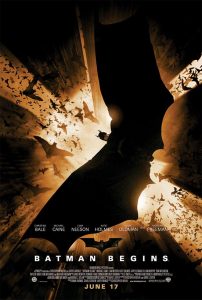
Batman Begins

mv5bmje3njqyodexmv5bml5banbnxkftztywnzyxmti3-_v1_As you can see, I’ve been kinda busy this weekend, with all the movies being watched and whatnot. The thing is, the whole moving thing has pushed me way behind. Even now, there are two theatrical releases I’d like to hit, and two more just days off. So, it’s nice to take a few moments of breathing space and enjoy myself. Which I did do, and the result is all this.

To wit, Batman Begins, the apparent start of a new DC movie franchise to finally compete with 5 years of Marvel supremacy. It’s tempting to claim that the franchise had small shoes to fill, what with the oddity of Batman Returns and the horror of the two later sequels to the original, but this was a genuinely good superhero movie in its own right, in the same quality tier as Spider-Man.

With so many quality stars in supporting roles, of course the acting was great. The leads did well too; Katie Holmes hit her usual eye candy marks with ease, and I’m not very sure what the complaints I’ve heard about her acting were based on. She did perfectly fine in every scene I watched. Nothing that cried out for an award, but not everything has to.

As with all origin stories that are completely familiar to the viewer, a big part of the fun was in watching the characters come together. Jim Gordon’s first meeting with Batman, Alfred transitioning so smoothly into the parental role, the very first Bat signal: all as iconic as they should have been.

Thematically is where it was a giant, though. In the opening act, the movie did a better job of explaining the Jedi/Sith dichotomy than George Lucas ever has, no matter how hard I’ve tried to read between the lines. The League of Shadows’ method of improving the world one fallen city at a time despite the individual cost in lives perfectly nails everything that Anakin Skywalker never had a sufficiently good script to say in the second and third prequel films. So, that made me fairly sad for my fandom, but happy for the potential future Batman movies, as long as they keep the same team working on scripts and direction.

Also: Serenity trailer. Shiny.

Constantine

When I first saw the preview for Constantine, with the hot Mummy chick getting pulled through a building and Keanu chasing after her, I really thought they were making another Matrix movie for some reason. This guess is not as far off the mark as you might think. It made about as much sense as Matrix Revolutions, but I feel better about it because of differing expectations.

Keanu’s acting worked pretty well for me in the John Constantine character, bearing in mind that I come to the movie untainted by the comic. Basically, his acting in any role (leaving aside the Theodore Logan aberration) works well, as long as the character is a cipher who never gets angry. He can emote detachment quite well, but detached shouting is oxymoronic. You may claim that ‘detached’ is not an acting skill, but there are a lot of characters in Hollywood with that as the defining characteristic, and actors have been filling those roles for all the years they’ve been written, some of them quite well. See also Charles Bronson.

Except for the part where lots of things were stated but not really backed up (Why is Constantine of so much interest to hell? What’s so special about this particular time that the neutrality thing is being breached?), the story was sufficiently comic-y to make me happy on that count. Also, Keanu has that look. Really tall, really thin, he just looks like a comic character. I’m sure a big part of that was the cinematography and wardrobe choices, but it was well-done enough that I want to emphasize it. For your comic movie to work, at least someone should look like a comic character.

Anyway: story, schmory. It had a good look, the Hell sets were really cool, and lots of demon-fighting. This is plenty to keep me happy with a February movie. Also, in a bow to gratuity, hot Mummy chick stayed soaked for the final half of the movie. That’s just good directing.