Tag Archives: graphic novel

Fables: Homelands

As the Fables world grows to include more and more key characters, some are falling into the background to make way for the rise of previously bit characters. And certainly the tone is changing away from the noir feeling of the early volumes as the stories start to grapple not just with events involving the fable characters, but with their overarching histories and futures. Or maybe it’s just that recent political upheaval is what has pushed Bigby Wolf and Snow White off the main stage, and the tone change is down to their absence as well. I figure it might be both, but I’ll have no way to really know until the Wolf is back and the noir returns, or doesn’t.

Homelands focuses on two characters over another handful of quickly passing years. In the opening, Jack Horner, and the Beanstalk, etc.[1] hatches another scheme for riches and fame, with better than usual success. It may be my independent knowledge, but it very much felt like Willingham saw that Jack was his for-fun character and didn’t really fit the flow of the main Fables story, and this was an explicit way to put him in position for the spin-off series, Jack of Fables, which I will begin reading relatively soon in the sequence, I think. And then in the main part of the storyline, Boy Blue infiltrates the fallen Homelands on a daring quest to rescue his love, save his best friend’s life, and with a little bit of luck, unmask and assassinate the Adversary himself! If that sounds pretty cool and exciting, well, sure enough, Fables keeps on delivering. And if you expect it to keep on delivering in ways the characters (and sometimes readers) cannot hope to foresee, well, that just means you’ve been paying attention.

[1] They’re all the same Jack, you see.
Ultimate Spider-Man: Silver Sable

As promised, a long overdue return to my graphic novel sequence! I’m still gradually catching up with the Marvel Ultimate series; the book I’m reading right now… is not the book I should be reading right now, apparently[1]. Son of a bitch. On the bright side, none of that has any effect on this particular review. And it’s not like I’m ever caught without a backup book in this kind of situation, it’s just frustrating to break order yet again, when I’m only finally getting back into it! So, I guess I’ll start over? Right, then.

That guy Spider-Man, yeah? He has been having a rough couple of months. He lost two close friends right in a row and then had to[2] break up with his girlfriend, and all the while the villains are mostly getting cannier. Plus, enough people have seen his face that if they all got together they could work up a composite and start putting him on milk cartons. When you get right down to it, it’s really about time he caught a break. And, well, that actually sort of happens in Silver Sable. I mean, on the one hand, he is being stalked by one of the pre-eminent bounty hunter types in the world, and that’s not so great. But for once, the chaos surrounding Peter Parker is really not of his own making, not even indirectly. Plus, as the X-Men had previously spoiled for me (since I’m reading a little bit out of order and all), he has a new girlfriend who is far less likely to be killed as a result of Spider-Man’s interference in a normal life. All in all, the book is a humor-centric piece of breathing space amid the various tragedy and drama in Peter’s life. And I’m glad; as well as Bendis handles the drama, it was starting to get a little oppressive in here! …though I can’t help feeling bad for Mary Jane.

[1] It was supposed to be Ultimate Annuals. I instead have Ultimate Annuals 2. And I’m really not sure how my filing system allowed it to happen!
[2] Had to? Plausibly yes. He certainly did, regardless.

Ex Machina: Ex Cathedra

The Ex Machina series has been, at every point, stingy with its distribution of information. Why did this one Mitchell Hundred guy (and his nemesis Pherson) get powers? Is someone pulling the strings? What is the end goal? But this stinginess has been basically okay, because the character and political interactions fill up a lot of time and entertainment. What is currently weirding me out, therefore, is how Ex Cathedra doesn’t really seem to fit any of the established patterns.

Honestly, it’s enough out of bounds that I wonder if I need to reread the book. It’s happened before with stuff this short, that if I’m just not all there on the day I read it, I have a bookfail. Anyhow, the majority of the book is taken up by Hundred’s acceptance of a requested audience with the pope, in Rome. So, there’s religious talk throughout, but less political than you’d expect. And the flashback scenes about Hundred’s career as the Great Machine, pre-politics, have no apparent tie-in with the rest of the story like I’m accustomed to seeing. On what I’m gonna call the bright side, it had the weirdest vision I think I’ve ever seen in a comic. The final one-shot storydid have nice character development, but the main plot has left me scratching my head.

Ultimate X-Men: Magical

As much as I’ve enjoyed Robert Kirkman’s work in The Walking Dead series (and anticipate enjoying his work with Marvel Zombies), I must perforce be all the more disappointed by what I’ve seen of his Ultimate X-Men run so far. Magical initially expanded upon the character that I liked least in his first book, the Kirkman-created Magician, whose mutant power seems to be the ability to do, y’know, anything. Quelle fromage, as the French say.[1] So, after three issues of that chunk of disappointment, we proceed into the Annual, in which Kirkman continues his systematic destruction of Nightcrawler, who has always been one of my favorite characters. I guess there’s a whole Marvel committee that approves of this stuff and possibly even suggests it, and that therefore my blame is somewhat misplaced. Nevertheless, I do not approve. Also, the dialogue continues to be sporadically stilted, in that superhero-declamatory way that by rights should have been discontinued in the 1950s at the latest.

All in all: blech.

[1] Most likely, both the claim and the grammar/spelling are inaccurate, and that’s well before you delve into the translation.

Ultimate X4

So, I’m learning as I go that there are still a lot of small time Marvel Ultimate titles that I have missed because they were either never released as graphic novels, were deemed insufficiently relevant and/or good and/or long, or in one case maybe took so long to be completed that the landscape has moved on. Dunno, really. The relevance to all of this is that I’ve just read Ultimate X4, a two-issue crossover in which the X-Men and Fantastic Four are manipulated into brief combat over the theft of Cerebro, a mutant-detecting machine developed by Professor X. And while I can imagine the story being written for world-changing relevance or being provided a gripping an in-depth plot, I can’t see either of those ever having happened with only two issues’ worth of material. Pity.

The book is padded by an incredibly dense but informative (and at least for me, timely) encyclopedia of the characters and groups inhabiting the Ultimate universe as of 2006. If read out of order, it would be way too full of spoilers, but it worked as a pretty good refresher on the at this point vast number of graphic novels I’ve read in this series over the past couple of years. Which pretty well saves the book for me, especially since the story part was so very, very short.

The Walking Dead: What We Become

The new Walking Dead books keep catching me by surprise. Which is nice, really, I’m not complaining. There I’ll be, scanning my Amazon gold box for cheap stuff that I usually don’t want or need, and hey, another new one! Still, I think it may be a little while before this happens again, so I will bask in pleasedness over the event for a moment.

You can probably tell by now that I’m padding. I have a good reason. The book is great, although not much plot momentum occurs. But that’s okay, because I’ve felt throughout this ride that Kirkman really gets what a zombie story is about. Zombies themselves are mostly boring, and the struggles against them, while interesting enough on both the purely physical survival level and on the mental game-of-chess level in which an entire unthinking world of death is ranged against the few survivors, can only capture so much attention before repetition sets in. But the psychology, the eroding emotional state of people who are thrust into this impossible and deadly world? I just don’t get tired of that, no matter how long the story lasts and no matter how many different versions of it I am presented with.

So you’ll understand why What We Become was so compelling to me, even though there was no real movement on the hinted plan for eventual salvation. But at the same time, I can’t really say anything about the book that the title hasn’t already said. A year beyond the zombiepocalypse, a year filled with unrelenting horror interspersed with only the sparest patches of peace and contentment, and it is time for the characters to take stock of their place in the world, an emotional dipstick measuring the dregs of their humanity. But no matter how bad things may seem? They’re still alive, and in Kirkman’s world, that may be the only measure anyone is still capable of taking with any true accuracy.

Ultimate Spider-Man: Warriors

So, the most recent Ultimate Spider-Man, Warriors[1], has me thinking about Peter Parker’s foes. Most of the time, they’re dudes that were changed by science like he was, only with more sinister results. Most of them are bit characters, because there are always way more villains than heroes, and the heroes never permanently lose. (Mostly.) You’ve got the Green Goblin and Doctor Octopus, with whom he shares pretty much a familial bond.[2] But otherwise, most of what he faces is a generic stream of similar villains that he can quite easily quip to death, even without the spider powers. But then there’s the Kingpin.

Wilson Fisk is just a rich guy mob boss type. His henchmen are all just folk too; Elektra has no special mutant or science-run-amok powers that I can figure, and just about everyone else he works with isn’t big-time enough to have a recognizable name. He could be Spider-Man’s least interesting foe, and yet instead I think he may be the best of the bunch. He’s scary smart and he has the power that money brings, even though he’s been laying low due to legal difficulties for practically the entire run of the comic. I guess it’s a lot like Lex Luthor with Superman: the only person who can really compete with an unstoppable force is the one who can out-think it. And okay, Kingpin is a bald rich guy, so maybe there’s a little bit of larcened[3] idea in the character at that. But I don’t really care, because the more important of the two is original, and nowhere near an unstoppable force anyhow, which leaves Kingpin free to be even more of a puppet-master. Case in point: the book that I just finished reviewing, albeit in footnote one.

[1] The actual book? Of course it was fantastic. What do you expect me to say instead, at this point? In a way, there were way too many bit characters from previous continuity (and, okay, also from previous events in this series), but in another way, that managed to work and be really cool itself, even though that kind of thing usually pisses me off. Which is why I keep writing paeans to Brian Michael Bendis. Whatever he’s selling, I apparently keep buying it.
[2] I mean, Norman Osborn created him, and the paternal vibe has been there ever since. All too readily, Harry Osborn falls into the overlooked brother role, and Otto Octavius, self-created but still in Osborn’s employ when it all happens, kind of feels like part of the family to me too. The last part may be a stretch, I admit, but I’m impressed with how neatly Bendis shoehorned the other three characters into these roles, just as though they had always been written this way.
[3] Is that even a word? I bet not.

Lucifer: Mansions of Silence

With the conclusion of Mansions of the Silence, I have completed over half of Mike Carey’s Lucifer story. And from a structural perspective, it is pretty obvious that the story is about half over. Well, I can’t say that much, but it’s at least obvious that it has reached a dividing point. That’s it’s half instead of a third or whatever, that can only be seen in retrospect. My point, anyway, is that the loose ends are rapidly being tied off. In keeping with his character, Lucifer is repaying his debts regardless of the cost to those around him.

Half the story follows his crew on a journey he himself cannot take, to rescue the soul of Elaine Belloc and clear that debt to her. And it makes for a pretty good travel-adventure yarn, sailing through the planes of the heavens on a Norse boat of the dead, built by honest-to-God[1] giants out of the fingernails of dead Vikings. Good mythical stuff, is all I’m saying. Meanwhile, the angel himself and his brother Michael take advantage of a device Lucifer recently found that can see into the mind of God, the results of which have almost certainly set in motion the second half of the story in ways that are currently well beyond my perception.

Pausing to take stock and look at the series through the Sandman lens[2], the storyline is pretty much as complex still, but the literary weight is… I’m having a hard time with it. It’s either not so much there, which is kind of reasonable, Sandman being pretty much seminal in the field of literary graphic novels. Or else, it’s there, but much weightier and a lot of it is sliding by me. Which is certainly possible. But without being too full of myself, if I’m missing it, most of the other readers are too. Anyhow, I say again: not quite living up to Sandman means you have a damn fine story happening.

[1] Er. Yeah, sorry about that.
[2] Since this seems to be my day for comparisons.

Ultimate Extinction

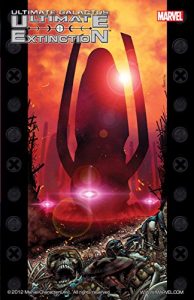
Concluding the Ultimate Galactus trilogy, Ultimate Extinction finally brings us the arrival of the traveling destructive force known as Gah Lak Tus, its Heralds, and quite possibly the end of humankind in the galaxy. As previously, the main hallmark of the book is that new characters[1] are produced only to be minimally utilized. To their credit, most of the characters that appeared in the earlier volumes return for this one, but that causes even more of a mish-mash feeling than the “Ultimate Universe is pulling together” feeling they were undoubtedly attempting to evoke. All in all, Ultimate Galactus was a decent story that was hampered by being told too fast for the amount of story that wanted to be told.

[1] That is, new Ultimate characters that I might have heard of if I had read deeper into the original continuity.

Ultimate Spider-Man: Hobgoblin

Not only am I running out of ways to say that the Ultimate Spider-Man series is fantastic, I’m kind of running out of ways to say I’m running out of those ways. I’m not sure I’m even objective on the topic anymore; it may have turned bad and I simply failed to notice in a whirlwind of fannish obsession. To nobody’s surprise, anyhow, I really liked Hobgoblin. Harry Osborn, son of the Green Goblin, is not having the best few months. His father has turned into a beast that regularly stalks him and killed his mother, and Harry most recently witnessed his father’s apparent (or actual?) death at the hands of the Ultimates and his very good friend Peter Parker. As usual, though, Harry’s return to school and mental state is only a small part of the book’s story. The tragedies that have dogged the Parker household during the same months that treated Harry so badly are finally pushing Peter to the breaking point.

I know things have to turn around soon, since the Ultimate universe apparently has an expiration date that I might be broaching by late this year. But honestly, I’m not sure how at this point. Pete is a pretty moody boy lately, and with good reasons. And the more tightly the inhabitants of that universe are tied together, the more interesting the stories get. Nick Fury’s small role in this book practically guarantees that whatever comes next for Peter Parker, it will not be the sudden positive turn that he really deserves.