Tag Archives: fantasy

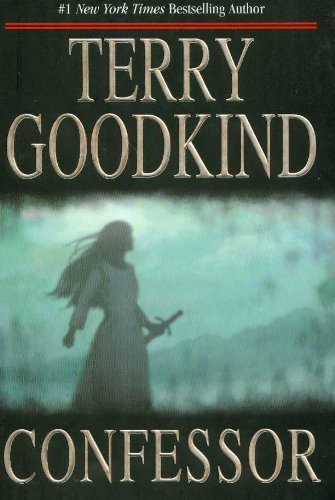
Confessor

41zwvtAmaML 51VSfzZ9TcLThat’s that, then. The Sword of Truth series is officially over, marking, what, the second open-ended series in my adult life to be completed by its author? (The only other one I can think of is King’s Dark Tower series, though it technically predates my adult life.) The final book, Confessor, very nearly drew me in. Despite the inevitable lecturing on the nature of good and evil as they relate to objectivism, there were some really solid moments. I’m thinking especially of the climactic rugby[1] game in the middle of the book and the events that followed after. I know that sounds like a ridiculous (if not outright parodic) thing to say, but I’m sincere on this point. There were 5 or 10 chapters of non-stop action that was probably as affecting as anything I’ve seen Goodkind write; my pulse was up, I was excited to see the outcome of the events (not just the game), I basically couldn’t put the book down. So, hooray for that.
My complaints, alas, outweigh that moment. I mean, I’ve accepted that objectivist screeds are an inevitable side-effect of the series, but there’s more to it than that in this book. It’s that the first screed was performed between two of the good guys, and since the good guys are all on the side of objectivism, it was required that one of them act angrily out-of-character so that the other could calm him down with the clear truth of things. It’s that a later one was performed by a (let’s say) 10 year-old girl, explaining to a (let’s say) 14 year-old girl that it was the teen’s own evil choices that had led her to this fate and she had nobody to blame but herself, moments before her flesh was devoured from her bones. It’s that the climactic screed was performed to an audience of, literally, every person in the entire world. (That’s right. Literally.) Plus, on a non-screed topic, it’s pretty clear that in the last 200 pages Goodkind still had about another book’s worth of story to tell, but was either out of screeds or tired of the series or wanted to stand by his promise that it was the final book, and so he had to rush things to a degree that was certainly all out of pace with the entire rest of the series, but that also[2] genuinely felt like important explanatory events were being left out. Plus plus, I’m nearly positive that elements of the series’ conclusion were lifted from Atlas Shrugged. But this last is not something I’m willing to elevate to the level of complaint, partly because I have thusfar failed to finish that book and partly because I’m pretty sure it would properly be called an homage, anyway.

If you’ve made it this far[3], you may as well finish the series out, right? Plus, that middle part of the book was, I reiterate, genuinely good.

[1] I mean, it’s not exactly rugby. But close enough for the purposes of this review.
[2] Because, and let’s be honest, it’s hard to see that as a negative at first blush. Objectivist screeds kind of break up narrative momentum, is what I’m trying to say here.
[3] And let’s face it: you haven’t.

Revelation

In the book of Revelation, we finally discover what’s been going on with God’s plan for Creation, plus there’s a lot of drama involving trumpets and earthquakes and some prostitute from Babylon 5. I don’t want to give away the ultimate climax, but, spoiler alert, Jesus is finally back, after we’ve all been waiting for what seems like millennia at this point. What I can’t figure out is how, if this is the penultimate novel of the Legacy of the Force series, they’ll have anything remaining for the last one.

Oh. Um. This is embarrassing. It turns out that the book I read is also called Revelation, but just that title by itself. Oops! So, right, completely different plot, but it fits much better as a next-to-last book, so on the whole I have to approve. (Sadly, no Jesus.) We’ve come back around to another entry focussed on Boba Fett, except this time it finally ties into the overall plot of the series, leading me to care a lot more. Plus, Mandalorian society and Fett’s personality are both a fair bit more interesting than they were in the previous such volumes, making this easily the best of Traviss’ three entries to the series. In addition to the superior character- and society-building being done, the plot that has to do with the new Sith Lord’s ascendancy that we’ve been examining over the past eight books now is also returning to the quality form of the first couple of books in the series.

Unfortunately, I’ve reached the point where anything I could say that holds meaning will be a serious spoiler for the first half of said series. I doubt this will really bother anyone, but on the off chance, look below the cut.

Continue reading

The Lies of Locke Lamora

I know it’s early yet, but this year is treating me excellently for books. I suppose the most important factor is the stack of recommendations I sift through these days, which in many ways has been a factor in the improvements my reading list has seen over the past year and more. But both of today’s book and Cryptonomicon have been more frequently and more widely recommended than the average, which I figure therefore makes a bit more difference than usual. In any event, if I read the best quality of books of my life in 2008, that’ll be awesome, and if I don’t, well, that’s probably fine too. The fact that they’re better is all to the good.
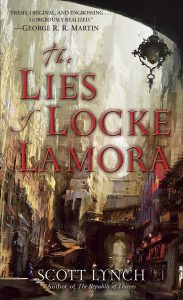
I’m holding my cards pretty close to the chest here, right? There you are, asking hopefully out into the void, “Chris, how did you feel about The Lies of Locke Lamora? If you’re just going to refuse to take a position, what good is any of this?” And I mean, yeah, you’re right, I really do need to learn to take a stand on these things. Anyway, one thing I liked about it was Locke Lamora himself. It’s been kind of a while since I’ve been so attached to a character. He’s like Danny Ocean without the inherent Clooney smugness, or maybe like Vlad Taltos without the deep and potentially unlikeable personality flaws. Another thing I liked was the last hundred or so pages of constant adrenaline. I cannot tell you the last time I was so excited at work. (Plus, the rest of the book was in no way boring, so make no mistake there.) Yet another thing I liked was the inherent lyricism of the title. I mean it, just try to say it out loud without feeling like you’re presenting poetry.

As for things I didn’t like… I’m really having a hard time. The only thing that springs out at me is a couple of times late in the book where expositional history of the city was presented just in time for it to be extremely relevant to the present plot. And even that seems like an unreasonable complaint; if he were a person telling me a story, I would expect him not to think of that kind of thing until he suddenly realized it was about to be relevant and that he hadn’t told me yet. Y’know? So there’s that, and it’s still pretty much all I have.

See, and all this talking about my feelings bullstuff has made me skip actually describing the book, in which Locke Lamora and his criminal gang wander around the grimy fantasy setting city running cons long and short on rich people and on their enemies, never suspecting the far longer and deeper con that they’ve been caught in the middle of. It’s really good stuff, and you should be sure to read it.

Fables: Legends in Exile

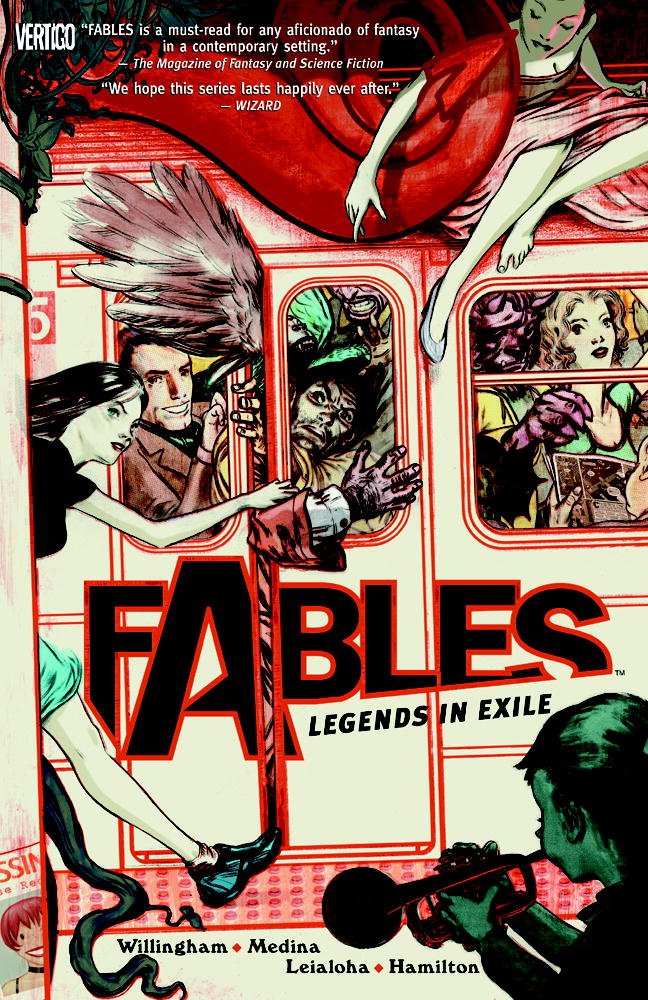
Another new graphic novel series? I can assure you, it’s all true. For, y’know, extremely relative values of new that seem in fact to reflect things published years ago. My initiation into the format only occurred within the last couple of years[1], though, so running behind kind of goes with the territory. The Fables series got on my radar via Amazon recommendations, much as with Dorothy and for that matter Ex Machina. Of my recent new series, this is certainly the one I’m the most satisfied with.

The idea of storybook characters all jumbled together in New York, while obviously cool enough to take the risk on (since I did buy it), seemed potentially fraught with peril. Apparently, they all come from different worlds (which I will choose to call dimensions) that were one after another attacked by an Adversary (who is thusfar shrouded in mystery), and by the time they realized that there was true danger afoot, they had no remaining options but to flee from their worlds to this one, which the Adversary has no apparent interest in. Being the stuff of fables, they’re immortal, so while they all came from different storybook dimensions to start with, they’ve had several hundred years on earth as Legends in Exile to properly mingle and form interrelationships. The upshot of all that background being that the interactions were rich and often funny, with distaste, attraction, working relationships, and even unlikely friendships all laid bare. The book was equal parts Storybook Melrose Place and Fable Noir.

Which raises my other extreme like for the book. The mystery was, if moderately simple, plotted quite well and made good use of the setting. Bigby Wolf[2], the sheriff of Fabletown, is confronted with murder most foul when Jack[3] reports that his girlfriend Rose Red is missing and her apartment covered in blood. Once Deputy Mayor Snow White[4], the victim’s sister, insists on including herself in the investigation and the rich and powerful Bluebeard is fingered as a potential suspect, all the trappings of a Humphrey Bogart noir are in place, and the only thing left to do is lean back and enjoy the ride. There are a lot of possibilities for the series, since the available characters cast such a wide net. I figure, if I get more volumes in the noir vein, well and good, and if not, the creators have already proven they have the chops to do good things with the premise, at least.

[1] Well, except for Sandman, which I’m prepared to call a special case.
[2] That name still gives me the giggles, even now.
[3] of “and the Beanstalk” fame
[4] whose surpassing loveliness is storied… er, whose fabled… Dammit. The point is, she’s a looker with legs that just wouldn’t quit and a smoldering fire in her eyes that told me she’d seen enough of the world to know that it wasn’t as pretty as the stories said it would be.

Dorothy, Volume I

I can no longer recall what prompted me to pick up the first volume of Dorothy, an extremely slow-publishing comic based on the Wizard of Oz that so far doesn’t have enough issues in play to warrant a Volume II. I mean, I’m sure it was related to my Amazon gold box, but as far as what made them think I should get it, I have no guess. Anyway, it has proceeded to sit on my bookshelf for lo these many months, occasionally pulled down but then supplanted by something else. Having finally taken the plunge, I am provisionally hopeful that the sequel will come forth someday. (Of course, even if it does, there will be more yet to come behind it, even slowlier.)

The most obvious thing about the book is the art format. A combination of photography and CGI makes it the most visually distinctive graphic novel I’ve read. I’m sure drawing could have done as good of a job at telling the story, but the images would almost certainly not stick in the same way, and neither would I be bothering to talk about the way it was put together except in broad strokes. So that’s a partial success. And nothing really looked bad, though I will say I’m not so sure about the contrast between the photographs and the standard comic-book lettering. A lot of the inhabitants of Oz had the long and concave faces that aliens have had ever since Communion was published, which struck me as odd. But to counter that, I feel strongly that Toto would have been greatly diminished by being drawn instead of CGIed into the photorealism.

The next most obvious thing about the book is the emo quotient. Modern Dorothy is completely alienated by Kansas’ many charms, and appears to spend most of her time doing drugs or complaining about her aunt and uncle in her diary. But once her tragic tale has been expanded over the course of several flashbacks and she’s fully committed herself to figuring out what’s going on in this bizarre and dangerous Oz place, both the plot and her character settle into a much more pleasing rhythm. For all her disaffected attitude, she’s the kind of tough in the clutch that emo kids believe they could be if only the world would give them the chance, proving right there in the statement of belief that they are not that kind of tough. And maybe being disaffectedly tough is good for her, because the Oz she’s been dropped into reminds me a lot more of the recent Sci-Fi channel movie, Tin Man, than it does of Judy Garland’s technicolor romp down the garden path. Oz is in bad shape: an evil queen in the West holds dominion over the whole land, and the only things that might displace her rule are the Wizard, who is gone to ground where nobody can find him, and prophecies of a girl who will someday come to Oz (specifically to oppose her? it’s not clear yet). Winged monkeys are out and about doing whatever they feel like, without the excuse of some diabolical mission to prompt their presence, if that gives you an idea of how bad things have become. I can dig it.

Dragons of the Dwarven Depths

A couple of Saturdays ago, at work: I’m sitting at my desk, bored with nothing challenging happening, trying to find ways to kill time. I’ve just returned from the vending machine with a turkey and (let’s say) cheddar Lunchable. In front of me on the desk is a copy of Dragons of the Dwarven Depths, a recent DragonLance novel that I’m reading.[1] To the best of my recollection, therefore, the only differences between that day and high school are that I was getting paid to sit there and that nobody was bothering me. It was kind of weird.

As far as the contents, they’re about what you’d expect from a main sequence DragonLance novel. There are dragons and a band of divided characters who must oppose them, each in their own way with heroics, low cunning, and magicky bits, in dungeons, wintry mountain passes and so forth. Basically, you get to see a fleshed out account of things that were glossed over in the original books, with some moderately implausible new information added (considering what knowledge the characters have later in the series) as well as a little depth of character for Sturm and Flint, who sometimes got short shrift in the originals. Unless you’re a sucker for the setting, and I am, you won’t really get anything out of it. But it’s by no means bad, if you are their type of sucker.

[1] In case you’re wondering, I accidentally left it in Austin with about 50 pages to go, and by the time it got back to me, I was so close to finished with the Dresden book that I completed that one first.

Fury

51l3ROGsfaLI am now officially caught up with all thing Star Wars. By which I mean not the comic books, not most of the prequel era or Sith era novels, not the young adult section books, and not the video games. But at least all of the future of the galaxy stuff, right? Well, probably all of that, anyway. Definitely all of the current big time Legacy of the Force series. So fancy! Nothing new until late February, which is probably more time away than I’ve spent reading the first seven books in the series, so that’s probably going to be a relief for some people, I bet.

Fury chronicles another chapter in the descent of Darth Caedus from grey-shaded humanity toward Sithy goodness evilness, in the galactic civil war at large, and in perennial heroic families Skywalker and Solo’s attempts to work against those forces and try to bring about something good from it all, the kind of galaxy where people can solve things diplomatically instead of by starting wars, building or utilizing planet-destroying megaweapons, or disassembling other people via the aggressive use of lightsabers. There is some dramatic irony in the fact that Caedus’ only moments of humanity these days revolve around his interactions with and thoughts about his daughter, despite that without his monofocus on her well-being at the expense of the other sons and daughters out there in the galaxy, he wouldn’t have fallen to the Dark Side in the first place. But if you leave that out of consideration, there’s nothing particularly special about this book to distinguish it from any other good Star Wars story. The ground is well-trodden by now, is what I’m saying, and as the series ramps up towards its finale, there’s not really any room for the unexpected twists and thematic explorations that marked the early volumes.

I do have an active complaint, which is about the series as a whole rather than this particular book; but now is as good a time as any. Even though the series has been tightly plotted, the breaks between books are far too jarring. One author (this one) is invested in the space battles, and another feels the stirrings of the Force on a regular basis if you know what I mean, and the third has an enormous hard-on for Boba Fett. And there’s nothing particularly wrong with any of these things, except that the books are written alternatingly by each author, with only enough attention paid to the other authors’ foci to maintain that it’s a single series and probably these earlier references will come back before everything is over. I’m fine with Fett still being alive and in the series, but if he pops up tangentially to the story, disappears for two books other than a few throwaway lines, pops back up on an even greater tangent to the story and then disappears for two more books minus a few more throwaway lines, then by the time he pops up for the third time, I’m going to feel a little jerked around by the pacing, even if he’s suddenly integral. And of course that’s only the one author; the other two are doing the same thing but with the characters they’re in love with instead. So, that’s the fly in an otherwise extremely entertaining serial ointment.

Beowulf (2007)

MV5BMTUzMjM0MTc3MF5BMl5BanBnXkFtZTcwNzU0ODMyMw@@._V1__SX1537_SY747_Things which I did not like about Beowulf: the way that either the 3D glasses directly or my regular glasses compressed beneath them were pushing against my sinuses so hard that occasional tears would stream down my face, and also the way that this gave me a nearly blinding headache by the end of the movie. I also wasn’t a giant fan of the times when coins or rocks or other small objects would fly out of the screen at me; the closer they got, the more out of focus and obviously fake they looked.

Things which I did like about Beowulf: practically everything else. I expected it to be gorgeous and awesome, and it pretty well was, what with the strides in depth of field they’ve made over the past few years. The screen really does look like it’s there in front of you spread out with the same depth as though you were in the front row at Beowulf: The Play, with the added bonus that the larger objects sometimes stick out over the audience instead of staying on the stage. The people looked… well, pretty fake at first, but mostly not too fake towards the end, as though my brain just took an hour or so to accept them. (Oddly, Grendel never looked the least bit fake.) The acting was often over the top, but look at the source material! And it had a good bit of subtlety and skill in it when needed.

So, a long time ago, like in the 4 digits range of years ago, someone wrote down a poem. In it, a warrior called Beowulf came to Denmark to kill a monster that was bothering everyone there. Later, he killed its mother, because of how she was unhappy about her son having been killed. Much later still as a king, he killed a dragon, but died doing so. That’s basically the entire story, as far as it goes. The only things particularly notable about it are that the stories are padded out to extreme length, partly with battle details but mostly with braggadocio on the behalf of the protagonist, and that it is the first piece of literature written in English. (Where first equals oldest in existence, at least that we’ve found yet. But since English doesn’t greatly predate the poem, it’s a fairly easy claim to make.) All of which adds up to a story with eye candy that has clearly been leveraged to great effect, but not much else going for it, right? Right.

Except, wrong! 10th century pre-British people understood spectacle[1], make no mistake. But they did not particularly understand story structure, probably because mostly what people wanted out of their story-telling was to be amused or excited, and you don’t really need themes or foreshadowing or alliteration (well, it was a performed piece; probably alliteration was fine, but they for sure frowned on fucking foreshadowing) to accomplish these goals. With our rather more sophisticated modern tastes[1], we of course hope for a little bit more to tie everything together. And with Neil Gaiman in the script credits, I can’t really act surprised that we got it. My point is, there was a lot more movie there than I expected from the trailers. Comedy[2], pathos, consequence and regret, all in addition to completely acceptable spectacle. I can dig it.

I did say I liked practically everything else. In the interests of full disclosure, one more thing bugged me. Late in the film, there’s a damsel-in-distress scene. I’m not automatically opposed to these on principle, but it simultaneously served no plot function and required no masculine intervention to solve, and yet I immediately knew that they were going to need the big strong man to come save them and had to roll my eyes. To those who will complain that modern feminism postdates the story of Beowulf, and thus making a point of the girls saving themselves would have been a little bit grating and out of place: I agree completely! The scene served no purpose at all and should have been removed entirely, is all I’m saying.

[1] By which I mean, check out the rack on Grendel’s mom!
[2] Clever scripting, sure, but also pretty decent physical comedy. Beowulf runs around naked, but the goods are always artfully concealed by random candlesticks or severed arms or things. Which is only a little funny by itself and has been done before, except that the 3D thing makes it seem as though if you crane your neck just right, stupid Wiglaf will no longer be blocking your view. (Trust me, the girl in the seat next to me was trying.)

Inferno

519vbU0Qg1LThe upshot of all these Star Wars books lately is that after the next one, I’ll be caught up to the release schedule. Also, there are only two more after that one, so however you look at it, it ends soon by volume if not by calendar date. On to the 6th book, Inferno, where I am continuing to be amused by the Amazon reviews of the series. For five books, people have been complaining that the plot is moving along too slowly, and nothing is happening, and it’s lame. Now that we’ve come to the first book past the crisis point of the series, where events are spiraling rapidly out of anyone’s control, people are complaining that the writing used to be intelligent and character-driven and possibly philosophical, whereas now it’s flat and derivative. Luckily, I occupy a middle ground devoid of shrillness.

The truth is, the first few books were chock full of philosophy and character development, none of it outstanding in the literary sense but most of it quite good, and well above previous Star Wars fare. And those elements were important to providing a convincing fall from Jedi to Sith as well as to providing a plausible excuse for family and friends not to have acted sooner. Each incremental change wasn’t so bad, and it even seemed that an act as despicable as trying to destroy one’s parents’ ship could be forgivable in context, although obviously a sign of a mind darkened by circumstance. Now that Darth Caedus[1] has moved on to such actions as setting the Wookiee homeworld[2] to burn, well, you might say that’s a cartoonishly evil decision. But for my part, it doesn’t seem all that far out of line from the last such decision he made, and there has to be a point at which you take an action that is tactically as well as strategically sound but which people use as the catalyst to finally re-qualify you in their minds as the bad guy, no matter what they wish were the case. If you never do anything like that and are eventually able to bring peace and order to the galaxy regardless, then, well, probably nobody would oppose the Sith in the first place, right? The obvious parallel is to the destruction of Alderaan, and I’ll argue for hours that this was nowhere near as capricious and cartoonish as that.

Anyway, that’s what the book is mostly about. Now that Caedus has reached his turning point in the prior book, the remaining characters get the chance to catch up to the way the galaxy is these days and start closing ranks and drawing battle lines. Which means more space battles, more lightsaber duels, more pitched fights with blasters against menacingly-uniformed troopers, all the excitement that those early book reviewers were asking for. Both aspects have worked throughout the series, for me, but I’m not going to complain that the scales are tipping toward the exciting end of things. I do wish that one of the three authors of the series had a little bit more investment in R2-D2, but as complaints go, that’s pretty minor.

[1] Yes, he’s a full blown Sith Lord now. And yes, I’m finally able to allude directly to who I mean with still no fear of spoilers, just as though the original name would be one that more than a fraction of my readers had ever heard before.
[2] As Star Trek fans would call it. Kashyyyk for the sake of accuracy[3], but again, what fraction of my readers has heard that name? I feel confident that many of them have heard of Wookiees, at least.
[3] Did I know this prior to reading the book, down to the correct spelling? I did.[4]
[4] Still, ladies, I have a lot of good qualities!

The Wake

And now I’ve finished my Sandman re-read, this time with all of the volumes in hand[1]. Well, all but the first two, which are still packed up with the rest of my books for the past two and a half years now. Argh, I really need to build those bookshelves. Anyway. The Wake is flawed in a couple of ways, I’ll acknowledge right up front. The art is initially somewhere between soft and blurry, which could be a problem with the art, or with the printer, or a purposeful representation of the reader’s eye-based emotional state at the time. Second, it frankly lasts a little bit too long. After a three-issue denouement plus an epilogue, there are still two more issues. And they’re both very good, and neither could have come any earlier in the series. But they’re still a little bit too much for the confines of the final Sandman story. It’s not like I have a good answer for what should have been done instead, so I feel a little bad even complaining about it.[2] But still, this kind of thing is my job for now, right? Right.

Those complaints are for the most part minor, though. Primarily, it was poignant, occasionally funny in that way that makes you feel a little bit sadder after you’re done laughing, and inclusive, a thank you note to the readers from the author. “I’m glad we stuck it out together, and we’re all a part of this.” Which sounds goofy when I read it over, but I still believe it. And it was very cleverly constructed, using ‘wake’ in every sense of the term I’m aware of. First, consequence, as in dealing with the outcome of what has happened, the wake of events. Second, and most obviously from the title, a celebration of the passed life. And lastly, inevitably, wakefulness, as in the long dream has ended and it’s time to return to reality. That one, I simultaneously appreciate and reject. More on that in a second, though, because I need to especially praise the epilogue first. Sunday Mourning gives us a last look at a couple of the most important secondary characters[3] a little further down the road of time, to let us know in a manner simultaneously ironic and apropos that, sure, life goes on. And back on the topic of clever, the epilogue was that, too: it managed to nicely capture everything, everything that I love about these books and everything that they mean to me in just a few short pages in which the main character is only ever referred to by pronoun.

Anyway, though, the part I mentioned appreciating-slash-rejecting, right? I quote:

…and then, fighting to stay asleep, wishing it would go on forever, sure that once the dream was over, it would never come back, …you woke up.

(And make no mistake, the art surrounding those lines is equally perfect.) Anyway… it’s good, because it admits that you have to wake up, and move on, and live. But it’s also patently false, because dreams do come back. They’re not ever the same as they were the time before, sure. They might be identical in composition, but the fact is, the dreamer has changed by the time the dream returns, so no, they’re not the same.[4] But they come back, and you get to be terrified in a different way, or sad in a different way, or filled with hilarity in a different way, or just quietly happy in a different way. And only the most vindictive author (or for that matter, personification of the concept of dreaming) would take away the option to re-experience those most powerful dreams again, as a new person, and see what they mean this time.

It will have to be a while, but I’ll come back here again.

[1] That a beautifully restored and collected series of Absolute Sandmans (Sandmen? I think not, though) has been released in the middle of my multi-year purchasing schedule is kind of unfortunate, but it’s at least something to look forward to.
[2] While on the topic of things I feel bad for saying, the very last issue, The Tempest, took me right out of the story. It was extremely good and had its place both emotionally and thematically. But at the same time, and for the first time in the series, Gaiman felt a little too self-absorbed, or maybe too self-congratulatory, or maybe the former is a necessary aspect of the latter? And I had a hard time enjoying the story part, because it pulled me so hard out of what has otherwise been a reread in which I appreciated the series just as much as the first time over a vacation week in 1996, and often more than that first time. So it at least deserves a footnote’s mention.
[3] It says something about the strength of the series, I think, that I can name many of them immediately without being able to say who was more important, only knowing that it would be impossible to talk intelligently about the themes of the series (not the plot, for which there are dozens more than these that would be necessary) without talking about Hob Gadling, or Nuala, or Matthew, or Death, or Delirium, or Rose Walker… and I’ll just stop now, rather than waste more space on a footnote nobody would bother to finish reading anyway.
[4] If I might steal another theme from The Sandman, it is literally impossible for the dreamer not to have changed. To not change is to die.