Tag Archives: superheroes

Ultimate Fantastic Four: Frightful

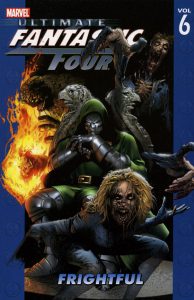
I’m not really sure what was done differently, but the latest volume of the Ultimate Fantastic Four managed to be as busy as the last few have been while simultaneously not feeling like each individual story was rushed. If anything, it felt like a return to the madcap days of the ’60s where each storyline lasted for two or three issues and hints of the future or ties to the past bled into each individual magazine; in short, like there was an ongoing, somewhat-planned story arc. It turns out, I really dig that.

Frightful features time travelling adventures in which dimensional spiders stand ready to eat you if you cause a paradox, yet another return of Doctor Doom, recurring super-zombies, and a Lovecraftian threat of world-crushing proportions! Also, whatever has been wrong with the art lately, they sorted that out too. Best book in the series since the first one, as nearly as I can tell.

Ultimate Spider-Man: Venom

51Tv0wFlAfL._SY344_BO1,204,203,200_I’ve been reading a lot of Marvel comics lately, as I trust you’ve noticed. Some of them are not so good, some brilliant, but in most all cases, I’ve had a fair bit to say, one way or another. The problem with Venom (and possibly the series in general; I remember this being an issue last time too) is that it can’t be brilliant all the time. Yet, it’s never the least bit bad. Other than saying, “Wow, this was good again, and you should be reading them if you have any taste for the genre at all,” I don’t have a lot to add. Which is a problem, because I can’t really just say that all the time.

On the bright side, Venom had some noticeable awesomeness going on, in the family arena. Still reeling from romantic difficulties and bits of negative public perception, Peter Parker stumbles across some old home videos that lead him to a childhood friend and old research into (depending upon whom you ask) a gel that can cure cancer or a military exo-suit. And these in turn lead him to his first tenuous answers about his parents’ sudden death ten years ago and into the fight of his life.

I’m always a sucker for dark family histories and unfolding mysteries, so that plus the always tight dialogue is more than enough to draw me in. There’s also the stirrings of a theme about the way that people who seem like they might have had identical childhood nurturing and opportunities can nevertheless diverge so drastically, and the parallels between that concept and the divergence of Venom from Spider-Man. But it wasn’t really followed through on, to my eyes; or maybe it wasn’t there at all and the English degree in me is trying to dig it out regardless. Also, though, the final chapter went a long way toward redeeming a character who had previously been tarnished enough that I was looking for ways to dislike him in other Marvel Ultimate titles as well. So that’s nice!

Ultimate X-Men: Return of the King

Sadly, I’ve already written this once, and some strange combination of unfamiliarity with the machine I’m writing from and a copy/paste failure conspired to eat it, right after I’d finished everything but the html. This is, as you might imagine, lame. If I had not liked the current Ultimate X-Men as much as I did, the review would probably have been hurt by this turn of events?

Luckily, though, I did like Return of the King. For one thing, I think Mark Millar is finally getting better at writing about things that are interesting, but I know for a fact that he was helped by a return to the roots. That’s right, as the title indicates, Magneto is back with a vengeance. And since the X-Men are on the run from a government who (justifiably?) blames them for his return, there’s not much of anyone who can put a stop to his latest plan to rid himself of the pesky homo sapiens once and for all. I’m saying: way cool.

Ultimate Fantastic Four: Crossover

If it seems like ages since I’ve hit the Ultimate Fantastic Four series, that’s because I’ve been trying to get all my other series into balance so I can be on pretty much the same volume number in all three and not have to think as much about where I am in any given one (and with the fourth slot reserved for short term series, if you care). Having gotten back, I was immediately struck again by how very much I hate the current artist. Luckily, the rest of Crossover was pretty good.

Mark Millar has his hands all over Marvel’s Ultimate universe, it seems, and I’ve had extremely positive reactions in some instances as well as pretty negative reactions in others; in this case, I am cautiously optimistic. He helped his case with extreme pandering, admittedly. The book starts off with zombified Marvel superheroes[1], and then it dovetails into a story about the Submariner that seems to be predicated on the idea that he genuinely is as much of a pretentious git as I personally find him to be, thoroughly unlikeable in every way. The only downside is that both stories fly by too quickly to really get involved in. Which, upon reflection, was one of my more minor complaints about the previous volume, also [partially] penned by Millar.

The book wrapped up with a reasonably effective *dun-dun-DUN* moment that might have been more effective still if I had caught the intended reference. On the bright side, it definitely worked for your “new” reader here, which at least partially indicates that their attempts to be accessible to whole new generations are succeeding.

[1] Apparently from an alternate universe largely identical to the modern version of the comics I was reading from the ’60s, back before I got too busy to do so.

Ex Machina: March to War

I’m headed toward the impression that maybe Ex Machina doesn’t know where it’s going after all, which would bother me less, I think, if I didn’t have the excellent Y: The Last Man series by the same author to compare with. As it is, March to War still delivers on sometimes thought-provoking and always entertaining post-9/11 political content, so I can’t complain very much; and it will only help matters if I lower my future expectations.

In this fourth volume, if you wonder, former superhero and current New York City Mayor Mitchell Hundred must deal with political protests of the war in Iraq and a new terrorist attack on his city, and an annoying radio personality as a framing device for a flashback to the time that he had an archenemy with a surprising and complementary power. So that’s pretty good stuff? Yeah, it is.

Ultimate Iron Man

To my surprise, the copy of Ultimate Iron Man I found used a few months ago is unlisted at Amazon. I had intended to say that it’s practically unfindable, which probably says more about my perception of Amazon’s ubiquity than of objective reality. Nevertheless, I did find it and read it, and in a continuation of recent comic trends, it’s written by someone who’s far more famous for doing something else, in this case for writing Ender’s Game. So that’s good, right?

I mean, it’s not like it’s bad. I’m not convinced it really matches what’s going on in the rest of the Ultimate universe, which may or may not matter. Instead of a re-envisioned telling of the Iron Man story (as portrayed well but with a lot of room for expansion in the Ultimates books about which I’ve raved so extensively), we’re given a straight origin story, one that has nothing in common with the 1960s version. I shouldn’t ought to complain about that, but the others have drawn so heavily from the well that this stands out. What is worse, though, is that it’s really not all that heroic, neither literally nor in scope. It’s mostly corporate espionage coupled with biological industrial accidents, disguised as a coming-of-age story in which not much age is, er, come of.

Maybe it was kind of bad after all? It just really didn’t go anywhere, the suit felt like a tacked-on afterthought, and then it failed to have an ending. I guess I’d read the sequel if it fell into my lap, but only because I know it won’t be very long, as is the wont of these kinds of books; and because maybe the next bit would have an ending. Still and all, I kind of hope it doesn’t fall into my lap. I could use the time rereading Ender’s Game, for example.

Ultimate X-Men: Ultimate War

This latest UXM title continues the trend of improvement while at the same time falling terribly short of the expectations Mark Millar has set in his Ultimates titles, a fact advanced from sad to ironical by virtue of the fact that Ultimate War is plotted as a battle between the X-Men and the Ultimates. Set between the first two Ultimates volumes (you can tell because Quicksilver and the Scarlet Witch are recruited to the Ultimates’ ranks here), the X-Men are being hunted down because Professor X made a possibly understandable but ultimately flawed choice regarding the fate of Magneto, some months back. Now that Magneto is on the loose and running his mutant terrorism organization again, well, mutants in general and Xavier’s X-Men in particular are once again in heavy political disfavor. As a result of which: battle between superhero teams. It’s a common enough trope, but the intelligence of the writing mostly makes it work well.

Or perhaps I’m just easily impressed by the X-Men being decently written instead of terribly? I can only hope the trend continues, either way.

Ultimate X-Men: Hellfire & Brimstone

By the time I finished the fourth X-Men book, I’d had it split up to read parts or all of two other books, plus it’s been more than a week since I finished it. And I’ve already denigrated the previous books in the series, to greater or lesser degree. So it will likely come as no surprise that I’m having a difficult time working out what to say about Hellfire & Brimstone, all things considered.

What is surprising is that despite still being a Mark Millar title, I really kind of liked it. The plots were a largely disconnected mishmash, about the introduction of Kitty Pryde[1], about a new evil growing underneath Magneto’s old island where the Brotherhood of Mutants used to hang out, about some rich people trying to summon a demon or an Old One or something to destroy the universe in exchange for limitless power, and about the evil mutants searching for new leadership. And it’s not just that they appear to be disconnected on the surface: they’re mostly just as disconnected by the end of the volume. But I guess each story was good enough on its own, or had sufficiently cool moments, that the entire thing was elevated as a result. However it worked, I’m relieved to have caught one that ended up being pretty darn good, for a change.

[1] That seems to be her real name, not her superhero name. Which: wow. (She can move freely through solid objects, if you care.)

The Ultimates 2: Gods and Monsters

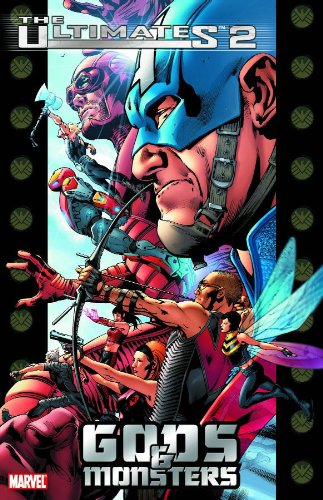
61rnRASuyiLFinally, something good out of the Ultimates universe again! I’m reading the four series, and Spider-Man has been great for the teen set while Fantastic Four has been okay, and X-Men feels adult even though they’re all teens too, but it’s been the not-that-good cousin to the clearly adult and clearly good Ultimates. My point in all of this, aside from the subtle recap, is to express my relief; the last few books I’ve read have been iffy.

Not so God and Monsters! I mean, it starts off all soap opera with a recap of how the various government-sponsored superheroes have been pairing off, and how the remaining unpopular heroes have been doing. (Giant-Man has been having the kinds of marriage problems that do not result in paparazzi wondering who you’re being frisky on the beach with, and the Hulk murdered a lot of people, so.) But after all the stage-setting is in place, it immediately turns into Schrödinger’s plot, wherein one of two possible things is happening. Either Thor really is the Norse god of thunder, and his brother Loki is altering reality to torment him and Midgard in general, or else Thor is a delusional Norwegian hippy who has become incredibly dangerous because of his unbalanced ratio of powerfulness to sanity, and meanwhile the Ultimates are being gradually turned into yet another military arm of the United States government. For my part, I’m honestly not sure which possibility is more dire for our heroes.

Also, there’s a downright hilarious sequence revolving around a group of second tier superheroes of the type you’d expect to start crawling out of the woodwork in this kind of world, looking to feel special without any pesky powers or skills getting in the way. And the Ultimates contain a secret traitor! Maybe! (Like I said, it has a lot of soap opera elements to it. But I am okay with that kind of thing.)

Ultimate Fantastic Four: Inhuman

The fourth entry in the Ultimate Fantastic Four series was mostly of the ungood. The first half of the surprisingly short book revolved around a character whose plot and disposal were both extremely predictable if you’re familiar with the Mad Thinker from the FF’s original run, but who appeared to be annoying and pointless if you aren’t. And the the second half was even more of the same, as though the only purpose of the series is to hit all the highlights from the 1960s version. And as much as I’ve complained about the Ultimate X-Men run, they’ve never once seemed blandly formulaic. On top of which, the art reminded me of someone who was not very talented trying to copy the character-style of Girls (which style you will no doubt recall I already found unsatisfactory) combined with repetitive backgrounds and heavy reliance on “characters in shadow”, as though the strain of cranking out such minimalistic-yet-bad art got to be too much, and only having to do shaded in outlines on some pages was a rest break from that.

On the bright side, none of the other books have seemed this bad, so there’s every chance that the quality will swing right back up again? (Plus, you know, the art may have unfairly lowered my overall opinion of the volume. If anything, I hope that’s true.)