Tag Archives: Marvel

Ultimate Fantastic Four: N-Zone

As we rejoin the youthful, modern Fantastic Four, they are still trying to determine how to reverse the changes that have been wrought upon them.  Well, at least those who actually want to go back to normal, which number is shrinking as they begin to realize that the potential for the future outweighs whatever burden they may feel. Since I’m not that big a fan of the reluctant hero, this is pretty much fine by me. In any event, in this volume, they plan a trip back into the N-Zone that was the source of their new lives, for science!

The story was basically fine, with all the sci-fi trappings that attached to the original FF moreso than any other old-school Marvel comic, including a spooky extra-dimensional universe with inexplicably giant skeletons and a bad guy named (roughly) E-Vil. I don’t know if the problem lies with the objective quality or with my just having read a much superior Ultimate Spider-Man book, but this one left me mostly dry. The good news is that the character interactions among the four of them that have been the best aspect of every book so far are just as solid here and if anything continuing to grow in quality. There’s nothing worth skipping, but if it was what I had to recommend the series from, I probably wouldn’t bother to.

Ultimate Fantastic Four: Doom

I haven’t found any Ultimate X-Men yet, the upshot of which is that I’ve already looped around on these quick reads to volume 2 of something. I don’t mind so much: there’s a goodly pile of things available, and so far they’ve been uniformly entertaining. That is not, as they say, nothing. The second Ultimate Fantastic Four picks up essentially right where the first one left off. Fresh from their first victory, Reed Richards and company[1] are still working to find a way to become normal people again. And the key to that is discovering what happened to the fifth person affected, Victor Van Damme. He, after all, was the one who changed the experiment’s parameters that caused the accident in the first place. The downside to the plan is that he already knows where they are. Being under effective house-arrest courtesy of the United States in the same Baxter Building where all of their schooling and late night studies took place makes this kind of easy, you see.

I’m definitely still liking the series. The comedic timing is improved over an already funny previous run, and the elements of government control over what is not yet a famed superhero group, but just a quartet of college kids? That’s a story with a lot of depth behind it, if they choose that direction to go in. Plus, y’know, Doctor Doom is there now, and we all know he’s a great adversary.

[1] My historical knowledge of the group, predating any actual reading, leaves me with only his name at the tip of my tongue. So my instinct is to assume that the other names wouldn’t mean a lot to most people. However, I feel compelled to come out in praise of how Sue Storm has been handled thusfar. She’s a modern love interest, in that he seems as much like her prize as she seems like his. And on top of that, she’s a gifted biologist in her own right, every bit as skilled in her field as Reed is in his. It’s a very pleasant contrast with the 1960s version; and make no mistake, even then she was a pretty strong female character for her genre and time!

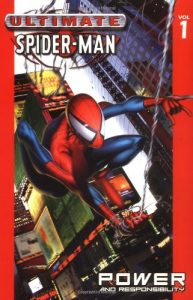
Ultimate Spider-Man: Power and Responsibility

A thing that is rapidly striking me as odd about the Ultimate Marvel universe is how unrelated the stories are, compared to 1960s Marvel. I mean, I’ve read three origin stories now, and all of them refer to events that are mutually exclusive of each other. As though they’re all actually set in mildly disparate realities from one another. This is not something that troubles me particularly, just an oddity. I mention it in part because it struck me last time and I never said, but also because it’s one of the many aspects informing my reading of the first Ultimate Spider-Man.

Other aspects include the initial Spider-Man movie, which appears to have been heavily influenced by this volume, my readings of the first 31 issues of the Amazing Spider-Man comic[1], and my expectations relative to the other Ultimate series in which I’ve dabbled that this one would be the most kid-oriented. And indeed, our Peter Parker is a mere 15 years old, with a fair bit of modern angst to him. So, on the whole, it really feels like I should be feeling a little meh about the whole thing. Instead, I enjoyed myself a lot. My guesses about this are that I’m even more of a sucker for high school angst than I thought (and, come on, get over it already, man), or that lowered expectations were just right for the book, or that the original story Stan Lee put together in 1963 has such a heaping helping of mythic resonance that any given retelling will affect me just as much as the first time I saw it. I think there’s a pretty good chance it’s that last one.

[1] I’ll be reading #32 pretty immediately after this review posts, in point of fact. Mary Jane Watson has been the elephant in the corner for at least 25 issues now, which is kind of hilarious to me, given my knowledge of what the future holds. I have to believe that Stan Lee had her in mind as the real deal all along; the set-up is too perfect to be coincidence.

Ultimate Fantastic Four: The Fantastic

As I believe I have mentioned from time to time, I’ve been reading a lot of Marvel Comics from the 1960s. The Ultimate series of Marvel Comics (a reimagining of the best-known characters from that period as though they had never been created and only appeared in the last 5 years or so instead) is not, alas, on DVD. However, I can find large swathes of the serieses in graphic novel form at my local used bookstore, and hey, why not? I’ve read enough of the original titles to know that I like the characters and the world, and enough to catch at least a substantial number of the references. Plus, I could conceivably catch up on this some day and read it sort of live, which is something that will never happen with the regular Marvel universe and its 45 years of bloat. That’s pretty cool, I guess.

So, anyway, The Fantastic provides the origin story and first major enemy faced by the Fantastic Four, who you’ve possibly heard of before, here if nowhere else. In this version of the story, the team is formed largely of precocious students who have been gathered together at a magnet school with government funding to invent the future, and the accident that provides their powers is the result of a teleportation experiment rather than flying through cosmic rays in space. In fact, my one complaint about the story is that the ‘What caused this?’ subplot was left unresolved in an unsatisfying way. I’m assuming they’ll make up for it by continuing to search for answers in future volumes. But the problems and personalities are spot on, the Moleman is far better realized than he ever was in the original comics (at least as far forward as I’ve read), the in-jokes were occasionally hysterical, and the art…

Well, I know it’s probably heresy, but I’m a lot more fond of the current art than the original stuff, and for a couple of reasons. The really heretical part is that I’m just not that big a fan of Jack Kirby. His backgrounds are great, yes, but his people have always left me cold. The other part is that the big, full-page art is very nice. It admittedly slows the story way down, explaining why what took FF #1 in 1962 about 20 pages to tell took the modern people 100 or more; but I don’t mind that the story slows down a bit, as continuity between issues is far tighter even than it was then. (And one of my most consistent praises of old era Marvel is how continuity-minded they were, and how high above my expectations the writing has been as a result.)

My point in all of this, I guess, is that I certainly liked what they’ve done with the reboot, and anticipate liking the other Ultimate titles as well. But since in a roundabout way I’ve been reviewing the old comics and the reboot concept more than this particular story, it’s probably fair to say that any future Ultimate reviews will be shorter than this. I mean, if that’s the kind of thing that worries you. (Which it probably would me; it’s a short graphic novel in the scheme of things, and not chock full of symbolism and enigma like most of the non-superhero comics I tend to read more often.)

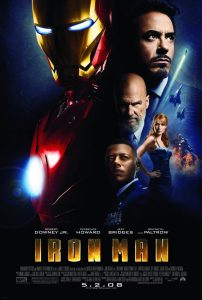
Iron Man (2008)

mv5bmtcznti2oduwof5bml5banbnxkftztcwmtu0ntizmw-_v1_sy1000_cr006741000_al_Going to a sneak preview is a thing that… well, okay, I’ve done it pretty damn recently, but I haven’t been to an advance preview for a blockbuster that everyone in the world is going to see, at least not in a while. However, I have an awesome friend named Kara who has that skill where she knows every single person on the planet, and can therefore get into clubs or crowded restaurants sans reservation, that kind of thing. As a result, she received an astonishing number of passes to Iron Man last night. Enough to fill more than an entire middle row with people that she knows (many of them people I know as well, and not incidentally including me). And this is just not an unusual event around her. So, yay Kara!

And then, on top of being surrounded by awesome, there was the whole ‘crowd of people who all love this idea too’ that I’ve mentioned liking from time to time. The energy of a theater full of real fans, in a big event movie like this, is something I really dig. (Even though, sometimes, I felt a little like our row was appreciating everything on a more visceral level than the rest of the crowd. I don’t know if this is factual or just proximity to what I could hear best, and if it is true, I don’t how much to blame on the huge press section just below us in the middle.) The downside of crowds is that, even in shorts and a t-shirt, I was dying of heat by the final act. Too many people and lack of air-conditioning spells consequences, my friends. But they did sell me a milkshake, so that was pleasant.

The careful readers among you may be noticing that I haven’t said very much about the actual movie yet. There’s a good reason for this, which is that I don’t wish to set anyone’s expectations at an unfortunate level. Realize that my Iron Man experience essentially consists of the first couple of years of him in the comics, plus the first many years of his time with the Avengers, and whatever odds and ends I’ve heard about his doings in the Civil War thing that just happened, but my feeling is that the latter has no real bearing on anything for these purposes. But, with the amount of Iron Man experience I have, I’m prepared to say that this is the best Marvel movie that wasn’t Spider-Man.

Contributing factors to this claim include the awesomeness of Robert Downey Jr.’s portrayal of Tony Stark, more special effects than you can shake a pointed stick at, the tastefully understated but always clear and heartfelt interactions[1] between Tony and his friends (which casts a wider net than you may initially think), the ease with which origin story and Iron Man versus a bad guy were shoehorned into the same two hours, and I’ll have to reiterate how great Robert Downey Jr. was. Even though I’m only familiar with the 1960s versions of the characters, it’s instantly apparent that at least Tony Stark and Pepper Potts were meant to grow into these two characters when adjusted for modernity. There’s no way to ask for more than pitch perfect characterization in a comic book adaptation; if you have that, the rest is guaranteed to work, says me. And this? Did.

[1] Later, you’re going to realize that this is hilarious.

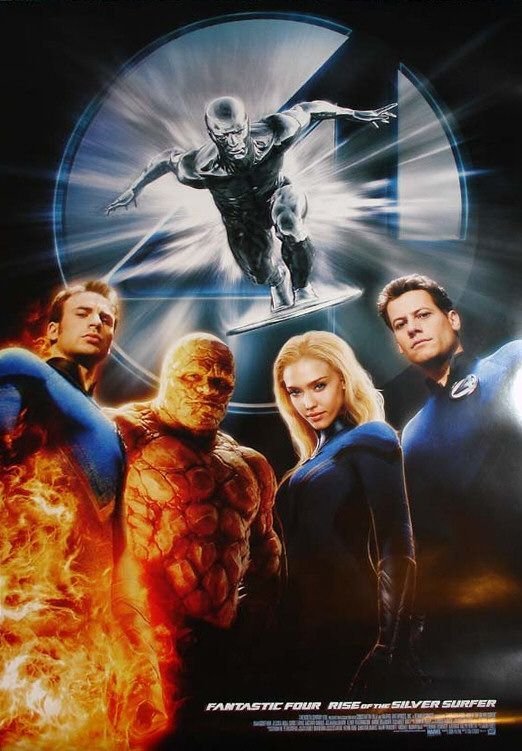
Fantastic Four: Rise of the Silver Surfer

MV5BMTgxMDc2NzA4MV5BMl5BanBnXkFtZTcwOTI1NTY0MQ@@._V1__SX1859_SY847_So I went ahead and saw that Silver Surfer movie my own self, which probably anybody could have predicted. For people who have not read the Fantastic Four comic any time in the last forty plus years (e.g., me) or for people who don’t know any comic book fans who have done so and would be not so much thrilled as actively compelled to explain it to you from that perspective (this one, not so much me; but someone, surely!), a plot synopsis.

So, the Fantastic Four are this public superhero team who, you know, save New York. And probably other stuff as well. But mostly New York, because despite the presence of Spider-Man, Daredevil, and the close proximity of the X-Men, it still doesn’t have enough saving going on. (Plus inevitable others of whom I am unaware. Iron Man, right?) And they’re doing their bicker and save New York and maybe get married thing, living out their everyday lives, when this silver guy appears on a surfboard. From space. Which sounds pretty cool, and probably would be, except he’s kind of a dick. To cite a couple of examples, he’s altering peoples’ genetic make-up with his cosmic radiation and digging these giant bowling ball finger holes into the earth, because he’s the Herald of Galactus. Galactus is a giant humanoid in a purple helmet who likes to eat planets. Except, because pretty much everyone realizes that would look exceptionally stupid on a giant movie screen in 2007, he’s a floating cloud full of energy and lightning and stuff. Like V-Ger, but less our fault. So now instead of bickering and maybe getting married and saving New York, they (the Fantastic Four, our nominal stars of the story, right?) have to save the world from being eaten and/or used for a frame of intergalactic ten pins. Well, and bicker, and maybe get married. (Not all of them, as comic book world is not so enlightened as to allow semi-gay or possibly polygynous marriage. Just Mr. Fantastic and the Invisible Woman. Also, since Johnny Storm is her brother, there are incest problems as well. I’m just saying, maybe in this particular case, comic book world has a point.) Also, Dr. Doom (he’s the bad guy from the first movie) is trying to swing this whole devoured planet thing such that he gets more power. And, one supposes, a new planet in the bargain? Because lots of power but floating in the vacuum of space seems like kind of a win/lose.

It was pretty cool. Tightly paced, not hampered by trying to squeeze a complicated origin story and a climactic battle sequence into the same 90 minutes, pretty, funny, and just on the whole entangled with a factor of coolness. Sure, it was no Spider-Man 2, but what is? It definitely topped Spider-Man 3. Now, we pause for two or three years while the writers try to come up with a new way to get Jessica Alba comically naked, and then wrap a movie around it. (I know that sounds a little derogatory, but only if you think that I disapprove of Jessica Alba themed nudity.)

Black Panther: The Bride

Things I do not do, a partial list:

1) Kick puppies, whether they deserve it or not.
2) Drive on the left side of the road.
3) Keep track of modern Marvel comics. (Well, or particularly the old ones, for that matter.)
4) Mine for diamonds in Siberia.

None of which would be relevant except that a co-worker happened to hand me a collection of Black Panther comics from last year in which the eponymous character goes off in search of a wife to be the queen of his kingdom in Africa. Despite hints of a super-powered bachelorette auction on the cover, apparently the Black Panther has had someone in mind the whole time: Storm, that one chick in the X-Men who controls the weather. (Apparently, she’s also their leader now? Not a big surprise that she might be without me knowing, since the most recent X-Men comic I’ve read was from 1968, well before the whole universe was reset a few years back. Hmmm. Maybe I do keep track of modern Marvel comics? Except, really, I don’t. I know people who feel obligated to keep me up, though. I’m not really sure why or anything, but I don’t mind.)

Anyway, it’s a pretty soap opera story. First they have the thing where they decide if they even like each other (apparently they have history that predates their herodom), then they have the shopping and parties and make-outs, then there’s a wedding. It all seems like an excuse to draw pictures of pretty people doing wedding things while random villains posture ridiculously and the Civil War storyline bubbles over from time to time. (Apparently, there’s a civil war between the superheroes, where some of them think they should all be registered with the US government for public safety and some of think they have a right to privacy. I guess Captain America got killed over it? Seems very involved.)

Things I have learned: comics are better when not taken in the middle, as it is easier to have an investment in the characters; super-villain-y declarations of their dramatic name and why they are not to be taken lightly because they’re so evil and effective worked a whole lot better in the 60s where it seems campy than today, where it just seems like they’re literally brain-damaged; that civil war storyline might be interesting, except that modern (and let’s be honest, historical) superhero comics are so convoluted and intertwined and downright incestuous that nobody could ever start at any arbitrarily defined ‘now’ moment and have a hope of catching up; and female superheros with average-sized breasts do not occur in nature. Well, okay, I already knew that last thing.

Spider-Man 3

Well, it’s summer now. There is an extent to which I feel like summer comes too soon, since there are no longer any good movies left by August. Nevertheless, I can only observe the status of these things, not correct them. I am like a groundhog for movies! (Except my job’s easier; summer never doesn’t come.) My point, of course, is this: midnight showing of Spider-Man 3, from which I am still reeling. I mean, I’m not talking about the movie yet; it’s just, I got five hours of sleep the night before due to seeing a musical on stage, and then I got something like four hours last night, but (and here’s the secret to making it extra awesome!) split into two parts. So if I’m incoherent, a) pretend like this is unusual and then b) blame it on my non-functioning brain.[2]

Let’s get the easy part out of the way. It was good. I regret the lack of sleep only on an intellectual level, and I’m quite sure I’ll go see it again. I might not do so without the IMAX draw, but only because of how little time I have relative to the number of movies I want to see right now. So, yeah, good. Probably won’t be the best movie of the summer, though. People[1] will tell you it was bloated both in time and number of plots. I don’t agree with that, because each and every one of the plots was personal to Peter Parker. Maybe they didn’t need to all occur at once, but neither were they arbitrary, and it all hung together as far as I could tell. Also, the action lived up to the previous movies.

Plus, plenty of meaty themes to sink your teeth into. For example: Good or evil isn’t who you are, it’s what you do. I can find shades of that in every single major male character. The part where the females are pretty much uni-dimensional cardboard is probably a trope of the genre, but it’s unfortunate nevertheless. They stand out only because of the comparison, though. Also present, and painful to watch, is the pride goeth before a fall theme. Because you can pretty well see each part of it coming, and Peter so obviously can’t, and you just want to grab him and shake him and explain how easy it would be to dodge most of this. Except he’s still a kid, and kids are supposed to make mistakes, and I’m not even sure grown-up Spider-Man would be of any interest. Anyway, I think it’s fair to say that it’s also as deep as the previous movies.

So why won’t it be the best movie this summer? Because it has a couple of stumbles and one major failure. For one thing, there’s an extraneous character; for the amount that Gwen Stacey added to the plot, she either should have had more to do or had her purposes rolled into Betty Brant and the character saved for use in a future sequel. For another, there’s a scene with a butler late in the movie (don’t worry; he didn’t do it) that was a clumsy plot bridge and terribly acted by said butler. The former is the more egregious crime, of course, but the latter made the former stand out in stark relief. But the big failure was the lack of an iconic moment. You have the New Yorkers on the bridge in the first movie, and Spidey on the train in the second one; you can’t make the conclusion of the trilogy be great without exceeding or at least matching one of these. And it just… didn’t. As much as I liked the movie, I’m not going to end up loving it, and that’s the only good reason why not.

[1] and by people, I mean critics; apparently I am one of those, now? Or maybe it requires a paycheck. I have yet to receive a penny, much less break even on domain registration, though, so I don’t count as that. And if I was paying for the hosting, it would be even worse.
[2] Also, I can kill you with my brain.[3]
[3] For reasons of my own!
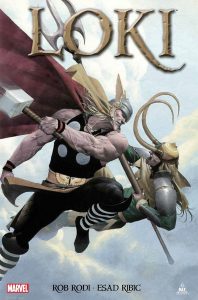
Loki

Although I’ve done a little bit of delving into old-school Spider-Man and X-Men, for the most part I’m only barely aware of the Marvel canon, outside what movies have told me. Of course, the comics have lots of advertising and in-story references to the other Marvel characters, so I’m getting a vague idea of what the universe looks like, thanks to the aforementioned excavations. So sure, I know that Thor spent some time as an Avenger (whatever that is), and that his comics frequently refer to Norse legend, which seems only right. But when I got the Marvel-branded book Loki for Christmas, I had no idea if I’d really be able to follow. As it happens, this story pre-supposes no Marvel knowledge at all that I could discern, so yay that! Even yayer, despite saying on the back that it collects Loki #1-4, it’s a completely self-contained story, so I wasn’t stuck wanting to buy future volumes and hope they might come out someday, and so forth. My point is, as far as the presentation, all good.

So then there’s the part between the covers. The art is amazing, though not entirely comic-like. Rather than contained action on each page, it’s more like a series of paintings. But since the story is a very introspective one, that works well. We open with Loki triumphant, in command of Asgard with all of his foes vanquished and Thor on his knees in chains at Loki’s feet. All that is left is for Loki to get the common people to follow his will, to decide how he will accomplish this, and, part and parcel, to decide what kind of ruler he will be. What follows is 60 or 80 pages of recriminations, impassioned arguments, and bitter tirades as Loki wanders a castle that holds no real meaning for him in itself, trying to apportion blame for his fate, the fate of the other Asgardians, and especially the fate of his brother Thor.

I know it sounds like one of those apologist texts that finds a way to blame other people for one’s own bad actions and decisions. To an extent it is, but only to the extent that Loki sees himself as a victim. The reader is free to make whatever decision they walk away from the text with, as all points of view are given equal time. But anyway, that’s just the sideshow. The burning question, ‘What will Loki do?’ is addressed with measured deliberation and to excellent effect by the story’s end. I don’t know how good this is for people who like Marvel, but I definitely recommend it for people who like Norse mythology.

Ghost Rider

And now I will demonstrate the usefulness of lowered expectations. Going into Ghost Rider, I expected a big pile of badness surrounding some enjoyable special effects. The special effects were, as predicted, pretty enjoyable. Of course, the fact that they can be in a February movie says more about the current state of the art than it does about the care taken on this particular project. But my sense of wonder has not yet faded on this axis, so I’ll let that part slip by unnoted. Then there’s the plot and the acting.

Acting first, as it’s easier. The scenery-chewing characters chewed scenery appropriately. (The Devil, the animatronic actual Ghost Rider, the bad guy, etc.) Sam Elliot made the best of his restrictive archetypal role. Eva Mendes made the best of her role as Bringer of the Cleavage. And Nicolas Cage played per usual. Any time he tried to be funny or dramatic, I was forced to cringe. Any time he tried to be soulful, he was fine. Best of all, though, any time he didn’t really try to be anything, he was pretty good. Especially with deadpan humor, possibly because he wasn’t told it would be funny? I really don’t get how he can be so hit or miss, but he definitely had some amount of hit on this one, which helped a lot.

And then there’s the plot. Well, really, the two plots. They’re inextricably tied together, but still pretty distinct despite that. On one hand, you have the origin story. Why did Johnny Blaze decide that jumping motorcycles over things wasn’t enough to get out of life, that he had to melt off his flesh and go all flamey and collect evil souls? How did he get that awesome chain whip? How has it affected his romantic life? Will the cops disapprove? And so forth. This part was pretty good, more engaging than any of the other February Marvel releases I can remember. And on the other hand, you have the story of the Ghost Rider vs. some demons. This was choppy and boring, and the payoff at the climax was too little, too late.

I wish I was in junior high or something right now, because ‘Ghost Rider: A Study in Contrasts’ would make an excellently pompous title.