Farcry: Instincts

A goodly long time ago, I played the PC version of Farcry, which pits our hero against an island paradise full of mercs and mutants. I liked it well enough that I was excited to hear news of a sequel being released, but at the same time appalled that it was for the XBox only. These kinds of games really do work a ton better on a PC, the success of Halo notwithstanding. Still, I eventually saw that it was to be bundled with yet another sequel on the 360, so I grabbed the pair and have eventually played Farcry: Instincts, the first of the two sequels.

Here’s the thing, though. It’s not a sequel after all. It’s a remake. And I’ve already played the original, and on a PC, no less. So, y’know: better. Even worse, the second sequel (although, actually, the only sequel, I suppose) cannot be touched until you’ve played through this remake. So, I buckled down and went for it. Thus, it was a pleasant surprise to discover that it was not a straight port of the game. There are definitely some new ways to play the game (the setting of traps and the more detailed biological changes from the mad scientist’s injection leap immediately to mind), and they help to disguise the fact that the story isn’t quite as compelling this time.

Because, let’s face it, you can’t very well write up a video game that draws this heavily from the Island of Dr. Moreau and only pay lip service to the inevitable rebellion of the creatures. The original game did a great job here, drawing the collapse of Krieger’s ordered society out over multiple chapters. So I guess I’m saying I’m torn. It was nice to play a different game instead of being made to play the same one twice in two years, but it was disappointing to play such a generic game after the relative (and possibly intrinsic) brilliance of the original.

Lady in the Water

I liked Shyamalan for The Sixth Sense, and I pretty well adored him for his highly underrated followup, Unbreakable. His films since then (despite any personal enjoyment on my part) have been less overtly, well, good than the first two.

Naturally, then, the question that is on your mind is: does Lady in the Water mark a return to the initial talent shown, or is it characterized by the lower watermarks from more recent films? Or, well, that would be your question if I’d seen it in July when it came out, instead of at the dollar movie over Labor Day weekend. Because, really, who cares about new movies this long after the fact without having seen them for themselves? (Besides, apparently, me.) Nevertheless, I’ve already started this review, so there’s nothing for it but that I pretend you really did ask, and answer.

You’re not going to like it, though.

The thing is, I’m just not sure. I remember wondering vaguely, at the time, why there was a lack of buzz. Positive or negative, it should have been there. Of course the possibility exists that people are just over him, and he no longer rates buzz. But I think the issue really is that I’m just not the only one who doesn’t know what to make of the movie. Because, sure, people make fairy tale movies. They just don’t choose to set them modernly when they do so, unless it’s an allegorical fairy tale. This one, being both literal and at the same time modern, causes too much cognitive dissonance at first glance to really figure it out. I think my biggest problem is suspension of disbelief. How am I supposed to allow fairy tale elements to creep into the real world without being skeptical of them?

Even worse, does this mean I’m insufficiently childlike at heart, anymore? ‘Cause that kind of sucks. And yet, the dedication to his daughters at the end and the implication that he filmed it as a love letter to them leaves me with little other conclusion to grab onto.

In any case, I will say that if you can get past the dichotomy, it’s a good fairy tale, with a workable blend of the frightening and the comedic. If it didn’t fall a little short in the Having a Clear Moral department, I’d probably be forced to call it a great fairy tale.

Carrie

51ethQZ+HyLSomething I’ve wanted to do for a while is a chronological re-read of the Stephen King oeuvre, now that it is complete. (Admittedly, it’s not complete, what with him still publishing a book or two per year. But he claimed it was complete with the finale of the Dark Tower series, and I have no problem with that. Like, before he was working on a decades-long masterpiece, and now that he’s finished it he considers himself a hobbyist with a good publisher, or something. Whatever works for the guy, I guess.) For various reasons that I don’t feel like getting into, this will probably not be that re-read. But it will do for a stand-in until the real thing comes along.

So, I read Carrie. Perhaps that’s insufficiently purist of me, and I ought to have been snagging them in order of the short story publication prior to them being put in collections, or some such thing. I’ll see if I can’t find a way to sleep at night. Anyhow, Carrie, for people who have been unaware of popular literature or film for the past thirty years, is the story of the unexpected rise and subsequent terrifying plummet of a previously unpopular high school girl, with collateral damage including the graduating senior class and most of a town. Because what her tormentors failed to take into account was her latent telekinesis.

It’s really not hard to see how King became so popular so fast. The themes might be a little trite (the difficulty of adolescence for everyone involved, the dangers of unchecked fanaticism, revenge fantasies brought to lurid life) and the symbolism might be a little heavy-handed (the girl who everyone made fun of for making it to sixteen without ever having had, or even heard of, her first period is brought low by pouring a bucket of pig blood on her? For God’s sake!), but they’re also vivid and timeless. Unless you had the perfect high school experience, it’s impossible not to feel some sympathy for Carrie’s plight, and unless you’re clinically insane, it’s impossible not to feel true horror for her family situation. (And if you did have the perfect high school experience or are clinically insane, then you still have a couple of the good guy high school students or Carrie’s mother, respectively, to identify with.)

My favorite theme, though, is one that echoes throughout almost all of King’s work, from the microcosm of a small Maine town like Chamberlain to the macrocosms of our entire planet or even the cosmology upon which it lies. Everything eventually fails and fades. Sometimes violently, via an angry telekinetic girl experiencing a psychotic break who sets off a series of explosions that are sufficient to physically destroy a high school and an entire downtown area, and sometimes gradually over time like a winding down clock. But it always happens sooner or later, and you can find hints of it in almost everything the man has written.

But all of that aside, I think the most amusing surprise was discovering that Stephen King’s first novel owes quite a bit more to science fiction than horror. Who knew?

Batman: The Dark Knight – Archives, Volume 1

After the extensive silliness of the archival Superman collection, I was a little trepidacious at the idea of the cracking open the initial Batman collection from the same people. (Well, okay, the people are DC, so that’s kind of a dumb way to put it, I guess.) But for lack of a better system I’m reading them chronologically, and that one was next. Therefore, in I plunged.

I’m pleased to report that this was a much stronger entry off the bat. (Er. Sorry.) I found that I kind of missed the full magazine approach that the other one used; no text stories amid the comics and no X-ray glasses or Batman fan-club order forms for me. I think as much as the nostalgia factor, I missed them because it left me less certain that I was actually reading all of the first few Batman adventures. (It didn’t help that one episode referenced a previous encounter between our hero and the villain in question. I have no idea if it was an in media res device or an actual backward reference to a missing story.) And in one unfortunate occurrence, Batman stole a story directly from the Superman of the same period: a football player is kidnapped, so Bruce Wayne uses his make-up and disguise talents (which are, admittedly, a lot more palatable than contemplating Clark Kent’s, whose best disguise consists of a pair of unlensed frames) to render himself identical to the missing player and win the big game. That’s, uh, heroic.

But like I said, on the whole it was a much stronger book. For one thing, it had iconic villains from the earliest stories. While Superman is off fighting interchangeable industrialists bent on raping the middle class and poor countries around the world, Batman is fighting the Joker or Catwoman. Definite advantage here. I have to think the smaller scope in general is part of what makes him a better superhero for the ages. He can be hurt, he can face real setbacks, he has enemies that can make realistic plans to take him out of commission.

And, he has a sidekick that… well, okay, Robin bugs me a little bit, in that he seems to be as effective at sixteen as the full-grown man he’s working with, despite the latter’s drive to avenge his parents and past. (As I understand it, Robin has an equally grim past, but it was never delved into in this volume.) Plus, he’s always grinning widely. Artistic decision, sure, but it also bugged me a little. I guess it’s part of the propaganda portion. He doesn’t really have a character of his own besides ‘generically happy’. He is clearly there for no better reason than to stand in for the teenage boy reader, which isn’t so bad by itself, but then he’s constantly used in that role to teach moral lessons. And I know that’s probably more good than bad, but I’m here for the plots and the characterizations, and I’m simply not going to like it when things get in the way of that. So, less Robin, more Batman, please.

Anyhow, that was as minor of a concern as the football adventure, really. The point is, Batman is dark but likeable, easy to identify with, has excellent opposition, and is just downright fun. Plus, he seems more averse to leaving a trail of corpses behind him, which it took the (seemingly more moral) Superman a little while to accomplish. The misogyny, though, that’s still there. Sure, he keeps saving Catwoman from other villains and now and again from the law simply because he thinks he can get in there, someday. (And watching Robin be confused over that hidden motive was worth his character being present at all.) But that’s the kind of misogyny that I’d think a girl could get behind, if it means she gets away with thousands of dollars worth of jewels every so often.

It’s the other kind that made the book for me, based on the shocked giggles it provided. (I know it’s a double standard, but since it happened 65 years ago and is so, well, cartoonish on top of that, it just doesn’t feel real; as I know it couldn’t happen now, I permit myself some obviously morally defective enjoyment out of it.) I will now describe a single panel of the book, from Batman’s first encounter with the Cat. Awful, I know. But also kind of awesome? You be the judge.

He has just removed the old lady wig, revealing Scooby Doo-style that she’s the villain. Now, he is forcibly wiping the old lady makeup from her face. She cries out, ‘Let go of me!’ His response: ‘Quiet or Papa spank!’

Nuklear Age

I’ve noticed lately that I barely have any time to spare for my leisure stuff. Sure, I read (although a bit slowly of late), and I get to listen to a lot more radio or books on CD during my commute than I previously had, but keeping up on TV watching is getting to be a chore, and my internet reading has fallen way off. But nothing has gone so badly as the webcomics. I’m down from about 20 per day on average to none in nearly three weeks, basically since the new job started. I’ll need to catch up soon, too, lest I have no idea where I was on any of them. (Well, okay, I know the date, but it still seems like a good idea.)

Among my handful of favorites is Brian Clevinger’s 8-Bit Theater, which on top of being reliably funny is what inspired me to finally play Final Fantasy all the way through. He spent a lot of months dropping hints about and then eventually published a book, separate from his webcomic presence but purportedly with the same humor. But it was out of a minor press, so I shrugged, Atlas-like, and moved on with my life. Until one fateful day at the used bookstore[1], when I spotted it on the shelf. For, admittedly, a ridiculous amount of money, since it was half-price off a truly ludicrous $42.95. But, y’know, I was probably never going to see it cheaper, or ever again for that matter, so I struck, snakelike.

No, that’s stupid. I mean, even if snakes picked things up by striking at them, how would it get out of the store? It can’t very well shoplift a book, what with the lack of backpacks or baggy shirts, neither could it pay, what with the lack of pockets. Hell, it takes pretty much all of their ingenuity to get all the way down the jetway and onto the motherfucking plane.

I guess my point here is, I got the book.

First of all, I have a complaint. The editing is atrocious. I mean, there are random grammatical oddities that I could get past, and there are places where what should be an s is randomly an a instead, like the spellchecker was never engaged or something. I could get past those too. I could even get past the homonym misspellings, probably. There are two things I cannot get past though. One is the various tics and things related to invented technology, regional dialect spelling to imply accent, etc. You can’t really play with that stuff in a book where the reader can’t trust the editing to be done correctly, because the reader is left to guess which things are on purpose and which aren’t. But most egregious of all, on a semi-regular basis, past tense verbs are presented as present tense. ‘The rocket blast off into the sky’ instead of ‘…blasted off…’ Is that some kind of local to Florida thing that I’ve never heard of, or would it drive everyone as crazy as it drove me?

Despite all that, I was able to get into the story. Nuklear Age is a prose version of comics about the adventures of Nuklear Man and Atomik Lad and their friends and nemeses. Influences from Batman to the Tick are obvious every time you turn a page, not to mention randomly inserted parodies of all kinds of modern fantasy and science fiction completely unrelated to comics. The humor is hit or miss, but more than enough hit to keep me laughing. Some of the characters are cardboard, though I think I’ve established that doesn’t bother me. A few are layered and nuanced, and they were enough to let me latch onto it, have someone to root for, and generally enjoy the ride. Except…

Old Usenet lore has it that the mark of doom for a book is when you utter the seven deadly words, “I no longer care about these characters.” At that point, the book is no longer for you, and you should stop reading it forthwith. It’s probably fair to say that I’m not good at following that adage, or at least that I’m not good about recognizing in myself when I stop caring, or when I should. Be that as it may, it’s not the issue here. Rather, I’ve found something that might be deadlier to one’s enjoyment of a book even than that.

What happens when you find out that the author no longer cares about these characters? Or worse, never did? It’s possible to care negatively about characters, or to care and still allow bad things to happen to them, sure. But to simply not care at all, and just use them as a means to an end that has little or no relation to their circumstances, to their depth as characters? Maybe I’m naive, and most authors don’t care about anything beyond making some kind of point, and the people they use to get there are just pawns invented in their mind to be tossed away or raised to queens at will. If so, at least most of them hide that from me. I’ll keep reading the comic, and I’d probably read another book he put out, if I could find it for cheaper than this, at least. There’s some skill there, even if it’s unpolished at the moment. But I’ll certainly not do it without someone else assuring me that the end goal is a bit less puerile this time.

Because the last 100 or so pages of this book? Imagine being kicked in the crotch repeatedly, but you know you can get through it because of how good it will feel when you’re no longer getting kicked in the crotch, and that thought alone, as simple as it is, is enough. But then, if it turns out you never do stop getting kicked in the crotch? It’s kind of like that.

[1] One Fateful Day at the Bookstore would probably make a good title for my biography.

Snakes on a Plane

I know what you’re thinking. I’ve been talking about Snakes on a Plane since even before Jon Stewart heard about it, and now it’s been out for a week with nary a peep from me. I’ve been trying (unsuccessfully, so far) to resolve the spam issue hereabouts, and that has been taking almost all of my attention. It sucks, but there it is. (Incidentally, spammer people. I delete all of it. It’s not going to help you any to put it here. I guarantee you send me more spam in a given week than I get hits, even if all of my readers were gullible idiots. What you are doing is useless. It’s not going to make you any money. I promise. Please stop. Or when you get indicted and are being transported to the trial, I may very well… but I’m getting ahead of myself.)
What you have to understand is how very, very tired I was. Running on low sleep from dealing with new job, 90 minutes of commute per day, grandfather in the hospital, and still trying to have some semblance of a personal life. So by 10 PM on Thursday night, I was already more than able to go right to sleep. Staying awake for an extra couple of hours to watch a movie instead, that was the stuff of insanity. And yet, it was motherfucking snakes on a motherfucking plane, man. How am I supposed to turn that down?

Well, it’s like this. I have a history, when it’s late and I’m tired, of falling asleep. Shocking, I know. But I even mean when I have every intention of staying awake. It’s a combination of comfort and darkness that is usually unbeatable by my higher brain functions. And I was a lot more tired than usual. The point of all this is to make it clear that when I say I stayed awake for the whole movie, that’s not just some idle aside which should have been obvious before you ever started reading. I was motherf-. Well, I was really tired, is my point.

Even despite all my protestations, I’ll admit that this isn’t the finest endorsement ever. But really, how much better of an endorsement could I give than the title of the movie? Well, for one, I am able to confirm that there were moth- *ahem* snakes on that plane. And they bit people in all kinds of excellent places. And a wide variety of two-dimensional characters were in danger of dying at any moment, and often did. Scripted lines and situations alike were laugh out loud funny, and if you didn’t really care what happened to most of the characters, well, that’s kind of okay, because the point is the spectacle of it. It was, in short, the very archetype of an action/horror movie.

Now, go see it.

The Descent

I have not been to the theater in freaking forever. It sucks. I have things I plan to see, and then I fail or get delayed by events and circumstances. Like, there’s this intersection near my house that’s under construction, right? And it has a right turn lane separated from the main road by the triangular concrete embankment? Only, due to construction, that thing is currently doubling as a hole in the ground. As I was driving by it one day, I imagined that thing where your car is dangling over empty space and you can’t back up or go forward, and you’re all trapped and helpless? It was no good. Then, just a few days later it rains for the first time in, so far as I can remember, the history of Texas. Naturally, people can’t drive in rain, and as I’m going by the intersection, this young couple has lived out my premonition. And it’s raining, so of course I had to stop and help, ’cause that just sucks. Net result: car freed after there were four people helping, my lower back hurt for about 48 hours, and I accidentally tracked mud all over the carpet at my destination. If I’d been planning to go from that destination to see a movie, but had been prevented by the stopping to help and then the cleaning the carpet? This would have been a perfect example of my point.
So, yeah, events and circumstances. Maybe I’ll get caught up, but usually I fail to, which is why I hate to get behind. For instance, this weekend I saw a completely unrelated current movie instead of one of the two or three from the past few weeks. But, see, it was a horror movie, and if I don’t get to those right away, a) who will? and b) they might be pulled early due to poor numbers, in that people keep screwing me over by liking movies about gay cowboys eating pudding instead of teenage camp counselors being murdered by pudding. (Y’know, basically. Thematically.)

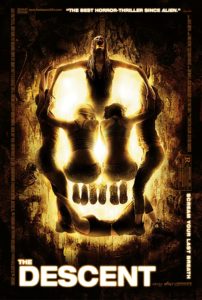
Thusly, I saw The Descent, a British movie; you can tell by all the British accents, and by how the bulk of the film in the Appalachians contained neither overalls nor banjos to any degree at all. After an opening scene fraught with both tension and tragedy, we pick back up a year later with our band of intrepid and extreme female adventurers meeting up to explore a cave system and bring their sisterhood closer together than ever before. Only, instead there’s a cave-in followed by the mysteries of the earth, which mostly include dire personal revelations punctuated by bloody murder. From, you know, human cannibals evolved to underground living over thousands of years. I mean, I complained about the lack of banjos, but I have to admit these people do understand the basic nature of the Appalachian region.

Take one small part The Cave, one small part Carrie, and stir it into a bowlful of How the Blair Witch Got Her Groove Back, and you have this movie here, about which I regret absolutely no part of my experience. Watch especially for the dramatic framing in the last several scenes, about from the point where our heroine Sarah steals River Tam’s pose at the end of Serenity until the very end. If it wasn’t for the fact that I’m sure the director intended them to be serious moments of character growth and breakthrough instead of the sheer hilarity that they actually are, I think I could have a new best (film) friend.

A Feast for Crows

Way back toward the end of last year, I got the fourth Song of Ice and Fire book. I was nowhere near ready to read it yet, even by my piles of to-read books standards, but on the other hand, sometimes books will be more discounted in the first few weeks than later on in the first few months, and it was anyone’s guess when I would be ready to read it. Thusly, action! In the form of buying a book from a bookstore, I mean, which some people might fail to characterize as an action-laden event. Nuts to them!

Let’s fast forward to a few months later, when I am in fact ready to read A Feast for Crows, fresh as I am from my rereading the rest of the series. Actually, though, that would be useless. ‘Cause, hey, look, there’s a book I haven’t read yet. How am I supposed to say anything meaningful about it? Answer: By going just slightly further ahead into the future, which is to say my recent past, when I finished the book. I’m a problem solver, you know. That’s how I got re-employed and all. Well, sort of. That is the field into which I got re-employed, though it’s possible that the talent also played a role in resolving the joblessness, too. Post-event analysis is a job for people who are not me, though.

Anyhow. Good book. I was wrong in my prediction of it being Sansa’s, though I certainly feel the girl has improved to a tolerable character. Considering that other people who improved to merely tolerable in previous volumes are now downright likable and interesting, I choose to take this as a good sign. Really, though, the book is Cersei’s. Despite certain unrelated characters and events, the bulk of the story is about the way she handles rulership of a kingdom shattered by war, famine, and soon the winter of endless zombies (perpetual motto: We’re going to be huge in the next book, honest!) Without going into spoiler-laden details, allow me to just say that I found her arc (and all of the arcs that whirled around hers, most notably Jaime’s) entertaining from start to finish.

Thematically, it’s every bit as dire as the title proclaims. Our continent of Westeros is teetering on the brink of eternal night, and even now, basically nobody realizes anything is particularly wrong. On the one hand, I’ve enjoyed the blindness theme immensely. On the other, the duration of it, despite being reasonable from a plot perspective, is starting to grow to Jordanian proportions. You can only have so much anticipation sans payoff before it starts to become burden instead of a delicious tease.

The next book, due out sometime in the next 6 months or so? Maybe? contains most of the characters I enjoy the most (although there are certainly a couple I enjoy in this one, lest you think this is actually a complaint), so I’m pretty excited for it to come out. On the downside, if I understood the structure of this pair of books correctly, not enough time is passing in the world for the amount of time that’s passing out here in real life between books. To cover what was supposed to be an unreferenced five year gap in events, Martin is going to have spent six or seven years in writing between the two books. Although the pace appeared to have picked up by the end of this one, that is still very much not an efficient timeline, and what with the rash of mysterious soap opera diseases that have been striking authors down lately, well, that makes me all the more concerned.

Mostly unrelatedly, I bet the new yearly Erikson is out. I ought to look into that.

Burnt Offerings

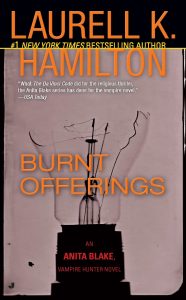
I had this whole big plan, I remember distinctly. Stay away from the vampire nearly-porn stuff for a little while. Alternate between the stack of hardbacks and the stack of graphic novels, knock out several reviews in a reasonably short time as a result. And, okay, the last part is likely to occur, or at least no less likely. But the problem with being on a plane (aside from all the motherfucking snakes, I mean) and not checking any bags is that it’s not worth it to try to bring along an unwieldy and damageable graphic novel when you could bring along a cheap paperback instead. And so, regrettably, I have read another tale of the exploits of Anita Blake.
Regrettable is an easy word to throw around in this context. For one thing, the vampire porn classification is getting to be more overt with each one I read. On the inside, sure, obviously, but I’m talking about the covers. Time was, I could pretend like it was detective fiction that happened to include the undead, and all was well. But it’s just really obviously porn to even casual passersby at this point. My street cred, always a precarious proposition at best, is taking a real hit lately. And then (getting back to the book’s steamy innards) the porniness quotient, vampire and otherwise, has risen as steeply as I was afraid it would after the last one. If the descent continues, it will be a romance novel next time, and the one after that should have its own special section in the used bookstore where the children can’t reach it.

Here’s the bad news, though. The paragraphs above do not contain my largest complaint about Burnt Offerings. Sure, okay, I was able to buy into it when our heroine graduated from ‘able to raise zombies’ to full on necromancer, with power over all of the dead. And I thought it was kind of cool in the first few books when all of the loose ends came together in a couple of climactic chapters despite seeming a Gordian mess just pages before. But now the girl is getting into all kinds of ridiculous abilities that are simultaneously overpowered and nonsensical, and simultaneously the plots are starting to feel like Ms. Hamilton has a page limit that she’s accidentally bumping up against (perhaps due to all the new and delightful sex?), which causes her to wave her wand of plot resolution and end the book on a dime. Not a good dime, either, one of those buffalo wooden dimes that are fake and worthless in every way, and by the end of the stock show you just find them laying on the street because nobody cares enough to hold onto them. Hell, not even that good. We’re talking buffalo nickels, here, people.

Oh, in case you care, the plot was about the visit of the vampiric master council, who are apparently in charge of all things vampire? Only, I guess not really, since they’ve never been mentioned before and seem to have little or no influence in America, just the Old World. That, and a pyrokinetic is maybe setting some fires around town, so Anita should help with that, since… well, for some reason. Maybe necromancers can squirt a lot of…. while I was typing that, the thought took an unfortunate turn in my head, so I’m going to stop now. Later, in what I hope will be a large number of months from now, fear for me when I get around to reading the next one, if it’s anything like this. ‘Cause, wow.

Kushiel’s Scion

From time to time, I browse my local Half-Price Books. Well, more accurately, there are two that are right close and another that is along a path I follow with semi-regularity, and I tend to be in at least one of them at least once a week. So, you know, a lot. I’ve always been okay with used books, and the thing where I have a lack of income has turned that into something more like necessity. But, my point is, regular freaking customer here. So when I saw a hardback copy of a new Kushiel book from Jacqueline Carey, completely without having been aware that the series was set to continue, I just snagged it and went. Only later did I learn of the unlikelihood of finding a used copy of a book that had only been out for about a week. So, hey, neat. Go, me!

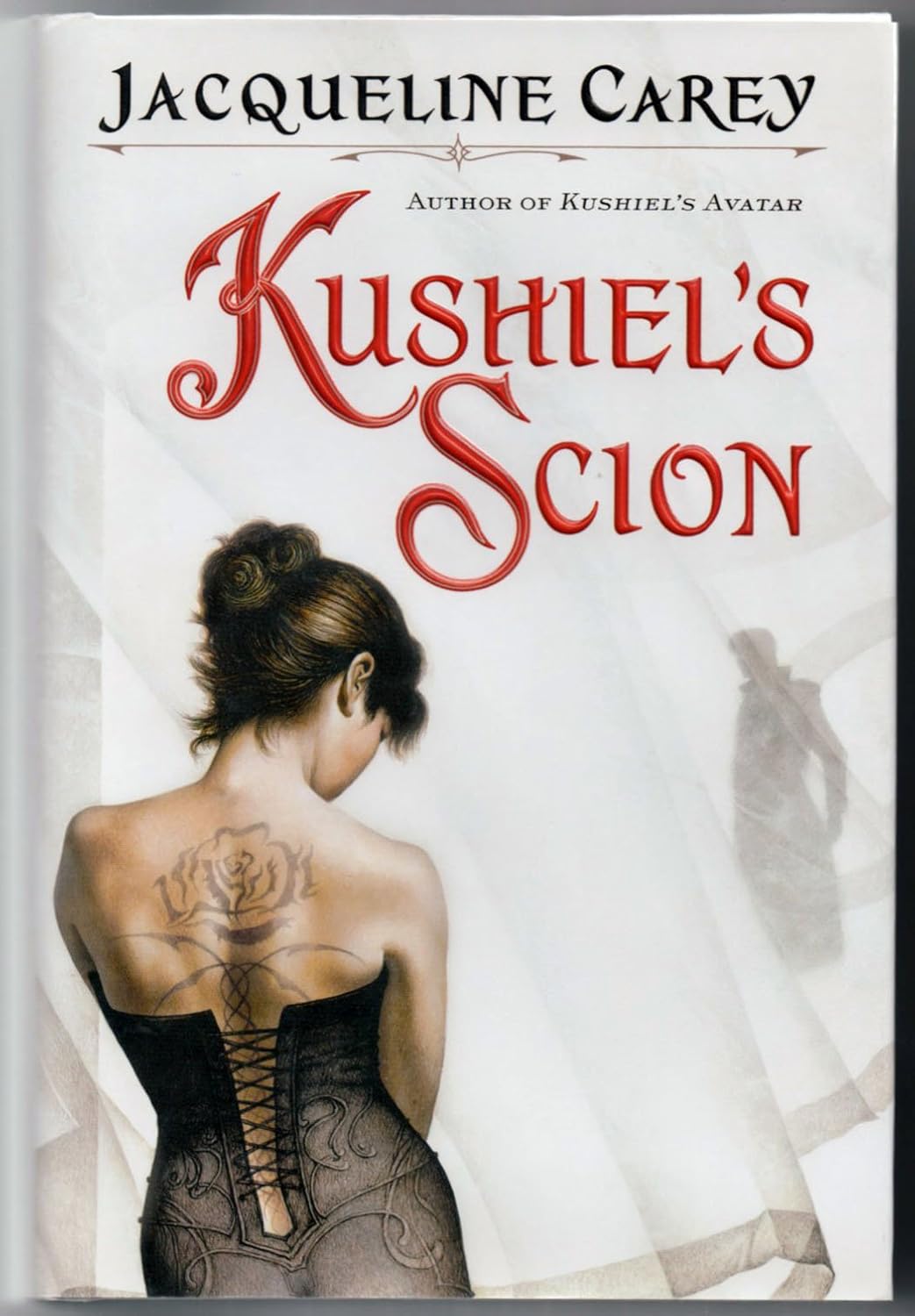
And then, a pair of incredibly busy weeks made me not only read it more slowly than one might guess, but also resulted in the review being a solid week late. The details have faded a little bit, but I can only assume that Kushiel’s Scion is about the further adventures of Phèdre, discarded child, high class prostitute, and now peer of the realm as she attempts to select and customise an incredibly ugly and inexplicably popular rectangular car without bankrupting her beloved Terre d’Ange or allowing the swirling intrigues of the court to distract her from her goal. Or, possibly, it’s about something else?

So, yeah, no. In fact, it’s about her adopted son Imriel, whose legacy is nearly as convoluted as her own. Birthed as part of a plot by his infamous mother and Phèdre’s longtime adversary to steal the throne for which he is third in line, raised unwitting of his heritage or rank in a remote monastery, kidnapped into slavery and sexual abuse at a tender age (completely coincidental to his past), and now raised to adulthood in the household of the most famed citizens of the modern age, our young Imriel has had a lot to overcome. And this book is as much about overcoming it as it is about introducing the hero of a new trilogy full of the same style (and, I think, quality) of political intrigue, lush travelogue and vivid characters that made the original so enjoyable.

Best of all, it being an introductory novel in no way hinders any of the other qualities one looks for in a book. You have the tried, true, and almost never trite trope of exploring the present by revealing aspects of the past. You have a tightly contained and incompletely explored thematic question of what it really means to be good, a question that haunts Imriel daily due to the dark passions that came to him through his bloodline and his fear-disguising hatred of his exiled mother. And lest you think that ‘incompletely’ indicates a criticism of some kind, let me hasten to assure you that the opposite would be the case; the temerity to consider such a complex question as solved would be the point where I’d think far less of an author, rather. And you have an excellent hook into what promises to be an even stronger second entry. The downside, of course, is that I’m once again in the middle of an ongoing series I’d thought closed off and complete. But, you won’t find me complaining too loudly about it. I’m a sucker that way.