Tag Archives: fantasy

The Unwritten: Tommy Taylor and the Bogus Identity

The first thing to say about Tommy Taylor and the Bogus Identity is that it is undeniably a rip-off of Harry Potter. The second, more important thing to say about it is that while the first thing I said is not particularly true, I do have the sense that Mike Carey was trying[1] to pull off a comfortable homage before he yanked the carpet out from beneath the reader’s feet, in much the same way that The Wheel of Time rips off Tolkien for about 100 pages. Which is to say, I have started (and more importantly, will be continuing) a new graphic novel series, this time on loan to me instead of on loan from me. Still, I may well buy them too, ’cause, they’re good.

Unfortunately[2], I don’t really know enough to say where The Unwritten is going as a series. I know it is playing with the role of literature in life, in a mysterious and (to me, but I’m a sucker for lit-as-pop-culture) exciting way. I know that the main character is a little boring right now, in the way that characters who stand in for the audience always are, but I am extremely interested in two of the secondary characters and also I trust that Tom Taylor will coalesce into a real person once he gets his feet back under him[3], so that doesn’t bother me right now. And I know above all that I want to know more. Plus, perfectly satisfactory art if you care about that kind of thing. The introduction by Bill Willingham of Fables fame (while overselling the book to the point that I got halfway through it before I was sure if I was in or not) indicated I should know who Peter Gross is, but I don’t. Possibly you do?

[1] and I daresay succeeding
[2] at least in one sense, completely awesomely in another
[3] After all, Carey pulled the rug out on his audience-stand-in at the same time he did the audience, pretty much by definition.

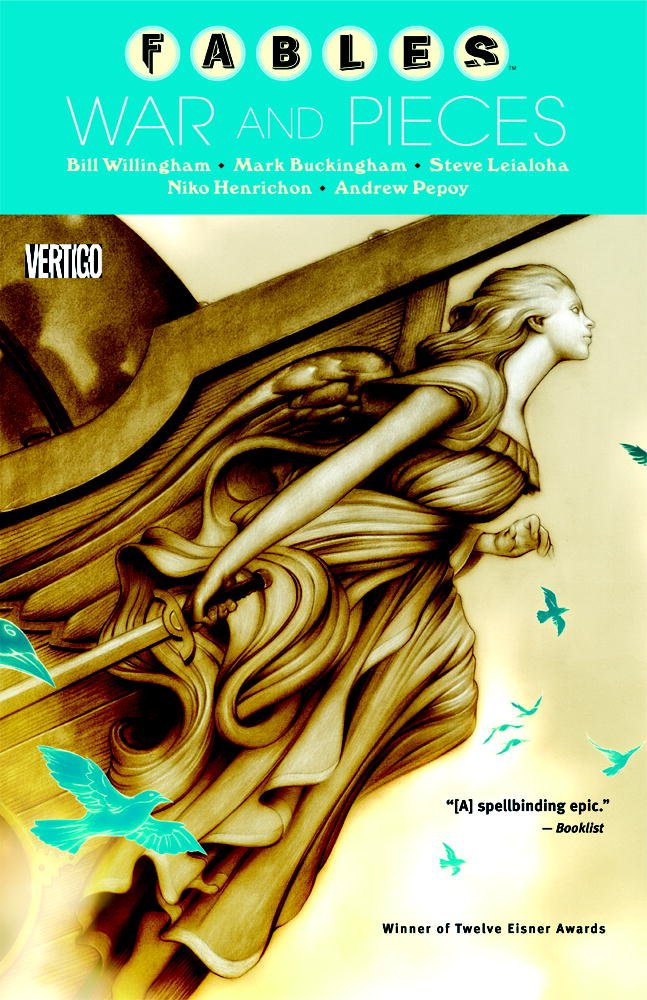
Fables: War and Pieces

717LwHDwIOLA little bit hard to believe: I am still more than three years behind on the Fables series. There are just a lot of these, you know? It’s not that I mind being behind, especially when I compare with having to wait six months for every new Walking Dead. It just caught me by surprise that it’s as far as all that. I suppose it caught me even more by surprise when twinned with the realization that this book marks the climax the stories have been building towards since basically the very beginning.

Yep, true story. The Fables of Fabletown, around a brief spy-heavy interlude that I kind of loved, have launched their long-planned war against the Empire that drove them out of their homelands lo these many centuries past. And as you can probably see from the title, War and Pieces, that is the main focus of the entire book. Which is as it should be. So I guess what really surprises me about being three years behind is that this is the kind of war where it’s hard to envision what comes next. Either Fabletown loses, its back broken and our mundy world now ripe for plunder while the survivors fight a desperate holding action and things get really grim, or else Fabletown wins, and, well… this is what they’ve been working for all along. What comes next? Apparently, three more years’ worth of stories, minimum, either way. When I figure out more, I suppose I’ll let you know.

Jack of Fables: The Bad Prince

It had been so long since I last read one of these books, I was convinced I didn’t remember anything about the series. Luckily, I could remember two plotlines and had only read two previous books, so apparently I’m okay after all. But still, there’s a noteworthy gap, and I’ll be more careful in the future.

So, anyway, Jack, right? I’m not sure whether I should care about the ongoing plot of his personal arc, since it is so obviously a low-key romp with little or no seriousness or long-term impact[1], but it was certainly visible that he was mostly hijinx with brief reminders of the plot tacked on this time instead of the plot itself. The hijinx revolved around getting a slightly clearer picture of his place in fabledom as well as of his history, while only incrementally advancing the potential long term plot via the clarification of powers above the fables and via hints about Jack’s son, if such a creature still exists.[2]

But then there was a thing that made no sense at all, and it was the title. Unexpected cloning, sure, potential Fable Creators, okay, more devil-dealing than you can shake a pointed stick at, absolutely. But if there was any kind of prince buried in the book, much less a particularly bad one? I’ll eat my hat. And I can assure you, it’s a fantastic hat that I would regret losing quite apart from the digestive issues.

[1] The truth is, this book makes me question that assumption for the first time. We’ll see I guess!
[2] Spoiler alert: I’m betting yes.

Backlash

star_wars_fate_of_the_jedi_backlash_frontcover_large_uz9CMVYuUc5x3R7While trying to remember the name of this book so I could find a link on Amazon, I determined that the series is almost completed, despite my not even having reached the halfway point. Does this mean I’ll suddenly start reading a lot more Star Wars books? Y’know, probably not, it’s not like anyone talks about them such that I have to avoid spoilers; if anything, I’m the one who’s guilty of them. It’s hard to avoid spoilers in my own reviews, because the continuity is so massive now. When I talk about Ben Skywalker’s brief period as potential apprentice to a Sithlord who happened to be his cousin, you’d be all like, “Wait, what? What Sithlord? What cousin? Since when is there a Skywalker named Ben?” Kind of enormous spoilers for events like 10 books ago, and yet necessary backstory to understand some of his motivations in Backlash, as he and his exiled father[1] try to prevent the Sith apprentice they are following from both returning to her leadership with news of a very powerful Dark Side creature they all encountered in the last book while simultaneously helping to end a long-standing wrong on the planet of Dathomir. Oh, and while laying the groundwork for future romance, I predict!

It’s funny how much this series reminds me of an episodic TV show like Burn Notice, or episodic book series like the Deathlands. I mean, don’t get me wrong, the connective tissue in which we are apparently to learn the Fate of the Jedi, politically as well as spiritually[2], is certainly interesting. And the non-Jedi politics are also a thing about which I… well, okay, I mostly don’t care who’s in charge, and the maneuvering is a little infantile after having just re-read the entire Song of Ice and Fire series to date over the summer, but I still rarely get tired of that kind of fiction. And you can always count on Han and Leia to get up to interesting things, regardless of what the story is notionally going to be about. But after two long series in a row, one with twenty books about extra-galactic invaders and one with nine books about that Sithlord, an episodic series with connective tissue feels a little bit like stepping backwards into the mid ’90s when none of the authors had a plan or any kind of interaction with each other as they stumbled from one event to the next to another one two years in between the first two, in the days after the fall of the Empire.

And don’t get me wrong, they only let pretty good authors write these books now, and they all collaborate extensively, so it’s not like I’ve read an actually bad Star Wars book anytime this decade. It just still feels weird to have so much looser of a plot arc than usual, is all. I find myself hoping for some kind of societal collapse, which I know is not okay, because billions of sentient beings would die or fall upon dire straits. Nevertheless, the wild and woolly days of the Empire, with scattered, ineffective Jedi and a struggle against overwhelming odds were a lot more fun than these struggles to maintain the status quo. Whatever the Jedi used to be in the Old Republic, they aren’t that anymore. Too many people remember too many failures, and as long as books keep being written in this time period, there’s never going to be a generation of peace during which they come to represent the old days, so forcing them to weather scandal after emergency just makes them look more and more small and sad, and I’d rather see roaming Jedi deciding what’s best for each situation on an individual basis than an Order that is as decayed today as the Senate was during the last days of Chancellor Valorum’s reign.

Huh. This is not the review I expected to write.

[1] Oh, you know. Don’t pretend.
[2] You may recall that a) they are on the outs with the current government after the big Sith thing I mentioned earlier and that b) some of them are going crazy, with virtually no rhyme or reason and certainly with no cure.
Fables: The Good Prince

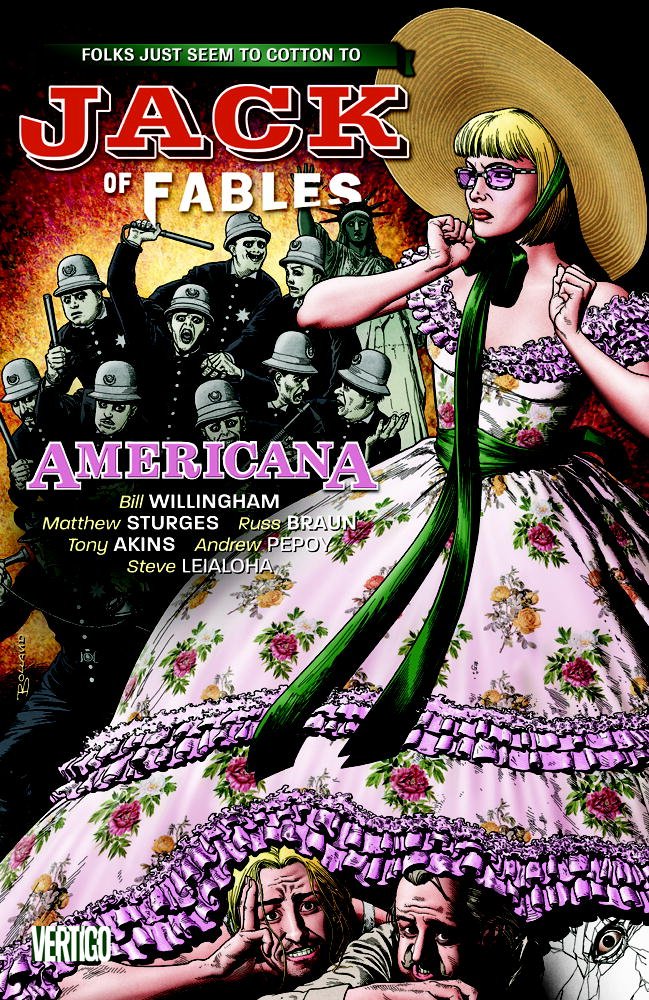
I am having trouble coming to grips with The Good Prince. Not because there’s any question of it being good; if anything, it was the most fable-like story of any long arc I’ve read in the series. I started to point out that there’s a twist where the most unlikely character of all blah blah blah, but the truth is, that is as fable-like or moreso than every other aspect of an extremely fablicious storyline. But at the same time, that’s my problem; if it looks like a happily ever after is in reach (and I’m not saying one has happened, but I can see the road from here to there), does that imply[1] that there’s going to be a sudden, dramatic (and rather unlikely) reversal of fortunes? Or is the series going to be about something else entirely than what it has been about for the last good while?

Then I remember that it wasn’t about this war with the Adversary for the first two or three books, and I liked them plenty, and I stop worrying about it. So maybe less grip-trouble than I thought?

[1] I should add here that there are a lot of books left in the series before I catch up to present time, and it’s still being published.

Harry Potter and the Deathly Hallows: Part 2

To the extent that there is a problem with the final Harry Potter movie, it is this: being split in two was a mildly unfortunate design choice. Because… I mean, okay, cool, this was an incredible summer movie, with non-stop action, split occasionally by tension-breaking humor or revelation after revelation, and I have no complaints about it for itself. (And for the record, I have a hard time imagining anyone, newcomer or longtime reader, being disappointed. Sure, the story gets a little weird at the end, but the only problem with the pair of films as adaptation is that it reminds the viewer how much better the fifth and sixth films (well, mainly the fifth) would have been served by an extra hour or two.)

It’s just that, when comparing it with the tight-focused character drama of Part 1, it’s impossible not to notice that what could have been an admittedly far-too-long movie that had just about everything any movie could need is instead two movies, one that interleaves magic and mystery with some of the best ensemble teen acting I’ve seen[1], and the other that interleaves magic and mystery with, y’know, loud summer explosions. I feel bad, because this makes the second movie sound worse as a standalone than it really is and also because it oversimplifies the situation and leaves some things out. But it’s still fundamentally true. Sorry it’s probably too late when you see this to get a double feature, as that’s clearly the way to go.

[1] It doesn’t matter that they were possibly early 20s by then, dammit.[2]
[2] Because, that’s why.

Pirates of the Caribbean: On Stranger Tides

I glanced at my reviews of the last couple Pirates movies, and they are a lot more positive than I remember the movies in my head. I wonder which of us is right! My point being, who can say how well you and / or future me can trust this forthcoming review of the fourth poncy Johnny Depp vehicle? Oh well, we’re both here, may as well read it anyway.

So, I have a few disconnected thoughts, and they are presented here in no particular order. On Stranger Tides demonstrates better than I remember the other movies having done that pirates, by and large, are bad people. Not so bad that I wish I hadn’t watched the movie, but I felt slimier than I really wanted to, once or twice. That said, the action set-pieces did a good job of distracting me from that sporadic feeling, much as they distracted me from what were at the time glaring plot holes, most of which I’ve forgotten since, which just goes to show you quite how successful said set-pieces were. The action wasn’t the best in the series or anything, because they’ve always been amazing. But it was absolutely at the same level of quality, minimum.

Two events stood out from the rest, though, and neither are spoilers, so I will tell you them! 1) Impressive use of the Greek literary technique, deus ex mickina. 2) Disturbingly spot-on interpretation of the Japanese dolphin capture / killing bays. (There’s a documentary in the last year or two, if you have no idea what I’m talking about. The descriptions have convinced me I would hate watching it, though.) But anyway, yeah, this was pretty good. Oh, right, some people want an inkling as to the plot, I forget that sometimes. What is is, is they’re looking for the Fountain of Youth.

Fables: 1001 Nights of Snowfall

The title is so obvious in retrospect, and yet I really didn’t anticipate the Arabian flavor of 1001 Nights of Snowfall until I read the first page of the book. After that, of course, I got to sit back and enjoy several stories of the history of the Fables before and during the War with the Adversary, even if not four (or, okay, even three) figures’ worth. And there’s not a whole lot more to say after that, though I found the secret histories of Snow White and Frau Tottenkinder[1] to be very entertaining and fully worth the price of admission. That there were in fact several other good stories, well, that’s good news too.

[1] That may not be her right name,and you may not know who I mean anyway, but she was once a witch who lived in a gingerbread house, if that helps.

Tiassa

Man. I love reading series, because you get the continuity of setting, and characters grow and change and develop over time and you get to see the outcomes of those as well. It’s I guess like the difference between a snapshot and a film. Or more accurately, between a film and a lifetime. But every time I need to review a book in a series, and that series has gone on longer than a trilogy or so, well, those times make me pretty frustrated. Because it’s virtually impossible to provide much information that isn’t rife with spoilers. I’m sure this isn’t the first and won’t be the last time I make such a complaint, but it bears saying.

Anyway, though, Tiassa, which title in the Vlad Taltos series has been one of the most anticipated of which I am aware, thanks to the main character of the Khaavren Romances series that parallels Vlad’s own being from the Dragaeran House of Tiassa. This either makes perfect sense to you if you’ve read either series or none whatsoever if you have not. So you see my dilemma. But if you have, you won’t want me to say much more, and if you have not, I think I can pretend like I would be telling you what to think about the book, sure, beyond the obvious statement that you need to go read Jhereg instead. See, there’s this guy, Vlad Taltos, who has at various times in his life been a crimelord, an assassin, a husband, a defender of the world, and a man on the run. And a number of other things as well. He lives in an empire peopled mostly by another species who deem him a second class citizen on good days. And these books tell the story of his life and/or the empire in which he lives. This particular book tells a story about a silver tiassa statue[1] and the swath it cuts through various events in Vlad’s life and through the future of the Empire. Also, Vlad and his fellow guest narrator each have fantastic narrative voices, which are not to be believed ever, even though sometimes they accidentally present an accurate picture of events.

You know, I really think I’m going to start re-reading these books. It has been way too long on most of them, and I’ve forgotten way too much, and it will be by-gum worthwhile. (Yeah, I have no idea when either, nor whether the previous statement will result in anything like accuracy. Which is not unlike listening to Vlad, come to think of it.)

[1] The Houses of the Empire are named after and share certain traits with animals that have been previously anthropomorphized by the Empire’s progenitors.

Your Highness

Stoner comedies, right? They vary wildly between the kind of thing only stoned people can enjoy and the kind of thing everyone should ought to dig, even if the stoned people will laugh harder. (I’m thinking here of Pineapple Express, which is apropos, since this was made by and stars many of the same people.) The point of all that, of course, is to allow me to place Your Highness onto that scale, right? Well, it’s somewhere in the middle, and while that’s not was I was hoping for, it’s not a terrible place to be either. (Although I should also say it’s kind of misframed by the title and previews and may not be a stoner comedy at all.)

The bright side, though, is that it’s really quite good as a fantasy adventure movie, enough so to surprise me. James Franco is an infinitely likable hero-type who must ride forth to rescue his girlfriend from the tragically underused wizardly nemesis, with the help of his jealous brother Danny McBride[1], his brother’s manservant, and also warrior-small-p-princess Natalie Portman, who really has been in a lot of movies this year. There’s a prophecy, a magic sword, a ton of cool special effects, and a standard yet well-presented story of personal growth.

I guess my point is this: if you are looking for a decent-but-not-brilliant fantasy movie that is frequently funny to boot, this is that film. If you are looking for a full-fledged comedic send-up of the swords and sorcery genre, you’ll probably have to wait for Simon Pegg to write one.

[1] You’ve seen him in stuff even if you don’t know it yet. This may not be his break-out lead role, but I expect he’ll have one such any time now.