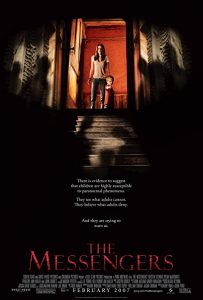
The Messengers

The last few years have seen a resurgence that I thought video had killed entirely. There have been a lot of decent to extremely good horror movies, multiple per year. And they just keep happening. I feel like a kid in a candy store some days, when I’m watching movie previews. Creepy, scary, bloody, occasionally naked… everything a movie should be. Well, maybe more naked.

Case in point: The Messengers, in which a family of erstwhile sunflower farmers is terrorized by the same dark forces that drove off (or much more likely killed) the previous inhabitants. Spooky Japanese-style ghosts crab crawl all over the place, frightening the teenage girl and mysteriously silent toddler while leaving the adults unscathed. Well, the mother has a recurring stain to clean. The point is, spooky stuff is happening, and the adults aren’t listening. Even handyman John Corbett, while sympathetic to what our young heroine is going through, has nothing to add in the way of evidence of ghostly happenings.

Also, there are a lot of ominous crows flying around. Like I said, pretty decent movie, marred primarily by my concept of one character’s role being better than the one provided by the writers. By the time the ending had somewhat disappointed me, I was already sold on all the good stuff that had come before, so that was okay.
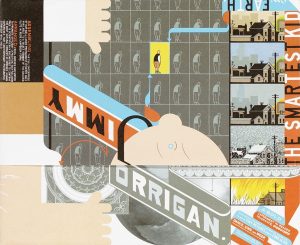
Jimmy Corrigan: The Smartest Kid on Earth

I think what keeps me from reviewing this graphic novel is the fear of being sucked back into the depression of it all over again. So I sit here staring at the blank screen that is in one incarnation or another over 24 hours old now. Which I’ll have you know isn’t all that uplifting itself, even by comparison. Therefore, I’m going to buckle down and power through it.
So there’s this dude, Jimmy Corrigan, right? He is named after his grandfather. In one timeline, adult semi-modern Jimmy is slouching towards middle-age in an apparently dead-end job with only his nursing home resident mother for real human contact. In the other timeline, young James is trying to survive his abusive father’s daily tirades while navigating the casually racist turn of the century Chicago school system. Both of these people are missing a parent, both of them are desperately unhappy with their circumstances, and both of them are due for a gradually worsening spiral from these rosy points of origin.

Without all of the misery bringing me down, there would have been a lot of interesting things to take note of. For example, the women in Jimmy’s life almost never have faces. (Notably, the only ones that do are women that James has seen.) Both men have vibrant fantasy lives; James’ allows him to briefly escape his genuinely tragic circumstances, while Jimmy’s is mostly farcical reimaginings of how his life might be going instead, each of them ending more pathetically than the already quite low reality. I suppose the point of the exercise is to watch each of them gradually get past their current lives and into a better place? I will opt not to reveal the secret answer to this question. I am willing to divulge that Jimmy Corrigan is not the smartest kid on earth. In fact, that may have been an example of this newfangled irony thing I keep hearing about.

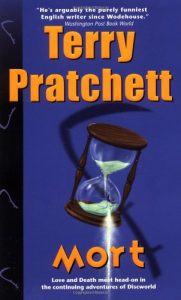
Mort

41Q2E9H3D0LI have purchased more than half of the Discworld books by now, but I haven’t read any in a long while, because of a continued failure to find the actual next one. Then, last month, I finally did, which means books and books stretch before me before I need to have found the next missing link. Which is nice. I like it when little stresses disappear. I mean, it shouldn’t be a stressor at all, except that I wanted to read the books. So, then.
Also good is the book itself, Mort. For one thing, it is unquestionably funnier than its predecessors, relying a lot more heavily on situational humor rather than bits of random oddness. The random oddness is there, as it should be; it just isn’t the centerpiece. Also and perhaps due to the same root cause, the story is a bit deeper than at least the first two, if not necessarily Equal Rites. In Mort, our titular hero takes a most unusual apprenticeship and learns that even the least common of jobs can have their ups and downs.

Okay, that was trite even for cover-copy, much less a review. It’s like this. Death (the anthropomorphic personification, thin fellow, carries a scythe) opts to take on an apprentice, pass on the trade as it were. Mort learns the importance of the job that might one day be his, Death learns the importance of a vacation, and the reader learns, at excruciating repetition, the way that light and dark work on the Disc. But really, other than that (which I’m sensitive to after the last Anita Blake book), this was a fun, breezy book. The breeziest examination of causality and predestination I’ve ever read, in fact.

Smokin’ Aces

So here’s a discovery. Ever since I started reviewing stuff, I’ve been more apt than previously to only see something I’m pretty excited about seeing. I hadn’t really noticed that trend, until last weekend I went to a movie wholly because someone else wanted to without much impetus of my own, only to discover that I’ve been able to come up with nothing much to say about it for at least three days now. Which is kind of sad when you consider that I still enjoyed it; it just didn’t seem to give me any kind of craggy surface to latch onto and get an impression from.

Smokin’ Aces is one of those collision course films. You take a lot of different characters, wind them up, point them at some common target, and watch the body count start piling up as they inevitably interfere with each other. In this case, magician Buddy “Aces” Israel is the common goal of a number of assassins, a few bail bondsmen, and an FBI protection team after word leaks out that the mob boss Israel is scheduled to testify against has promised to pay a million dollar contract to The Swede when he brings him Israel’s heart. Bloody violence, games of cat-and-mouse and occasional hilarities ensue. Also, it’s the Nevada mob, so there are a lot of hookers.

The film doesn’t have a lot of depth, which is okay; it’s not supposed to. It carries you through sheerly by force of adrenaline. In fact, the only bad thing I can say about it is that the closing reel has enough depth that it feels like part of a different movie. But if you can forgive that, there’s a reasonably star-studded list of journeyman actors and a beltload of bullets to get you from start to finish. If you’re cool enough to get past the velvet rope and the bouncer at the door, that is. It’s just that kind of movie, and it knows it full well.

The Walking Dead: Days Gone Bye

Despite how it looks, I don’t read only on the weekends. It’s just that the graphic novels have a way of going fast, and especially so if I happen to be reading them on Saturday, aka “nothing breaks at work because nobody is messing with the network day”. So I suddenly find myself with free time on my hands, not all of which can be filled with illicit games of nethack. (I can hardly wait for someone at my place of employment to figure out this is me.) All of which is a clever(?) way of introducing a new graphic novel series into my rotation. This puts me at three now, but with a couple more pretty soon.

This one isn’t about the wellspring of mythology or coming to literal grips with religion, though. Nope, it’s about zombies! Days Gone Bye is the first volume of a thusfar ongoing series, The Walking Dead. Kentucky police officer Rick Grimes wakes up from a coma acquired in the line of duty to find that the world he knew has been blown away like a carelessly held handful of dust. Now he has figure out how to survive while civilization gradually winds down to nothing and find his wife and son. And okay, maybe this introduction isn’t that much different from Resident Evil: Apocalypse or 28 Days Later, but let’s be honest. It’s certainly a good way to explain all that early book exposition on how we got here. And from there, it flows straight into Romero territory. Which is a compliment rather than an accusation of plagiarism. Sure, the question is one that Romero has asked in each of his movies: when everything is gone except for the daily, hourly struggle for survival, is it still possible to retain humanity? But the beauty of that question is that it has so many avenues to an answer. About as many as there are people left to define possible answers. Sure, zombies have a special place in my heart (as, I’m sure, my heart would have a special place in a zombie), but this is something you can get out of any good post-apocalyptic story, and it’s a big part of why I like them.

Also from Romero territory is the black and white motif. I’m not sure what makes it work so well. Maybe it’s that it causes me to pay more attention to details, whereas my eyes take in color as part of the natural order of things and slide straight to the action. It seems to fit the theme of the world winding down very well, though, with the panels starkly black or white by turns as days and seasons progress. The people don’t talk too often, and that’s okay. Long speeches and angry shouts seem out of place in this world, and not just because it gives the walking dead something to hear and look for. It’s more that the words have run out and only actions have relevance anymore. Which is where those panels full of black or white come back into it: every word spoken feels as much of an intrusion onto the art as it does into the silence of the dead civilization or into the grief of our characters at each new or newly discovered setback.

Me Talk Pretty One Day

Is there any book quite as intriguing as the loaned book? I mean, don’t get me wrong: I’ve devoted the majority of my life to the premise that owning books is awesome, pretty much since I had two coins to rub together. But the thing about someone loaning you a book is that they liked it so much that they are compelled to share it, and that they see a commonality in you and really believe that you’ll love it every bit as much as they did, if not more. That’s deep, meaningful human contact right there. And spiritual, too. They are giving you of their own book, that you might read it and think of them. It’s, like, The Last Supper, but without as much bread, man!

…too far? Anyway, my point is, I approve of this practice between people.

As you may have worked out by now, this most recent book was a loaner. Me Talk Pretty One Day is a book of essays by David Sedaris, who apparently is a reasonably well known essay writer. (At least, he’s in the top 5 or 10 people I see mentioned on eharmony, behind Dan Brown and that guy that pissed off Oprah and five heavenly dead dudes.) I was very amused to discover that his sister Amy is in fact actress Amy Sedaris, though. Anyway, books of essays aren’t really my thing, generally speaking. And it would be difficult to make the claim that I have much of anything in common with a 40-something gay art guy who spent most of his life in New York and Paris.

And yet, he grew on me. There’s just something about his voice as he describes his misfit childhood and drugged out youth that gradually converted my tolerant smiles into quiet chuckles, and by the time he got to the second half of the book and his expatriation to France (for example, right now I’m having a chuckle at how he’d hate it being characterized that way), I was bursting out with sharp laughter once or more per story. I’m pretty sure this doesn’t indicate that the early stuff in the book isn’t as polished; like I said, he grew on me. I think if I went back and read it from the start, I’d find a lot of it more funny now. I’m not likely to any time very soon, but I expect I’ll try to borrow one of the others before too many books have passed. Because if loaning is a great way to say ‘I think I know you well enough to know this is for you’, reciprocal borrowing has got to be the best way to say, ‘good call, you were totally right’.

Still, though. It might be my bias, but I’m pretty sure the stories that included Amy were the funniest.

Peter Jackson’s King Kong

Back in the hazy, halcyon days of yore, when I had just gotten my ‘siddy, there were a fair number of launch titles I was interested in. And a few I wasn’t, mostly racing games and Perfect Dark Zero, which always seemed kind of terrible and whose demo left me cold. And there was King Kong, which seemed pretty awesome, but outside my then-jobless budget. And then as the months passed, it kept looking kind of old and worn compared to the new shiny games coming out at the same prices. (I’m looking at you, Dead Rising and Oblivion!)

But then, earlier this month, it was sitting lonelily on the shelf at Fry’s for $19.99. That is the exact perfect price to win me over. And as it happens, it’s a price I’m pretty happy with. It’s still a lot prettier than Wii Sports, but when I compare it to any of the last 6 months’ worth of HD games I’ve played, it lacks a certain indefinable something. I’m pretty sure that something is realistic water effects, and wow, behold the snobbery of me! Anyway, aside from that, it was a pretty good game. Maybe slightly short, and maybe slightly easy, but neither in such a way that I felt like I’d lost out on the deal.

As the title implies, it’s almost a straight port of the movie, though with a lot more fighting giant insects and man-sized dinosaurs, and a little more running from T. Rex-y ones. I took longer than I should have to figure out the right way to perform most of the combat. But since I was playing as a script writer turned adventure hero, I don’t mind so much. Also, I’m sure the game would have been a lot easier if I’d been willing to leave areas with any of my enemies unkilled. The play as Kong part suffered from some of the same failure of learning curve on my part, which is less excusable, since I kind of figure he knew how to fight all along. (Though if so, where did all the other giant monsters keep coming from? Shouldn’t they have been dead by now?) Still: perfectly fun game up until the last level, where it suddenly becomes a quagmire of misery and depression. In case you’re not familiar with the game or any of the three versions of the film: nevermind why.

The Hitcher (2007)

Finally, a new local theater. It fails to be as wonderful as the Alamo Drafthouse, but it’s an easy second place among dine-in movie establishments. There must be something about Austin that made that one chain so much more awesome than any of the pretenders. But the Studio Movie Grill has daily menu specials and the occasional special event or limited release film; once they start having themed feasts and more events, it could be a reasonable facsimile of the real thing, until they get around to opening a theater up here. Plus, they have good crowd energy right now; I hope it stays that way, as it’s another good sign overall. The important thing, though, is that Monday is margarita night. I can’t really recommend the blue margarita, as it tasted both weird and not very blue, but I’m looking forward to the sangria one.

Speaking of things you shouldn’t do while driving, the movie on the screen was The Hitcher. It’s a remake of a movie I was aware of, but never got around to seeing. A young couple driving through New Mexico ends up picking up John Ryder, a guy who is in pretty bad need of a ride and who chooses his pseudonyms with flair. And then, instead of just riding quietly and getting out at the motel up the road like he’s supposed to, he starts screwing with their heads. And then he implicates them in a massive crime spree. That sounds kind of cheesy, and his ability to keep appearing in unexpected places as though he implanted His-n-Hers tracking chips in their asses definitely pushes some of the scenes over the top. They made up for that one chink in my suspension of disbelief by keeping the tension locked at fever pitch for almost the entire movie. No matter how deep you think the hole has gotten, they find a way to dig it deeper. And that’s awesome.

Also awesome: the soundtrack. Songs rather than a score for the most part, but the songs were masterfully chosen. Of particular interest is Nine Inch Nails’ “Closer” playing over the helicopter chase. The only particular flaw I can point to is the anticlimacticism of the finale. With another 30 seconds of footage, they could have given the movie a much deeper theme on the dangers of staring too long into the darkness. For all I know they did, though, and it didn’t Test Well. So, y’know.

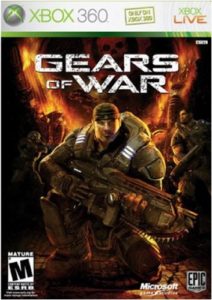
Gears of War

The day is coming when I’ll feel obliged to cross-reference some games with the movies section. The last couple of Zeldas fall into that evolving category, as does Halo 2. As, also, does Gears of War. On a class M somewhere out in the galaxy, humans are living out a reasonably Utopian existence. (Utopia looks like a sidewalk cafe in Paris in the springtime, apparently. If you remove the Parisians, then, fair enough.) The problem with Utopia, in this case, is all the humanoids and beasts living below the surface of the planet who decided one day to erupt onto the surface and smash human civilization. Now, some years or decades later, the military remnants continue their struggle against, um… the bad guys. No, seriously, I can’t remember. Ah, okay, it’s the Locust Horde. (I can only assume they call themselves something else.)
The actual in-game story is quite a bit more awesome than the, for now at least, cardboard premise. A squad of marines is tasked with penetrating Locust defenses to retrieve a potential doomsday weapon that has been lost behind enemy lines when the helicopter transporting it was shot down. Although only two are playable, all of the six or so characters has sufficient depth to be in a video game; that is, you care what happens to them and hope they don’t die. The story being about as grim and post-apocalyptic as it sounds, don’t count on that hope winning out, though.

As far as gameplay? It’s really pretty cool. I felt more present than I have in the majority of first-person shooters, despite it being a third-person. The maps being open enough for true flanking and the easy-to-use cover system make the repetitive parts of the game (where you repel this or that wave of enemy attackers before proceeding to the next such wave) not only tolerable but genuinely fun again, and the non-standard parts of the game where you’re dealing with the things that come out after dark, the unkillable aliens, or the ginormous spider all have sufficient tension and uniqueness of play to rival anything I’ve hooked a controller up to. Plus, yay, it’s a current-gen game, so you don’t have to hook up controllers anymore. And not a moment too soon.

The Good Shepherd (2006)

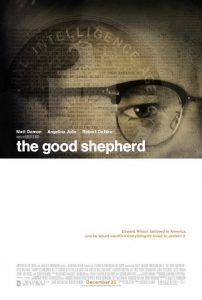
I went to a lot of movies this weekend. Well, three, but three is kind of a lot, I think. One was Children of Men again, and I liked it every bit as much the second time. Another was The Hitcher, which I’ll discuss later. The first one, though, was The Good Shepherd, Robert De Niro’s largely failed Oscar-bait story of the founding of the CIA. I’ve been busy with things as well as stuff, but I also have been trying to let the film marinate in my brain juices so I could figure out what to say about it. It’s three and a half days later, and I’m still really not there yet.

Was the acting good? Yes. Did I like it? I did. Am I trying to fill up an entire paragraph with a Rumsfeld impersonation? I’m pretty sure he was never in the CIA, so that wouldn’t fit the theme; therefore, I will lie and say no. Was the movie too long? Maybe, but it’s a pretty dense subject. I think it comes down to whether you’re extremely interested in that subject, or to whether you care about CIA guy Edward Wilson’s experiences and the effect his devotion to the job had on his family, and the effect his family had on his devotion to the job. Because there’s a really good character study on the question of where cause ends and effect begins hidden in that script, behind layers of Bays of Pigs and deaf girls inexplicably going out for nights at the opera and in-depth studies of Skull and Bones, “the most secret society in America”. For the record, it does a much better job of portraying the character study than of exploring the early CIA, so if you’re after the latter, it probably is too long, after all.