Tag Archives: superheroes

Astro City: Life in the Big City

Never let it be said that I do not leap to grant the wishes of my loyal readers! Or at least, that serendipity does, ’cause my semi-boss semi-randomly loaned me the first two volumes of the Astro City series within a day of when lots of people here recommended I read it soon. And I put loaner books on the top of my reading queue, as you do, which means I have already read one such, and the other is not all so far behind. Astro City has a thousand stories: Life in the Big City is a very episodic series of vignettes about six of them. And they’re really all quite good, but I think the whole exceeds the sum, because they are merely “quite good”, aside from the first one which is basically a meditative work of genius on the negative sides of being a hero.

But taken as a whole, the book has to accomplish a lot of things in a very small amount of space. It introduces an entire world with decades of history, and, okay, since there are decades of comic history and everyone always starts these parallel worlds back in the late ’30s when the superhero comic was born, I suppose it’s fair to say that people have a frame of reference there. But in addition to the world itself, it introduces decades of heroes and villains, tragedies and triumphs, all of which I have learned only enough about to know for a fact that I want to learn more; and yet I will almost certainly never accomplish more than scratching the surface. This is the kind of depth you can’t always count on getting out of multiple volumes of doorstop fantasy series, and it’s just scattered around like leaves in the fall, underfoot and part of the landscape, barely remarked upon from one vignette to the next. And I guess this is why I’m so impressed, because it has the feel of a new author writing stories in a world that has actually existed with decades of continuity all along, this being just the current batch of events; except for how that continuity does not in fact exist. And then the stories themselves take you from the petty to the profound, the average to the alien, and obviously not to every stop along the way, because that would be stretching the metaphor and the praise both a little thin. But at the same time, I can’t help believing that if the series went on long enough, “every stop along the way” would be entirely possible.

Ultimatum: Requiem

If you are anything like me, you are wondering: why did you read so many Marvel Ultimate comics in a row just now? Way more than usual, and also you were kind of pissed, right? Well, the thing is, despite my distaste for the handling, I really had no choice but to see how things worked out for Spider-Man after reading that issue, so finishing up was my only valid option. And here we are.

Ultimatum: Requiem does about what a student of Latin would expect. That is, it sings a song for the dead. At least, that is kind of what it does. Although there are obituaries galore, at least one very moving and many of the rest little more than thinly veiled character histories, the bigger theme tying the three authors and stories together is aftermath. What will New York City be like with its self-appointed guardian Spider-Man presumed dead in the wreckage? Can the Fantastic Four survive the losses they have taken, to their families, to their mutual trust, to their innocence? Will the mutant community survive the knowledge that one of their own became, in one day, the most successful mass murderer in history? What could have been (and okay, in the case of the X-Men, was; you can’t win ’em all) not much more than an excuse to tie off loose ends before the brand changes to Ultimate Comics and new stories begin was instead a chance to acknowledge the wounds experienced by a whole world and put them in a human context. Superhero comics are always about wish fulfillment to some degree or other, but sometimes, they are more. Despite a deeply flawed execution of a tenuous premise, I figure a couple of authors were able to eke that out of even this situation.

(And I’m not just saying that because Joe Pokaski proved me wrong by in fact explaining to some degree what had happened to the Human Torch after all. I mean, it still wasn’t all that interesting, but at least he gets one of the two aftermath wins to make up for it.)

Ultimatum

jpegSo, Ultimatum, right? I’ve been talking about this for maybe longer in real time than Marvel did when they were gearing up for it in the first place. Due to some extremely poorly hidden spoilers that even show up in the titles of graphic novel collections, Magneto is finally sufficiently pissed off at humanity to do something about us once and for all, the major upshot of which is that Manhattan is devastated by an enormous tidal wave, in exactly the style you have seen so many times before. And then, shit goes down.

And the thing is, that sounds pretty okay to me as a premise. The whole world is affected, sure, but New York gets the lion’s share of focus, just as Marvel has always done. But then they screwed up my experience by dividing the story between the Ultimatum issues and the issues of the various series they had in progress at the time. Still, I think I could have been okay with that too, except that the actual event issues, even after I disregard the poor ordering, were… tawdry. Largely, they were a series of strung-together faux-shocking events, one after another, designed for maximum impact predicated upon minimum thought. And even that I could forgive, except that solid chunks of the events have no explanation at all. What really happened to the Human Torch? Did I miss something regarding Quicksilver’s fate, or was it presented as a fait accompli with no prior reference? Does Namor actually have any relevance to anything in the entire Ultimate universe? And since I’ve actually read the entire sequence now, it’s not like I can pretend to myself that these questions were answered or even acknowledged as valid.[1]

Essentially, there were a handful of characters that had a story arc in the Ultimatum event, and everyone else was only present to be trimmed down or because we knew they’d be supposed to be present during a global terrorist event. For the record, Wolverine, Magneto, Spider-Man, and J. Jonah Jameson actually had interesting stories to be told. Oh, and, to my very great surprise, Henry Pym. Iron Man and the Thing did okay. And that’s really all. For the climactic event of a ten year series, that is not nearly enough.

[1] I lie, as I have not completed Requiem yet. But I know I’m right. And even if I’m wrong, making stuff up and explaining it a few months later? Unsatisfying!

Ultimate Spider-Man: Ultimatum

Okay, just to get it out of the way: the Ultimatum storyline is poorly collected across three or four books. (I am hoping across only three, and that the epilogue book will at least have continuity[1] again.) I have read each of the three books in question, so I can say this with authority now, not merely the speculation that marked my last review. As a result, even Spider-Man’s take on the Ultimatum event is kind of disjointed. But here’s what I liked about it. While the other authors were stumbling past each other trying to figure out who could tell which part of whose story and in what order, Bendis got past the actual event as quickly as possible so that he could tell a smaller, more personal story about the immediate aftermath, and not incidentally about the nature of heroism.

The final issue of Spider-Man’s Ultimate run, #133, had the fewest words I think I’ve ever seen in a single comic issue. It may also have been the most affecting I’ve seen. And just to repeat myself, this in the midst of what has otherwise been a useless mishmash of tangled and rarely more than half-complete storylines. But, y’know, I should save a little vitriol for the next review, since this one deserves basically none whatever.

[1] The literary kind, not the years-or-decades-of-plot kind.

Iron Man 2

Iron Man 2: I liked it. That has kind of an epitaphy feeling, which is not precisely what I’m going for, as I decidedly do not presume that it marks the gravestone of a franchise. I think I may be mildly disappointed with it relative to my expectations, though, mostly based on how Spider-Man 2 turned out. ‘Cause there was a pretty great sequel. Still, though, on the whole it was a thoroughly entertaining sequel to an even better first movie, with nothing to particularly dislike about the new execution. Spectacle plus franchise equals success, right?

Also in the win column, Robert Downey Jr. maintains his essentially perfect portrayal of a billionaire superhero who is always secretly dying, having trouble forming real attachments to women, and drinking a lot. (It occurs to me that this may not be an acting job, ‘dying superhero’ aside.) This time he is facing trouble from the U.S. government, a rival military industrialist, and a brand new supervillain that shares characteristics with a couple of people from the comic book, most notably Whiplash. And while a bad guy who can split metal with his special whip may not seem all that interesting in a comic book[1], it works a lot better when he is using Stark’s own ARC reactor technology to create really cool-looking energy whips; also, when he is played by Mickey Rourke. The plot was probably a little bit muddled, but the pace was fast enough for me not to care, when combined with my knowledge that comic plots are often at least a little bit muddled in the first place. But then again, any time you sit me down in front of a movie screen where Downey either gets to be constantly awesome or gets to relearn how to be awesome after some kind of setback, that will be enough to satisfy me regardless of anything else that happens.

Also, if the spoiler-laden transition of Stark Industries’ CEO position never happened in the comics run? It should have. (I mean, the details are spoilers, the fact really isn’t. So please don’t misunderstand this as me having given away the farm, over here.)

[1] For my money, that seeming is fully accurate, though he’s only appeared in one story I’ve read so far and may get better later.

Kick-Ass

MV5BMTc0Mjg4ODc1Ml5BMl5BanBnXkFtZTcwNTUwNjEwMw@@._V1__SX1859_SY893_Here is an interesting true story for you. In addition to seeing Kick-Ass yesterday evening, I also happened to read Marvels (by Kurt Busiek and Alex Ross) the same day. I should probably review it separately, but since I read them as someone’s loaned comics instead of in a book, I have nothing to reliably link to, which is one of my lines for “shouldn’t get reviewed after all”. But also, it makes a very convenient companion piece, and so here we are. So, quick nutshell: Marvels is a four-issue comic that shows stories from the golden and silver age through the eyes of a news photographer, a regular guy who is the stand-in for the audience. Pretty much, a reaction shot to stories that the reader is theoretically already familiar with. A way to show not what being a superhero is like, but what living in a world with superheroes is like.[1]

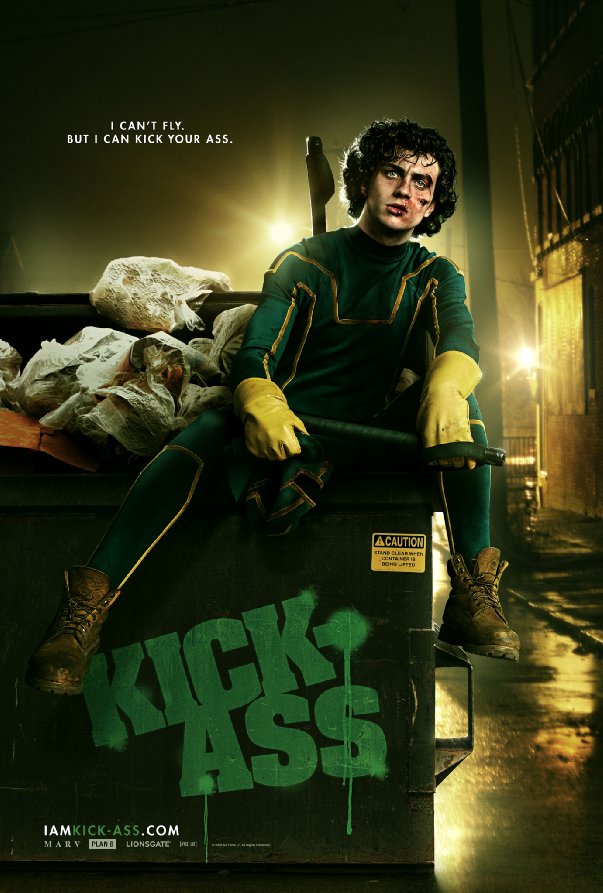
But, anyway, Kick-Ass. It is almost exactly the same thing, except that the world doesn’t really have superheroes (or does it?), and the stand-in character wants to be one. Named Kick-Ass, as you may have already surmised? And I understand that this doesn’t really sound the same at all, but I don’t want to go much further into the plot, because it works extremely well fresh, or at least I thought so. The similarity is that Kick-Ass is in far over his head, in a world that he doesn’t yet know the rules of and has no real power over, and yet he still struggles to impose his values upon it. To the good of the world? To the good of himself? Neither? I say, just as in Marvels, that this isn’t the point; the struggle is.

The only problem with this review is that I’m making the movie sound far more high-minded than it is. I think it is high-minded, don’t get me wrong, but only in the deep undercurrents that I could for that matter be imagining. On the surface, it’s an insane, ultra-violent[2] romp through several origin stories and culminating in an over-the-top spectacle of a battle royale with the supervillain, the way most comic books movies want to be. And it is threaded through with the essential humanity of every one of its characters, the way more comic books and their movies should aspire to, but frequently do not.

[1] It’s also pretty good / recommendable, if that matters.
[2] I am utterly mystified how it got a PG-13 rating.

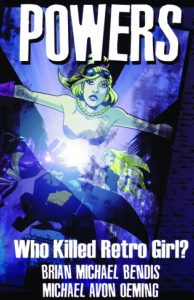
Powers: Who Killed Retro Girl?

Here’s the thing. Either I (via listening to my friends and Amazon recommendations, it’s true, but in this case also on my own merits, since I bought it used and un-recommended) am really good at picking graphic novel series that I will like, or else I am a sucker for the format and just like any of them that I read. I don’t wish to test the theory by picking up something I expect to dislike and seeing how it goes; apparently because my happiness trumps science.[1] I’m not exactly sure how to tell you to calibrate your expectations when I don’t know which of the options is the truth, but at least now you know the pain I go through on a daily basis in trying to bring you as objective of a report as possible.

Thanks to having completed and / or caught up on so many of my ongoing series, I have as implied started a new one: Powers, by Brian Michael Bendis. (Oh, so right, technically that made it kind of a known quantity? I still say my selection algorithm is probably superior!) The simple but fairly cool concept is one I’ve seen a lot of during my years of Marvel comics, only from the other side. In a world full of superheroes and supervillains, the cops still have to solve crimes, keep people safe, generally do their jobs. Who Killed Retro Girl? is a story about that, with the added twist that the big crime that defines the new partnership between police detectives Christian Walker and Deena Pilgrim is the murder of one of these superheroes. Aside from the mystery, it’s pretty much an introductory book in every way: to the world, to the characters, to their relationships, to their antagonists. So mostly, what your interest level will be come downs to whether you like them and their world or not.

I did.

[1] Science!

Ultimatum: March on Ultimatum

Even though there’s still one book left that predates the events about which I am now reading, it has yet to be released in trade paperback size to match all the rest of what I have, so apparently I’ll have to actually find out what’s up with this whole Ultimatum thing, now. Except, technically not quite yet, because despite the branding, March on Ultimatum is really just a handful of new annuals featuring mostly the usual suspects doing mostly the usual things. Still, there is a little big of a finger waggle pointing out that this whole Ultimatum thing is just over the horizon now, which since I’ve known that for months of my time as I’ve been reading along means it must have been excruciating waiting on these titles to release a month at a time, and all of them going on about the inevitable doom for a year or so.

The first pair of stories is the most relevant: the X-Men travel back in time[1] to prevent Reed Richards from doing something that has ruined[2] their future. Although this honestly doesn’t seem to have much to do with the Ultimatum, they at least mention it as an inevitable event in the near future from which these other problems sprang forth. But it’s okay, because I enjoyed the story on its own merits as well as for the characterizations of Ben Grimm and future-Sue Storm. Then there’s a Black Panther story which seems to exist only to retcon my racial concerns from The Ultimates 3. It I suppose accomplishes that, but at the expense of taking a pretty cool character and rendering him meaningless in the Ultimate universe, at which point, how about just not using him instead? Also, there’s a Hulk story that for some reason includes one of the Squadron Supreme character from Ultimate Power and (for that matter) that for some reason includes the Hulk; the less said about it, the better. (I exaggerate, in that it was mildly amusing. But mainly it was spectacularly unnecessary.)

The best of the bunch[3] was the Spider-Man story, which had no apparent tie to anything else at all and was just another large-sized Spider-Man story. It’s just, as usual, Bendis shows a world full of meaningful progress and understandable consequences while everyone around him is scrabbling wildly for plotlines from miserable futures or annoying side-dimensions or the drips and drabs of 45 years of bloated Marvel continuity. For example, the police? They have noticed that Spider-Man usually accomplishes things and are glad of his help. Will that ever happen in mainstream Marvel continuity? Not as of issue 91, I can state with great current authority. (And, okay, this third annual postdates a higher issue number in Bendis’ run, so I’m not being perfectly fair here. But I still don’t expect anything to suddenly change.) Bost mostly it’s a relationship story punctuated by the arrival of Mysterio[4], who plays such a small (and unresolved!) role that I fully expect him to matter quite a bit in the next full Spider-Man graphic novel, predictably named Ultimatum.

[1] Is it just me, or are future timelines just littered with X-Men possessing time machines? Time travel is never a mutant power, and one dark future is never described the same way as the next. Nevertheless, back they keep coming. Persecution complex, much?
[2] And while I’m on the topic of things that are just me: is it, or does Reed Richards destroy every alternate universe / dimension / timeline he gets his grubby paws on? That guy is just a colossal dick. (Though the younger Ultimate version is at least endearing about his galactic failures.)
[3] Prepare to feign shock in 5… 4… 3…
[4] In mainstream continuity, he’s a special effects wizard turned supervillain; here, it is way too soon to tell who he might be or what he wants. But I expect him to not be a mere villain retread, not this late in the game.

Ultimate Spider-Man: War of the Symbiotes

The most recent (and in a way, the final?) Ultimate Spider-Man book is based on a video game. That could be a death sentence in a lot of hands, but Brian Michael Bendis has, through years of solid effort, earned my trust. More troublingly, though, it’s based on a video game that came out in 2006, which by even the least generous of publishing schedules means that its events would be months or years out of real-time date from when these scripts were being adapted. So it was kind of strange to see, at a time when every other comic in the Ultimate universe was getting ready for the big Ultimatum conclusion to everything, the Spider-Man story jump back in time by a month or two for a pretty meaningful story-insertion (or, if you feel bitter about it, a big retcon).

War of the Symbiotes tells of what has been happening with Eddie Brock, trapped inside the Venom suit, or possibly it trapped inside him.[1] The problem of course is that I wasn’t all that interested in Venom the last time I saw him, and he’s only gotten iffier since. But in my experience thusfar, a mediocre Bendis Spider-Man story still makes for a pretty good ride on average, and certainly this one got better as it went along. The end result (courtesy of an additional, unrelated retcon) is a pretty big deal, like I said. I cannot decide if I approve or not; it depends on how it gets used down the line. But I have a feeling I’m not going to find out until after the whole big Ultimatum thing, which I am beginning to realize I will have a hard time taking with perfect seriousness; it’s been looming over my knowledge of the series for entirely too long. But I guess we’ll see!

[1] Even in video games, Bendis is pretty good about providing that minimal amount of depth / uncertainty, about just who the parasite is supposed to be.

The Ultimates 3: Who Killed the Scarlet Witch?

I’m torn on this book, unlike the rest of the internet. (They seem to despise it, and I think it is only fair to calibrate expectations in that way.) But first things first: Who Killed the Scarlet Witch? is simultaneously the straight-forward murder mystery that its title implies and also a means of setting the stage for the upcoming Ultimatum that, so far as I know, I am only two books away from. I can’t think of a good way to add more to my plot summary that wouldn’t be extensively spoilerish, so I’ll move on to the controversy.

On the one hand, I really did enjoy the actual storyline. Both the pacing of the mystery’s unraveling and its ultimate denouement were satisfactory to me. And honestly I think even that, my enjoyment thusfar of the build toward this crossover event thingy they’ve decided they had to do, is a bit controversial. But so be it, some days I am an easy audience. Still, there’s that other hand, wherein a lot of the details went wrong. Like, wasn’t Juggernaut dead the last time I saw him? And was it absolutely necessary to drop in a Ka-Zar[1] cameo this many years into the Ultimate run, and this close to its end? And, seriously, the use of the Black Panther seemed racially insensitive at best. And none of those missteps was necessary to create the plot that I was happy with! So frustrating.

[1] He’s a Tarzan rip-off from the mid ’60s. Not bad as characters go, just untimely.