Tag Archives: science fiction

Red Holocaust

It is clear to me, in retrospect, that I waited too long between these books. (Of course, that’s true of most of my books, but it’s more true when the books are so very light as this, and also I’m facing a quarter-century backlog for the series.) But I have finally read the second book of the Deathlands series, Red Holocaust. When last we saw the one-eyed Ryan Cawdor, pleasantly mutated Krysty Wroth, gun enthusiast J.B. Dix, and the man of mystery known only as Doc, they had escaped vengeful danger of some kind or other into one of many Redoubts, hardened chambers scattered around America that are filled with guns, supplies, and most importantly for our purposes, teleportation rooms.

This new book starts what I expect to be a long-term trend, in which the Trader’s crew will teleport randomly from place to place, find something horribly wrong, and go about fixing it. In this particular instance, the main wrong thing is that the Bering Strait has frozen over again[1], allowing both marauders and an apparently somewhat cohesive Soviet pursuit to cross into Alaska. Since the first teleport destination is also in Alaska, you can imagine that some kind of militaristic event is about to ensue. And I think that is what I am expecting to be the most common path for the series as it unfolds: party teleports somewhere randomly, comes out to discover a situation in need of caretaking, does so, probably loses some members while gaining others, returns, and teleports randomly once more. The draw, therefore, will be the gradual unfolding of the geopolitical situation[2], revelations of character histories, and of course fragment by fragment of the secret of the Doctor, who can’t keep track of a stream of consciousness for more than a few moments, yet who has all manner of pre-war knowledge, both trivial and sublime. Most recently, for example, he revealed that the matter transporters have also been used in time travel experimentation! Dating back to 1930s!

I don’t know exactly why I lap this stuff up, but really, it’s not that big of an investment. A day or two to read a book that would work equally well as a single or two-part episode of a television series, and then onto something else? It’s more than fun enough to pay that price, and thusly I do.

[1] Thanks, nuclear winter!
[2] For example, who knew that Russia would manage to be visibly more together than the United States, a hundred years after World War III? I mean, besides doomsday scenario authors, who I believe were certain of this fact throughout the duration of the Cold War.

Daybreakers

As horror movie season dawns upon us, I find myself with fewer exciting choices than I’ve recently grown accustomed to. (But definitely not none! The upcoming Crazies looks like it could be good enough to make up for some of this lack. Nothing will make up for missing Horrorfest this year, but when they don’t actually have a screen anywhere within 200 miles, I pretty much have to give up. I’ll host my own Horrorfest weekend once the DVDs appear, I suppose, and my concessions will be cheaper and have a broader variety! Also, alcohol.) One of these less exciting choices, to forcibly drag myself back on point, was the yet-another-vampire-movie Daybreakers. Luckily, it turns out that I misjudged it based on the previews, and it was a vampire movie in the same way Night of the Living Dead is a zombie movie: as window dressing for the plot.

Ten years after a fluid-transmitted vampire virus was unleashed upon humanity[1], dystopic societal collapse is the order of the day. Humans are nearly extinct and the lack of food supply means that vampires are already starting to follow, although their method is less pleasant than simply being dead. In the midst of this three-way social (and sometimes more literal) war between privileged vampires, their starving and grotesquely transformed underclass, and the final, hunted humans, Ethan Hawke is an ethical scientist in search of a blood substitute that can save his people and not incidentally the humans as well. The plot has twists and turns and is basically interesting, but it’s overshadowed by the sociology of the vampirism and its ethical implications. The disease started accidentally, and I’m sure some people were converted accidentally in the first days. But it eventually turned into the kind of thing that some people were doing by choice, and that some people were forcing on their friends and relatives rather than watch them gradually change from dominant species to sole food source of the new dominant species. And, meanwhile, as that food source grew scarcer and scarcer through the combination of death and transformation from food to hungry mouth, there was the new sociology of class warfare, as vampires watched themselves slowly being doomed to the same violent and hideous fate as the too-poor-to-buy-blood vampires they had ’til now been shunning.

It’s a rich cornucopia of discussion fodder: is it evil to choose immortality[3] knowing that it will be at the expense of people who did not so choose? How about once enough people are choosing it that you’re nearly certain to be killed as food, instead of only maybe? Would you consider saving someone against their will? Would you compare it to rape instead? How much would you help the poor if not helping them meant they turned into ravening monsters that tried to kill you a lot? Would you death penalize them despite their lack of complicity in these attacks? And all that stuff is just the background. So you can see why the actual storyline would kind of pale by comparison. Honestly, the only part of the movie I didn’t like that much was when, past the climactic revelations, it turned into a bloody horror film for the last five minutes or so. It was simply too much of a let down on what had up to that point been an incredibly rich premise.

[1] You can probably work out just exactly how it is transmitted, if you have ever been aware of any vampire lore.[2]
[2] If you have not, 1995 me is rolling his eyes at you, while 2010 me is ever-so-slightly jealous.
[3] This leaves aside the question of whether there was ever immortality to be had. The disease had only existed for ten years, and although people did not age anymore during that period, it’s not a nearly large enough sample period to extrapolate from, says me.

9

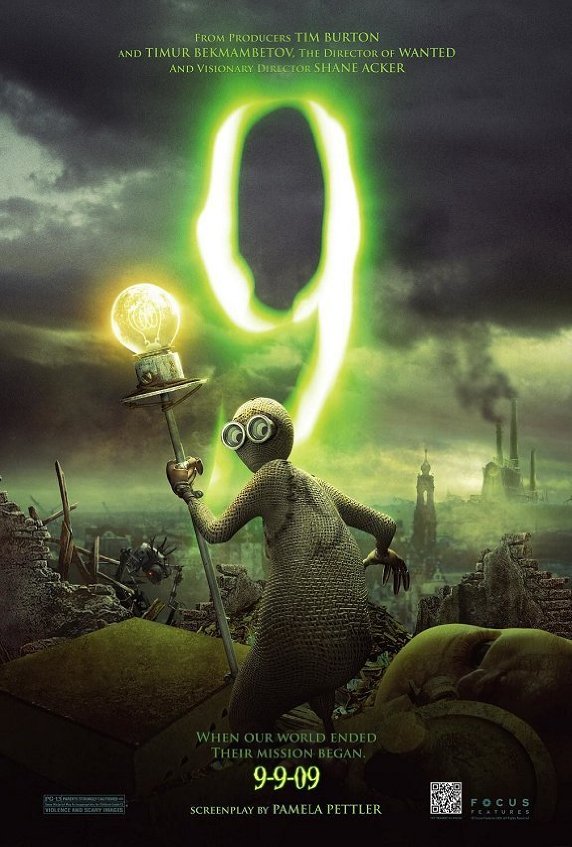
MV5BMTY2ODE1MTgxMV5BMl5BanBnXkFtZTcwNTM1NTM2Mg@@._V1__SX1859_SY847_I had my time-killing afternoon movie for yesterday narrowed down to three options, when suddenly someone at the end of the table said, “Hey, do you wanna go see 9?” And other than a slightly more expensive ticket price, I had no compelling reason why not; after all, it’s a flick I’ve wanted to see, even if Tim Burton is kind of getting played out by virtue of basically every single one of them being about loneliness. I can deal with that in my music, but it starts to get old on the screen, eventually.

In the dawning years of World War II, war-attuned scientists have created self-replicating machines “for the defense of the nation”. And then… well, you know what happens next, don’t you? As sure as zombies commute on trains[1], the machines rise up against their masters. And as humanity declines, one scientist, perhaps seeing the way the wind is blowing, engages in a knit-punk experiment to create nine tiny homunculi in the slim hopes of carrying on life on the planet. So, that’s where the movie begins; as for the actual plot, it can best be summed up as “adventure and interpersonal[2] conflict ensue”.

It was a decent albeit flawed movie. I look at it like this: if you want to see a movie with incredible animation, as good as any I’ve ever seen, you should check this out. If you want to see actiony dramatics, you’re good. If you want to see the best use of Over the Rainbow as score, this is the place to be. If you want to see a thoughtful movie that makes coherent sense as a whole, well, you might should ought to look somewhere else. Also, if you are at all allergic to the really crunchy granola[3], you’ll have some problems.

[1] Dude, it rhymes. You expect more depth from zombies?
[2] Grpuavpnyyl, vagencrefbany, but that would be a spoiler. P.S. http://rot13.com
[3] Hippies, yo. Hippies. You know what I’m saying.

District 9

It occurs to me that really good science fiction movies don’t come along all that often. In this decade, there’s pretty much Children of Men and Serenity. And I mean, those are two great movies, but there’s only two of them, so. Except, I watched another one on Friday. The only problems I have with District 9 are that I have to figure out whether I liked it better than Children of Men and that I have to figure out how to talk about it without actually saying anything.

Because, see, this is a movie that I’m pretty sure is best seen cold. But that makes a weak review, so I’ll give you a little less than I got from the previews, and certainly no more than I got from the first ten minutes. Twenty years ago, a spacecraft carrying insectoid aliens in conspicuously refugee-like conditions appeared over Johannesburg, South Africa. Whether this was a true state of affairs or unfortunate human prejudice trumping the facts is neither answered nor even addressed by the often documentary-style film. All that matters is twenty years have passed during which the residents of Johannesburg have become gradually more disenchanted by the slum called District 9 to which all the “prawns” have been relegated after it became clear that their ship wasn’t going anywhere. Nobody wants to be subjected to the prawns’ presence or share any services with them, out of nothing more apparent than outright xenophobia, excepting only enterprising Nigerian[1] businessmen hoping to profit off the suffering and a multinational conglomerate who wants to unlock the secrets of their weapons tech.

So, that’s the setting. The film documents an approximate week during which the prawns are to be evicted from their slum and then moved to a new, designed camp with the bureaucratically original name of District 10, which has been set up 250 kilometers outside Johannesburg, conveniently out of sight and mind of all the disaffected human citizens. That’s about all I have to say, except that it is by turns horrible and deeply moving, has possibly my favorite child character of any movie in history, and did I mention that it is that rare gem of the cinematic experience, good science fiction?

[1] Seriously! They were identified specifically as Nigerians. I snickered.

Halo 3

It occurs to me to state for the record that I did finally finish playing Halo 3. A few weeks ago, I guess? I forgot it was a noteworthy event, as it happens. The Halo games, as you may or may not be aware (but probably you are), chronicle a three-way war between humans (led by Master Chief, a genetically improved guy in a big metal powersuit), um… a confederation of aliens that I distinctly recall having a name that escapes me at the moment (led by religious fanatics), and the Flood (about whom the less said the better in the unlikely event that you care about spoilers for a game that is almost a decade old). The war is fought in a variety of places, but mostly on giant terraformed rings called Halos which figure prominently in the fates and histories not only of the aliens and the Flood, but of the galaxy itself.
In this game, a first-person shooter like the others, you control the Master Chief as always, and up to three other players in co-op play, which at the time was pretty new. Other games have made good roads into that space in the meantime, but, that’s how it goes. And you continue to fight against the other two sides of the war and try to save the galaxy and all. Also, there’s some pretty fantastically customizable multiplayer components to the game.

Despite the disinterested tone of the review, it really is a great game. It doesn’t have quite the strength of storyline of Halo 2, but the game play is equivalent and probably improved, so, decent tradeoff. If it weren’t for the fact that the game play in the original game was iffy, I could unreservedly recommend the whole trilogy as a pretty good sci-fi yarn wrapped around finding a bunch of guns and using them to kill things. Which, I mean, they’re aliens. That’s why they’re on the screen!

Land of the Lost

Unemployment plus dollar movie plus having failed to catch a lot of my secondary summer movies equals a pretty good deal, right? The moreso, of course, because only paying $1.25 to see Land of the Lost feels a lot better, even in a substandard theater, than paying full price would have done. They did a pretty good job of hitting up on a couple of nostalgia-meters, and a halfway decent job at a plot, and an occasionally decent job at being funny. And then, of course, there was the rest of the job they did at being funny, which ranged from iffy to my being able to see what they were going for to solidly unfunny to scientifically offensive.[1]

The story, lifted straight from decades of Saturday morning kid television, revolves around the fate of [Dr.] Marshall, Will, and Holly, who, while on a routine expedition, accidentally go over a waterfall and through a rift in the space-time continuum, landing in a lost world populated by monkey people, lizard people, dinosaurs, and all kinds inexplicable modern detritus that has fallen through, one supposes, other rifts that were less waterfall-accessible. The chick was pretty hot if unfortunately lacking in story relevance otherwise, the Judd-Apatow-friendly actor was about as funny as you’d expect him to be[2], and Will Farrell… it’s like, when he’s playing a pompous blowhard, I appreciate his talent. But as soon as the physical comedy shows up, I just want him to stop, as quickly as possible. This movie, alas, had a healthy mix. For the record, despite me coming down mostly negatively, I did not at all feel like my childhood had been raped.

[1] I should note that that eight-year-olds in the audience did find the last part pretty damn funny, to my chagrin.
[2] This is true whether you are an anti-fan of Apatow or not, I expect. I still haven’t seen any of his movies yet, only the ancillary stuff that floats around in his wake, but I’m pretty okay with him, to date.

Star Trek

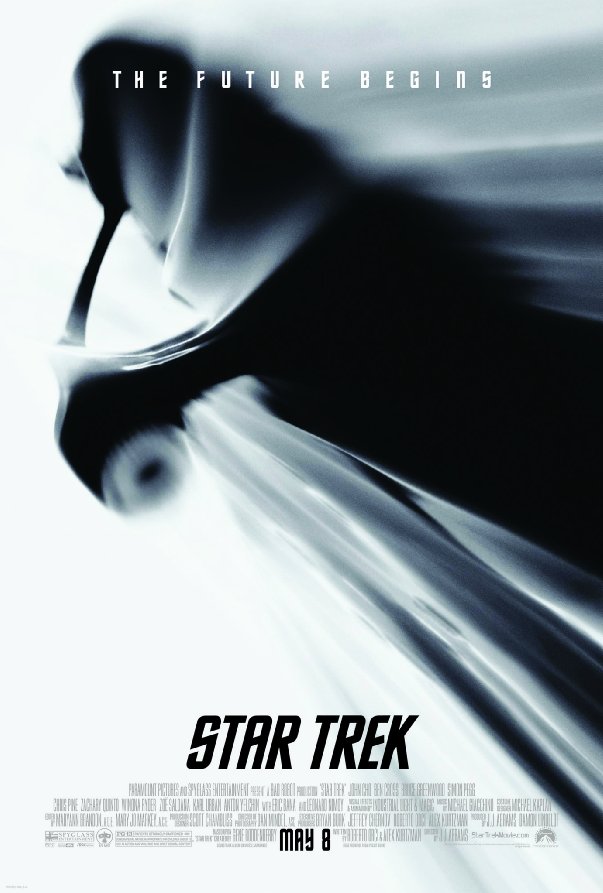
MV5BMjE5NDQ5OTE4Ml5BMl5BanBnXkFtZTcwOTE3NDIzMw@@._V1__SX1859_SY893_Obviously, you are aware of this movie, and you’ve probably already formed your own opinion. And anyway, I’d be leery of spoilers for anyone who hasn’t seen it. In theory, this constrains my review by quite a lot, but I figure it leaves me free to talk about what I really wanted to anyway. But, first things first. Did I like it? Enough to see it three times on opening weekend. Did it have flaws? I can think of a couple offhand, one extremely nitpicky and one that, absent, would have failed to feel like a Star Trek movie anyway. Plus, I think I’m willing to claim that at one point, there was actually an insufficient amount of technobabble. Was it accessible to non-fans? I feel as though it really was, and the reviews I’ve heard from non-fans (and in one case, an actively anti-fan) have borne this impression out. So you should really go see it, if this has not already occurred.

Because what J.J. Abrams made here was a philosophical, character-driven action movie, and really, how many of those do you think exist? Of the ones that exist, how many do you think aren’t insufferably smug about it? This right here is a narrow field to occupy! Action: ’cause, you know, space battles and laser gun fights. Character-driven: the driving forces of the story are all based in interactions. Kirk and McCoy’s friendship. Kirk and Spock’s rivalry. Spock’s relationship with his human mother. Nero’s irrational impulse for personal rather than systemic revenge. (He’s the bad guy.) Philosophical: take a group of people that shook the foundations of the Federation (and, projecting outward less than you’d think, the galaxy) and drastically change their history. Okay, many of the changes were not drastic, but one was, and there are clear, subtle ripples from there even before the main plot of the movie takes over. And then explore the question of random chance versus unalterable destiny.

I liked that by the end of the movie, the history of the Federation is vastly divergent from the one that fans of five TV series and ten movies know. And I like that it’s not going to be “fixed.” It was a bold move that I think is going to pay off in spades for the future of the franchise. But as much as I approve of that, I absolutely adored watching as, moment by moment, destiny pushed beloved characters into roles that they had fallen into by seeming happenstance in the original timeline. This new Trek may have surprisingly non-causal time travel that never really existed in “my father’s” Star Trek, but it also has some modicum of fate. And that’s kind of cool.

Push (2009)

You know what’s cool? There are just so many movies right now that have science fiction and/or superhero themes going. And it’s much like the present horror renaissance, in that so many genre films coming down the pipe means a lot of them will be not so good. But the whole point of that is that you inevitably end up with the real gems now and again. Which brings us to Push, which in all honesty looked from the previews like someone had watched Jumper and said to themselves, hey, I can make that movie too!

And, okay, instead of teleporters and evil paladins, they have telekinetics and future-drawers and mind controllers and a whole host of additional powered people, plus the U.S. government and the Triads. And they all run around Hong Kong, trying to find a drug that the consistently-talented Dakota Fanning’s mom says will bring down the feds. Who are kind of evil, maybe? But not as bad as the Triads.

Here’s the thing. It has plot holes you could drive a truck through, and it is at core a little bit silly. But it was damn fun! And it had drunk Dakota Fanning! I’m pretty sure that in the next five to ten years, she is going to be an incredible actress, and good for her. And ultimately, I kind of figure that whoever made Push was basically making Jumper again. What I forgot to consider until the movie made me realize it is that it’s possible to make Jumper again, but to make a good version. And that is pretty much what this was. Yay, that.

The Day the Earth Stood Still (2008)

Michael Rennie had no reason to be ill on Friday, The Day the Earth Stood Still. After all, the remake of his most famous role[1] had a lot of cool to it. Nice effects budget, Keanu Reeves in a role tailor-made for him, thoughtful science fiction examinations of humanity. It was, on the whole, a good movie.

Which, in an odd kind of way, is exactly what was wrong with it. I’m not sure if it’s peculiar to me, or if I’m objectively right about this: but it needed to be a great movie, to be successful. And it never reached that level. The acting was all eminently competent without being inspiring. The effects would have looked outstanding five years ago, but they only look pretty cool today. The central questions of the film, does homo sapiens deserve to thrive? and what about at the expense of other species?, are important ones that perfectly fits the sci-fi mold. And if there had been any doubt about what answers the film would provide, then the examination of the question might not have felt quite so shallow as it did.

I don’t know, maybe it is my fault, holding expectations a little too high. All I know is, I wanted to think it was great, the way I thought last year’s sci-fi hit was great. And I only thought it was good. Oh, well.

[1] I mean, as far as I know.

Pilgrimage to Hell

Over the past year or more, I have become more and more intrigued by a pair of series by a mythical author, James Axler, that I keep seeing on the shelves at Half-Price Books. The problem is, they run back several years, and of course the first one is never available. Right? Right? Wrong, as it happens! Not only did I find the first one, I found the first one of the older series. Unlikely, and yet I am standing here before you today to swear it is all true. The odds of finding the other first book, or this second book… but still, one takes what one can get.

Pilgrimage to Hell was written in 1986, and except for failing to predict the collapse of the Soviet Union, it handled the next dozen years fairly well. And then, of course, nuclear apocalypse provides the stage for our story, a century later. The face of North America is drastically changed via biological and chemical weaponry in the South, dramatically altered weather patterns in the Southwest, nuclear bombs along faultlines having effectively removed the West Coast, and so on. Pretty much every aspect of life is ruled by what guns you’ve been able to maintain, find, or buy. Which is why the Trader and his army are so well-regarded and so feared; he has made a career out of finding hidden caches of weapons, munitions, vehicles, and gasoline that predate the Nuke, and then taking them around and selling them to help people protect themselves from the environment, the mutants (both human and otherwise) and each other.

Of course, despite the sci-fi underpinnings and overtones, at heart it’s one of those men’s adventure type things that spends entirely too much time describing the make and model of a gun being used, the quality and quantity of brains being expelled from an exploded skull, the heft, curvature, and coloring of a pair of breasts. But surprisingly, there’s a pretty well-told tale underneath all that, with Jungian archetypes all over the place. I’m serious: this guy Ryan finds a girl who knows how to get to a utopian promised land beyond the Deathlands, has the Trader as a father figure who (spoiler alert) is not long for this world, and goes through a giant metal door in order to take his first real step along the path to this utopia, but only after defeating a guardian beast who is (and I’m still serious) named Cerberus. So, okay, it’s a hamhanded usage of Campbell’s resonance road-map, but that still leaves a lot of room for being fun and interesting in the parts of the map that aren’t as detailed.

I don’t know if I exactly recommend it, because you probably already know exactly what intersection of enough apocalypse porn and sufficient lack of gun porn is right for you[1]. But for my part, it was a pleasant surprise that leaves me forced to keep on searching for the later volumes.

[1] Please note: as far as the porn porn, except for the lead chick being described in lusting detail, the women are each and all as capable as the men at every turn, so it probably isn’t nearly as bad along the feminist axis as you were expecting, and pretty much unique among books in this category that I’ve read for being so evenly written.