Tag Archives: action

Drive (2011)

Drive is going to fill one and possibly two niches this year. It will be the best movie that many people never bother to see, and it will also be the best movie that many people saw accidentally, expecting it to be a cheap Transporter knock-off. In either case, it will almost certainly be underappreciated. There’s this guy, played by Ryan Gosling, who seems to be drifting through life at a huge remove from everyone else. While they are hiring him to be a getaway driver, or clumsily mentoring him[1], or paying him for movie stunts, he just seems to observe it all, sometimes with a slightly bemused smile, more often laconic and blank-faced. Which is a pity, because those rare smiles give a window into his inner life that implies more pure joy than most characters convey with reams of dialogue and spontaneous jigs.

But when an accident of geography entangles him in the lives of his pretty, world-saddened neighbor, her son, and her imprisoned husband, well… I don’t want to say much, since you already know that he’ll be in for the drive of his life, or else what a terrible name for a movie. I guess it’s like this. If that sounds like a set-up for the client-of-the-week section of an episode of Burn Notice, it should. But the fallout is a lot less like Michael Westen’s always slick solutions and a lot more like the 1970s era cinema that inspired Quentin Tarantino. But, okay, do you know what Drive is the most like? I hesitate to say this, because it will so easily be construed as less than high praise, but, it reminds me of nothing so much as what someone could have easily written as the plot progression of a mission arc in a modern Grand Theft Auto game. Mostly imprintable anti-hero? Check. Conflicts with cops and other criminals alike as events spiral out of control? Check. Sympathetic characters humanizing the proceedings? Most definitely.

I’m not surprised by the Fresh Air reviewer who said it was the darling of Cannes this year. Movies like this just don’t get made anymore, and lucky us that someone failed to realize it.

[1] Enough good can probably not be said about Bryan Cranston, so I will not try harder than I just have.
Rise of the Planet of the Apes

I caught a movie last night with an outsider / coming of age theme. The young, unusually intelligent student (played by Andy Serkis) is befriended and mentored by surrogate father figure James Franco, but despite all of their efforts, the student’s outsider status reigns supreme as he is gradually shuffled through a system that understands him no better than the inhabitants of the various locations into which he is placed by it. Can he find a way to make himself understood and grab onto happiness somewhere in the world? Can Franco make the student understand his own connection, his own love, and can that connection be enough?

Oh, also they tacked on a science fiction framework around that basic storyline, based as a prequel to a classic movie with Charlton Heston that you may have heard of[1], and also some really significant special effects and a pretty cool actiony climax. So that part was alright too.

[1] Hint: it’s not “people”.

Captain America: The First Avenger

[1] You know what made this movie better than it had any right to be? It was the Captain America they wrote into it. I know that sounds painfully trite, but stay with me for a second here. I’ve read the ultra-patriotic Captain America of the 1950s[2], the reflective, uncertain, self-consciously apolitical Captain of the 1970s, and the hyper-capable, overly superior (in thought, word, and deed) Ultimate Captain of this past decade. There are things to like and dislike about each of them, but none of them made it into the movie. This guy, from his abortive attempts to enlist during World War II as an asthmatic, archetypal 98-pound weakling through his confrontation with the chillingly and somehow never cartoonishly villainous Red Skull, and at every moment in between, is just an all around average joe who happens to be the nicest guy you’d ever want to meet. That he’s brave, intelligent, and acquires super-powers is almost beside the point. The heroism, explosions, and cool stunts were certainly worthwhile too, don’t get me wrong. But mainly, it’s how damn likable Steve Rogers is that carried me through the movie. Everyone has shades of grey these days, and they should, because that’s the real world. But it’s refreshing to know that sometimes the good guy really can just be, y’know, the best guy.
It’s not fair to compare him with the Captain America who was frozen in the Arctic Circle for a variable number of decades since World War II and wakes up with his whole life left behind him in the blink of an eye. Of course that guy is going to have a harder time of it than the one who asked for a chance to fight and was given everything. But it really is going to be hard to go back to angsty and/or superior Cap after liking this one so very, very much.

[1] Just to get it out of the way, my intent was not to see the movie in 3D, but events conspired against me. It’s, y’know, fine?
[2] This is true from a certain point of view, at least.

Transformers: Dark of the Moon

Giant robots? Explosions? Random people yelling “Optimus!” at regular intervals? Yep, it’s a valid live-action Transformers movie. I don’t want to say a lot about it, partly because we both know there’s not a lot to say, and partly because it doesn’t seem right to accidentally give away what threadbare moments of plot exist. But I was definitely impressed by the extent as well as the quality of the extended cast, I dug the new girlfriend (though I wish she’d had more to do besides look pretty and be in danger, but, y’know, Michael Bay), and I was pleasantly surprised by the lack of racist, moronic robots as “comedy relief”.

I can’t decide if it’s worth mentioning that the plot had a massive, glaring flaw or not. (‘Cause, again, Michael Bay. Right?) And despite how (glaring plot flaw aside) it was a largely good popcorn flick, I still don’t think I’ll ever get over the first impression I had, when I was watching an incredible sci-fi movie preview about how the moon landing was a cover-up for our exploration of a crashed alien spacecraft, and I really wanted to see what would happen next. And then what happened next was Transformers 3 instead of something new, gorgeous, and possibly amazing. Dark of the Moon was funny, cool, and chock full of exploding robots, and, okay, it was gorgeous; but it was by no means amazing, much less new.

Priest (2011)

Priest was an odd duck of a movie, because it didn’t really try to be anything. There’s this weird alternate reality, see, where humans and vampires have been openly at war for centuries, and despite that the vampires are far stronger and vastly numerous, somehow the sunlight advantage has allowed humans to progress scientifically and spiritually throughout the years, culminating in some kind of religio-genetic hybrid warriors with cross tattoos on their faces who took the war back to the vampires and pretty much won it.

Only now, maybe the war isn’t really over after all, and the church leadership is in denial and considers anyone who wants to investigate the opposing viewpoint to be anathema. So there’s you a great little theme about corrupt religious power, versus reason, versus true faith, probably versus other possibilities as well, only, yeah, once the premise was settled, they went nowhere with it beyond cartoonish antagonism. And there’s a thick, rich Vietnam metaphor in the priests, who everyone can recognize as having been part of this great war that was a stalemate at best, and they no longer have any place in society now that what they were created for is over, and one of them is beset on all sides, by the law, by his past, by threats to his family, and this is the most Rambo-like character I’ve ever seen, only…. again, they did nothing with him. He almost had a sympathetic superior, but not really. He kind of had people to go rescue to prove the war hadn’t ended, but the scope was too narrow.

So, instead of all this potentially rich territory, there was a lot of CGI kung fu, cool explosions, and implausible usage of motorcycles. Oh, and a giant pile of sequel-bait, except all the possibilities for conflict more compelling than “we’d better kill this next dozen vampires” was already ignored and discarded here in what I hope will not be described by future generations as the first movie.

Batoru Rowaiaru

There’s only one problem with Battle Royale. The premise doesn’t make even a lick of sense. The introductory text scroll lays it out like this: Japan is in economic turmoil, with record unemployment and an extremely bad delinquency problem among the youth, apparently because they see what they have to look forward to? So, the adults fearfully pass the BR law, which… here’s where it makes no sense. Apparently, once a year, a randomly selected ninth grade class is sent to an island, given bags full of equipment and random weaponry, and asked to kill each other over the next three days. If there is more than one survivor after 72 hours, everyone left will be killed. Pretty straightforward, right?

And the events portrayed in the final 80% of the movie are chock full of hard decisions and violence and teenage melodrama, in which anyone can die at any moment, just like you’d expect of a pack of inter-murderous ninth graders. So if you can get past the premise, there’s a great deal of that, and I approve! But still, I can’t figure out how it makes any sense. That is to say, how does the “law” help anyone? At one class per year, it’s not going to make a dent in any population concerns. And randomized with such a small incidence, it’s not like the kids have any fear-based incentives to change their ways; if anything, I’d expect them to get a lot more disaffected and violent than before. (Except this particular class didn’t seem to have any idea the annual event existed, which is its own kettle of worms, believe me.)

Still, to be clear, that didn’t stop me from enjoying the other 80%, it just drove me crazy at the start of the movie and again while considering my review. So, y’know, mixed bag.

Green Lantern

Going into Green Lantern, I knew very few things about the character. He does stuff in space, and he can do anything at all with his magic ring, unless what he is opposing is yellow, in which case he’s completely powerless. (DC, you know, about which I know little enough except for their very majorest characters.) My point is: yellow? Really? High budget effects or not, I wasn’t very hopeful. Yellow.

I’m not sure, but I think that may have been the movie’s saving grace. It had a lot of “gee, whiz” coolness going for it, don’t get me wrong, but the plot was really quite predictable, and the origin story fell flat for me when they spent half the movie establishing that Hal Jordan isn’t reliable and needs to grow up to realize his potential, and then had the turn-around occur on a dime for the flimsiest of reasons. So while I can’t say that it was one of the great comic book movies, it easily surpassed my tragically low expectations.

I mean, yellow!? I’m not saying yellow lameness was absent from the movie, but either they fixed whatever made it especially horrible in the comic, or else I’ve had a misguided notion of how things worked all these years. Either way, really. What’s important is nobody painted a baseball bat yellow to defeat the otherwise cosmically powerful good guy.

X-Men: First Class

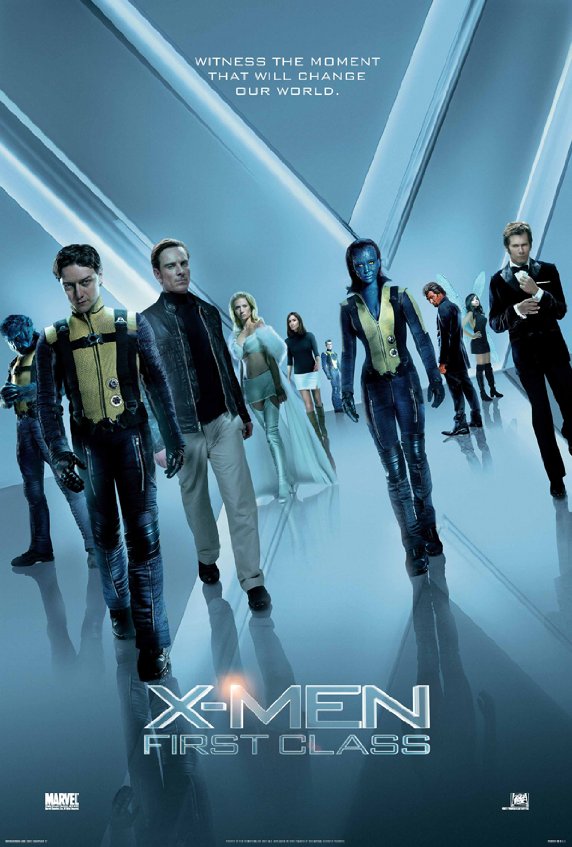
MV5BMTg5OTMxNzk4Nl5BMl5BanBnXkFtZTcwOTk1MjAwNQ@@._V1__SX1859_SY847_Do you know what is embarrassing? When you get about halfway through a review and then realize you forgot one that should have come first. And it’s all the worse in this specific case, because you-the-reader will now inevitably think that my forgetting is a knock against X-Men: First Class rather than a reflection of the truly massive amount of overtime that is happening to me and the correlatively massive lack of sleep that is also happening to me. But my point is, while I only finished that book last night, I saw the X-Men movie on Saturday, aka 40 hours of work ago. And you know, I liked it.

The tricky part is figuring out how to say why I liked it. I’ve seen several one-line reviews, some positive, some negative, some thoroughly tangential, and every single one of them is correct. January Jones either made no attempt to inhabit the character of Emma Frost, was incapable, or the character was flatly written[1]. Some of the mutant powers are really pretty stupid. That was unquestionably the funniest f-bomb in superhero history. And this was very likely the best X-Men movie, or at worst tied with the one about Weapon X. If you can ignore the fact that the villain and his Hellfire Club failed to ever really make it clear what was the underlying purpose behind their efforts to drive Kennedy and Kruschev to World War III, the spectacle of the thing alone will carry you through most of the movie. And when you are able to add to that the interrelationships between the characters who are not quite yet Professor X and Magneto and Mystique, and especially the tragic relationship between humans and mutants that has led to some of Marvel’s best collective writing over the decades, I guess you’ll be able to see why it is so easy for me to say I liked it.

[1] I haven’t gotten to Emma Frost in Marvel continuity, and in the Ultimate continuity, like in this movie, the character is too much of a cipher, relying on what people “already know” about her to flesh out the missing pieces. (Or January Jones was indeed terrible. Beats me!) My point, anyway, is that I have no way of knowing the cause; maybe Emma Frost is just a terrible character and that’s why nobody seems to be able to make me get it, instead?

Thor

I’ve been reading old Marvel comics for, well, a few years now. And also the Marvel Ultimate reboot series, for about the same number of years. In that time, I’ve gotten through 10 or so years of the newer version and 13 years now of the older version. Over those “years”, I’ve had characters I’ve liked and characters I’ve disliked, as you do. For instance, I will read as little about the Submariner as humanly possible, and I’ll be glad of it. Anyway, my point is this: I’ve seen a great deal about Thor as an ensemble character, and only a very little of him as a main character in his own stories. Everything I’ve seen of the latter (except for a few Loki-centric stories in the Ultimate version) has led me to be bored at the idea of picking them up, even when virtually every other major Marvel character has eventually won me over.

All of this to explain that I had pretty low expectations when I heard that they had a Thor movie in the works as part of the build-up to the Avengers franchise. Often, of course, correctly lowered expectations are the key to enjoying something that you otherwise might have rolled your eyes at or even actively hated. But the thing is, I don’t think that’s the deal here. The opening narration doesn’t give the slightest amount of delay in explaining that these aren’t really Norse gods, they’re just really advanced aliens who happened to choose Earth as a battleground, naturally confusing the natives. (Arthur C. Clarke is referenced so many times you’d think he got royalties.) And once that’s out of the way and we’re caught up to modern times, the story they’re telling is pretty much exactly the story I wanted to hear, without any of Thor’s old-school enemies who bore me so, without more than a smattering of his over the top formality that bores me even more; instead, it’s a sibling squabble between Thor and Loki, of exactly the type that has so enthralled me in all the new Ultimate stories. Except, you know, with cosmic implications and a few interesting earth people involved.

But other than the Loki thing, and I have decided over the past couple of years that in the hands of a capable writer, I could happily read or watch him doing just about anything, the main draw versus the comics that I was so leery of is that they took an overly formal prig with a stick wedged so solidly up his ass that it made Mjollnir look about as unmovable as an empty plastic bag in an independent film about existentialism and turned him into a jovial, likable, and best of all, overly rash hero among men. If someone tries to convince me that the Thor in the (non-Ultimate) comics eventually turns into that guy, I’d probably be willing to pick up his stories. Not until then, mind you, because I just don’t care enough about the backstory. Not this time.

Source Code

I knew Source Code was a sci-fi movie, but I think if I had known that it really was full-on science fiction, instead of just with the trappings, you understand, I would have pushed myself to see it sooner. As it is, there’s hardly any time left to recommend it to people, what with the summer movie season having started yesterday. And that’s downright unfortunate, because it’s the kind of workmanlike, personal sci-fi story that people should ought to see, and that really should ought to be made more often in the first place.

Jake Gyllenhal plays his affable everyman self, military edition, attached to a top-secret project called the Source Code.[1] Using the brain patterns of a train-bombing victim, the project coordinators are able to place him into the last eight minutes of that man’s life, again and again, to determine the identity of the bomber before he can strike again. All of which is enough by itself to make for a rollicking good sci-fi / action movie, but then they went and focused on Captain Stevens’ experience in the virtual reality: his growing attachment to his fellows[2], the physical and mental agony of each failure, and his rapidly growing disillusionment with… ah, but that would be telling too much.

The important thing is, they’re telling a much deeper story than the one that might have fit in an hour of zippy television in the Seven Days, or, yes, Quantum Leap vein (and if you manage to catch Scott Bakula’s cameo, you’re a better person than I was). It doesn’t strike me as being among the very best genre movies of the (well, previous, now) decade, and here I’m thinking of Children of Men. But this is a new decade, and it’s the best one so far, plus also it’s every bit as good as another recent example of the personal sci-fi genre I’ve seen (which I shall avoid mentioning here because the comparison could be spoilery to either film), even if it didn’t manage to live up to a global-scale story that is among my favorite movies ever.

[1] Caps implied every time the name of the project-slash-device is mentioned.
[2] Especially, it must be admitted, the pretty one sitting across from him.