Tag Archives: science fiction

Ice and Fire

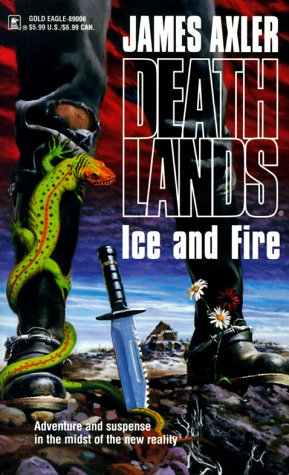
51nrpwy4fylI’m reading too many of these, and they are too similar, for much in the way of in depth reviews. So I think if you are interested at all, you’ve got the premise settled in your head by now, and I can just go with sense impressions, unless something vital changes. So, here’s what’s going on in Ice and Fire.
1) More secrets from the past, via cryogenic chambers! That is definitely a cool thing, not simply for the information they have been able to glean that will help them on their way, but also because where there is one bank of cryogenically frozen people from the past, there will be more. Y’know?
2) More ambivalence about the purpose of their travels. I guess the real purpose is to eventually teleport into a place where they like what they find and want to stay there forever and grow old and fat together with lots of slightly mutated children, but I think even though that’s what they believe, they none of them would be willing to put down roots when there are more things to see and people to save. Yet at the same time, they spent the whole book seeing a big, obvious problem (otherwise happy, wealthy people living one of the better lives available in our tragic future, except the massive mutant snake-worshiping cult that has sprung up is threatening to turn them all into hate-filled religious slaves) and saying in a number of different ways, “Hey, this is not our problem, we don’t have to solve everything, we’ll just get chilled if we do”. Right up until they end, when they remembered that they’re suppose to leave the campsites cleaner than they found them. I want this ambivalence and, okay, flip-flopping to be a psychologically interesting long term problem, but the truth is that it’s probably just iffy writing. Still, I hold out hope!
3) Romance is in the air! By which I mean the guy who likes guns is awkward around the baron’s secretary and also the blonde girl that’s been associated with Doc Tanner gets tired of him being old and her vagina starts making questionable decisions for her. The second part was the worst thing in the series so far, because even though their relationship troubles have been in evidence around the edges of the previous book or two, she suddenly becomes completely unreliable out of nowhere in this book, and then is clumsily removed from the plot. It all felt very “teenager in an ’80s horror movie”, when the rest of the series has not shown any evidence of slut-shaming or indeed imbalance between the sexes on either the good or evil sides of the equation.
4) Gradual cast turnover continues as well, which I still like, even if I could stand for it to not be, y’now, clumsy like this was.

By and large: there’s still more good than bad here, even if I wasn’t so susceptible to the setting that I’d ignore the bad for as long as possible. The edges are fraying a little bit, but I see all kinds of ways to recover, so for now I’ll hold out hope that my trashy apocalypse-porn series can stay less trashy than one might expect.

11/22/63

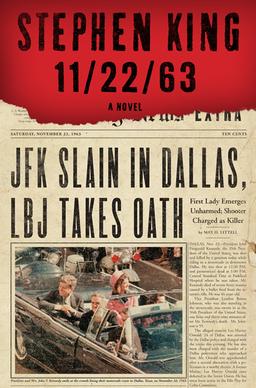
You know how I was recently talking about running out of Stephen King books? Well, now it’s actually happened. I’m sure he’s still writing something, but there are no more plans floating around in the world for when the next one will come out. I have read an entire canon.[1] This particular book is his take on the big time travel questions, like “What would happen if you went back in time and killed Hitler?” or “What if you killed your own grandfather before he met your grandmother?”[2] or, predictably in the specific case of 11/22/63, “What if you saved Kennedy?”
Naturally, of course, the book proceeds to be only partially about that. Mostly, it’s about an (only slightly nostalgia-tinged) trip through the late ’50s and early ’60s filled with the same ratios of horrible and wonderful people that exist everywhen and with the consequences of impossible choices. What King gets right (really, what I think he always gets right and is least appreciated for) is the characters. They are always painfully honest and painfully real. Nobody, not even the wifebeater who apparently[3] shot the President, comes off as irredeemable. And nobody, not even the man who plans to give up five years of his life just on the odds that he can prevent the assassination and that doing so might make the world better, is faultless. Typing it out, that sounds trivial and necessary in any worthwhile story, but I guess I am more talking about the unflinching way he portrays the horribleness that lurks in the best people and the basic decency and love that exists in the very worst people.

What he gets wrong? I mean, obviously I’m going to trust his historical research, because I don’t have that kind of time. The other things are towards the end of the book and are pretty subjective. Also, due to their placement, they are spoilers, but I still want to talk about them, so see you in the first comment!

[1] The most trivial of internet research has revealed the preceding statements to be untrue. But after April? Nothing.
[2] Why would you do that? That’s stupid.
[3] No spoilers!

The Hunger Games

A forthcoming movie announcement led to a few people (my former roommate decidedly not among them) raving about The Hunger Games trilogy, which I had never heard of before that moment. This is understandable, since it’s written under the auspices of the young adult section of ye olde bookestores, which I have not often entered in this post- Harry Potter world. But all the same, a dystopian future America with hidden secrets in which teens are randomly selected every year to compete in a fight to the death, all so that the Capitol can flex its muscles over the 12 districts? It’s like someone watched Battle Royale and decided to rewrite it so that backstory would make sense. Obviously, once someone got around to telling me about it I wanted to read it for myself!
Anyway, the upshot is that while I learned all about the Hunger Games themselves[1] and a fair amount about Katniss Everdeen, our narrator-heroine, I did not learn very much yet about the hidden secrets of the dark future. But that’s cool, I have two other books where that can happen, and in the meantime the book was just compulsively readable. Of course, it had a few problems as well, though I hasten to add that none of them dampened my interest one bit. It’s written mostly in present voice, although it dips into the past for flashbacks and history lessons. I thought that would turn out to be a problem, but it’s not so bad, I’m just not used to seeing it. The other, larger problem, is that Katniss is sometimes jaw-droppingly oblivious as a direct result of her overabundance of natural suspicion[2]. I thought this would break the character, and it may yet, but not so far; because, so far, it has been at least as much hindrance to her as it has been benefit, and it turns out I’m interested in reading about characters with flaws that actually affect the progression of the story. As long as she either fixes herself or eventually gets badly hurt, I will have no complaint here either in the long run. (And it’s not like that suspicion of hers is unjustified, given her world.)

So, cool setting, cool plot, interesting narrator, and if the rest of the characters were just a little beyond two-dimensional at best, well, that didn’t bother me through the voice of this particular narrator. It might in the movie, but then again, the characters in the movie might have more depth. All that matters for now is, y’know, this was a pretty good book! I should find the next one, eh?

[1] Enough to make me wonder how they can adapt this young adult book as anything but an R-rated festival of violence without changing a lot of things during the Games themselves. I shouldn’t care about that, but, well, you saw the Battle Royale reference earlier, right?
[2] Well, okay, and a third problem, not so much for me but maybe for you if you are not in fact a teenaged reader, which I expect you will not be if you’re reading this particular review, is the occasionally awkward “Who do I really like, if anyone?” or “What will my first kiss be like?” folderol that when you get right down to it are the only parts of the book that felt like they were aimed at a young adult audience, and I almost wonder if they were conceived after the fact to get the book into this particular… genre? That doesn’t seem like it should be the right word.

Dectra Chain

Camping now means “another Deathlands book”, since they’re already old and don’t need to be kept very well plus also it’s not like I’m going to run out of them anytime soon. Of course, I only managed to read a tiny portion of the book while camping, because I had very little luck concentrating on any book until the last full day. And then it took me like a year to read it afterward, but that’s because I’ve been busy with too many hours of work (and lots of comics to read while there) and too many hours of TV that I fell behind on while camping, so, y’know. It’s just weird ’cause these read so easy.

You know what else is weird? Dectra Chain does not refer to anything actually in the book, and even Wikipedia Pete knows almost nothing about the word. It appears to have to do with navigation? Which, okay, is fair enough, since the book is about a post-nuke whaling village in Maine. It’s not clear to me where they got their boats or the know-how to maintain them, but I guess it’s been a hundred years, people adapt and all. If you’re anything like me, a whaling village doesn’t sound like it has the kind of serious threat that Ryan Cawdor’s band of teleporting rovers needs to take care of, except perhaps from the whale’s perspective. But sure enough, there’s a bloodthirsty captain who holds the town in a strange thrall and who our heroes naturally manage to run afoul, after which violence ensues, as it is wont to do.

But what’s interesting to me is not this so much as the fact that our good guys are still kind of assholes at times. Notably, they both ran across some French Canadian hunters[1] and chased them off and stole their food and weapons instead of just leaving them be, and then later very nearly left town without Righting the Wrong. I like to think the subsequent difficulties were karmic retribution, but I suppose I’ll instead have to get used to the idea that they’re merely the best of a bad world, and not always good in a bad world instead. However else I may feel about it, that at least has the virtue of being suitably apocalyptic.

In other, unrelated news, there may be more people teleporting around! And also a secret, more highly classified teleporter that leads to a secret moonbase? Whether these facts are related or will ever become the focus of an episode remains to be seen.

[1] Well, that’s what I assumed, all it said was that they couldn’t speak English.

Cowboys & Aliens

A number of years ago now, I was given a graphic novel that a friend had acquired at either the first Free Comics Day, or the first one I heard about[1]. And it was, well, not very good, despite an eye-catching title/concept. Fast forward four years, and I started hearing rumors about a movie based on said graphic novel, and in fact that it really hadn’t ever been a graphic novel per se, so much as an attempt to woo movie studios with their script concept. Which kind of explains the extremely free aspect of the book.

So I started downgrading my expectations hard and fast, since I knew that sooner or later I’d be bound to see it despite my foreknowledge, because who is going to listen to me trying to explain that, no seriously, I’ve read this story and you just aren’t gonna like it, I don’t care what you think, when the title I’m railing against is Cowboys & Aliens? And, as is often the case, that worked out pretty well for me.

The movie (as opposed to the comic) had three really strong things going for it. The first was Harrison Ford playing a morally dark asshole[2], and the second was the exploration of the unfortunately-renamed Jake’s amnesia and how absolution[4] is affected by people’s perspective on your history. But the third and most important thing is that Favreau focused his remaining energy on alien tech and cool explosions, instead of a trite, overused indictment of Manifest Destiny. Not because I disagree with that message, believe me, but because there are so many more interesting messages for science fiction to thematically provide us[5].

[1] Or, having re-read my review to figure out the discrepancy between book and movie reaction, none of the above. Oh, fickle memory. Why you gotta be that way?
[2] I don’t mean morally grey anti-hero a la Han Solo before Lucas started fucking around with the footage, I mean dark. The guy is a prick, and maybe it’s too much[3] of Ta-Nehisi Coates’ excellent blogging of his grapple with the Civil War talking, but I could not stop thinking about how, while a real point was made of Colonel Dolarhyde’s wartime brilliance, which side he fought for was conspicuous for not being mentioned.
[3] by which I mean the right amount
[4] Remind me to come back to this.
[5] So, right. Footnote Four. Absolution. I love that this was the (blink-and-you-missed-it, the reference was so fleeting in the opening scene) name of the town around which the film’s events were set. That’s the kind of “heavy-handed” theme I can get behind. It doesn’t make the entire coming plot an exercise in eye-rolling the way the book’s did, it just gives you the tools to watch each character struggle towards their own individual version of absolution. If the movie had been based on this book, instead of the one it actually was? It would belong in junior high literature classes. (Which is praise, to be perfectly clear. There’s no shame in being a stepping stone.)

Pony Soldiers

I am kind of relieved to see some errors cropping into the Deathlands series. It’s not that they’re great literature; they are little more than fun sci-fi romps that would make a great 80s TV show[1], but in a way, that’s kind of my point. They have no business being as forward thinking and well-constructed as they are, considering their genre and their publication era alike. So it’s nice to see Pony Soldiers come along and suddenly provide a recurring villain as well as letting the characters act uncharacteristically foolish toward him now that he’s finally on the scene. Of course, then I think, no wait, they don’t know here in book five that the series is going to get into triple digits and still have new books coming out even as I castigate them for that lack of foresight, and most of those same 80s TV shows waited less than a year between recurring villains, which is about the length of time between the first and fifth books being published, so really this probably isn’t an error after all. Dammit. Fine, but I’m holding on to the part about them acting foolishly around him, instead of him just being so clever as to avoid his fate. At least it’s something?

In addition to all that, the story delves a little bit more into the concept of time travel that has been looming over everyone’s heads, by virtue of apparently dropping General Custer in the middle of a pitched war with the post-nuke Apache somewhere in the mostly radiation-free Southwestern deserts. Between that little mystery, viewpoints from a few more characters than we’ve had before, and ever-greyer moral quandaries, the series is definitely getting more interesting the further along it goes. And that’s not just my relief over the misstep talking.

[1]  Think A-Team, except with more continuity than they ever could have dreamed of in those days. And more female characters outside refrigerators than they ever could have dreamed of, for that matter.

Rise of the Planet of the Apes

I caught a movie last night with an outsider / coming of age theme. The young, unusually intelligent student (played by Andy Serkis) is befriended and mentored by surrogate father figure James Franco, but despite all of their efforts, the student’s outsider status reigns supreme as he is gradually shuffled through a system that understands him no better than the inhabitants of the various locations into which he is placed by it. Can he find a way to make himself understood and grab onto happiness somewhere in the world? Can Franco make the student understand his own connection, his own love, and can that connection be enough?

Oh, also they tacked on a science fiction framework around that basic storyline, based as a prequel to a classic movie with Charlton Heston that you may have heard of[1], and also some really significant special effects and a pretty cool actiony climax. So that part was alright too.

[1] Hint: it’s not “people”.

Assassin’s Creed II

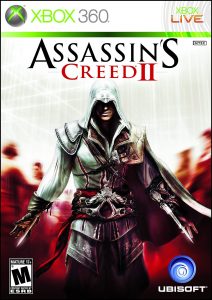
Assassins-Creed-2_X360_BXSHT_ESRBI’m always so happy when I finish a game! Though in this case, it was long enough that I may need to take a break (or at least a palate cleanser) before I start anything else serious. So, remember when I hated Assassin’s Creed? But I thought I would still love Assassin’s Creed II after a brief glance at it? So, yeah, that turned out to be true. It is the same as the other game in most important respects, only subtly better every time there’s a comparison to be made. Giant sandbox of a game, this time set in 15th Century Italy, where assassins must battle Templars for control of the hearts and minds of people, and, well, also the future. But that’s okay, because the future is in every bit as much evidence as the past; in fact, you’re not really in the past so much as your near-future guy is going into a cool machine that lets him live the memories of his ancestors (I think?) and learn from them, both skills and information. So while the game is open and sandboxy and actiony and jaw-droppingly beautiful, the plot is science-fictional and always interesting. Plus also, if you for some reason don’t care for the high-level plot, the plot on the street is of this kid first learning about his family’s secrets and then, when things take a wrong turn, setting about fixing everything, over 25 years of life. Good drama!

And if none of that does it for you, you also get to climb really tall buildings, wander around dusty tombs, and sometimes pounce on people from 40 feet above to stab them in the throat. And hang out with Leonardo da Vinci all the time. And learn a lot about regional history[1]. And… y’know, if you’re not persuaded by now, I really don’t know what I could add. Damn fine game, though, and I feel bad for you.

[1] I quickly decided the easiest thing to do would be to assume everything that happens in the past portion of the game is historically accurate. I’m pretty sure it was, anyway, so.

Super 8

So, the thing about Super 8 is that you’re not really allowed to talk about it. There are these kids making a movie in 1979, as you do when you are kids and have a video camera and a friend who wants to make movies and video games haven’t been invented yet. And while they are at the train station filming a scene, they accidentally witness a pretty huge train wreck. All of this is in the teaser trailer from like 18 months ago, right? Anyway, after the wreck, things get mysterious, and that’s all I’m going to say.

What I suppose I am allowed to talk about, though, is the reactions it has been getting. I’ve seen people say that it implies there used to be magic in the world, but you have to go back in time to get it because now things are way too mundane for a big adventure. I have a little bit of sympathy for this, I do. Because I’ve thought to myself that if I had been older in the ’70s, I might have been one of those people making a Chainsaw or an Evil Dead, so I’m already a little predisposed to see the ordinary, everyday magic of widened possibilities in that era moreso than in this one, where you have to be slick and polished to even get any word of mouth going. (That’s not true, of course, but most of what I’ve seen for which that wasn’t true was just terrible. And clearly it wasn’t always thus.) But when I watch this movie, I don’t see anyone saying the magic has gone out of the world. I see someone saying, this is what the world was like when I was a kid. Of course, I also notice the freedom of movement and association those kids have versus what I expect kids today to have, and I wonder. They’re in a small town, and maybe things haven’t changed all that much? But if things have changed, we’re the adults now, deciding what kids of that age are doing, and if the magic of 30 years ago is absent these days, there’s really only us to blame for it. But for now, I think it’s mostly a difference of place than time, and that the young writers and directors of today will still be finding magic in their own childhoods as we near the middle of the century.

On a more technical level, I’ve also heard people make comparisons to Goonies or Gremlins. While those are both fine movies, I didn’t tweak to either comparison myself, except at the most superficial level. No, what it immediately made me think of, and I never found myself disagreeing later, was a sweeping Stephen King small-town epic, along the lines of It or Under the Dome. Only, presented on the screen far better than any of those have ever been. You may be aware that’s pretty high praise.

Homeward Bound

The problem with the Deathlands series, which will only grow in scope as I get further into it, is that the formula is already starting to preclude my ability to say anything new. This is not a problem with me reading them, by any means; what most people get in comfort out of re-reading favored books, I’m getting out of these. I’m only five in now, and there are almost certainly over a hundred, with new ones still being published every two or three months right now, but Homeward Bound doesn’t deviate from the formula established by the end of the third book, not a bit. The band of adventurers pops of out a teleportation room sealed up inside an undiscovered government hideaway, emerges into the post-nuclear landscape, runs off to do some good deeds, and then heads back for another teleport.

Sure, this book added a brief trip to an apparent moonbase (which, okay, that was pretty cool, but I wonder if it will turn out to have been flavor text rather than a hint at future adventures) and let the main character, Ryan Cawdor, come face to face with his past[1], but they couldn’t even leave me with the vague hint of doubt as to whether he would try to stick around and rule his ancestral barony instead of running right back to adventuring.[2] Nope, the last two pages are, “Let’s all pile in our car and drive back to the teleport room!” I’m only asking for that to be replaced by maybe 10 or 20 pages at the beginning of the next book, right? Still, better to know what I’m in for now than later, I guess? Enh, “in for”, I say, when the only real problem is the reviews. The books themselves I will continue eating like candy long past the point where my brain is fat and complacent.

I am amused at the contrast between this and Anita Blake, where I’m only tolerating the books for the reviews. If it weren’t for GRRM, that is what I’d have read next! Instead, the next while will be recap city. Sorry about that.

[1] The wrong being righted by Sam Beckett in this episode of Quantum Leap is that of the Cawdor family’s destruction by black sheep middle brother Harvey.
[2] Oh, and to clarify two points, 1) Obviously the title of baron didn’t come to be until, y’know, after the nuclear war. In many senses, his father was exactly the sort of power-grubbing man that the survivors of the Trader’s old crew keep coming up against in each “new” book. Oh, and 2) I just said the series lasts for like a hundred books, so no pretending that the party’s survival and success count as spoilers. (Like you were gonna read them anyway!)