On recommendation of one of my graphic-novel-sharing friends, I picked up a turn of the 20th Century mystery book, The Alienist. (And, seriously, it was recommended several times, and has been mentioned several times more while I’ve owned it unread. Which is not a complaint about my pushy, pushy friend, it’s a wry nod to my massively overflowing bookshelf.) But the point is, I got to it, only to find (unsurprisingly) that everything I heard was true! It is in fact a pretty darn good fiction about the genesis of modern police procedure set against the trashy, immigrant-filled slums of New York City’s 1896. It occasionally bordered on feeling too modern, but never quite got there, all while managing to have a shockingly strong female protagonist in the cast, an occasionally Holmesian feel, and special guest appearances by Theodore Roosevelt and Charles Ranhofer. Oh, and “the first” serial killer. That may not actually be something for everyone, but it’s something for just about everyone I want to know.
Source Code
Leave a reply
I knew Source Code was a sci-fi movie, but I think if I had known that it really was full-on science fiction, instead of just with the trappings, you understand, I would have pushed myself to see it sooner. As it is, there’s hardly any time left to recommend it to people, what with the summer movie season having started yesterday. And that’s downright unfortunate, because it’s the kind of workmanlike, personal sci-fi story that people should ought to see, and that really should ought to be made more often in the first place.
Jake Gyllenhal plays his affable everyman self, military edition, attached to a top-secret project called the Source Code.[1] Using the brain patterns of a train-bombing victim, the project coordinators are able to place him into the last eight minutes of that man’s life, again and again, to determine the identity of the bomber before he can strike again. All of which is enough by itself to make for a rollicking good sci-fi / action movie, but then they went and focused on Captain Stevens’ experience in the virtual reality: his growing attachment to his fellows[2], the physical and mental agony of each failure, and his rapidly growing disillusionment with… ah, but that would be telling too much.
The important thing is, they’re telling a much deeper story than the one that might have fit in an hour of zippy television in the Seven Days, or, yes, Quantum Leap vein (and if you manage to catch Scott Bakula’s cameo, you’re a better person than I was). It doesn’t strike me as being among the very best genre movies of the (well, previous, now) decade, and here I’m thinking of Children of Men. But this is a new decade, and it’s the best one so far, plus also it’s every bit as good as another recent example of the personal sci-fi genre I’ve seen (which I shall avoid mentioning here because the comparison could be spoilery to either film), even if it didn’t manage to live up to a global-scale story that is among my favorite movies ever.
[1] Caps implied every time the name of the project-slash-device is mentioned.
[2] Especially, it must be admitted, the pretty one sitting across from him.
Portal 2
A handful of years ago, a game came out that did something entirely new in the genre of first-person shooting. This was not a surprise in the scheme of things, Valve having been long known for such innovations.[1][2] But the degree of new was pretty surprising. Sure, the Half-Life games have always had an element of puzzle solving, but Portal was purely puzzle solving in a way that forced you to think of spatial relationships and three-dimensional physics as you had never done before. And it had a great deal of humor and plot crammed into its several hours of gameplay. Now, I can’t say a whole lot about Portal 2, but I’ve figured that I can almost certainly say more than most reviews I’ve seen, which are that it’s amazing and you should play it and anything else would be a huge spoiler.
Mind you, I am saying a good deal of that, I’m just working my way around the last part. Since it’s my job to, and all.[3] So, basically, in the recently-updated ending to Portal, you are dragged off by robots at the conclusion of your apparently-not-so-successful-as-all-that escape from the Aperture Laboratories facility. After a non-specific but implied period of time passes, you wake up and some brief plot occurs, followed by a nod to people who never played the original or who haven’t in a very long time, in which you learn controls and physical concepts. And then, well, then you are launched down a rabbit hole full of history, psychology, morality, and, just like last time, really a lot of puzzles and humor. And all manner of troubling revelations, also just like last time. And, well, okay, there’s a lot of just like last time to this game, although rest assured that the puzzles and the plot alike have significant updates as well. The point is that it’s not a brand new game that will leave you amazed nobody ever did this before.
It is, however, the best interactive story I’ve ever seen, from both the interactive and story sides of that equation separately. The fact that they’ve been joined into one game? I guess it’s like this. I don’t imagine it’s the best game that will ever be made, and I would easily accept arguments from people saying the first game is better; it’s all down to taste and what you want from your experience. But I cannot imagine a way that a game named Portal 2 could have been better than this one. As best I can tell, it is entirely without flaw.
And if you care about the mythology of that shared dystopian future world (which I do), I was impressed anew today by how I can take a joke line about the Black Mesa research facility from the first game’s closing song and both extrapolate very nearly precisely when Portal occurred in the shared timeline of the multiple game series and also a good deal of information about… well, and there’s that rabbit hole full of spoilers again. Because I actually don’t want to provide the hint about what else I was able to determine from that line of song, lest it simultaneously hint at events in the game you might otherwise never have anticipated. Because seeing this stuff cold? It has always been the best way. The point of this closing digression, I think, is that I expect more insights into both this game and the world of shared games as I think more about it all. And also, there’s an entirely separate two-player cooperative Portal experience that I have yet to touch. But I wanted this review while things were still very fresh; if there’s enough innovation or storyline revelation to warrant it, I’ll just have to revisit the game with another review sometime in the uncertain future.
[1] For innovating the way storylines and characters are handled in the genre, there’s the original Half-Life.
[2] For innovating the ways in which you can interact with the random detritus of your environment, look no further than Half-Life 2‘s gravity gun.
[3] And anyway, if I can’t work my way around seemingly-insurmountable obstacles in a review about a game derived from Portal? I’m clearly doing something wrong.
Scream 4
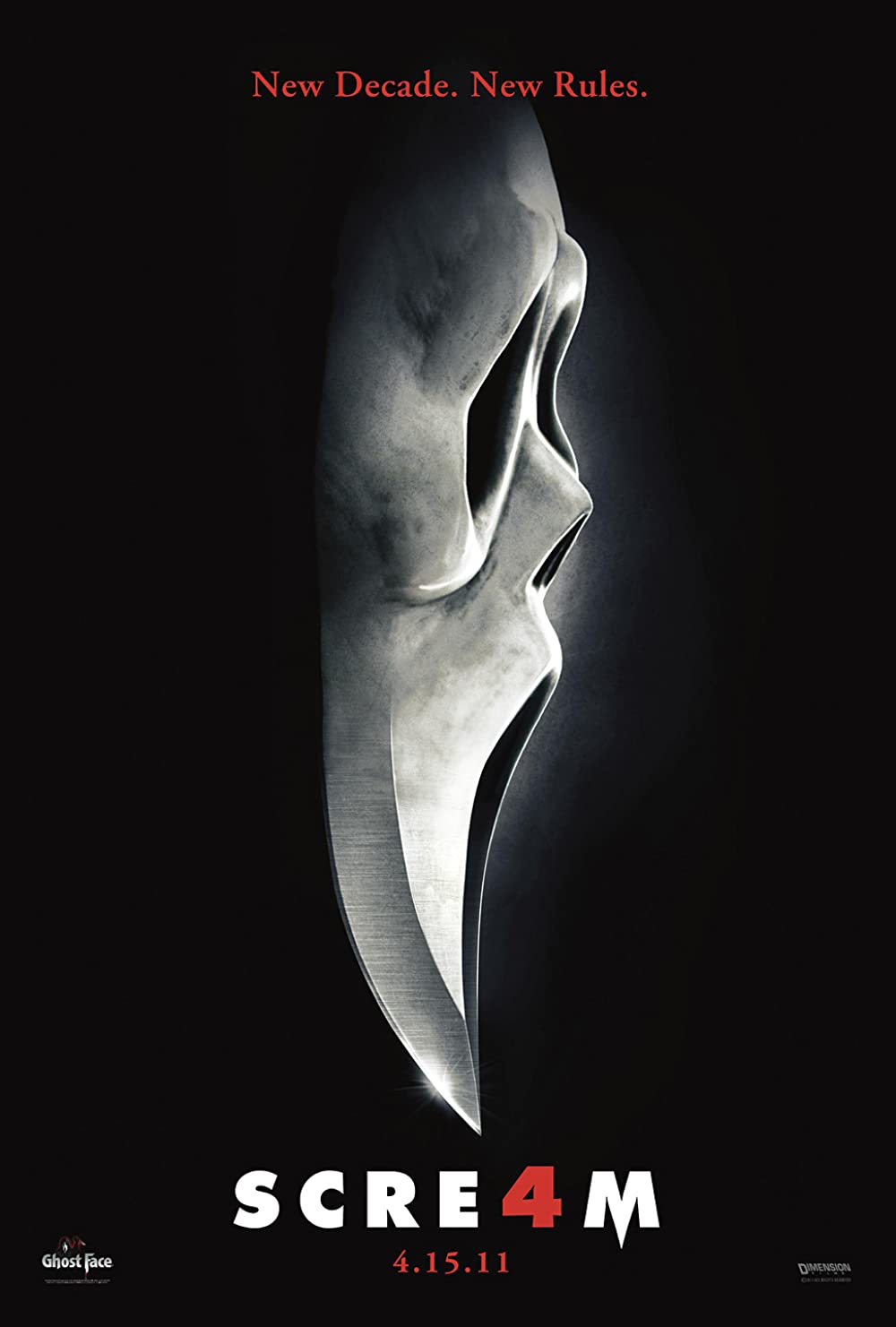 A good long span of time has passed since the last Scream movie. In case you don’t remember, they are popular for reinventing the slasher film via clever, self-aware postmodernism at a time when the genre had very nearly died. Also, for stabbing really a lot of people and creating a brand new interchangeable killer via a consistent ghost-faced mask and voice modulator for perpetual victim Neve Campbell in every movie.
Which actually is where Scream 4 comes into play, with Sidney Prescott returning home on tour, on the heels of a successful book about her quest to stop feeling like a victim. It’s too bad, really, about the new person-or-people who have grabbed onto the same M.O. to start threatening a new batch of teens, including Sidney’s cousin, along with the woman herself and also perpetual co-stars Deputy Dewey and Gale Weathers.
I can’t detail more, both because horror movies don’t lend themselves to fine detail in the first place and especially because this series has continued its unbroken streak of leaving me unable to guess at the identity of the murderer-or-murderers[1], and I’d hate to remove the fun of it for anyone else. The writers definitely took the self-aware schtick to a whole new level, which did not bother me, though I can imagine it having played a little stale to some viewers. As usual, also, my companion and I were in the vast minority of laughers at the showing. I know sometimes I laugh at things a movie didn’t intend, but I also know the Scream movies are the kind that do intend more of the laughs than not, and as usual, I have to wonder why so many people are watching different movies than I am.
[1] That’s the second such reference, so I will point out that it is not meant to be a spoiler of these events, only an acknowledgment of the trend from previous entries in the series.
Ultimate Thor
I’m excited by the fact that the Ultimate Comics imprint is finally wrapping up enough storylines to have started publishing graphic novels again. After so many months of a limitless supply (that has finally dried up this year as I caught up with the line), I finally have an inkling of what people who insist on watching TV episode after episode all in a row must feel like waiting for the sixth (or whichever) season of House (or whatever) to finish up. While I will be saddened sometime in June by the speed with which I ran through my glut, for now, I can bask in the existence of two more books in my house after this one, both of which will tell me more about the future of that world.
Unlike Ultimate Thor, which is wholly comprised of backstory and origin on the Norse god turned Ultimate who we most recently saw… well, that would be a spoiler, I suppose, so I will say no more than that he hasn’t been in any of the books since Magneto’s ultimatum played itself out, culminating in the devastation of New York City and ensuring the destruction of all mutant rights for years to come. Though that is the subject of another book. Anyway, my point is that Thor’s story here tells only of the past, spanning the history of Asgard and his divine family, the unexpected enmity of Baron Zemo in World War II, and his re-emergence in the modern world some months ago, around the time that the Ultimate universe started reckoning time. On the one hand, it’s a good story (and perhaps a necessary one, after the way that reality was toyed with in The Ultimates 2). But on the other hand, of course I’m eager for more aftermath and new storytelling instead of retreading the past. Which is why it’s so lovely that the two more books on deck freed me to enjoy this one for what it was.
Tiassa
Man. I love reading series, because you get the continuity of setting, and characters grow and change and develop over time and you get to see the outcomes of those as well. It’s I guess like the difference between a snapshot and a film. Or more accurately, between a film and a lifetime. But every time I need to review a book in a series, and that series has gone on longer than a trilogy or so, well, those times make me pretty frustrated. Because it’s virtually impossible to provide much information that isn’t rife with spoilers. I’m sure this isn’t the first and won’t be the last time I make such a complaint, but it bears saying.
Anyway, though, Tiassa, which title in the Vlad Taltos series has been one of the most anticipated of which I am aware, thanks to the main character of the Khaavren Romances series that parallels Vlad’s own being from the Dragaeran House of Tiassa. This either makes perfect sense to you if you’ve read either series or none whatsoever if you have not. So you see my dilemma. But if you have, you won’t want me to say much more, and if you have not, I think I can pretend like I would be telling you what to think about the book, sure, beyond the obvious statement that you need to go read Jhereg instead. See, there’s this guy, Vlad Taltos, who has at various times in his life been a crimelord, an assassin, a husband, a defender of the world, and a man on the run. And a number of other things as well. He lives in an empire peopled mostly by another species who deem him a second class citizen on good days. And these books tell the story of his life and/or the empire in which he lives. This particular book tells a story about a silver tiassa statue[1] and the swath it cuts through various events in Vlad’s life and through the future of the Empire. Also, Vlad and his fellow guest narrator each have fantastic narrative voices, which are not to be believed ever, even though sometimes they accidentally present an accurate picture of events.
You know, I really think I’m going to start re-reading these books. It has been way too long on most of them, and I’ve forgotten way too much, and it will be by-gum worthwhile. (Yeah, I have no idea when either, nor whether the previous statement will result in anything like accuracy. Which is not unlike listening to Vlad, come to think of it.)
[1] The Houses of the Empire are named after and share certain traits with animals that have been previously anthropomorphized by the Empire’s progenitors.
Resident Evil 4
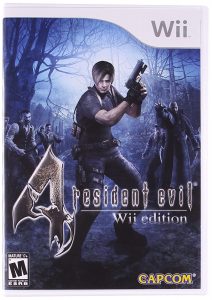 Although completion of the main game revealed several shorter alternate game options, and although I actually do intend to look into and maybe even fully play through those options[1], I think it is fair to review Resident Evil 4 solely on the strength of the main storyline. The setting is some years after the fall of the Umbrella Corporation and the destruction of the T-virus, famous for its ability to create zombies. You play as Leon Kennedy, formerly of Resident Evil 2, who is now part of the Secret Service (I guess?) and has been sent to a small village in Spain to follow leads on the kidnapping of the President’s daughter, Ashley, whose only real utilities are a) to provide a sense of immediacy by being constantly kidnapped again or otherwise placed into danger and b) to provide a sense of fan service by wearing a Catholic schoolgirl skirt and hitting on the late 20s-something Leon according to the script of a Gordon Sumner song.
Of course, no Resident Evil game would make sense without zombies, and this is no exception. Well, that is, they aren’t technically undead zombies so much as parasitically-controlled voodoo zombies, but the point remains the same. Add in several more-dramatically mutated foes and a variety of ever-larger weapons with which to fight them, plus a handful of familiar antagonists and allies and a truly inspired Napoleonic midget, and, well, now it’s sounding like a Resident Evil game. Thankfully, I really enjoy those, and so with this, despite not having a modern console on which to generate acceptable graphics. Still, that’s what Resident Evil 5 will be for, once I get around to it. As far as the Wii aspect of the game? I actually think that the specialty controller makes this kind of game more immersive, what with the actually aiming at the screen and all, but still. It is telling that I’ve only ever finished two games on the Wii over the lifespan of the console.
[1] Cue derisive laughter
The Reeds
The last movie of the fest was also the most difficult. See, I was winding down on juice for perhaps obvious reasons, and it was a British movie full of British people with quasi-comprehensible British accents. Still, I made a game attempt at it, and here is what you get. The Reeds documents a boatful of couples on weekend holiday who get lost in some, well, reeds. If it were not for the medical emergency and the hunter-or-hunters of unknown, mysterious, and possibly ghostly persuasion killing them off, this would probably not have been such a big deal. But, you know. These things happen.
Dread
Dread marks another powerful entry in the fourth Horrorfest. Note that I chose that word carefully, though. See, there are these college art students[1] who want to do a study on fear in peoples’ lives. What do they fear, what is their earliest memory of fear, how does it affect them? And all of this goes on camera in first-person interviews that, though wholly unrelated to reality TV, would not be at all out of place there.
And of course there are revelations among the main characters that push boundaries and change relationships in unexpected and frequently awkward and unsustainable ways, but that wouldn’t be enough to make a horror movie. It’s when someone decides to change the rules and force people to start facing and overcoming their fears that things take a turn for the ugly. And even then, it’s closer to tragedy than horror, I think? But either way: quite powerful, and quite disturbing.
[1] I’m pretty sure they were art students rather than psychology students, since one of them paints a lot of nudes (though he may technically not have been enrolled) and another was I think a film student, but maybe I imagined that? I suppose it bears pointing out that even the fact of them being involved in the college was only an excuse to have a few dorm shots and a ready supply of subjects, so the lack of clarity on this point isn’t really a big deal.
The Final
Okay, with only two movies left, I’m caught up again. It is convenient that after burning through several movies in a row, the most recent one is also the one I’ve liked best today. Playing on the fears (and in some cases, almost certainly the fantasies) of a post-Columbine public, The Final presents a group of high school misfits led by the President of Holden Caulfield’s fan club who hatch a plot to get all of their tormentors together at a weekend party for a series of deadly lessons on the nature of being pushed too far.
Other than a subplot about a racist Vietnam vet, pretty much every character in every scene is filled with pathos and well-presented anger in equal measure, by the end of the movie if not in any given scene. There are a few good guys, but nearly everyone is a bad guy at some time or another, and that part of high school doesn’t show up on the screen very often. Still, the plot was mostly predictable once all the characters were set in motion by the middle third of the movie; the real joy here was the acting. I may or may not have liked Kill Theory better, but this is certainly the only one so far I’d recommend to anyone else.