Return Engagement

I think half the fun of alternate history writing comes from the winks and nudges that the author is able to give the informed reader about the parallels and outright differences between what got written and what really happened. Not that this is hard to achieve in a Turtledove novel; he’s the genre’s Grisham, writing alternate history for the masses, which means that he’s not really writing beyond the high school history level on most occasions. There are certainly things to spot even for more informed readers, but they’re rare. (Or else, I’m insufficiently informed; that’s likely.)

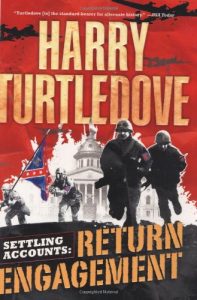
As for a review of the actual book, there’s not a lot I can say. Although Return Engagement is the first of the Settling Accounts trilogy, it’s the eighth book in the same storyline. Turtledove posits that a set of military orders sent by Lee to his subordinates early in the Civil War was not lost by the messenger, and then jumps ahead first to the 1880s to examine the new fates of such historical personages as Teddy Roosevelt, George Custer, and Abraham Lincoln against the backdrop of a divided continent, while the fledgling Confederate States face their second military challenge.

Except for How Few Remain, each of the books that follows is part of a trilogy, watching the events of first the Great War, then the boom and bust 1920s and 1930s, and most recently the second World War, through the eyes and lives of fictional characters both incidental and important. It works for him, because I’m as interested in the characters’ lives and outcomes as I am in the greater outside events he is chronicling.

Unfortunately, as I said, the similar style of each of these books makes it hard to review an individual one without delving deep into spoilers, especially this far along in the series. (Hint: he’s pretty well writing the same history we have now, except the players and outcomes are wildly divergent. His theory of human nature (which I buy into) just keeps pulling them back to the same places, despite the divergences.) The quality is as high as it was in the first book of the Great War trilogy, and consistently higher in this pure venue than when he writes about fantasy settings with parallels to real world history, or about aliens who launch a worldwide attack in the early days of World War II. Turtledove is simply a better historian than fantasist, and this series lets his talent through better than anything else I’ve read by him.

One thing I can say about this book in particular: as the series goes on, I can see things coming more clearly than I could reading the early books, and as I watch these characters that I’m interested in make clearly wrong choices, the warring sympathy and revulsion leaves me very uncomfortable, I think because of how it humanizes the actors in my world’s history. For my money, that’s good writing.

Ginger Snaps Back

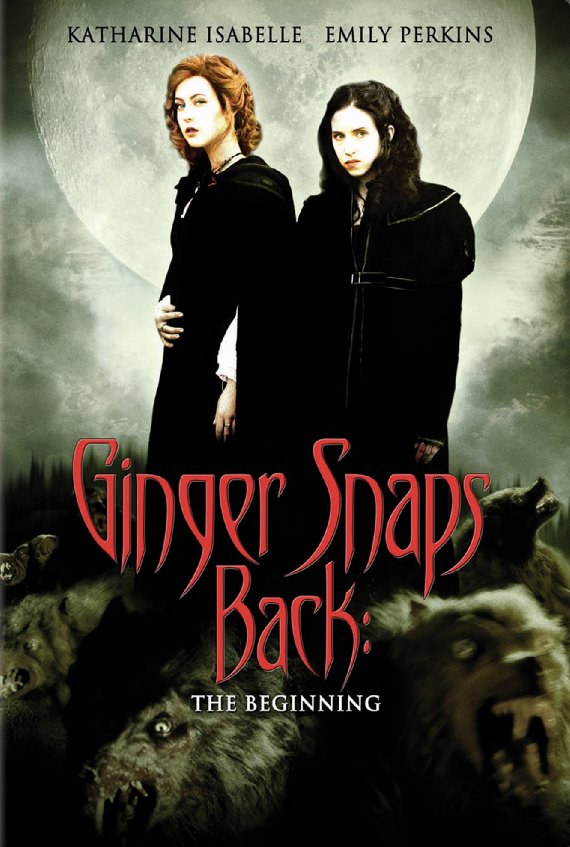
MV5BMTg1NTg3OTI4N15BMl5BanBnXkFtZTcwNDAxNDYwNQ@@._V1__SX1859_SY847_It’s a rare movie (or book, for that matter) prequel that can be watched prior to the original story without ruining the narrative flow, or at least spoiling the plot. Ginger Snaps Back: The Beginning is such a film, which makes it all the more the pity that it was so superfluous. Purporting to provide the origin tale of the werewolf-y menace that led up to the surprisingly good Ginger Snaps and its sequel, it instead tells the same story from Ginger Snaps all over again, only without the clever puberty metaphor and with a tie-in to the old wendigo legend that, frankly, doesn’t really fit.

Sisters Ginger and Brigitte are back for an old-school battle against the werewolves that are terrorizing a trading company’s fort in 1815 Canada, with a conspicuously missing explanation for how they arrived on the scene or why their dialogue sounds so modern compared with the members of the fort. With the setting and cast list out of the way, the plot follows its predictable (to anyone who has seen the original, and generally speaking, you really should) arc into the final act, which ought to have had real dramatic tension. Unfortunately, as a prequel, the outcome was basically pre-ordained.

This is why I say it would go better as the original film of the trilogy. The only problem being, it’s not nearly as good as Ginger Snaps, and deciding to give that film a miss based on it being the sequel to a fairly iffy movie would be in the same ballpark of unfortunance as skipping multiple seasons of television goodness because you were turned off by Ben Affleck’s film debut.

Elektra

The thing about being sick is that you kind of look forward to it. An excuse to not have to go to school, say. Or to work, which is even better, because the concept has been institutionalized. There are entire “sick days”, which are for the sole purpose of saying, ‘no thanks, I’m not going to work today, because I’m taking a sick day. It’s because I’m sick!’

It’s all a trick, though. The cold reality is that when you’re actually sick enough to not be at work, you won’t enjoy yourself. You’ll go to the doctor, get your prescriptions, get them filled over the course of an hour in which, sure, you have a book, but you’re sick enough that being in the same place all that time will start to make you more uncomfortable even than you started out, and it’s really hard to concentrate on reading for more than ten minutes at a stretch, what with the sinus headache, and on top of that, you get your first taste of just how bad the company drug insurance has become when they finally tell you it’s time to leave.

All of which is probably a close approximation of how Jennifer Garner felt in between Daredevil and Elektra. She had just been in a terrible movie, her character died, and… okay, that’s really all I know about her. I’ve never even seen Alias. So I guess the metaphor broke down, a little. I’m sick, sue me.

Luckily for Miss Garner, her quasi-sequel is substantially better than her last turn in Affleck’s doomed vehicle. It has a lot going for it. An old-school Campbellian plot about the motherless daughter at the heart of the ancient, hidden battle between Good and Evil, lingering, mood-setting camera work that mostly hides the TV episode-length story being stretched into a 90 minute feature, a crew of bad-ass enemies with spooky mystical powers, a boatload of ninjas, and most importantly, nary a hint of its Hollywood forebear.

All this plus decent sequel potential, and the obligatory child actor wasn’t all that bad. And did I mention the ninjas?

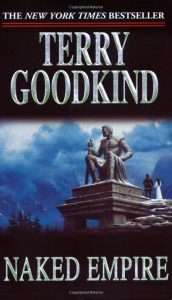
Naked Empire

61jwmR8eIHLAs with all people, sometimes I do things that I find embarrassing, and wouldn’t really want other people to know about. I collect Misty Mundae DVDs. I have Scooby Doo boxers. I watch Joey on NBC. Worse by far than all of these (although not my blackest secret, either), I read Terry Goodkind’s Sword of Truth series.

Yes. Still.

This I could have carried to my grave, I think, except that now I review things I read. It’s a problem, but not one that I could get around and be fair to you, my faithful reader. So, yeah. Now I have to talk about it, and feel even worse about myself. Because reading it analytically, it’s worse than when I would just read it because a new one was out, and that was already aggravating.

Sure, the first book has the ‘Let’s ban fire!’ thing, which bothers me far more now than it did when I first read it. And then the next three or so seemed like cheap Wheel of Time knockoffs. But now that the Wheel of Time is no longer particularly copyable, he’s led the reader along toward an even worse fate, the objectivist screed.

It’s not that I dismiss Ayn Rand out of hand, or even disagree with a lot of what she had to say. It’s more that Goodkind presents the arguments as though it is not possible to have a reasonable disagreement about some of the points, some of the time. And of course, since he’s writing both sides of the argument, it’s easy for him to get away with. But I could forgive him that, I think, if it wasn’t for the screed part. Because, and I sincerely believe this to be true, fully half of the 725 page story revolved around Richard Rahl – our intrepid hero who carries the Sword of Truth (and therefore is named the Seeker of Truth, which makes him the best argument from authority fallacy on two legs ever) and wields both halves of a magical gift that nobody else has been born with for three thousand years, and is the sole line of defense for the people of the world according to prophecy, and to the people of his empire literally (but only as long as they make the proper devotions to him (and yes, yes I am feeling worse about myself the further into this I go)) – going off on pages-long diatribes explaining to people why it’s wrong to oppose the war in Iraq, and why it is not only right but morally necessary to kill anyone who actively stands in the way of having it accomplished.

Sure, he talked about fictional enemies that fit into the world of his story, but he didn’t really use different words, and even if the author will claim the subtext isn’t there, this is one of those times where what the author thinks doesn’t really have much bearing on the reality.

I got sidetracked. Anyway, my point is, half the book: swords and sorcery and the incremental advancement of the main plot of the series, plus the fully realized sub-plot that is the main plot of the novel. So he has that going for him, the stand-alone accomplishment. Which Mr. Jordan is welcome to plagiarize at any time now, really. The other half of the book: lectures on objectivism and how it relates to real-world morality.

It was every bit as fun as it sounds. The worst part is, I still want to find out how the main sequence story ends. I have no self-control when it comes to following a story from start to finish. (Like I said, I watch Joey.)

Half-Life: Opposing Force

51C9XNXNT7LWell, look at me, all with the string of finished games under my belt. I like to think the trend could even continue, although past experience indicates that these things run in cycles. Except the books, of course. I always, always read. Right now, my Half-Life kick is continuing with the first expansion, Opposing Force.

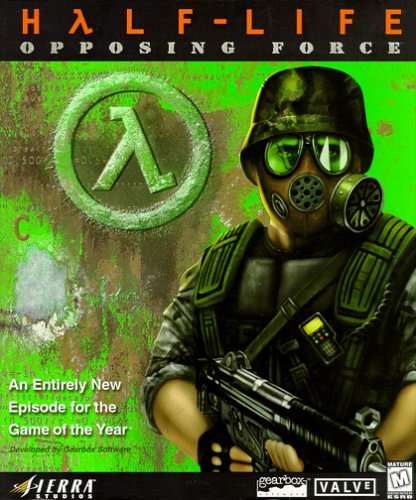
In it, you play as Corporal Adrian Shephard, a member of the military forces assigned to clean up the Black Mesa incident. There are a few familiar locations and at least two very memorable scenes to watch from the original, and the designers have cleaned up the moral ambiguity of playing as army guys bent on killing all survivors and especially on capturing Gordon Freeman, by setting Shephard’s arrival late in the incident. There are a lot more aliens running around, and the military have already started teaming up with scientists and security guards and whoever it takes to survive and escape.

Unfortunately for the player, you are opposed in this goal by special-ops black forces who view the army grunts to be as big of chumps as the army grunts viewed the scientists in the original game, and you are also opposed by the mysterious strange-voiced briefcase guy who has plans of his own (which, by the way Valve/Sierra/Steam/whoever I should be talking to about this, I hope will be explored more fully in Half-Life 3). And, as always, by the extra-dimensional Xen forces that are at the root of the problems in every game.

Can it be compared to the original? Strangely, yes. Whoever is on this design team is to be praised, because every storyline so far is nearly as deep as the original. The gameplay is nearly identical, and while yes, it’s a shorter game than either main sequence entry, I’m not going to fault an expansion for not lasting 30 hours. I am looking forward to the last Half-Life expansion, Blue Shift. Not as much as I would be if it was available on Steam for free with Half-Life 2, like the others have been. But I’ll find some highly legal way or other to get it. And before I’ve lost my momentary enchantment with the series, if at all possible.

Half-Life

I haven’t really addressed the issue of what happens when I re-experience something. I watched the Star Wars movies over Christmas weekend, for example, with nary a review in sight. I’m not sure if this is good or bad, and probably I’ll deal with it on a case by case basis. My gut instinct says that while movies are too easy to review at any moment, games and books require an investment of time and energy that makes it worth revisiting them. This doesn’t mean I’ll follow that rule, of course. But I might.
The thing is, I got so thoroughly sucked in to playing Half-Life 2 that I was more interested in re-playing the original Half-Life than Doom 3. (All the random red sparkle pixels in Doom 3 aren’t helping any, but I’ll get back to it, never fear. It was just starting to get good and terrifying.)

For a game that came out seven or so years ago, Half-Life retains incredible replayability. I went all the way through the game without cheating or skipping anything, up until the very last fight. I only cheated there because I was ready to move on and had beaten it once before for real. The graphics are very descriptive for being so clunky by today’s standards, and the storyline is enthralling. Gordon Freeman, our everyman hero with a PhD in physics who works at a top secret government research facility, is caught in the results of an experiment gone awry. In his struggle to reach the surface with his hide intact, he comes to symbolize to the workers in the complex their own shining hope to survive the disaster themselves (and unlike in most games, you genuinely feel bad when most of them do not), and he comes to symbolize a threat equal to the one he wants to escape, to those forces which oppose him.

Well, I don’t want to spoil it or anything, but the fact is that nearly everyone in the world has played this game already, and I’ll spoil it when I review the next game in the sequence anyway, as it would be unavoidable there. So, yeah, it’s the military clean-up crew and the dimension-shifting alien forces. Sure, they hate each other more than they hate Gordon, but he runs a close second. What is a physicist to do? Well, clearly, he is to kill anyone that tries to kill him first, and eventually stop the alien invasion once and for all, coming to symbolize the dreams for freedom of an entire generation of humans and Xen alien slaves who… but I’m getting ahead of myself. For that, you need the sequel.

And I’m serious there. You *need* the sequel. This is shaping up to be one of the best video-game storylines available, if they can even maintain the same meager slide in story quality for the forthcoming Half-Life 3 that occurred between 1 and 2. If they improve again, well, watch out!

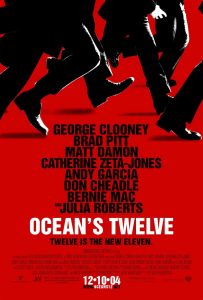
Ocean’s Twelve

Holidays are an excellent time for watching movies. And for gathering with families and friends, and for gifts and for snow and fireplaces (sadly, not so much for me personally, but I hear tell), and some people claim for football, and for celebrating your winter faith of choice (I prefer the one where the hot Wiccan chicks dance naked in the moonlight, could I but only find them). And, of course, for lots of empty calories.

Ocean’s Twelve
marks a good confluence of the first and last items on my list. Fun movie, devoid of any real content at all. Despite that, Soderbergh still managed to put a new spin on the heist caper, above and beyond the work of beauty that was the pure heist of his 2001 remake.

I say spin, but he basically turned it on his head. Danny Ocean’s merry band of thieves who steal from the rich and give to themselves are at it again, planning a heist that never seems to occur to stave off a vengeance that never quite materializes, and somehow it still works. It’s a little more jokey and a little less nuts and bolts, and every bit the cure for the end of the year Oscar-ridden wasteland.

A good time will be had by all who don’t think that Julia Roberts looks like a horse, and this time they also added in Catherine Zeta-Jones for those who (like my father) do. He stayed at home and slept through it, sure, but that’s not the point. Just the fact that he would have had an alternative proves my point.

Meet the Fockers

So, it’s the whole big Christmas Day thing, with the presents, and the cooking of the meal, and all that. My first Christmas to host, or to cook. I’m on downtime right now, the potatoes are baking, to be followed by the turkey roast. Also, Star Wars is on, maintaining a Christmas tradition begun by the USA network but today continued by my DVD player. Finally.
Wherein lies my problem. I have time to discuss Meet the Fockers, but it’s hard to put together the inclination. It was funny, sure. Lots of genuine humor, and lots of feel bad about yourself for laughing humor. It’s just that it was very generic. I liked the first one quite a bit, but despite the extended starry cast list, this felt like Meet the Parents-lite. Twice as many expensive actors, half as much edginess and black humor.

Even De Niro was phoning it in. I mean, name a movie of his where he doesn’t stab someone in the neck with a syringe. And too many of the scenes were there to be one-note jokes that were completely separate from the plot of the movie. Funny is good, but it should either be less disposable or a lot more funny to make it justifiable. If you really need a comedy, sure, go, but it was PG-13, so if you can stand commercials, I’d wait for it to show up on Comedy Central. Also: Why Christmas? A very nonsensical release weekend, if you ask me.

Anyway, back to the cooking. Which will be more filling and fulfilling, both.

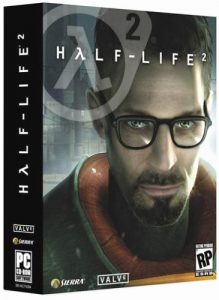
Half-Life 2

I know it looks like I’ve been neglecting my duties here. Instead, I just randomly finished three different things in the same 18 hour stretch. I’m not really clear on how that kind of thing happens, and yet here I am.

This time out, Half-Life 2, the story of Gordon Freeman, the rogue physicist who can’t seem to catch a break. After going through the rift accidentally opened by his fellow scientists at the Black Mesa research facility to put a stop to the creatures coming through, Gordon wakes up years later to find that his efforts didn’t result in as safe a world as he’d expected.

Then, crowbar at his side, he finds himself swept along by events once again, this time not just in an attempt to survive but due to the efforts of a resistance movement that has long viewed him as the savior of humanity. As many dark turns as were taken in the original Half-Life, this story nevertheless has a more somber feel to it. The stakes are higher, the betrayals are more deeply felt (if less surprising), and the character interactions are more fully realized. All this despite the main character never uttering a word of dialogue.

As for the gameplay: Lots of loading screens. It breaks up the game, which didn’t bother me. I can easily imagining it bothering other people, but I typically enjoyed the pause to relax and reflect. Spectacular gameplay. Well, fine, anyhow. I think that the FPS control and interaction scheme has been finalized for quite a while. No real improvements, but it’s worked very well, and continues to here.

The graphics are breathtaking. I’m on record as having said that they were a solid increment above the Final Fantasy movie, and here I mean the in-game play, not the cutscenes (of which there are none). I’ve since considered that I may have overstated that. The character movements in Final Fantasy were more realistically human, but still images and especially facial expressions don’t really hold a candle to the ones in this game. The rest of the world is essentially photorealistic. If FPSes weren’t quite to twitchy, it would be very easy to entirely forget you were playing a game.

I look forward to Half-Life 3, although not to the years-long wait for it. I expect I look forward to whatever expansions that get thrown out too. However, I do wish the game wasn’t so tightly copy-controlled that you have to be online to play the game. I didn’t pay money for it, as it came free with my video card. That smokescreen aside, I feel very uncomfortable not owning a physical copy of a game I’ve paid for. Not even the CD so much (although that too), but the idea that if I unplug my ethernet cable, I suddenly no longer have the game. For one thing, companies do go out of business from time to time. Mostly, I mistrust the precedent. Today, I can’t control my own purchases, tomorrow, eyeless crabs are latching onto people’s heads while an unelected military organization enforces the whims of our unseen alien overlords.